
EECE 210 Homework 1, Fall 2014
American University of Beirut · Electric Circuits · 5 pages
More EECE 210 files
Show the text of this homework
Homework 1
P1.1.2
In a one-dimensional flow of current through a semiconductor, positively-charged
holes move in the positive x-direction at a steady rate of , and electrons move in
the negative x-direction at a steady rate of electrons/min. Determine the total
current in mA in: (a) the positive x-direction, (b) the negative x-direction. (c) What
would be the current if the holes and electrons move in the same direction? Note
that the positive charge of a hole has the same magnitude as the charge of an
electron, which is 1.610-19 C.
Solution: (a) The current due to positive charges moving in the positive x-direction adds to
the current due to negative charges moving in the negative x-direction. The
total current is: + 0.02 A 20 mA;
(b) The sign of the current is reversed to -20 mA;
(c) The currents due to holes and electrons are in opposition. The total current is:
+ in the direction of movement.
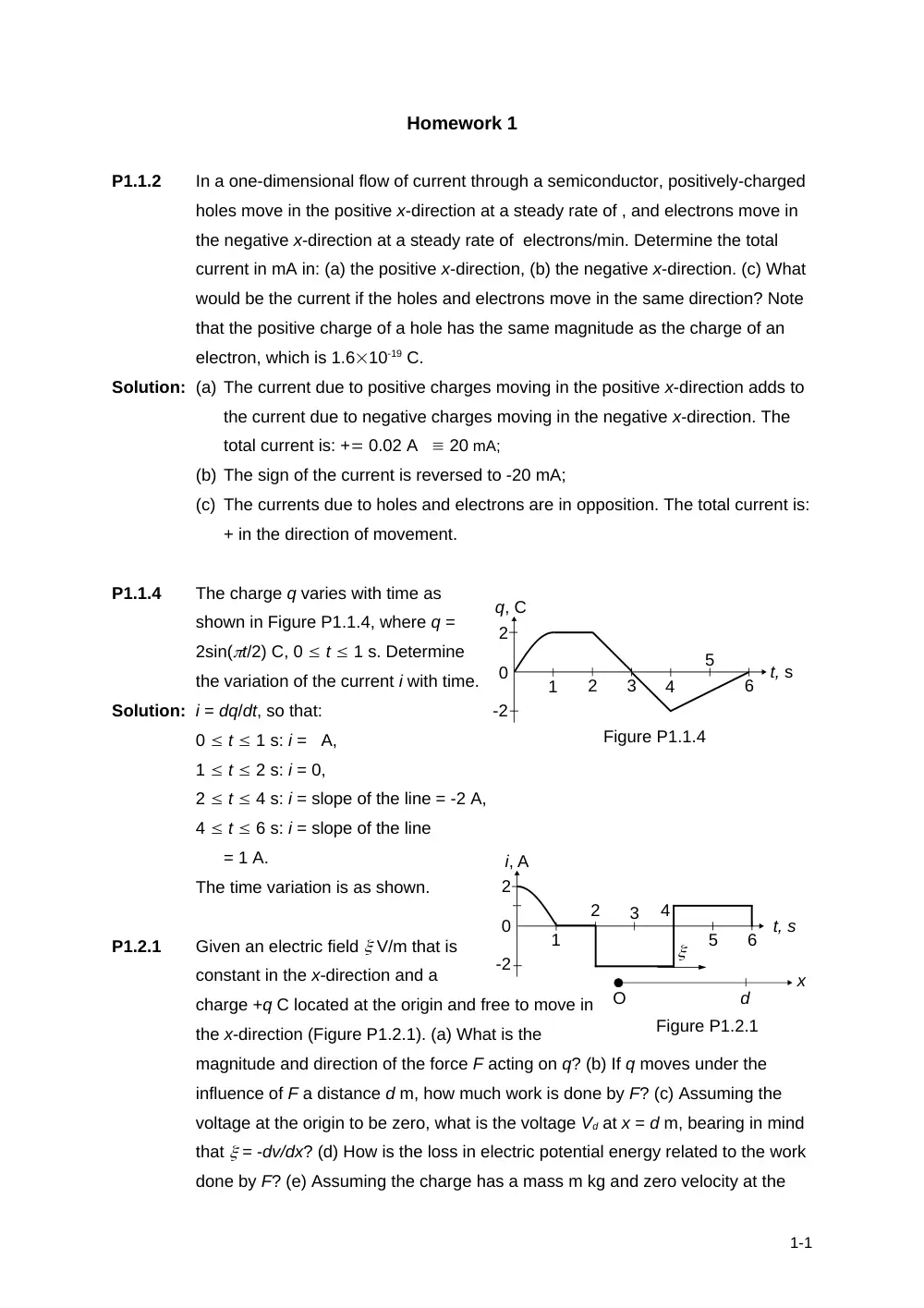
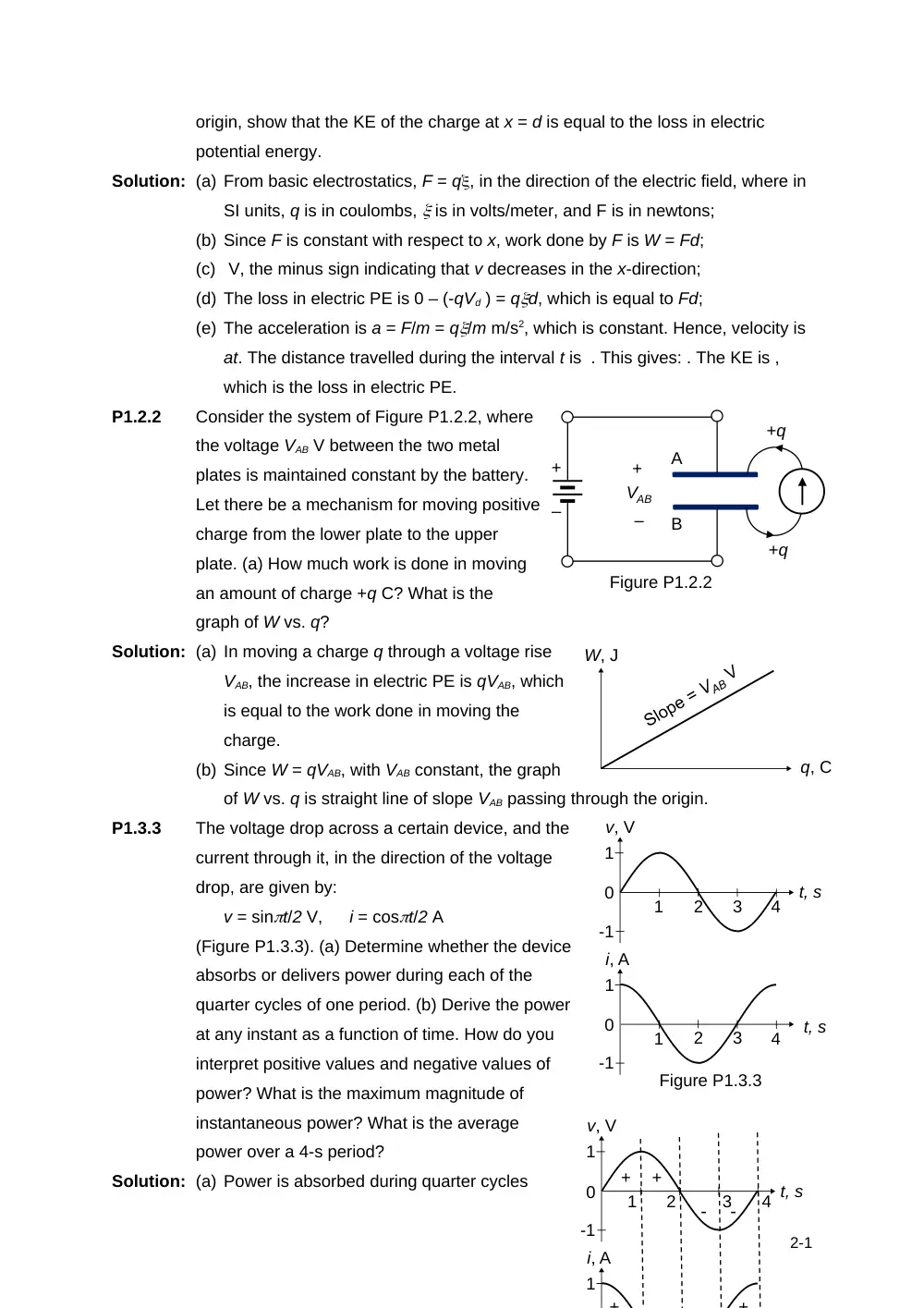
P1.1.4
The charge q varies with time as
shown in Figure P1.1.4, where q =
2sin(t/2) C, 0 t 1 s. Determine
the variation of the current i with time.
Solution: i = dq/dt, so that:
0 t 1 s: i = A,
1 t 2 s: i = 0,
2 t 4 s: i = slope of the line = -2 A,
4 t 6 s: i = slope of the line
= 1 A.
The time variation is as shown.
P1.2.1
Given an electric field V/m that is
constant in the x-direction and a
charge +q C located at the origin and free to move in
the x-direction (Figure P1.2.1). (a) What is the
magnitude and direction of the force F acting on q? (b) If q moves under the
influence of F a distance d m, how much work is done by F? (c) Assuming the
voltage at the origin to be zero, what is the voltage Vd at x = d m, bearing in mind
that = -dv/dx? (d) How is the loss in electric potential energy related to the work
done by F? (e) Assuming the charge has a mass m kg and zero velocity at the
1-1
t, s
q, C
2
1
-2
2
3
4
5
6
Figure P1.1.4
0
t, s
2
1
-2
2
3
4
5
6
i, A
0
O
d
x
Figure P1.2.1
origin, show that the KE of the charge at x = d is equal to the loss in electric
potential energy.
Solution: (a) From basic electrostatics, F = q, in the direction of the electric field, where in
SI units, q is in coulombs, is in volts/meter, and F is in newtons;
(b) Since F is constant with respect to x, work done by F is W = Fd;
(c) V, the minus sign indicating that v decreases in the x-direction;
(d) The loss in electric PE is 0 – (-qVd ) = qd, which is equal to Fd;
(e) The acceleration is a = F/m = q/m m/s2, which is constant. Hence, velocity is
at. The distance travelled during the interval t is . This gives: . The KE is ,
which is the loss in electric PE.
P1.2.2
Consider the system of Figure P1.2.2, where
the voltage VAB V between the two metal
plates is maintained constant by the battery.
Let there be a mechanism for moving positive
charge from the lower plate to the upper
plate. (a) How much work is done in moving
an amount of charge +q C? What is the
graph of W vs. q?
Solution: (a) In moving a charge q through a voltage rise
VAB, the increase in electric PE is qVAB, which
is equal to the work done in moving the
charge.
(b) Since W = qVAB, with VAB constant, the graph
of W vs. q is straight line of slope VAB passing through the origin.
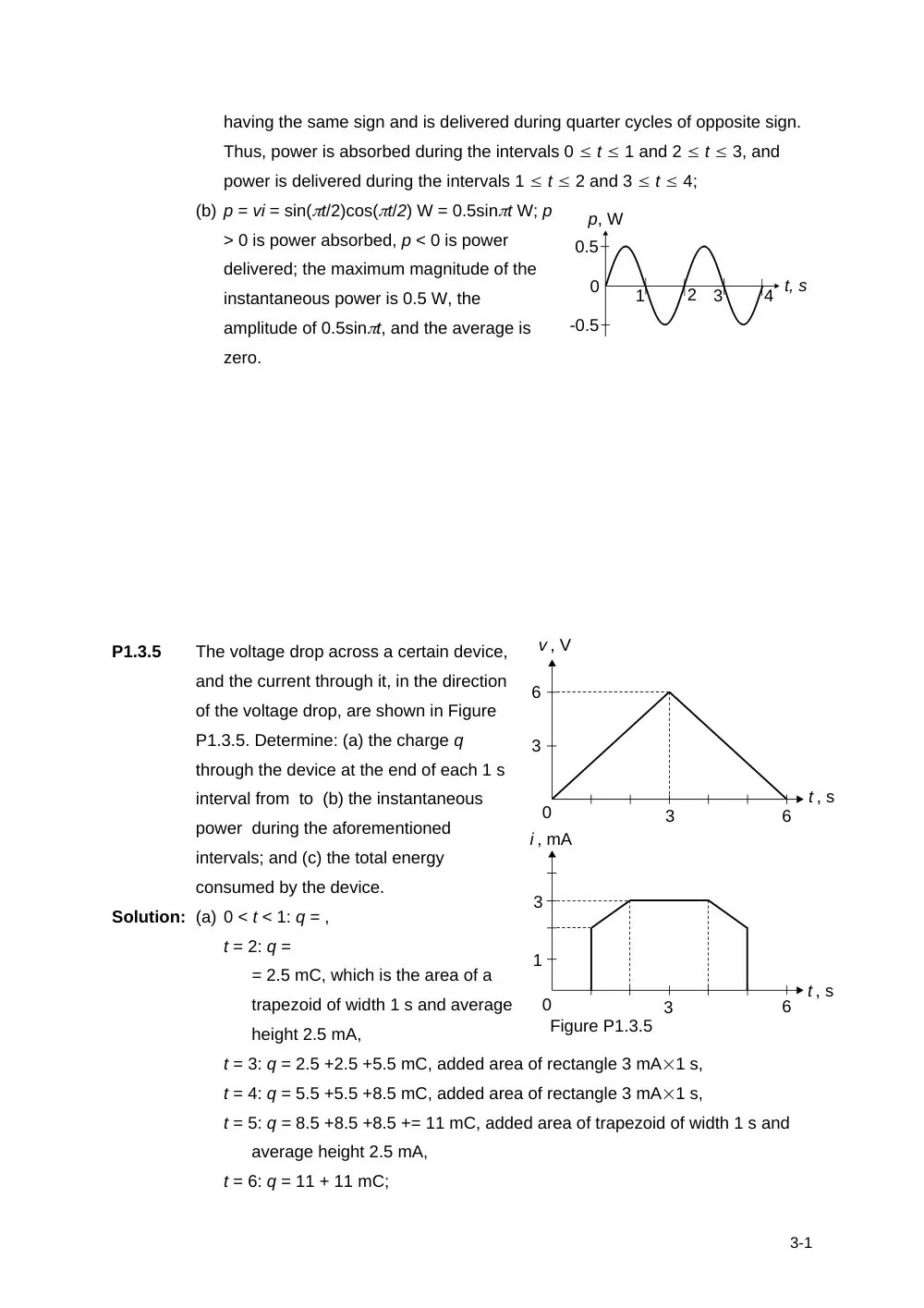
P1.3.3
The voltage drop across a certain device, and the
current through it, in the direction of the voltage
drop, are given by:
v = sint/2 V,
i = cost/2 A
(Figure P1.3.3). (a) Determine whether the device
absorbs or delivers power during each of the
quarter cycles of one period. (b) Derive the power
at any instant as a function of time. How do you
interpret positive values and negative values of
power? What is the maximum magnitude of
instantaneous power? What is the average
power over a 4-s period?
Solution: (a) Power is absorbed during quarter cycles
2-1
t, s
1
1
-1
2
3
4
0
v, V
1
i, A
+
+
+
+
-
-
A
B
Figure P1.2.2
+
–
+q
+q
+
–
VAB
W, J
q, C
t, s
1
1
-1
2
3
4
Figure P1.3.3
0
v, V
t, s
1
1
-1
2
3
4
0
i, A
having the same sign and is delivered during quarter cycles of opposite sign.
Thus, power is absorbed during the intervals 0 t 1 and 2 t 3, and
power is delivered during the intervals 1 t 2 and 3 t 4;
(b) p = vi = sin(t/2)cos(t/2) W = 0.5sint W; p
> 0 is power absorbed, p < 0 is power
delivered; the maximum magnitude of the
instantaneous power is 0.5 W, the
amplitude of 0.5sint, and the average is
zero.
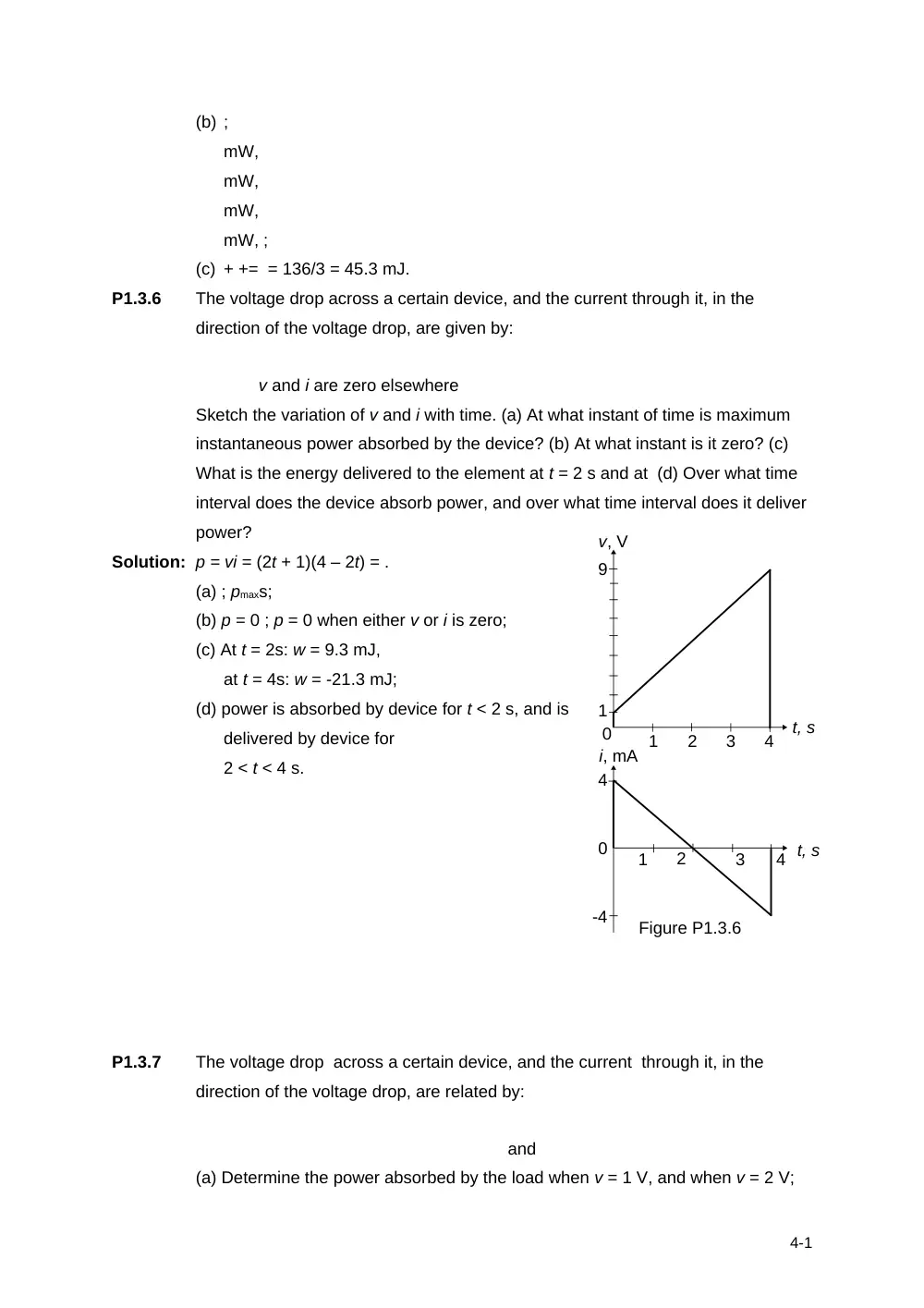
P1.3.5
The voltage drop across a certain device,
and the current through it, in the direction
of the voltage drop, are shown in Figure
P1.3.5. Determine: (a) the charge q
through the device at the end of each 1 s
interval from to (b) the instantaneous
power during the aforementioned
intervals; and (c) the total energy
consumed by the device.
Solution: (a) 0 < t < 1: q = ,
t = 2: q =
= 2.5 mC, which is the area of a
trapezoid of width 1 s and average
height 2.5 mA,
t = 3: q = 2.5 +2.5 +5.5 mC, added area of rectangle 3 mA1 s,
t = 4: q = 5.5 +5.5 +8.5 mC, added area of rectangle 3 mA1 s,
t = 5: q = 8.5 +8.5 +8.5 += 11 mC, added area of trapezoid of width 1 s and
average height 2.5 mA,
t = 6: q = 11 + 11 mC;
3-1
t, s
0.5
1
-0.5
2
3
4
0
p, W
t , s
3
6
v , V
6
3
t , s
6
3
i , mA
3
1
Figure P1.3.5
0
0
(b) ;
mW,
mW,
mW,
mW, ;
(c) + += = 136/3 = 45.3 mJ.
P1.3.6
The voltage drop across a certain device, and the current through it, in the
direction of the voltage drop, are given by:
v and i are zero elsewhere
Sketch the variation of v and i with time. (a) At what instant of time is maximum
instantaneous power absorbed by the device? (b) At what instant is it zero? (c)
What is the energy delivered to the element at t = 2 s and at (d) Over what time
interval does the device absorb power, and over what time interval does it deliver
power?
Solution: p = vi = (2t + 1)(4 – 2t) = .
(a) ; pmaxs;
(b) p = 0 ; p = 0 when either v or i is zero;
(c) At t = 2s: w = 9.3 mJ,
at t = 4s: w = -21.3 mJ;
(d) power is absorbed by device for t < 2 s, and is
delivered by device for
2 < t < 4 s.
P1.3.7
The voltage drop across a certain device, and the current through it, in the
direction of the voltage drop, are related by:
and
(a) Determine the power absorbed by the load when v = 1 V, and when v = 2 V;
4-1
Figure P1.3.6
t, s
1
1
2
3
4
0
t, s
4
1
-4
2
3
4
0
i, mA
v, V
9
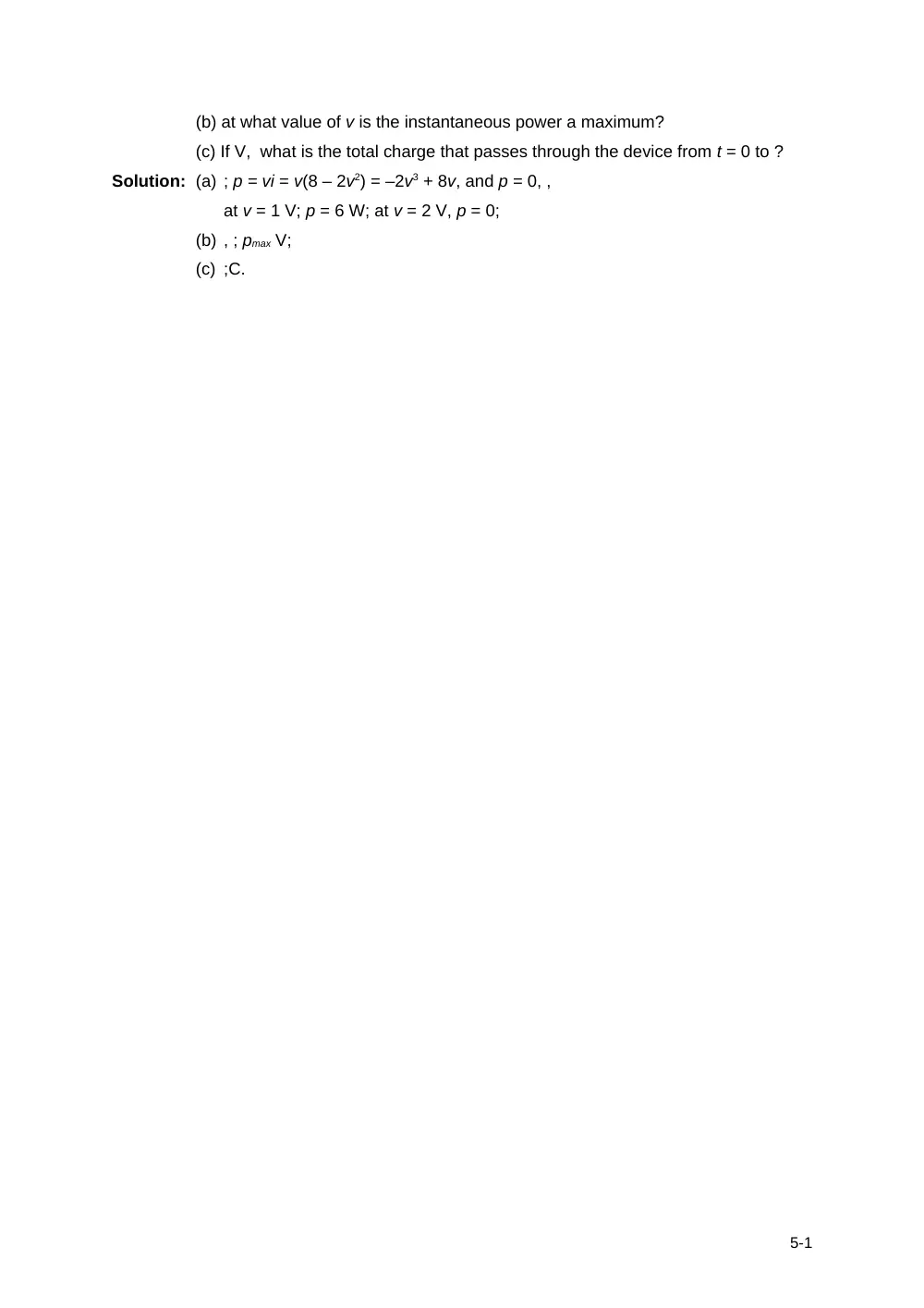
(b) at what value of v is the instantaneous power a maximum?
(c) If V, what is the total charge that passes through the device from t = 0 to ?
Solution: (a) ; p = vi = v(8 – 2v2) = –2v3 + 8v, and p = 0, ,
at v = 1 V; p = 6 W; at v = 2 V, p = 0;
(b) , ; pmax V;
(c) ;C.
5-1