
EECE 210 Homework, Spring 2008
American University of Beirut · Electric Circuits · 4 pages
More EECE 210 files
Show the text of this homework
Homework 3
Solution
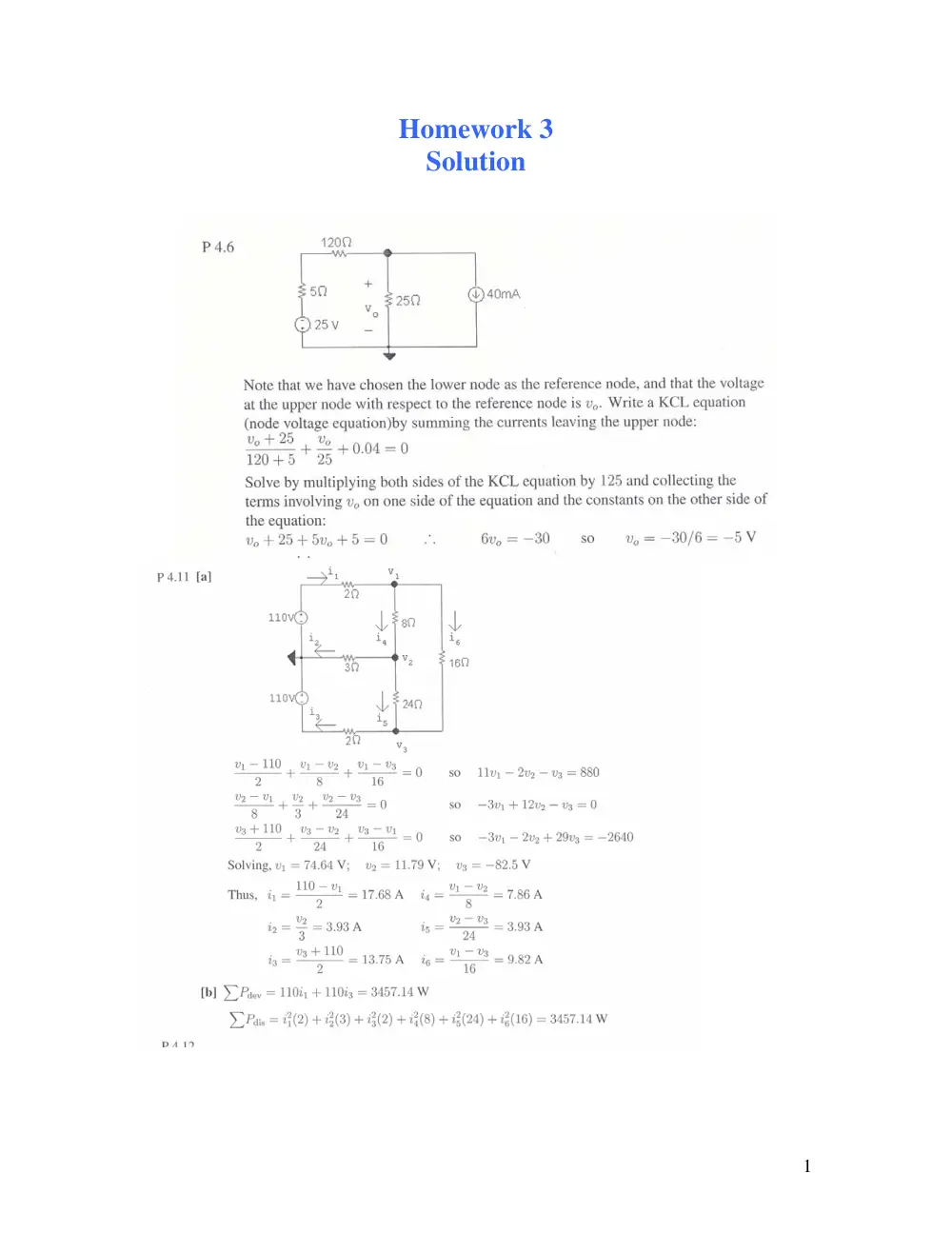
P4.6 1200)
52 7 250 @40ma
ev
P4.11 [a]
Note that we have chosen the lower node as the reference node, and that the voltage
at the upper node with respect to the reference node is vp. Write a KCL equation
(node voltage equation)by summing the currents leaving the upper node:
2
Hohe Uh Oa ef
120+5 25
Solve by multiplying both sides of the KCL equation by 125 and collecting the
terms involving v, on one side of the equation and the constants on the other side of
the equation:
Vo +25+5u.+5=0 He 6up = —30 so Uo = —30/6 = -5 V
%—110) wy—ve Wy — v3
2 8 16
Vg—V, . U2 . Ug — U3
8 3 24
vg+110 ug—vg vg —Vv
> + 4 *
=0 so 11v, — 2ue — v3 = 880
=0 so —3u; + 12v2 — v3 =0
=0 so —3v, — 2v2 + 29v3 = —2640
Solving, vu) = 74.64V; v2=11.79V; v3 = —82.5V
— 1o-y% V1 — V2
Thus, i) = 2 =1768A ig= AS 786A
. U2 P U2 — U3
=> =3.93A = = 3:
n= 3 is 71 3.93 A
. v3 +110 . UV, — U3
= =13.75A = =9.
or) 5) ig 16 9.82 A
[b] $>Paey = 1104, + 110i = 3457.14 W
DA19
Pais = i3(2) + (3) + 23(2) + 3(8) + #3(24) + #2(16) = 3457.14 W
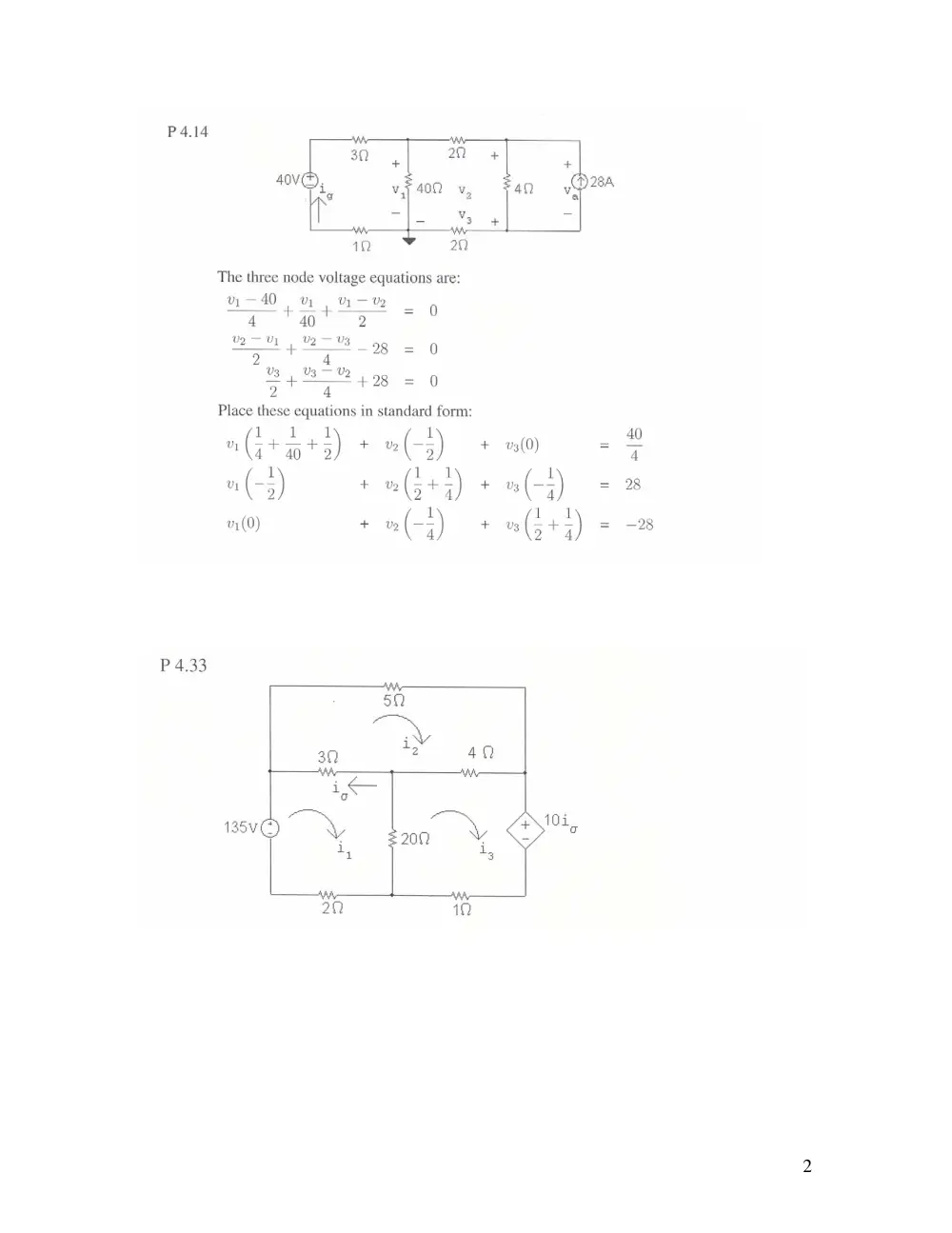
P4.14
40v@,
The three node voltage equations are:
vy —-40 vy v—v2
a nobis = 0
4 * 40 2
vg—U, | Vg— U3
2S _og = 0
a U 4
3 3 42
= 28 = 0
27 4 ‘
Place these equations in standard form:
1 = . ( 1) ,
W2,1,1 vi
n(G+a 2 M9
oC) + GH) + #3)
wo sal) + w(bH
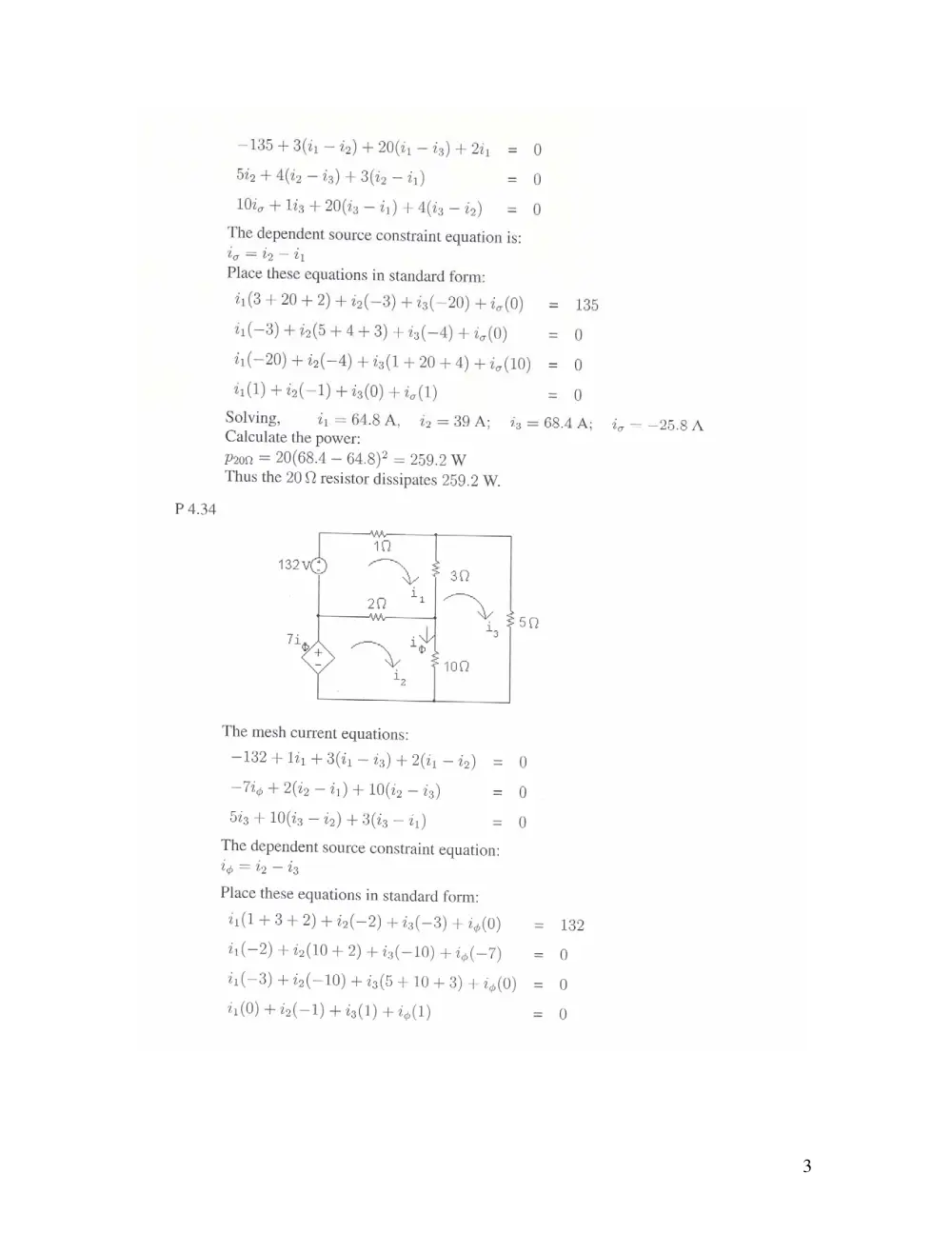
P 4.33
Ay
50
a
3n g 4Q
+ “—— Ay 4
= “yy oo"
1 13
AM My Why
20 10
an, 20 ‘| \
vy 40Q v 4Q yD28A
g 1 2
oan ee
AW AM
19 2
135 + 3(t; — ig) + 20(t, —i3)4+ 2%, = 0
5ig + 4(t2 — ig) + 3(%2 — iy) = 59
10i, + liz + 20(i3 — 21) + 4(ig —ig) = 0
‘The dependent source constraint equation is:
tg =n -ty
Place these equations in standard form:
41(3 + 20 + 2) + ig(—3) + is(—20) +7,(0) = 135
i1(—3) + 42(5 + 4 + 3) + i3(—4) + i,(0) = 0
ty (—20) + ie(—4) + i3(1 +20 + 4) + 4,(10)
44 (1) + i2(—1) + 43(0) +1, (1) = 0
Solving, 4,=64.8A, i2=39A; ig = 68.4 A; i, =—25.8A
Calculate the power:
P200 = 20(68.4 — 64.8)? = 259.2 W
Thus the 20 2 resistor dissipates 259.2 W.
iT}
Oo
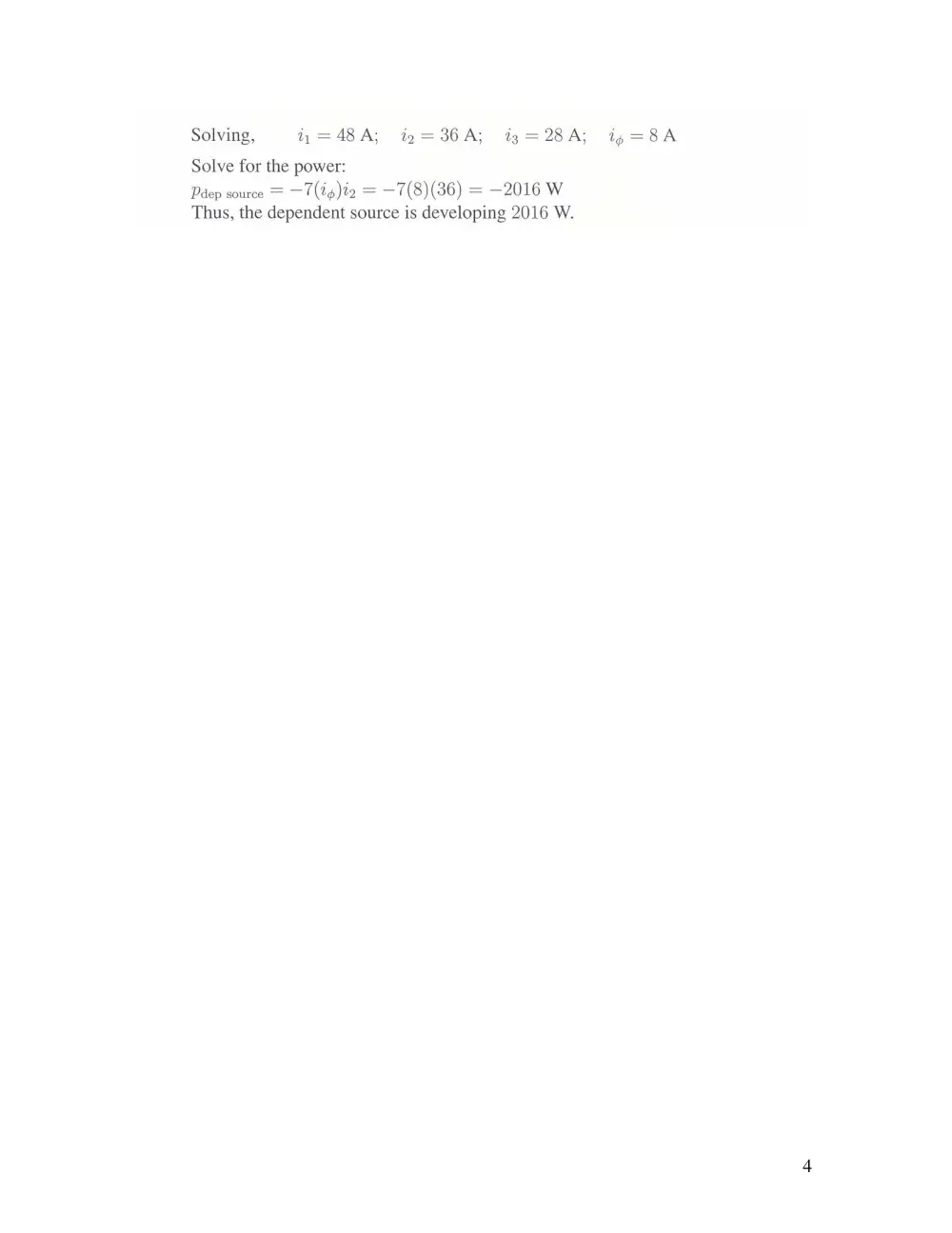
P 4.34
1200 a l AP
The mesh current equations:
—182 + li + 3(i, — 3) + (i, — ig) = 0
—Tig + 2(i2 — 41) + 10(ég — ig) = 0
5t3 + 10(ig — tg) + 3(izg — 11) = 0
The dependent source constraint equation:
ig = tg — ig
Place these equations in standard form:
i(1 +3 + 2) + i9(—2) + i3(-3) 4 i4(0) = 132
ty(—2) + ig(10 + 2) + i3(—10) + to(—7) = 0
i1(—3) + io(—10) + i3(5 + 10 +3) 4 i,(0) = 0
4,(0) + ig(—1) + 43(1) + ég(1) = 0
Solving, 4, =48 A; %2=36A; %3 = 284A;
Solve for the power:
Pdep source = —T(ig)ie = —7(8)(36) = —2016 W
Thus, the dependent source is developing 2016 W.
ig =8A