
EECE 230 Exam 2, Fall 2012
American University of Beirut · Introduction to Programming · 5 pages · Dr. Louay Bazzi

More EECE 230 files
- Exam 2 Solutions · Spring 2019Exam · with solutionView
- Exam 1 Solutions from Dr.Bazzi · Spring 2019Exam · with solutionView
- Exam 1 Quiz 1 Spring 18 · Spring 2019ExamView
- Exam 2 · Spring 2018ExamView
- Exam 1 · Spring 2018ExamView
- Exam 2 Quiz 2 Collection with Solution · Spring 2017Exam · with solutionView
- Exam 2 Quiz 2 2016 · Spring 2017ExamView
- Exam 1 Quiz 1 with Solution Bazzi · Spring 2017Exam · with solutionView
Show the text of this exam
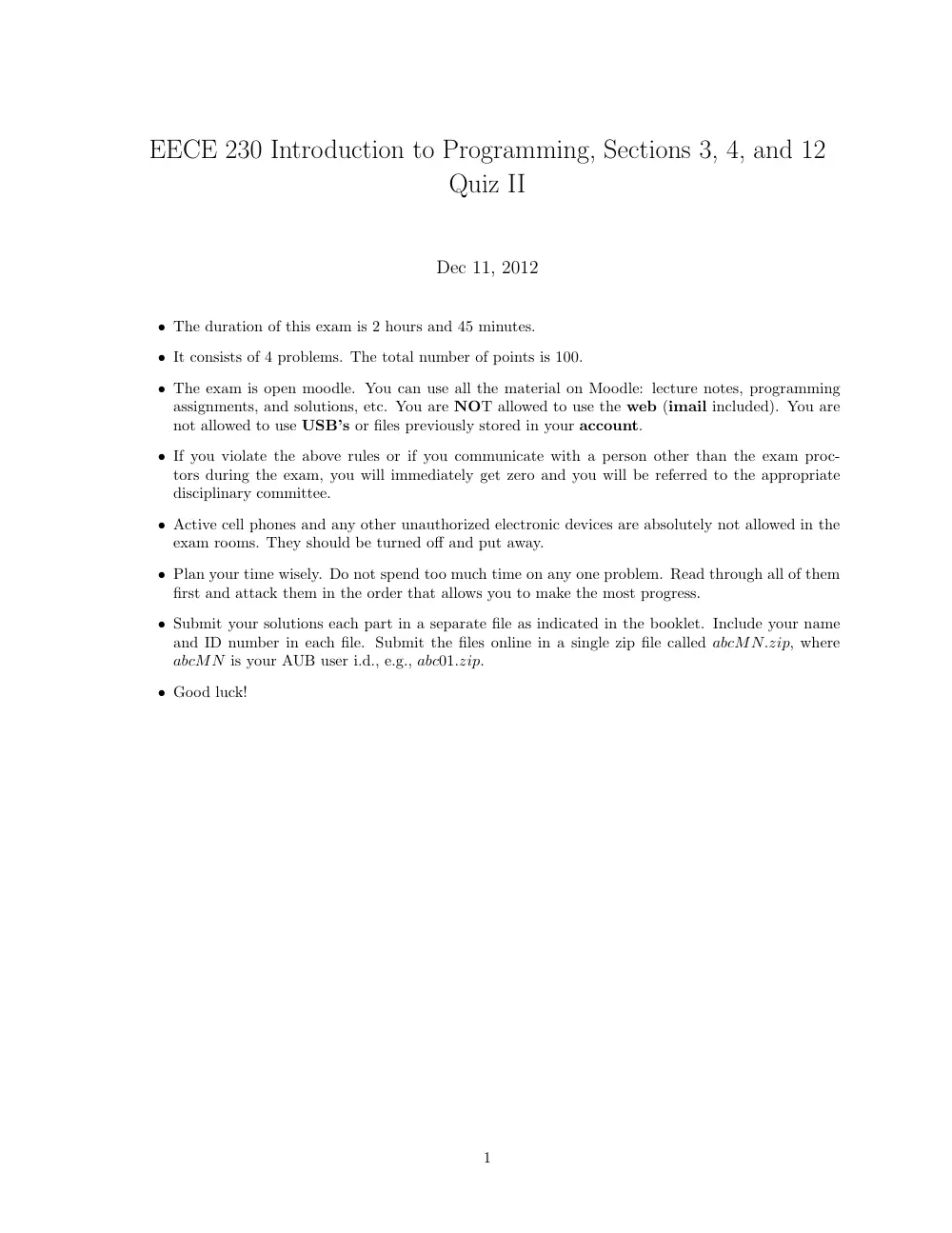
EECE 230 Introduction to Programming, Sections 3, 4, and 12
Quiz II
Dec 11, 2012
• The duration of this exam is 2 hours and 45 minutes.
• It consists of 4 problems. The total number of points is 100.
• The exam is open moodle. You can use all the material on Moodle: lecture notes, programming
assignments, and solutions, etc. You are NOT allowed to use the web (imail included). You are
not allowed to use USB’s or files previously stored in your account.
• If you violate the above rules or if you communicate with a person other than the exam proc-
tors during the exam, you will immediately get zero and you will be referred to the appropriate
disciplinary committee.
• Active cell phones and any other unauthorized electronic devices are absolutely not allowed in the
exam rooms. They should be turned off and put away.
• Plan your time wisely. Do not spend too much time on any one problem. Read through all of them
first and attack them in the order that allows you to make the most progress.
• Submit your solutions each part in a separate file as indicated in the booklet. Include your name
and ID number in each file. Submit the files online in a single zip file called abcMN.zip, where
abcMN is your AUB user i.d., e.g., abc01.zip.
• Good luck!
1
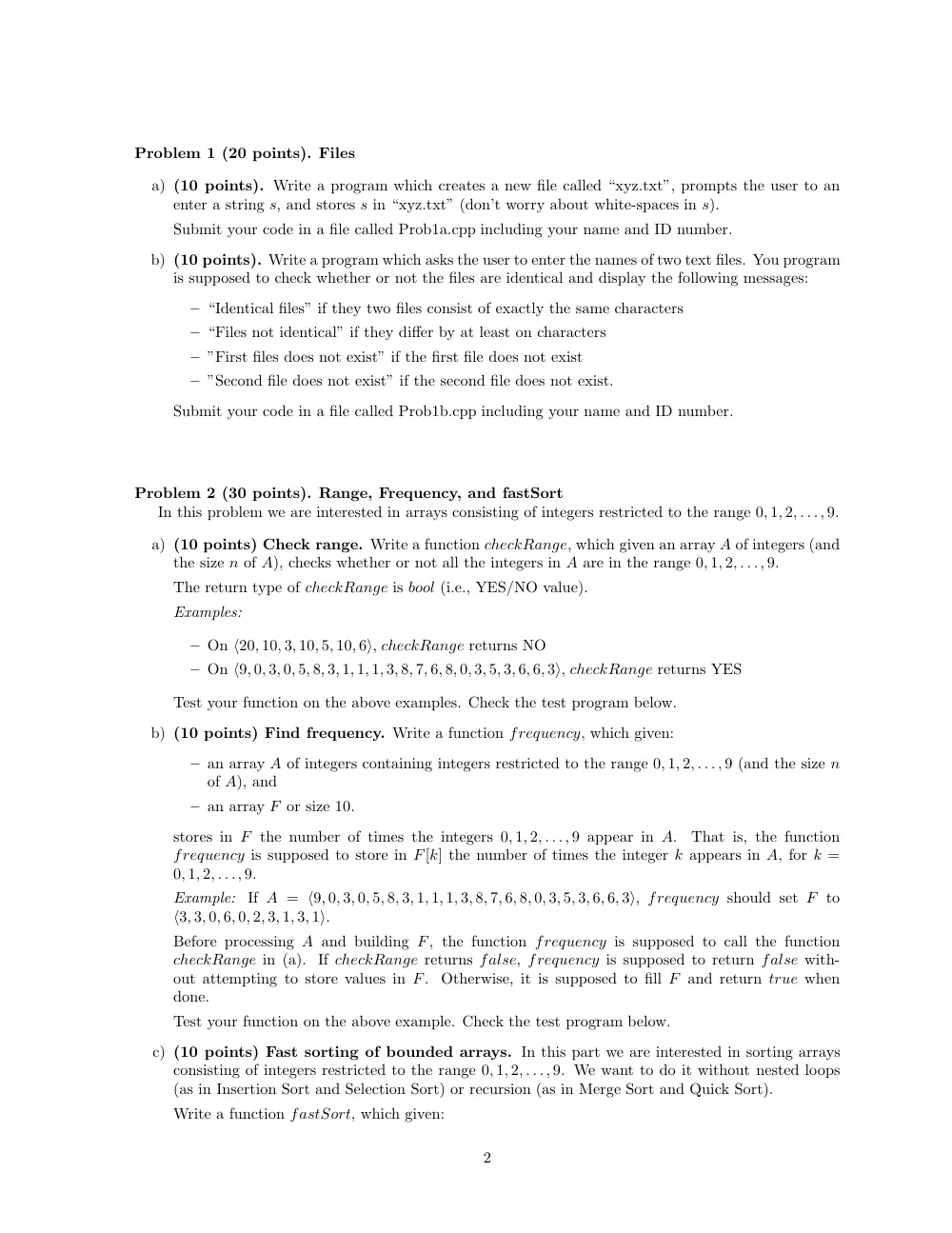
Problem 1 (20 points). Files
a) (10 points). Write a program which creates a new file called “xyz.txt”, prompts the user to an
enter a string s, and stores s in “xyz.txt” (don’t worry about white-spaces in s).
Submit your code in a file called Prob1a.cpp including your name and ID number.
b) (10 points). Write a program which asks the user to enter the names of two text files. You program
is supposed to check whether or not the files are identical and display the following messages:
– “Identical files” if they two files consist of exactly the same characters
– “Files not identical” if they differ by at least on characters
– ”First files does not exist” if the first file does not exist
– ”Second file does not exist” if the second file does not exist.
Submit your code in a file called Prob1b.cpp including your name and ID number.
Problem 2 (30 points). Range, Frequency, and fastSort
In this problem we are interested in arrays consisting of integers restricted to the range 0, 1, 2, . . ., 9.
a) (10 points) Check range. Write a function checkRange, which given an array A of integers (and
the size n of A), checks whether or not all the integers in A are in the range 0, 1, 2, . . ., 9.
The return type of checkRange is bool (i.e., YES/NO value).
Examples:
– On ⟨20, 10, 3, 10, 5, 10, 6⟩, checkRange returns NO
– On ⟨9, 0, 3, 0, 5, 8, 3, 1, 1, 1, 3, 8, 7, 6, 8, 0, 3, 5, 3, 6, 6, 3⟩, checkRange returns YES
Test your function on the above examples. Check the test program below.
b) (10 points) Find frequency. Write a function frequency, which given:
– an array A of integers containing integers restricted to the range 0, 1, 2, . . ., 9 (and the size n
of A), and
– an array F or size 10.
stores in F the number of times the integers 0, 1, 2, . . ., 9 appear in A.
That is, the function
frequency is supposed to store in F[k] the number of times the integer k appears in A, for k =
0, 1, 2, . . ., 9.
Example:
If A = ⟨9, 0, 3, 0, 5, 8, 3, 1, 1, 1, 3, 8, 7, 6, 8, 0, 3, 5, 3, 6, 6, 3⟩, frequency should set F to
⟨3, 3, 0, 6, 0, 2, 3, 1, 3, 1⟩.
Before processing A and building F, the function frequency is supposed to call the function
checkRange in (a). If checkRange returns false, frequency is supposed to return false with-
out attempting to store values in F. Otherwise, it is supposed to fill F and return true when
done.
Test your function on the above example. Check the test program below.
c) (10 points) Fast sorting of bounded arrays. In this part we are interested in sorting arrays
consisting of integers restricted to the range 0, 1, 2, . . ., 9. We want to do it without nested loops
(as in Insertion Sort and Selection Sort) or recursion (as in Merge Sort and Quick Sort).
Write a function fastSort, which given:
2
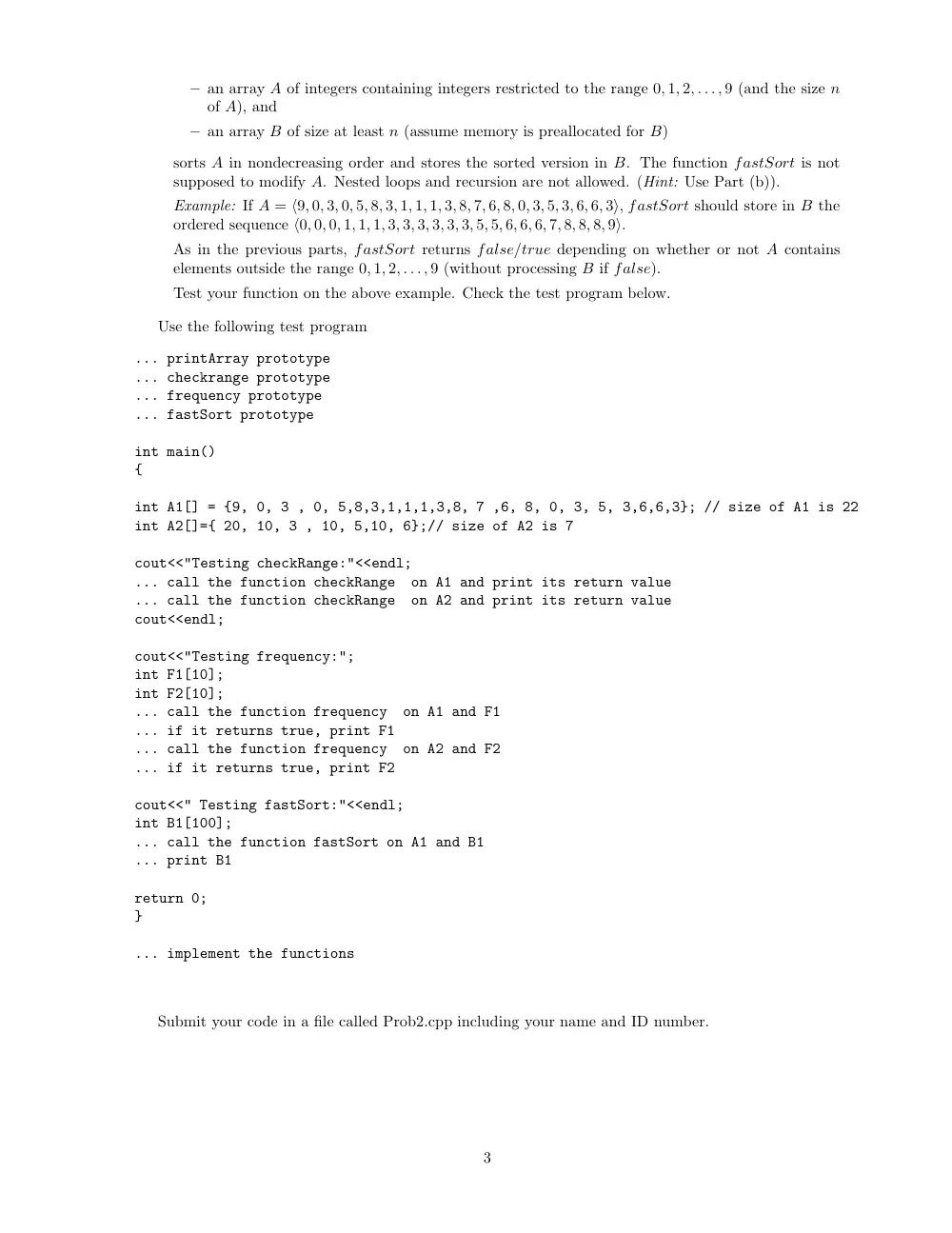
– an array A of integers containing integers restricted to the range 0, 1, 2, . . ., 9 (and the size n
of A), and
– an array B of size at least n (assume memory is preallocated for B)
sorts A in nondecreasing order and stores the sorted version in B. The function fastSort is not
supposed to modify A. Nested loops and recursion are not allowed. (Hint: Use Part (b)).
Example: If A = ⟨9, 0, 3, 0, 5, 8, 3, 1, 1, 1, 3, 8, 7, 6, 8, 0, 3, 5, 3, 6, 6, 3⟩, fastSort should store in B the
ordered sequence ⟨0, 0, 0, 1, 1, 1, 3, 3, 3, 3, 3, 3, 5, 5, 6, 6, 6, 7, 8, 8, 8, 9⟩.
As in the previous parts, fastSort returns false/true depending on whether or not A contains
elements outside the range 0, 1, 2, . . ., 9 (without processing B if false).
Test your function on the above example. Check the test program below.
Use the following test program
... printArray prototype
... checkrange prototype
... frequency prototype
... fastSort prototype
int main()
{
int A1[] = {9, 0, 3 , 0, 5,8,3,1,1,1,3,8, 7 ,6, 8, 0, 3, 5, 3,6,6,3}; // size of A1 is 22
int A2[]={ 20, 10, 3 , 10, 5,10, 6};// size of A2 is 7
cout<<"Testing checkRange:"<<endl;
... call the function checkRange
on A1 and print its return value
... call the function checkRange
on A2 and print its return value
cout<<endl;
cout<<"Testing frequency:";
int F1[10];
int F2[10];
... call the function frequency
on A1 and F1
... if it returns true, print F1
... call the function frequency
on A2 and F2
... if it returns true, print F2
cout<<" Testing fastSort:"<<endl;
int B1[100];
... call the function fastSort on A1 and B1
... print B1
return 0;
}
... implement the functions
Submit your code in a file called Prob2.cpp including your name and ID number.
3
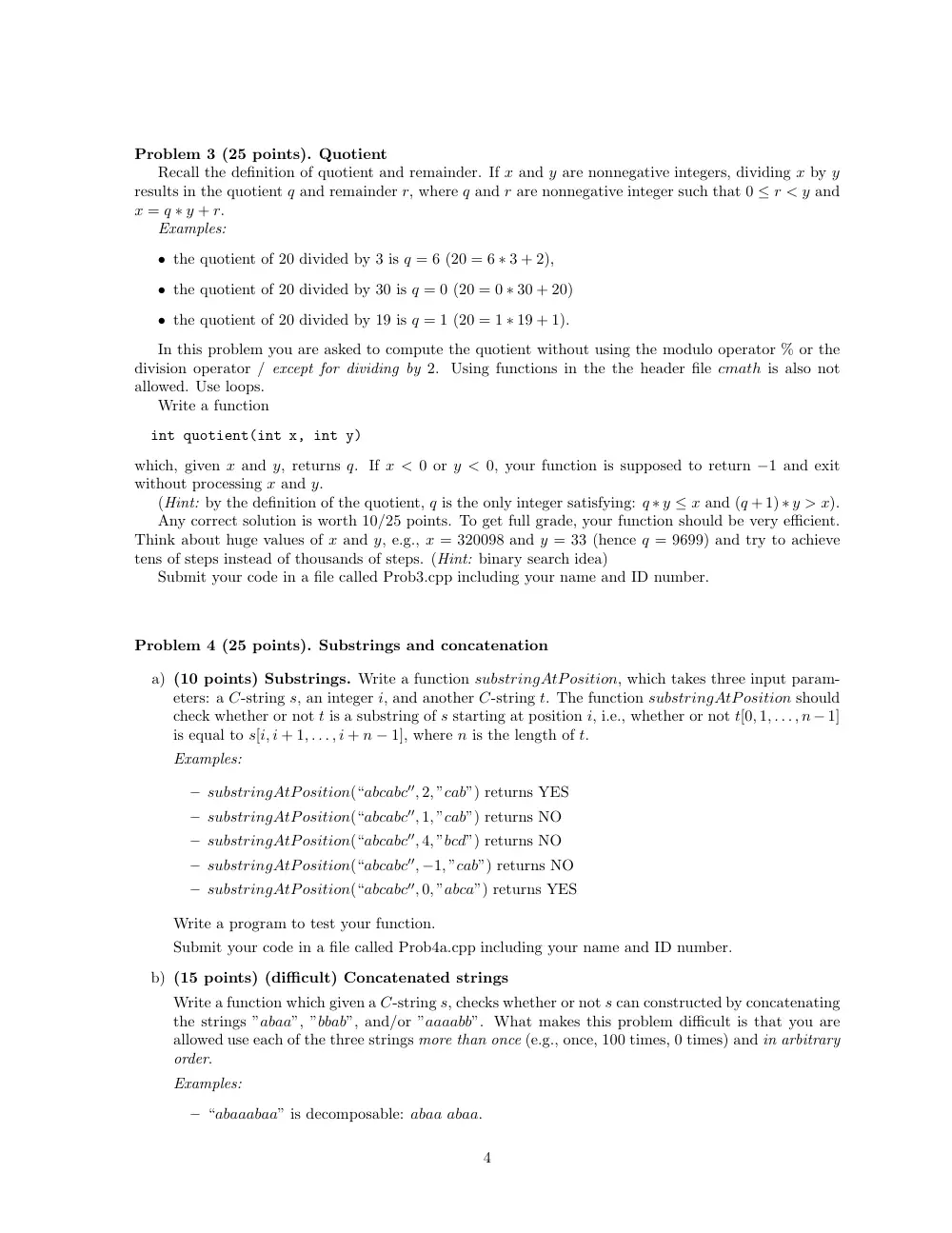
Problem 3 (25 points). Quotient
Recall the definition of quotient and remainder. If x and y are nonnegative integers, dividing x by y
results in the quotient q and remainder r, where q and r are nonnegative integer such that 0 ≤ r < y and
x = q ∗ y + r.
Examples:
• the quotient of 20 divided by 3 is q = 6 (20 = 6 ∗ 3 + 2),
• the quotient of 20 divided by 30 is q = 0 (20 = 0 ∗ 30 + 20)
• the quotient of 20 divided by 19 is q = 1 (20 = 1 ∗ 19 + 1).
In this problem you are asked to compute the quotient without using the modulo operator % or the
division operator / except for dividing by 2. Using functions in the the header file cmath is also not
allowed. Use loops.
Write a function
int quotient(int x, int y)
which, given x and y, returns q. If x < 0 or y < 0, your function is supposed to return −1 and exit
without processing x and y.
(Hint: by the definition of the quotient, q is the only integer satisfying: q ∗ y ≤ x and (q + 1) ∗ y > x).
Any correct solution is worth 10/25 points. To get full grade, your function should be very efficient.
Think about huge values of x and y, e.g., x = 320098 and y = 33 (hence q = 9699) and try to achieve
tens of steps instead of thousands of steps. (Hint: binary search idea)
Submit your code in a file called Prob3.cpp including your name and ID number.
Problem 4 (25 points). Substrings and concatenation
a) (10 points) Substrings. Write a function substringAtPosition, which takes three input param-
eters: a C-string s, an integer i, and another C-string t. The function substringAtPosition should
check whether or not t is a substring of s starting at position i, i.e., whether or not t[0, 1, . . ., n − 1]
is equal to s[i, i + 1, . . . , i + n − 1], where n is the length of t.
Examples:
– substringAtPosition(“abcabc′′, 2, ”cab”) returns YES
– substringAtPosition(“abcabc′′, 1, ”cab”) returns NO
– substringAtPosition(“abcabc′′, 4, ”bcd”) returns NO
– substringAtPosition(“abcabc′′, −1, ”cab”) returns NO
– substringAtPosition(“abcabc′′, 0, ”abca”) returns YES
Write a program to test your function.
Submit your code in a file called Prob4a.cpp including your name and ID number.
b) (15 points) (difficult) Concatenated strings
Write a function which given a C-string s, checks whether or not s can constructed by concatenating
the strings ”abaa”, ”bbab”, and/or ”aaaabb”. What makes this problem difficult is that you are
allowed use each of the three strings more than once (e.g., once, 100 times, 0 times) and in arbitrary
order.
Examples:
– “abaaabaa” is decomposable: abaa abaa.
4
– “abaaabaaaaaabbabaabbabbbababaa” is decomposable: abaa abaa aaaabb abaa bbab bbab abaa.
– “aaaabbbbababaabbabbbabbbababaa” is decomposable: aaaabb bbab abaa bbab bbab bbab abaa
– “abaaaba” is not decomposable
– “aaaabbbabababbababb” is not decomposable
Any correct solution is worth 7/15 points (Hint: use the function in Part (a) and use recursion).
To get full grade your solution should be efficient, i.e., it shouldn’t take forever on strings of size
above 100 (Hint: think in terms of smaller subproblems but don’t use recursion).
Write a program to test your function. Submit your code in a file called Prob4b.cpp including your
name and ID number.
5