
EECE 230 Exam 2 Solution, Spring 2014
American University of Beirut · Introduction to Programming · 4 pages · Dr. Louay Bazzi · with solution
More EECE 230 files
- Exam 2 Solutions · Spring 2019Exam · with solutionView
- Exam 1 Solutions from Dr.Bazzi · Spring 2019Exam · with solutionView
- Exam 1 Quiz 1 Spring 18 · Spring 2019ExamView
- Exam 2 · Spring 2018ExamView
- Exam 1 · Spring 2018ExamView
- Exam 2 Quiz 2 Collection with Solution · Spring 2017Exam · with solutionView
- Exam 2 Quiz 2 2016 · Spring 2017ExamView
- Exam 1 Quiz 1 with Solution Bazzi · Spring 2017Exam · with solutionView
Show the text of this exam
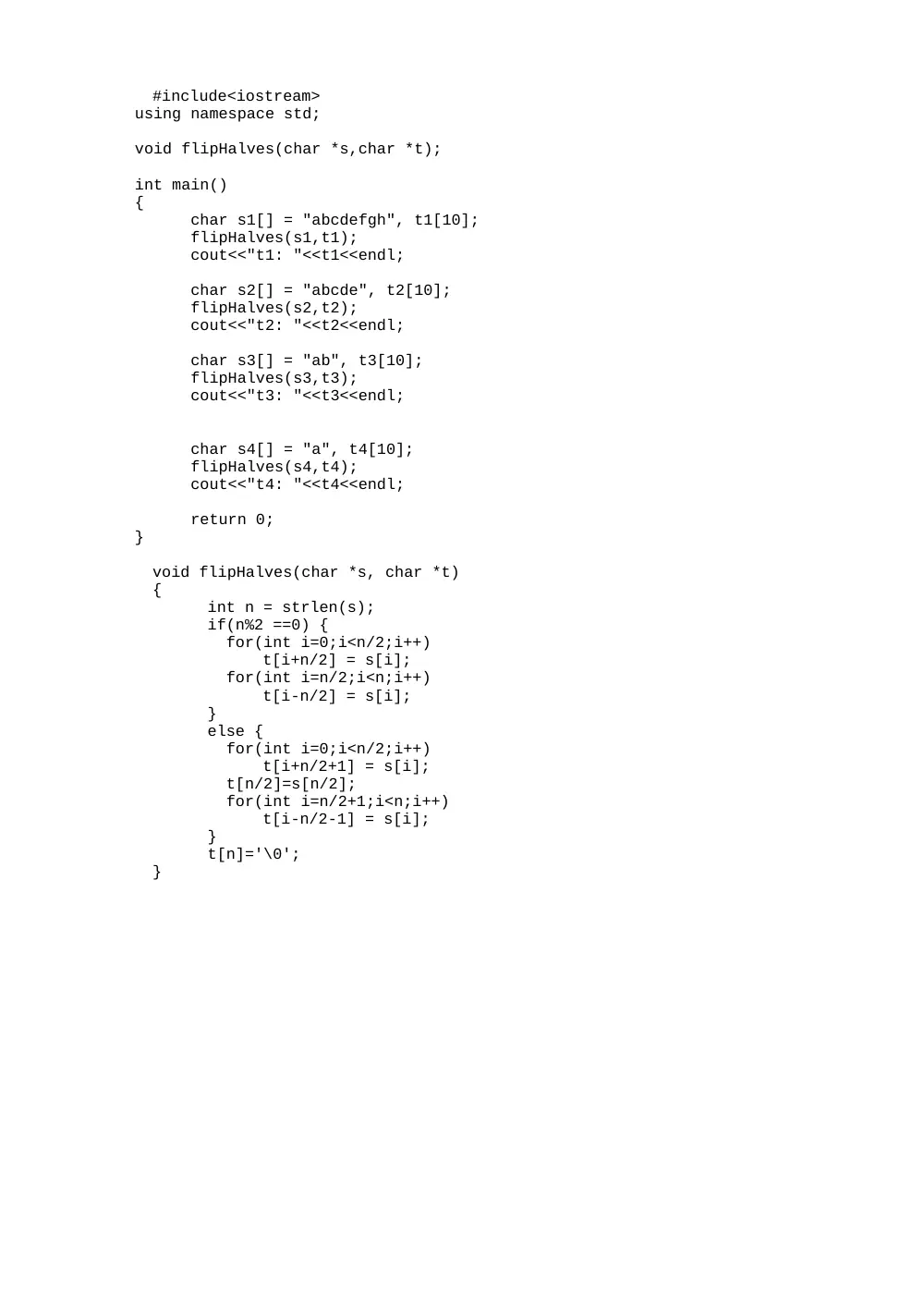
#include<iostream>
using namespace std;
void flipHalves(char *s,char *t);
int main()
{
char s1[] = "abcdefgh", t1[10];
flipHalves(s1,t1);
cout<<"t1: "<<t1<<endl;
char s2[] = "abcde", t2[10];
flipHalves(s2,t2);
cout<<"t2: "<<t2<<endl;
char s3[] = "ab", t3[10];
flipHalves(s3,t3);
cout<<"t3: "<<t3<<endl;
char s4[] = "a", t4[10];
flipHalves(s4,t4);
cout<<"t4: "<<t4<<endl;
return 0;
}
void flipHalves(char *s, char *t)
{
int n = strlen(s);
if(n%2 ==0) {
for(int i=0;i<n/2;i++)
t[i+n/2] = s[i];
for(int i=n/2;i<n;i++)
t[i-n/2] = s[i];
}
else {
for(int i=0;i<n/2;i++)
t[i+n/2+1] = s[i];
t[n/2]=s[n/2];
for(int i=n/2+1;i<n;i++)
t[i-n/2-1] = s[i];
}
t[n]='\0';
}
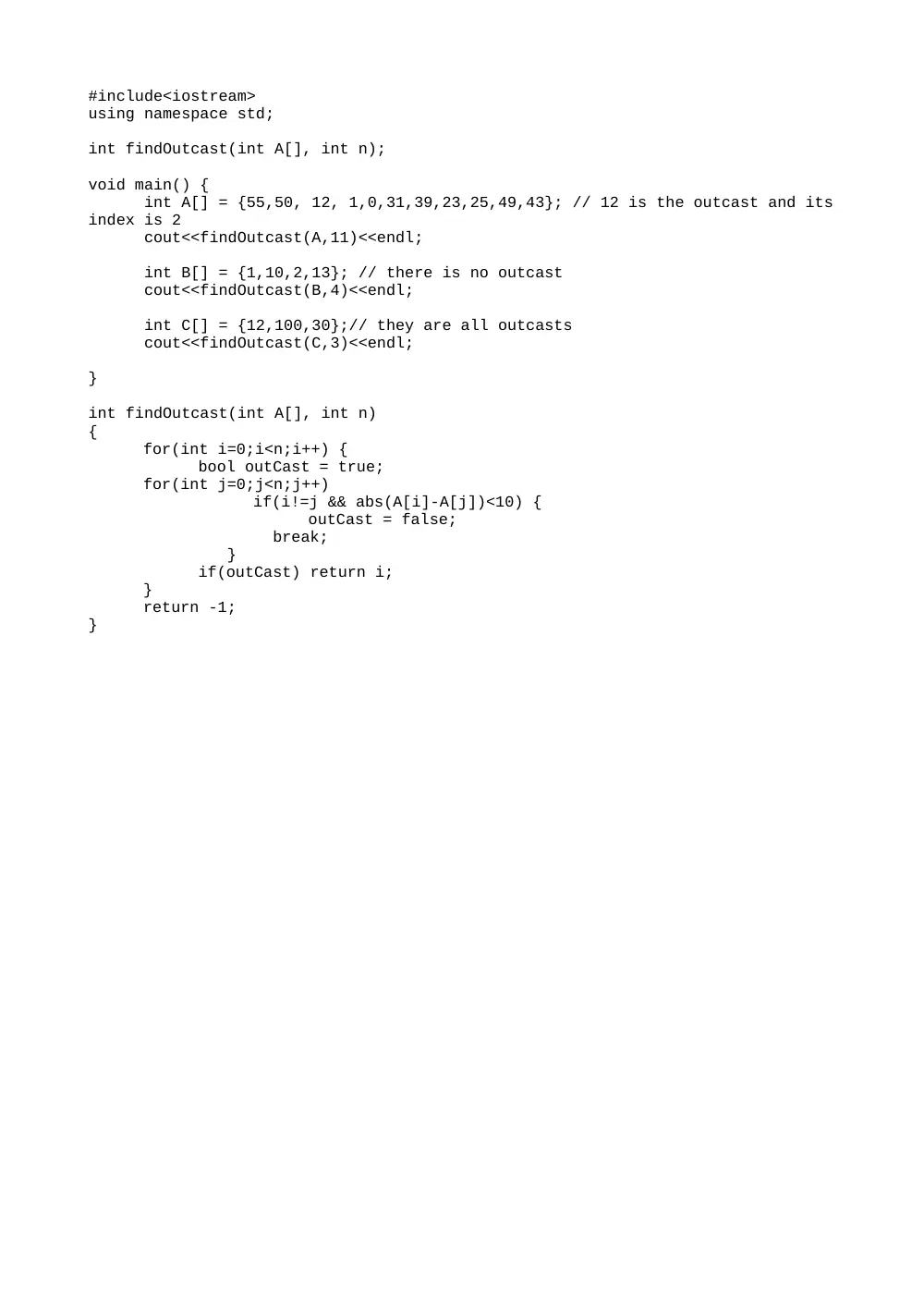
#include<iostream>
using namespace std;
int findOutcast(int A[], int n);
void main() {
int A[] = {55,50, 12, 1,0,31,39,23,25,49,43}; // 12 is the outcast and its
index is 2
cout<<findOutcast(A,11)<<endl;
int B[] = {1,10,2,13}; // there is no outcast
cout<<findOutcast(B,4)<<endl;
int C[] = {12,100,30};// they are all outcasts
cout<<findOutcast(C,3)<<endl;
}
int findOutcast(int A[], int n)
{
for(int i=0;i<n;i++) {
bool outCast = true;
for(int j=0;j<n;j++)
if(i!=j && abs(A[i]-A[j])<10) {
outCast = false;
break;
}
if(outCast) return i;
}
return -1;
}
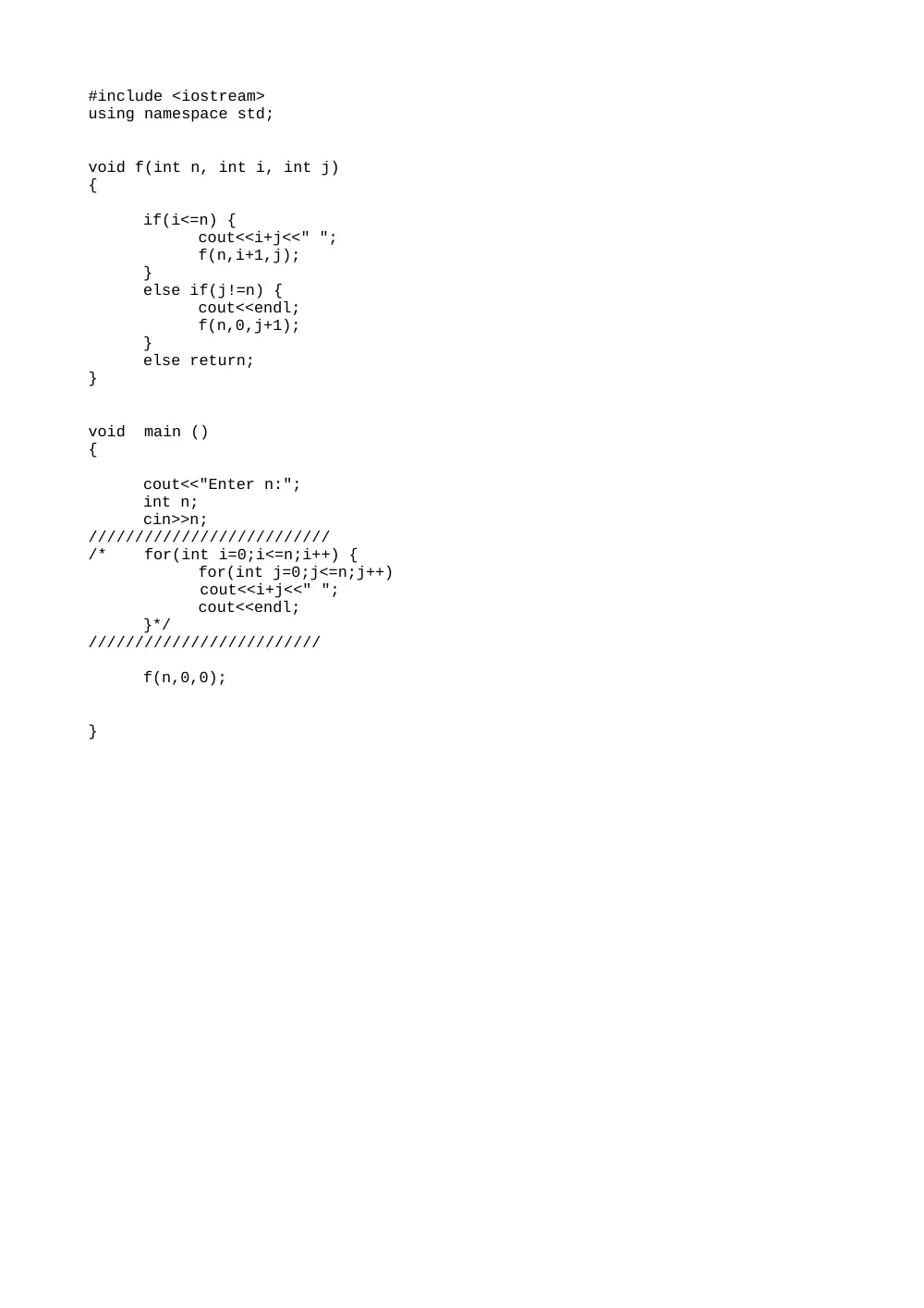
#include <iostream>
using namespace std;
void f(int n, int i, int j)
{
if(i<=n) {
cout<<i+j<<" ";
f(n,i+1,j);
}
else if(j!=n) {
cout<<endl;
f(n,0,j+1);
}
else return;
}
void main ()
{
cout<<"Enter n:";
int n;
cin>>n;
//////////////////////////
/* for(int i=0;i<=n;i++) {
for(int j=0;j<=n;j++)
cout<<i+j<<" ";
cout<<endl;
}*/
/////////////////////////
f(n,0,0);
}
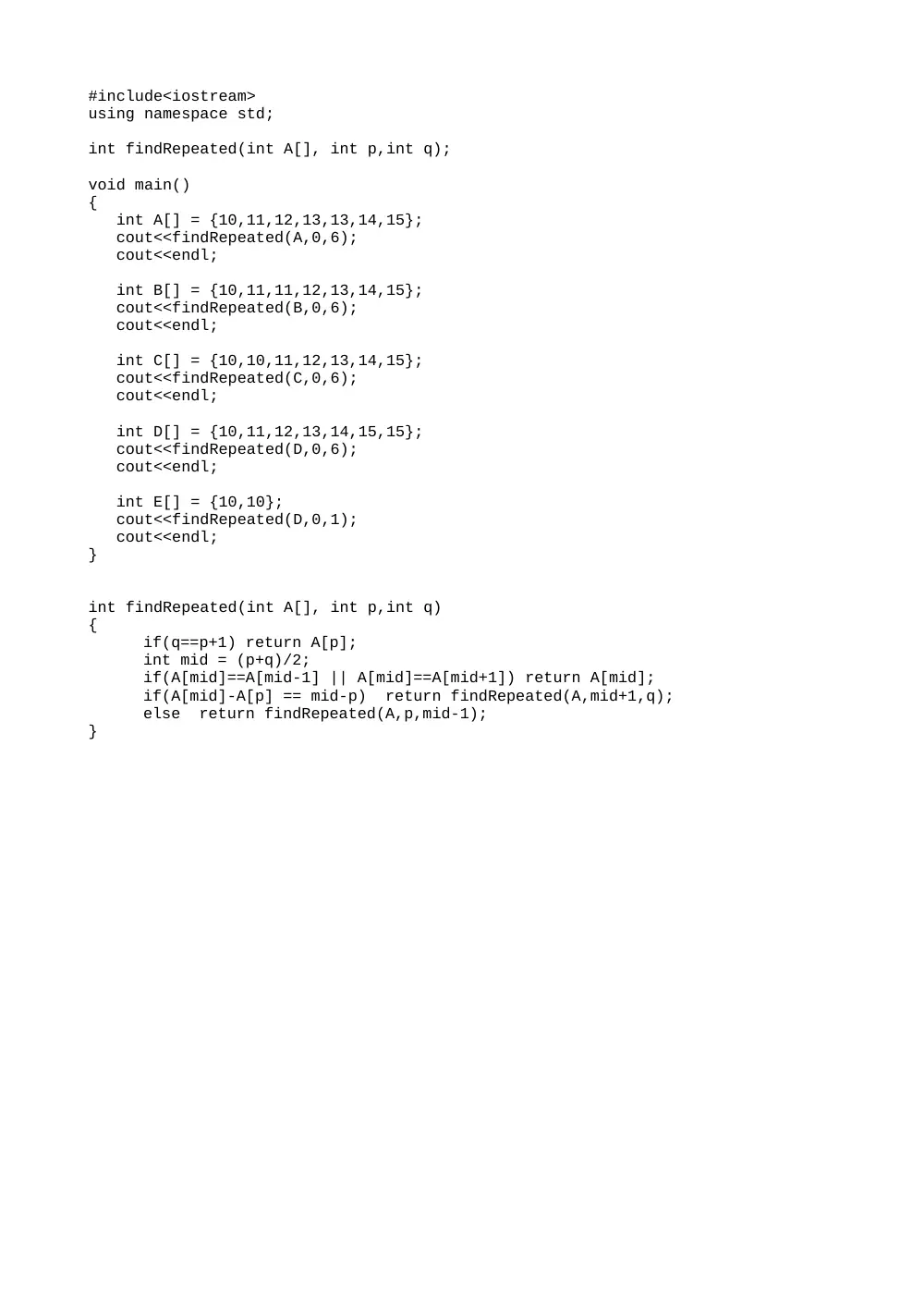
#include<iostream>
using namespace std;
int findRepeated(int A[], int p,int q);
void main()
{
int A[] = {10,11,12,13,13,14,15};
cout<<findRepeated(A,0,6);
cout<<endl;
int B[] = {10,11,11,12,13,14,15};
cout<<findRepeated(B,0,6);
cout<<endl;
int C[] = {10,10,11,12,13,14,15};
cout<<findRepeated(C,0,6);
cout<<endl;
int D[] = {10,11,12,13,14,15,15};
cout<<findRepeated(D,0,6);
cout<<endl;
int E[] = {10,10};
cout<<findRepeated(D,0,1);
cout<<endl;
}
int findRepeated(int A[], int p,int q)
{
if(q==p+1) return A[p];
int mid = (p+q)/2;
if(A[mid]==A[mid-1] || A[mid]==A[mid+1]) return A[mid];
if(A[mid]-A[p] == mid-p) return findRepeated(A,mid+1,q);
else return findRepeated(A,p,mid-1);
}