
EECE 230 Final, Fall 2013
American University of Beirut · Introduction to Programming · 5 pages · Dr. Louay Bazzi


More EECE 230 files
- Final Exam · Spring 2020Final examView
- Final Questions · Spring 2019Final examView
- Final Questions · Fall 2018Final examView
- Final Solutions · Fall 2018Final exam · with solutionView
- Final Collection Finals with Solution · Spring 2017Final exam · with solutionView
- Final Problem 2 · Fall 2013Final examView
- Final Problem 3 · Fall 2013Final examView
- Final · Fall 2013Final examView
Show the text of this final exam
EECE 230 Introduction to Programming, Sections 3,4, and 12
Final Exam
January 8, 2013
• The duration of this exam is 3 hours.
• It consists of 5 problems.
• The exam is open moodle. You can use all the material on Moodle: lecture notes, programming
assignments, and solutions, etc. You are NOT allowed to use the web (imail included). You are
not allowed to use USB’s or files previously stored in your account.
• If you violate the above rules or if you communicate with a person other than the exam proctors
during the exam, you will immediately get zero and you will be referred to a disciplinary committee.
• Active cell phones and any other unauthorized electronic devices are absolutely not allowed in the
exam rooms. They should be turned off and put away.
• Plan your time wisely. Do not spend too much time on any one problem. Read through all of them
first and attack them in the order that allows you to make the most progress.
• Submit your solutions each part in a separate file as indicated in the booklet. Include your name
and ID number in each file. Submit the files online in a single zip file called abcMN.zip, where
abcMN is your AUB user i.d., e.g., abc01.zip.
• Good luck!
1
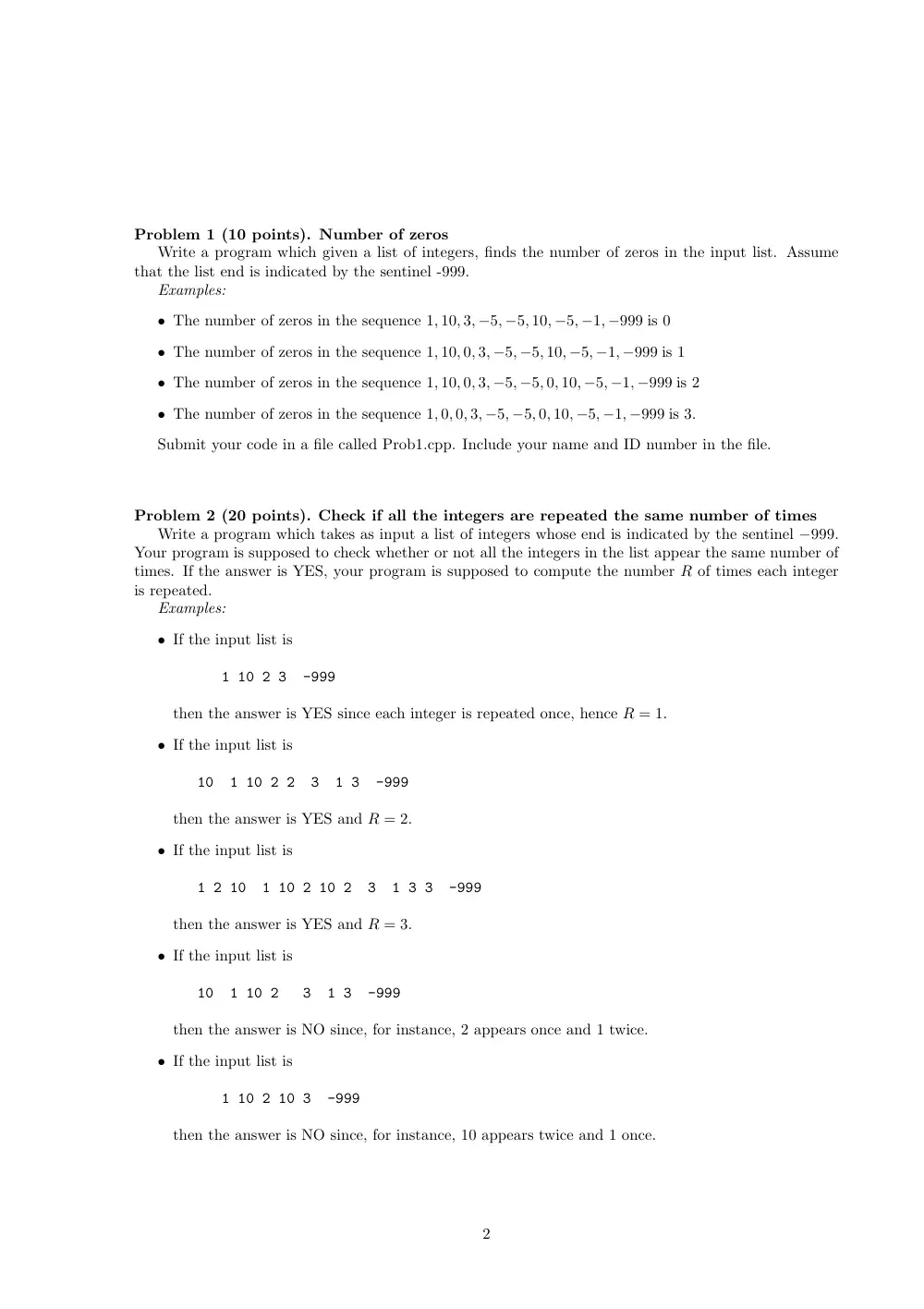
Problem 1 (10 points). Number of zeros
Write a program which given a list of integers, finds the number of zeros in the input list. Assume
that the list end is indicated by the sentinel -999.
Examples:
• The number of zeros in the sequence 1, 10, 3, −5, −5, 10, −5, −1, −999 is 0
• The number of zeros in the sequence 1, 10, 0, 3, −5, −5, 10, −5, −1, −999 is 1
• The number of zeros in the sequence 1, 10, 0, 3, −5, −5, 0, 10, −5, −1, −999 is 2
• The number of zeros in the sequence 1, 0, 0, 3, −5, −5, 0, 10, −5, −1, −999 is 3.
Submit your code in a file called Prob1.cpp. Include your name and ID number in the file.
Problem 2 (20 points). Check if all the integers are repeated the same number of times
Write a program which takes as input a list of integers whose end is indicated by the sentinel −999.
Your program is supposed to check whether or not all the integers in the list appear the same number of
times. If the answer is YES, your program is supposed to compute the number R of times each integer
is repeated.
Examples:
• If the input list is
1 10 2 3
-999
then the answer is YES since each integer is repeated once, hence R = 1.
• If the input list is
10
1 10 2 2
3
1 3
-999
then the answer is YES and R = 2.
• If the input list is
1 2 10
1 10 2 10 2
3
1 3 3
-999
then the answer is YES and R = 3.
• If the input list is
10
1 10 2
3
1 3
-999
then the answer is NO since, for instance, 2 appears once and 1 twice.
• If the input list is
1 10 2 10 3
-999
then the answer is NO since, for instance, 10 appears twice and 1 once.
2
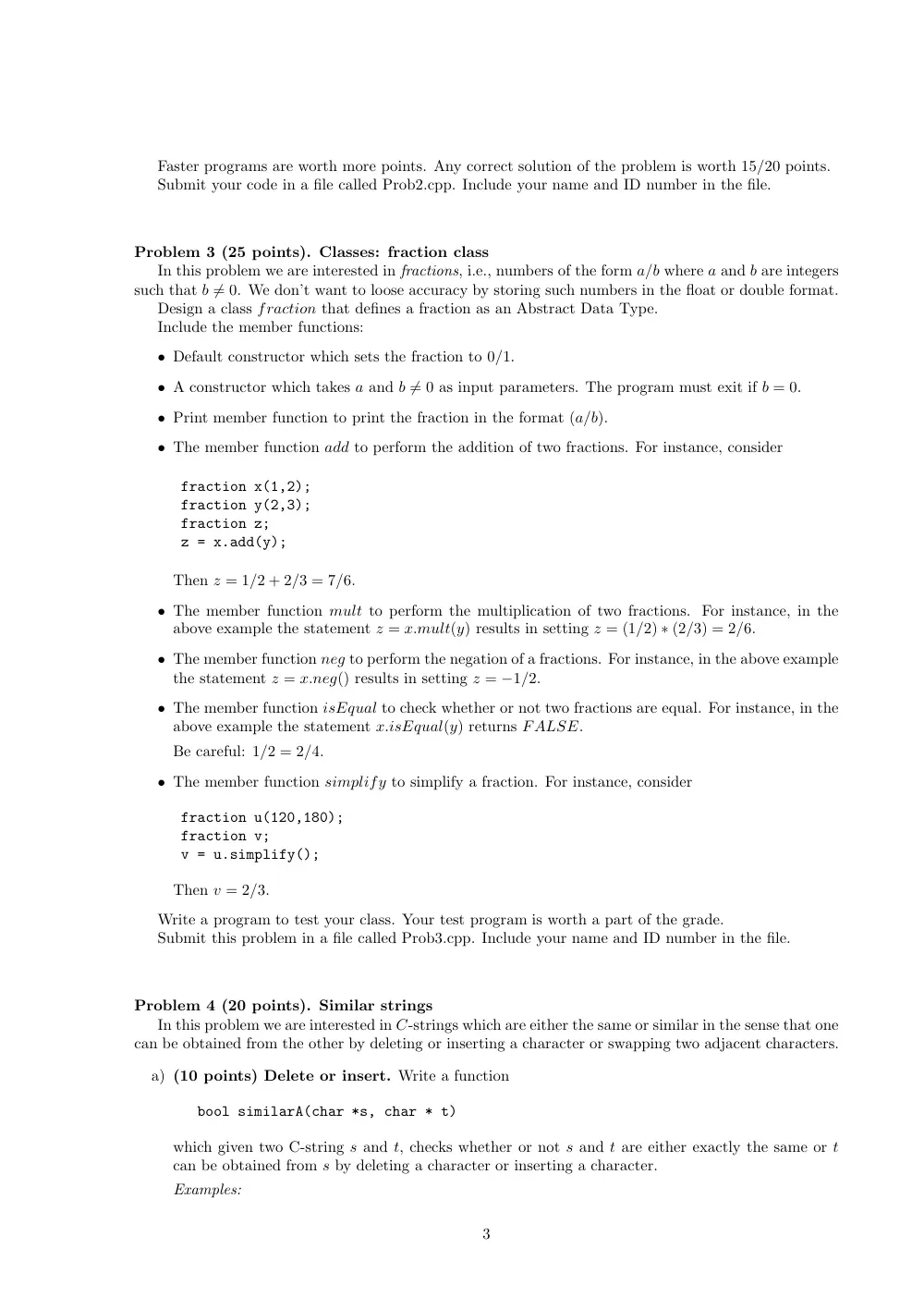
Faster programs are worth more points. Any correct solution of the problem is worth 15/20 points.
Submit your code in a file called Prob2.cpp. Include your name and ID number in the file.
Problem 3 (25 points). Classes: fraction class
In this problem we are interested in fractions, i.e., numbers of the form a/b where a and b are integers
such that b ̸= 0. We don’t want to loose accuracy by storing such numbers in the float or double format.
Design a class fraction that defines a fraction as an Abstract Data Type.
Include the member functions:
• Default constructor which sets the fraction to 0/1.
• A constructor which takes a and b ̸= 0 as input parameters. The program must exit if b = 0.
• Print member function to print the fraction in the format (a/b).
• The member function add to perform the addition of two fractions. For instance, consider
fraction x(1,2);
fraction y(2,3);
fraction z;
z = x.add(y);
Then z = 1/2 + 2/3 = 7/6.
• The member function mult to perform the multiplication of two fractions. For instance, in the
above example the statement z = x.mult(y) results in setting z = (1/2) ∗ (2/3) = 2/6.
• The member function neg to perform the negation of a fractions. For instance, in the above example
the statement z = x.neg() results in setting z = −1/2.
• The member function isEqual to check whether or not two fractions are equal. For instance, in the
above example the statement x.isEqual(y) returns FALSE.
Be careful: 1/2 = 2/4.
• The member function simplify to simplify a fraction. For instance, consider
fraction u(120,180);
fraction v;
v = u.simplify();
Then v = 2/3.
Write a program to test your class. Your test program is worth a part of the grade.
Submit this problem in a file called Prob3.cpp. Include your name and ID number in the file.
Problem 4 (20 points). Similar strings
In this problem we are interested in C-strings which are either the same or similar in the sense that one
can be obtained from the other by deleting or inserting a character or swapping two adjacent characters.
a) (10 points) Delete or insert. Write a function
bool similarA(char *s, char * t)
which given two C-string s and t, checks whether or not s and t are either exactly the same or t
can be obtained from s by deleting a character or inserting a character.
Examples:
3
– If s = ”problem” and t = ”problem”, the answer is YES (they are the same).
– If s = ”problem” and t = ”proble”, the answer is YES (delete m)
– If s = ”problem” and t = ”prolem”, the answer is YES (delete b).
– If s = ”problem” and t = ”probslem”, the answer is YES (insert s).
– If s = ”problem” and t = ”probleme”, the answer is YES (insert e).
– If s = ”problem” and t = ”proleme”, the answer is NO (we can either delete or insert but not
both).
– If s = ”problem” and t = ”poblm”, the answer is NO (we can delete at most one character)
– If s = ”problem” and t = ”abcm”, the answer is NO
b) (10 points) Swap. Write a function
bool similarB(char *s, char * t)
which given two C-string s and t, checks whether or not s and t are either exactly the same or t
can be obtained from s by swapping two adjacent characters.
Examples:
– If s = ”problem” and t = ”problem”, the answer is YES (they are the same).
– If s = ”problem” and t = ”porblem”, the answer is YES (swap r and o).
– If s = ”problem” and t = ”rpoblem”, the answer is YES (swap p and r).
– If s = ”problem” and t = ”problme”, the answer is YES (swap e and m).
– If s = ”problem” and t = ”rpoblme”, the answer is NO (only one swap is allowed)
– If s = ”problem” and t = ”proble”, the answer is NO
– If s = ”problem” and t = ”abcm”, the answer is NO
Write a program to test your functions. Use the above examples.
Submit this problem in a file called Prob4.cpp. Include your name and ID number in the file.
Problem 5 (25 points). Basketball score
In a basketball game, a goal is worth 1 point, 2 points, or 3 points. Given the score n of a team at
the end of a game, we are interested in the possible ways the score n can be achieved.
a) (15 points) Count. Write a function
int count(int n)
which given n, returns the number of possible ways the score n can be achieved.
Examples:
i) count(3) = 4 since the possible scores are:
1 1 1
1 2
2 1
3
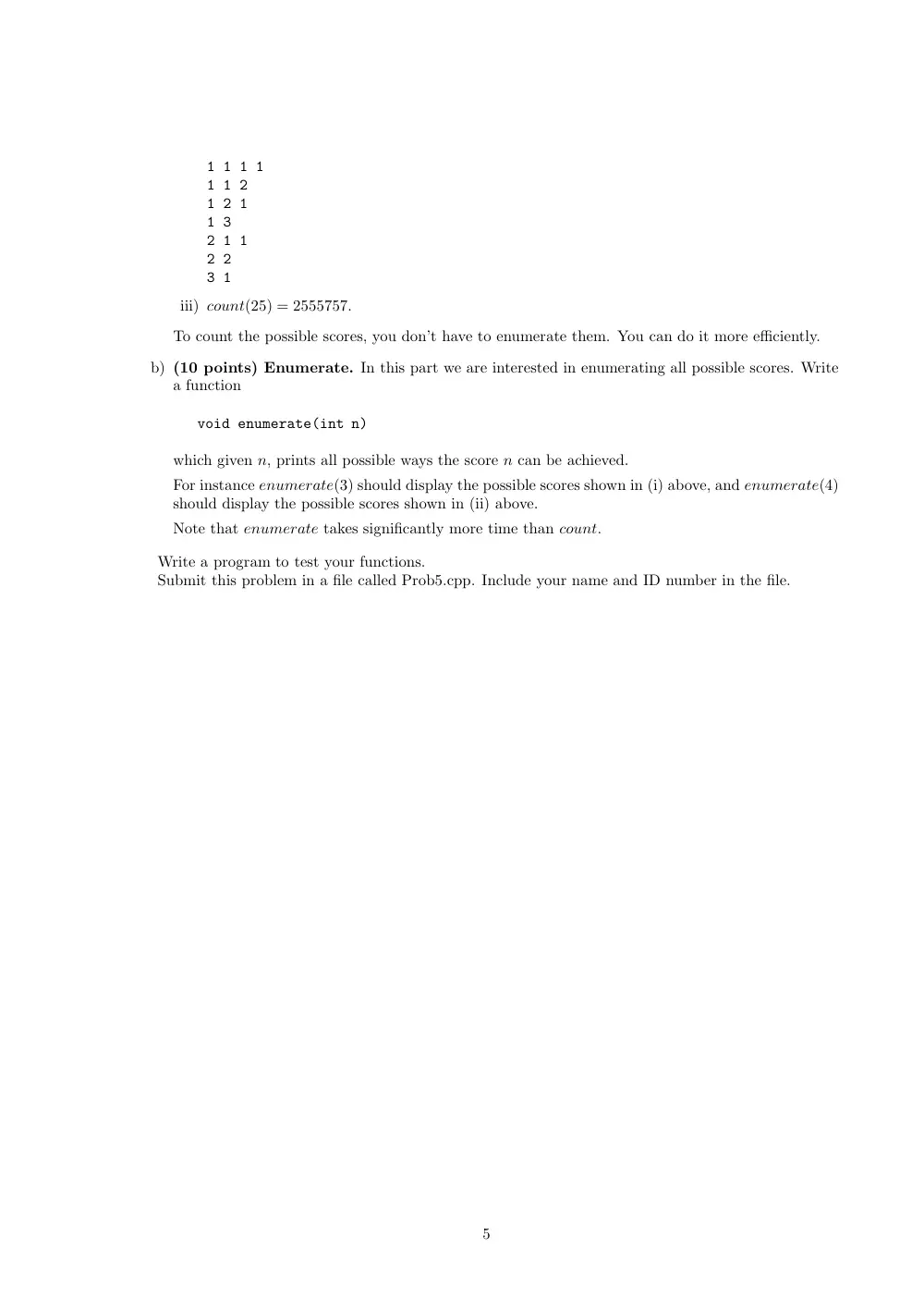
ii) count(4) = 7 since the possible scores are:
4
1 1 1 1
1 1 2
1 2 1
1 3
2 1 1
2 2
3 1
iii) count(25) = 2555757.
To count the possible scores, you don’t have to enumerate them. You can do it more efficiently.
b) (10 points) Enumerate. In this part we are interested in enumerating all possible scores. Write
a function
void enumerate(int n)
which given n, prints all possible ways the score n can be achieved.
For instance enumerate(3) should display the possible scores shown in (i) above, and enumerate(4)
should display the possible scores shown in (ii) above.
Note that enumerate takes significantly more time than count.
Write a program to test your functions.
Submit this problem in a file called Prob5.cpp. Include your name and ID number in the file.
5