
EECE 230 Final, Spring 2008
American University of Beirut · Introduction to Programming · 31 pages





Showing the first 10 of 31 pages. Download the PDF to see all of it.
More EECE 230 files
- Final Exam · Spring 2020Final examView
- Final Questions · Spring 2019Final examView
- Final Questions · Fall 2018Final examView
- Final Solutions · Fall 2018Final exam · with solutionView
- Final Collection Finals with Solution · Spring 2017Final exam · with solutionView
- Final · Fall 2013Final examView
- Final Problem 2 · Fall 2013Final examView
- Final · Fall 2013Final examView
Show the text of this final exam
//Paul Salameh 200700446 FINAL
// removeDuplicates function added
#ifndef H_LinkedListType
#define H_LinkedListType
#include <iostream>
#include <cassert>
using namespace std;
//Definition of the node
template <class Type>
struct nodeType
{
Type info;
nodeType<Type> *link;
};
template<class Type>
class linkedListType
{
public:
void deleteLargerThan(Type item);
const linkedListType<Type>& operator=
(const linkedListType<Type>&);
//Overload the assignment operator.
void initializeList();
//Initialize the list to an empty state.
//Postcondition: first = NULL, last = NULL, count = 0;
bool isEmptyList() const;
//Function to determine whether the list is empty.
//Postcondition: Returns true if the list is empty,
// otherwise it returns false.
void print() const;
//Function to output the data contained in each node.
//Postcondition: none
int length() const;
//Function to return the number of nodes in the list.
//Postcondition: The value of count is returned.
void destroyList();
//Function to delete all the nodes from the list.
//Postcondition: first = NULL, last = NULL, count = 0;
Type front() const;
//Function to return the first element of the list.
//Precondition: The list must exist and must not be
// empty.
//Postcondition: If the list is empty, the program
// terminates; otherwise, the first
// element of the list is returned.
Type back()const;
//Function to return the last element of the list.
//Precondition: The list must exist and must not be
// empty.
//Postcondition: If the list is empty, the program
// terminates; otherwise, the last
// element of the list is returned.
bool search(const Type& searchItem) const;
//Function to determine whether searchItem is in the list.
//Postcondition: Returns true if searchItem is in the
// list, otherwise the value false is
// returned.
void insertFirst(const Type& newItem);
//Function to insert newItem at the beginning of the list.
//Postcondition: first points to the new list, newItem is
// inserted at the beginning of the list,
// last points to the last node in the list,
// and count is incremented by 1.
void insertLast(const Type& newItem);
//Function to insert newItem at the end of the list.
//Postcondition: first points to the new list, newItem
// is inserted at the end of the list,
// last points to the last node in the list,
// and count is incremented by 1.
void deleteNode(const Type& deleteItem);
//Function to delete deleteItem from the list.
//Postcondition: If found, the node containing
// deleteItem is deleted from the list.
// first points to the first node, last
// points to the last node of the updated
// list, and count is decremented by 1.
linkedListType();
//default constructor
//Initializes the list to an empty state.
//Postcondition: first = NULL, last = NULL, count = 0;
linkedListType(const linkedListType<Type>& otherList);
//copy constructor
~linkedListType();
//destructor
//Deletes all the nodes from the list.
//Postcondition: The list object is destroyed.
protected:
int count; //variable to store the number of
//elements in the list
nodeType<Type> *first; //pointer to the first node of the list
nodeType<Type> *last; //pointer to the last node of the list
private:
void copyList(const linkedListType<Type>& otherList);
//Function to make a copy of otherList.
//Postcondition: A copy of otherList is created and
// assigned to this list.
public:
void removeDuplicates();
};
template<class Type>
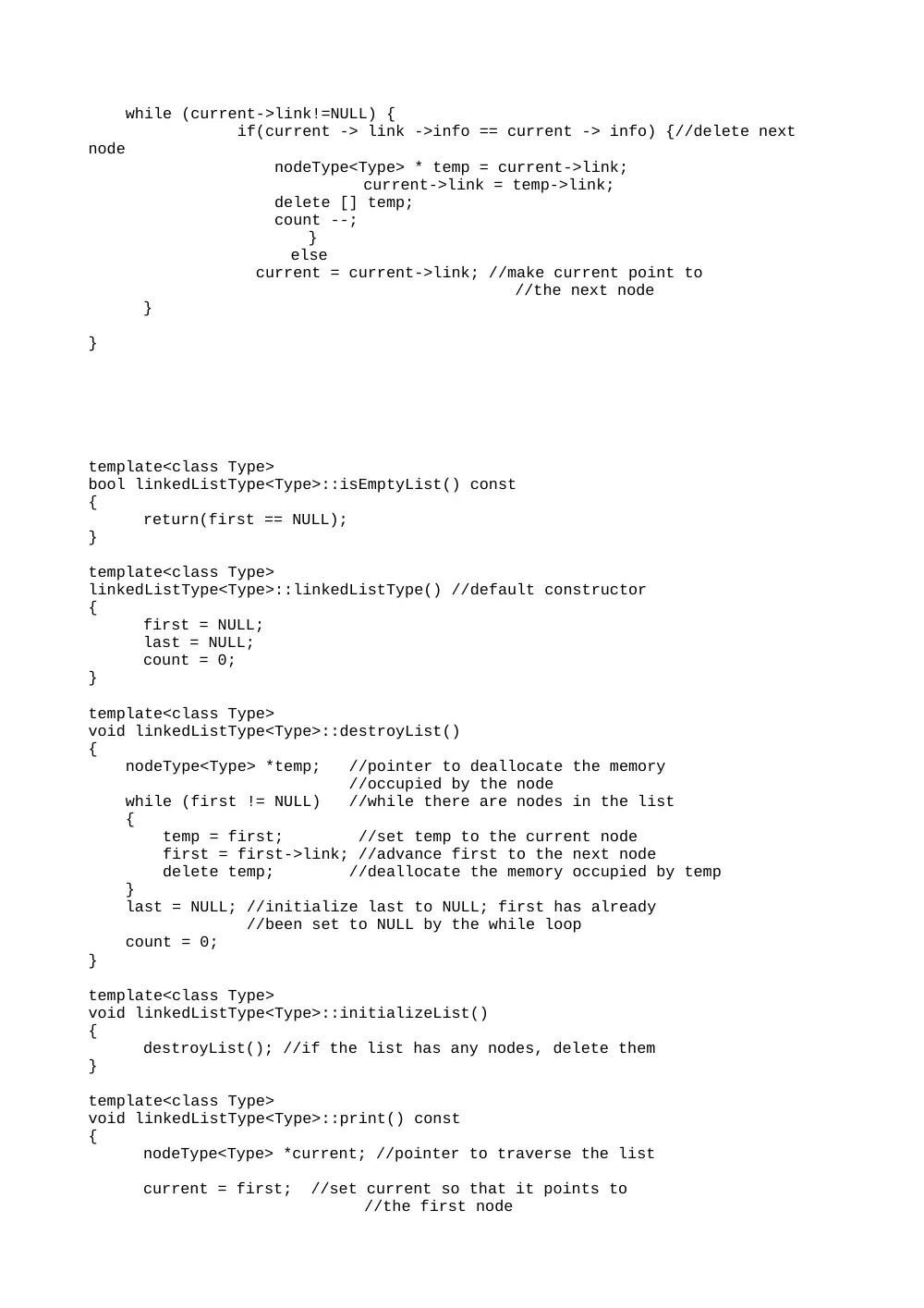
void linkedListType<Type>::removeDuplicates()
{// assumes list is sorted in nondecreasing order
nodeType<Type> *current; //pointer to traverse the list
current = first; //set current to point to the first node in the list
if(current == NULL) return;
while (current->link!=NULL) {
if(current -> link ->info == current -> info) {//delete next
node
nodeType<Type> * temp = current->link;
current->link = temp->link;
delete [] temp;
count --;
}
else
current = current->link; //make current point to
//the next node
}
}
template<class Type>
bool linkedListType<Type>::isEmptyList() const
{
return(first == NULL);
}
template<class Type>
linkedListType<Type>::linkedListType() //default constructor
{
first = NULL;
last = NULL;
count = 0;
}
template<class Type>
void linkedListType<Type>::destroyList()
{
nodeType<Type> *temp; //pointer to deallocate the memory
//occupied by the node
while (first != NULL) //while there are nodes in the list
{
temp = first; //set temp to the current node
first = first->link; //advance first to the next node
delete temp; //deallocate the memory occupied by temp
}
last = NULL; //initialize last to NULL; first has already
//been set to NULL by the while loop
count = 0;
}
template<class Type>
void linkedListType<Type>::initializeList()
{
destroyList(); //if the list has any nodes, delete them
}
template<class Type>
void linkedListType<Type>::print() const
{
nodeType<Type> *current; //pointer to traverse the list
current = first; //set current so that it points to
//the first node
while (current != NULL) //while more data to print
{
cout << current->info << " ";
current = current->link;
}
cout<<endl;
}//end print
template<class Type>
int linkedListType<Type>::length() const
{
return count;
} //end length
template<class Type>
Type linkedListType<Type>::front() const
{
assert(last != NULL);
return first->info; //return the info of the first node
}//end front
template<class Type>
Type linkedListType<Type>::back() const
{
assert(last != NULL);
return last->info; //return the info of the first node
}//end back
template<class Type>
bool linkedListType<Type>::search(const Type& searchItem) const
{
nodeType<Type> *current; //pointer to traverse the list
bool found = false;
current = first; //set current to point to the first
//node in the list
while (current != NULL && !found) //search the list
if (current->info == searchItem) //searchItem is found
found = true;
else
current = current->link; //make current point to
//the next node
return found;
}//end search
template<class Type>
void linkedListType<Type>::insertFirst(const Type& newItem)
{
nodeType<Type> *newNode; //pointer to create the new node
newNode = new nodeType<Type>; //create the new node
assert(newNode != NULL); //if unable to allocate memory,
//terminate the program
newNode->info = newItem;
//store the new item in the node
newNode->link = first; //insert newNode before first
first = newNode; //make first point to the
//actual first node
count++;
//increment count
if (last == NULL) //if the list was empty, newNode is also
//the last node in the list
last = newNode;
}//end insertFirst
template<class Type>
void linkedListType<Type>::insertLast(const Type& newItem)
{
nodeType<Type> *newNode; //pointer to create the new node
newNode = new nodeType<Type>; //create the new node
assert(newNode != NULL);
//if unable to allocate memory,
//terminate the program
newNode->info = newItem; //store the new item in the node
newNode->link = NULL; //set the link field of newNode
//to NULL
if (first == NULL) //if the list is empty, newNode is
//both the first and last node
{
first = newNode;
last = newNode;
count++;
//increment count
}
else //the list is not empty, insert newNode after last
{
last->link = newNode; //insert newNode after last
last = newNode; //make last point to the actual last node
count++;
//increment count
}
}//end insertLast
template<class Type>
void linkedListType<Type>::deleteNode(const Type& deleteItem)
{
nodeType<Type> *current; //pointer to traverse the list
nodeType<Type> *trailCurrent; //pointer just before current
bool found;
if (first == NULL) //Case 1; the list is empty.
cout << "Cannot delete from an empty list."
<< endl;
else
{
if (first->info == deleteItem) //Case 2
{
current = first;
first = first->link;
count--;
if (first == NULL) //the list has only one node
last = NULL;
delete current;
}
else //search the list for the node with the given info
{
found = false;
trailCurrent = first; //set trailCurrent to point
//to the first node
current = first->link; //set current to point to
//the second node
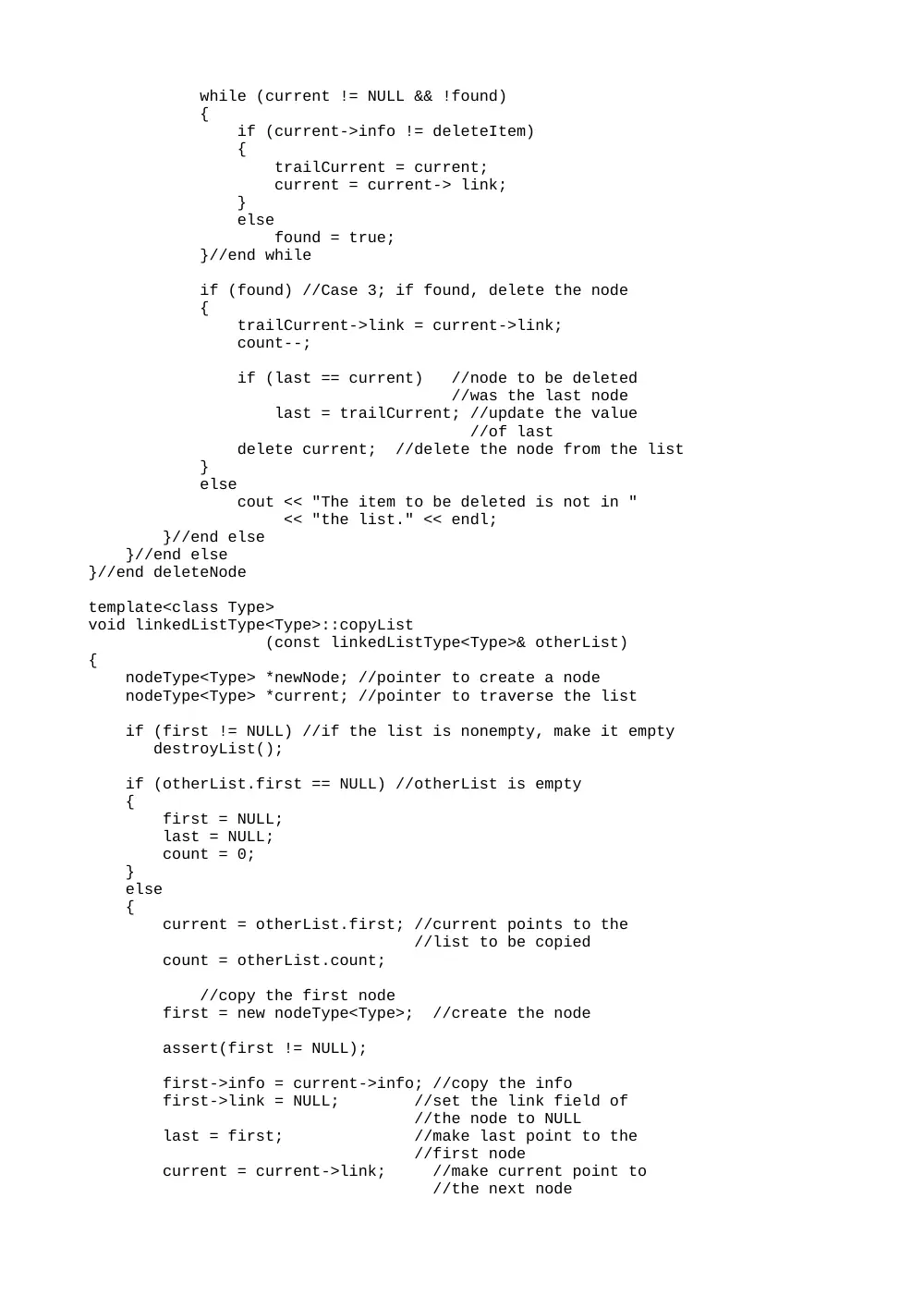
while (current != NULL && !found)
{
if (current->info != deleteItem)
{
trailCurrent = current;
current = current-> link;
}
else
found = true;
}//end while
if (found) //Case 3; if found, delete the node
{
trailCurrent->link = current->link;
count--;
if (last == current) //node to be deleted
//was the last node
last = trailCurrent; //update the value
//of last
delete current; //delete the node from the list
}
else
cout << "The item to be deleted is not in "
<< "the list." << endl;
}//end else
}//end else
}//end deleteNode
template<class Type>
void linkedListType<Type>::copyList
(const linkedListType<Type>& otherList)
{
nodeType<Type> *newNode; //pointer to create a node
nodeType<Type> *current; //pointer to traverse the list
if (first != NULL) //if the list is nonempty, make it empty
destroyList();
if (otherList.first == NULL) //otherList is empty
{
first = NULL;
last = NULL;
count = 0;
}
else
{
current = otherList.first; //current points to the
//list to be copied
count = otherList.count;
//copy the first node
first = new nodeType<Type>; //create the node
assert(first != NULL);
first->info = current->info; //copy the info
first->link = NULL; //set the link field of
//the node to NULL
last = first; //make last point to the
//first node
current = current->link; //make current point to
//the next node
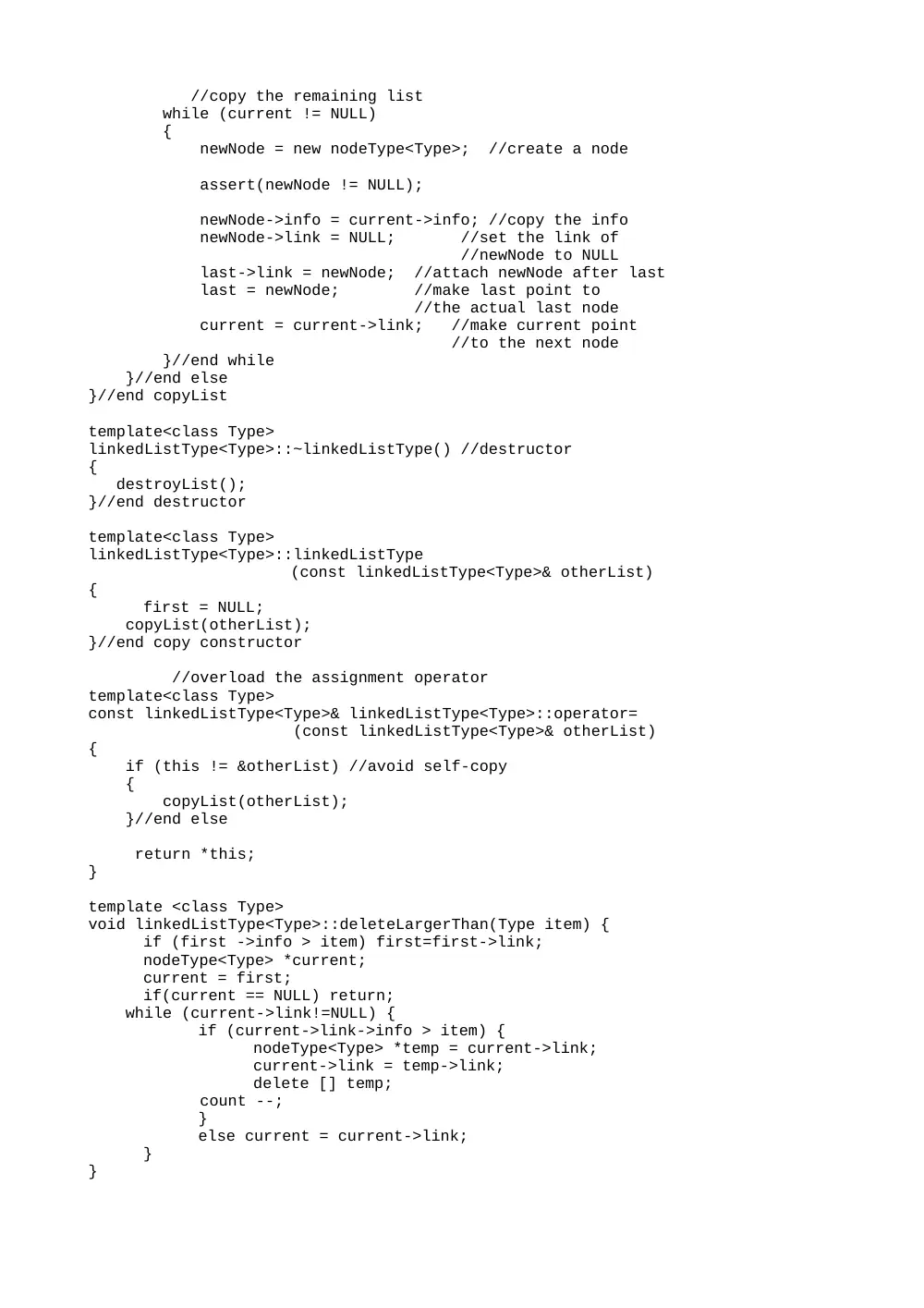
//copy the remaining list
while (current != NULL)
{
newNode = new nodeType<Type>; //create a node
assert(newNode != NULL);
newNode->info = current->info; //copy the info
newNode->link = NULL; //set the link of
//newNode to NULL
last->link = newNode; //attach newNode after last
last = newNode; //make last point to
//the actual last node
current = current->link; //make current point
//to the next node
}//end while
}//end else
}//end copyList
template<class Type>
linkedListType<Type>::~linkedListType() //destructor
{
destroyList();
}//end destructor
template<class Type>
linkedListType<Type>::linkedListType
(const linkedListType<Type>& otherList)
{
first = NULL;
copyList(otherList);
}//end copy constructor
//overload the assignment operator
template<class Type>
const linkedListType<Type>& linkedListType<Type>::operator=
(const linkedListType<Type>& otherList)
{
if (this != &otherList) //avoid self-copy
{
copyList(otherList);
}//end else
return *this;
}
template <class Type>
void linkedListType<Type>::deleteLargerThan(Type item) {
if (first ->info > item) first=first->link;
nodeType<Type> *current;
current = first;
if(current == NULL) return;
while (current->link!=NULL) {
if (current->link->info > item) {
nodeType<Type> *temp = current->link;
current->link = temp->link;
delete [] temp;
count --;
}
else current = current->link;
}
}
#endif
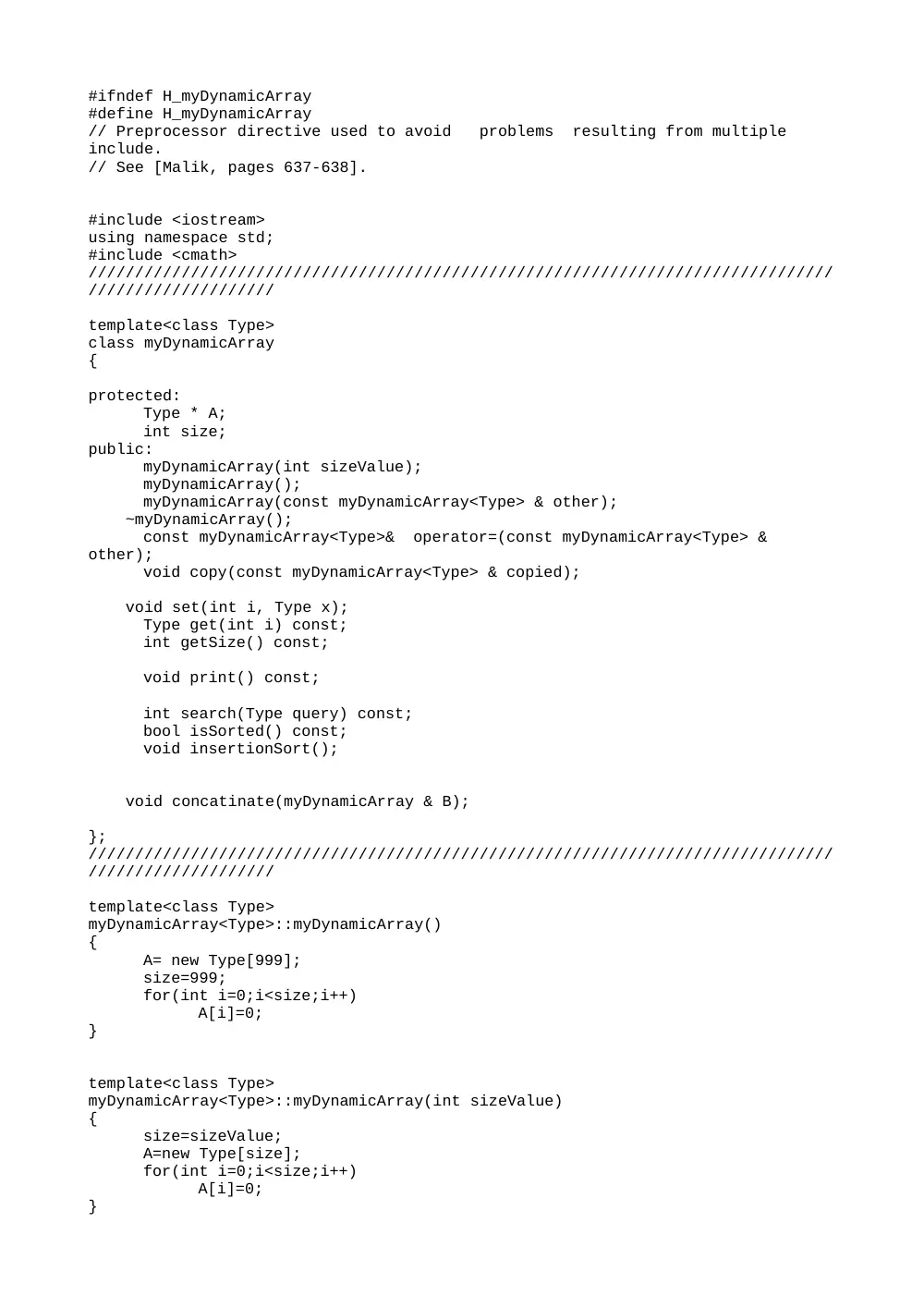
#ifndef H_myDynamicArray
#define H_myDynamicArray
// Preprocessor directive used to avoid problems resulting from multiple
include.
// See [Malik, pages 637-638].
#include <iostream>
using namespace std;
#include <cmath>
////////////////////////////////////////////////////////////////////////////////
////////////////////
template<class Type>
class myDynamicArray
{
protected:
Type * A;
int size;
public:
myDynamicArray(int sizeValue);
myDynamicArray();
myDynamicArray(const myDynamicArray<Type> & other);
~myDynamicArray();
const myDynamicArray<Type>& operator=(const myDynamicArray<Type> &
other);
void copy(const myDynamicArray<Type> & copied);
void set(int i, Type x);
Type get(int i) const;
int getSize() const;
void print() const;
int search(Type query) const;
bool isSorted() const;
void insertionSort();
void concatinate(myDynamicArray & B);
};
////////////////////////////////////////////////////////////////////////////////
////////////////////
template<class Type>
myDynamicArray<Type>::myDynamicArray()
{
A= new Type[999];
size=999;
for(int i=0;i<size;i++)
A[i]=0;
}
template<class Type>
myDynamicArray<Type>::myDynamicArray(int sizeValue)
{
size=sizeValue;
A=new Type[size];
for(int i=0;i<size;i++)
A[i]=0;
}
template<class Type>
myDynamicArray<Type>::~myDynamicArray()
{
delete [] A;
size = 0;
}
template<class Type>
myDynamicArray<Type>::myDynamicArray(const myDynamicArray<Type> & other)
{
copy(other);
}
template<class Type>
const myDynamicArray<Type>& myDynamicArray<Type>::operator=(const
myDynamicArray<Type> & other)
{
if(this != & other)
copy(other);
return *this;
}
template<class Type>
void myDynamicArray<Type>::set(int i, Type x)
{
A[i] = x;
}
template<class Type>
Type myDynamicArray<Type>::get(int i) const
{
return A[i];
}
template<class Type>
int myDynamicArray<Type>::getSize() const
{
return size;
}
template<class Type>
int myDynamicArray<Type>::search(Type query) const
{
for(int i=0; i<size; i++)
if(A[i]==query) return i;
return -1;
}
template<class Type>
void myDynamicArray<Type>::print() const
{
for(int i=0;i<size;i++)
cout<<A[i]<<" ";
cout<<endl;
}
template<class Type>
bool myDynamicArray<Type>::isSorted() const
{
bool sorted=true;
for(int i=1;i<size;i++)
if(A[i-1]>A[i]) sorted=false;
return sorted;
}
template<class Type>
void myDynamicArray<Type>::insertionSort()
{
Type temp;
for(int j=1;j<size;j++) {
temp=A[j];
for(int i=j-1; (A[i]>temp) && (i>-1);i--)
A[i+1]=A[i];
A[i+1]=temp;
}
}
template<class Type>
void myDynamicArray<Type>::copy(const myDynamicArray & copied)
{
delete [] A;
A = new Type[copied.size];
size=copied.size;
for(int i=0; i<size; i++)
A[i]=copied.A[i];
}
template<class Type>
void myDynamicArray<Type>::concatinate(myDynamicArray & B)
{
Type * final;
final = new Type[size+B.size];
for(int i=0;i<size;i++)
final[i]=A[i];
for(i=size; i<(size+B.size); i++)
final[i]=B.A[i-size];
delete [] A;
A = final;
size=size + B.size;
}
////////////////////////////////////////////////////////////////////////////////
/////////////////////
#endif
//Paul Salameh 200700446 FINAL
#include <iostream>
using namespace std;
bool subArraySum(int *A,int n, int t, int & start, int & end);
bool subArraySum(int *A,int n, int t, int & start, int & end) {
for (int i=0;i<n;i++) {
int sum =0;
for (int j=i;j<n;j++) {
sum = sum + A[j];
if (sum == t) {
start = i;
end = j;
return true;
}
}
}
return false;
}
void main() {
int A[]={1,7,5,3,2,12,-25}, t = 22, start,end;
if (subArraySum(A,7,t,start,end)) cout<<"YES, it contains subarray and
start = "<<start<<" and end = "<<end<<endl;
else if (!subArraySum(A,7,t,start,end)) cout<<"NO, it doesn't contain
subarray\n";
}
//Paul Salameh 200700446 FINAL
#include <iostream>
using namespace std;
int signChangeLocator(int * A,int start,int end);
int signChangeLocator(int * A,int start,int end) {
if(start <=end) {
int mid = (start+end)/2;
if (A[mid] > 0 && mid+1 <= end && A[mid+1] > 0) {
if (A[mid+1] > 0) return signChangeLocator(A,mid+1,end);
}
else if (A[mid] < 0)
return signChangeLocator(A,start,mid-1);
else if (A[mid] > 0) {
if (mid+1 > end || A[mid+1] < 0) return mid;
}
}
else return -1;
}
void main() {
int A[] = {3,18,5,2,10,7,-4,-10,-1};
int B[] = {7,-4,-10,-1};
int C[] = {3,18,5,2,10,7,-4};
int D[] = {3,18,5,2,10,7};
int E[] = {-4,-10,-1};
int index = signChangeLocator(A,0,8);
cout<<index<<endl;
index = signChangeLocator(B,0,3);
cout<<index<<endl;
index = signChangeLocator(C,0,6);
cout<<index<<endl;
index = signChangeLocator(D,0,5);
cout<<index<<endl;
index = signChangeLocator(E,0,2);
cout<<index<<endl;
}
//Paul Salameh 200700446 FINAL
#include <iostream>
#include "myDynamicArray.h"
#include <cassert>
using namespace std;
class permutation: public
myDynamicArray<int>
{
public:
permutation(int dimensionValue) : myDynamicArray<int>(dimensionValue) {
for (int i=0;i<dimensionValue ; i++) A[i]=i+1;
};
permutation(const permutation & other) {copy(other);}
int length() const {return size;}
permutation operator*(const permutation & q) const {
assert(length()==q.length());
permutation product(length());
for(int i=0;i<length();i++) product.A[i]= A[q.A[i]-1];
return product;//Here I'm having error with return although I'm
using the copy
};
//constructor the same way it was used in the
previous final exam!!
permutation operator!() const {
permutation temp(length());
for(int i=0;i<length();i++) temp.A[i]= A[A[i]-1];
return temp;//Here I'm having error with return although I'm using
the copy
};
//constructor the same way it was used in the
previous final exam:
/*realVector operator-() const {
realVector r(dimension());
for(int i=0;i<dimension();i++)
r.A[i] = - A[i];
return r;
};
*/
void set(int i, int j) {
A[i]=j;
};
void print() const {
cout<<"(";
for(int i=0;i<length();i++) {
cout<<A[i];
if(i!=length()-1) cout<<" ";
}
cout<<")"<<endl;
};
};
void main() {
permutation p(5);
p.print();
p.set(0,2);
p.set(1,3);
p.set(2,1);
p.set(3,5);
p.set(4,4);
p.print();
permutation q(5);
q.set(0,5);
q.set(1,3);
q.set(2,2);
q.set(3,1);
q.set(4,4);
q.print();
permutation r(5);
r = p*q;
r.print();
permutation t(5);
t= !p;
t.print();
cout<<t.length()<<endl;
}
//Paul Salameh 200700446 FINAL
#include <iostream>
#include "linkedList.h"
using namespace std;
void main () {
linkedListType<int> L;
L.insertLast(1);
L.insertLast(7);
L.insertLast(12);
L.insertLast(3);
L.insertLast(4);
L.insertLast(20);
L.insertLast(7);
L.insertLast(8);
L.insertLast(15);
L.insertLast(11);
L.insertLast(2);
cout<<"L: ";L.print();
L.deleteLargerThan(10);
cout<<"L: ";L.print();
linkedListType<int> S;
S.insertLast(11);
S.insertLast(7);
S.insertLast(12);
S.insertLast(3);
S.insertLast(14);
cout<<"S: ";S.print();
S.deleteLargerThan(10);
cout<<"S: ";S.print();
linkedListType<int> T;
T.insertLast(11);
cout<<"T: ";T.print();
T.deleteLargerThan(10);
cout<<"T: ";T.print();
}
#ifndef H_LinkedListType // Preprocessor directive used to avoid
#define H_LinkedListType // problems resulting from multiple include.
#include <iostream>
#include <cassert> // See assert function below
using namespace std;
//Definition of the node
template <class Type>
struct nodeType
{
Type info;
nodeType<Type> *link;
};
template<class Type>
class linkedListType
{
public:
const linkedListType<Type>& operator=
(const linkedListType<Type>&);
//Overload the assignment operator.
void initializeList();
//Initialize the list to an empty state.
//Postcondition: first = NULL, last = NULL, count = 0;
bool isEmptyList() const;
//Function to determine whether the list is empty.
//Postcondition: Returns true if the list is empty,
// otherwise it returns false.
void print() const;
//Function to output the data contained in each node.
//Postcondition: none
int length() const;
//Function to return the number of nodes in the list.
//Postcondition: The value of count is returned.
void destroyList();
//Function to delete all the nodes from the list.
//Postcondition: first = NULL, last = NULL, count = 0;
Type front() const;
//Function to return the first element of the list.
//Precondition: The list must exist and must not be
// empty.
//Postcondition: If the list is empty, the program
// terminates; otherwise, the first
// element of the list is returned.
Type back()const;
//Function to return the last element of the list.
//Precondition: The list must exist and must not be
// empty.
//Postcondition: If the list is empty, the program
// terminates; otherwise, the last
// element of the list is returned.
bool search(const Type& searchItem) const;
//Function to determine whether searchItem is in the list.
//Postcondition: Returns true if searchItem is in the
// list, otherwise the value false is
// returned.
void insertFirst(const Type& newItem);
//Function to insert newItem at the beginning of the list.
//Postcondition: first points to the new list, newItem is
// inserted at the beginning of the list,
// last points to the last node in the list,
// and count is incremented by 1.
void insertLast(const Type& newItem);
//Function to insert newItem at the end of the list.
//Postcondition: first points to the new list, newItem
// is inserted at the end of the list,
// last points to the last node in the list,
// and count is incremented by 1.
void deleteNode(const Type& deleteItem);
//Function to delete deleteItem from the list.
//Postcondition: If found, the node containing
// deleteItem is deleted from the list.
// first points to the first node, last
// points to the last node of the updated
// list, and count is decremented by 1.
linkedListType();
//default constructor
//Initializes the list to an empty state.
//Postcondition: first = NULL, last = NULL, count = 0;
linkedListType(const linkedListType<Type>& otherList);
//copy constructor
~linkedListType();
//destructor
//Deletes all the nodes from the list.
//Postcondition: The list object is destroyed.
//ADDED BY ASSIGNMENT
Type extractMin();
void divideMid(linkedListType<Type>& subList);
void mergeLists(linkedListType<Type> & List1, linkedListType<Type> &
List2);
int getCount();
//ADDED BY FINAL EXAM
void removeDuplicates();
protected:
int count; //variable to store the number of
//elements in the list
nodeType<Type> *first; //pointer to the first node of the list
nodeType<Type> *last; //pointer to the last node of the list
private:
void copyList(const linkedListType<Type>& otherList);
//Function to make a copy of otherList.
//Postcondition: A copy of otherList is created and
// assigned to this list.
};
template<class Type>
bool linkedListType<Type>::isEmptyList() const
{
return(first == NULL);
}
template<class Type>
linkedListType<Type>::linkedListType() //default constructor
{
first = NULL;
last = NULL;
count = 0;
}
template<class Type>
void linkedListType<Type>::destroyList()
{
nodeType<Type> *temp; //pointer to deallocate the memory
//occupied by the node
while (first != NULL) //while there are nodes in the list
{
temp = first; //set temp to the current node
first = first->link; //advance first to the next node
delete temp; //deallocate the memory occupied by temp
}
last = NULL; //initialize last to NULL; first has already
//been set to NULL by the while loop
count = 0;
}
template<class Type>
void linkedListType<Type>::initializeList()
{
destroyList(); //if the list has any nodes, delete them
}
template<class Type>
void linkedListType<Type>::print() const
{
nodeType<Type> *current; //pointer to traverse the list
current = first; //set current so that it points to
//the first node
while (current != NULL) //while more data to print
{
cout << current->info << " ";
current = current->link;
}
}//end print
template<class Type>
int linkedListType<Type>::length() const
{
return count;
} //end length
template<class Type>
Type linkedListType<Type>::front() const
{
assert(last != NULL); // terminate program if last!=NULL
// is essentially the same as: if(last==NULL) exit(0);
return first->info; //return the info of the first node
}//end front
template<class Type>
Type linkedListType<Type>::back() const
{
assert(last != NULL); // terminate program if last!=NULL (see [Malik, page
187])
// is essentially the same as: if(last==NULL) exit(0);
return last->info; //return the info of the first node
}//end back
template<class Type>
bool linkedListType<Type>::search(const Type& searchItem) const
{
nodeType<Type> *current; //pointer to traverse the list
bool found = false;
current = first; //set current to point to the first
//node in the list
while (current != NULL && !found) //search the list
if (current->info == searchItem) //searchItem is found
found = true;
else
current = current->link; //make current point to
//the next node
return found;
}//end search
template<class Type>
void linkedListType<Type>::insertFirst(const Type& newItem)
{
nodeType<Type> *newNode; //pointer to create the new node
newNode = new nodeType<Type>; //create the new node
assert(newNode != NULL); //if unable to allocate memory,
//terminate the program (see [Malik, page 187])
newNode->info = newItem;
//store the new item in the node
newNode->link = first; //insert newNode before first
first = newNode; //make first point to the
//actual first node
count++;
//increment count
if (last == NULL) //if the list was empty, newNode is also
//the last node in the list
last = newNode;
}//end insertFirst
template<class Type>
void linkedListType<Type>::insertLast(const Type& newItem)
{
nodeType<Type> *newNode; //pointer to create the new node
newNode = new nodeType<Type>; //create the new node
assert(newNode != NULL);
//if unable to allocate memory,
//terminate the program (see [Malik, page 187])
newNode->info = newItem; //store the new item in the node
newNode->link = NULL; //set the link field of newNode
//to NULL
if (first == NULL) //if the list is empty, newNode is
//both the first and last node
{
first = newNode;
last = newNode;
count++;
//increment count
}
else //the list is not empty, insert newNode after last
{
last->link = newNode; //insert newNode after last
last = newNode; //make last point to the actual last node
count++;
//increment count
}
}//end insertLast
template<class Type>
void linkedListType<Type>::deleteNode(const Type& deleteItem)
{
nodeType<Type> *current; //pointer to traverse the list
nodeType<Type> *trailCurrent; //pointer just before current
bool found;
if (first == NULL) //Case 1; the list is empty.
cout << "Cannot delete from an empty list."
<< endl;
else
{
if (first->info == deleteItem) //Case 2
{
current = first;
first = first->link;
count--;
if (first == NULL) //the list has only one node
last = NULL;
delete current;
}
else //search the list for the node with the given info
{
found = false;
trailCurrent = first; //set trailCurrent to point
//to the first node
current = first->link; //set current to point to
//the second node
while (current != NULL && !found)
{
if (current->info != deleteItem)
{
trailCurrent = current;
current = current-> link;
}
else
found = true;
}//end while
if (found) //Case 3; if found, delete the node
{
trailCurrent->link = current->link;
count--;
if (last == current) //node to be deleted
//was the last node
last = trailCurrent; //update the value
//of last
delete current; //delete the node from the list
}
else
cout << "The item to be deleted is not in "
<< "the list." << endl;
}//end else
}//end else
}//end deleteNode
template<class Type>
void linkedListType<Type>::copyList
(const linkedListType<Type>& otherList)
{
nodeType<Type> *newNode; //pointer to create a node
nodeType<Type> *current; //pointer to traverse the list
if (first != NULL) //if the list is nonempty, make it empty
destroyList();
if (otherList.first == NULL) //otherList is empty
{
first = NULL;
last = NULL;
count = 0;
}
else
{
current = otherList.first; //current points to the
//list to be copied
count = otherList.count;
//copy the first node
first = new nodeType<Type>; //create the node
assert(first != NULL);
first->info = current->info; //copy the info
first->link = NULL; //set the link field of
//the node to NULL
last = first; //make last point to the
//first node
current = current->link; //make current point to
//the next node
//copy the remaining list
while (current != NULL)
{
newNode = new nodeType<Type>; //create a node
assert(newNode != NULL);
newNode->info = current->info; //copy the info
newNode->link = NULL; //set the link of
//newNode to NULL
last->link = newNode; //attach newNode after last
last = newNode; //make last point to
//the actual last node
current = current->link; //make current point
//to the next node
}//end while
}//end else
}//end copyList
template<class Type>
linkedListType<Type>::~linkedListType() //destructor
{
destroyList();
}//end destructor
template<class Type>
linkedListType<Type>::linkedListType
(const linkedListType<Type>& otherList)
{
first = NULL;
copyList(otherList);
}//end copy constructor
//overload the assignment operator
template<class Type>
const linkedListType<Type>& linkedListType<Type>::operator=
(const linkedListType<Type>& otherList)
{
if (this != &otherList) //avoid self-copy
{
copyList(otherList);
}//end else
return *this;
}
template<class Type>
Type linkedListType<Type>::extractMin() {
if (first !=NULL){
nodeType<Type> *current = first;
Type min = current->info;
for (int i=1;i<=count;i++) {
if (current->info < min) {
min = current->info;
}
current = current->link;
}
deleteNode(min);
return (min);
}
else exit(0);
}
template<class Type>
void linkedListType<Type>::divideMid(linkedListType<Type>& subList) {
if (count > 1) {
int count1 , tempCount=count;
if (count%2==0) count1 = count/2;
else count1=count/2+1;
nodeType<Type> *current = first;
for (int i=1;i<=count1;i++) {
last = current;
current = current->link;
}
subList.destroyList();
subList.count=count-count1;
int subCount=subList.count;
for (i=1;i<=subCount;i++) {
subList.insertLast(current->info);
nodeType<Type> *temp = current;
current= current->link;
deleteNode(temp->info);
}
subList.count=tempCount-count1;
count=count1;
}
}
template<class Type>
void linkedListType<Type>::mergeLists(linkedListType<Type> & List1,
linkedListType<Type> & List2)
{
destroyList();
int i =1, j = 1 , m=List1.count, n=List2.count;
nodeType<Type> *currentL = List1.first;
nodeType<Type> *currentR = List2.first;
count=m+n;
int maxSize=count;
for(int k = 1;k<=maxSize;k++)
{
if (i<= m && j <= n) {
Type iL = currentL->info, iR = currentR->info;
if ( iL < iR ) {
insertLast(currentL->info);
if (currentL != List1.last) currentL = currentL->link;
i++;
}
else {
insertLast(currentR->info);
if (currentR != List2.last) currentR = currentR->link;
j++;
}
}
else if (i==m+1) {
insertLast(currentR->info);
if (currentR != List2.last) currentR = currentR->link;
j++;
}
else if (j==n+1) {
insertLast(currentL->info);
if (currentL != List1.last) currentL = currentL->link;
i++;
}
}
List1.destroyList();
List2.destroyList();
count=m+n;
}
template<class Type>
int linkedListType<Type>::getCount() {
return count;
}
template<class Type>
void linkedMergeSort(linkedListType<Type> & L) {
int tempCountL = L.getCount();
if(tempCountL>1) {
linkedListType<Type> L2, L3;
L.divideMid(L2);
linkedMergeSort(L);
linkedMergeSort(L2);
L3.mergeLists(L,L2);
L=L3;
}
}
template<class Type>
void linkedListType<Type>::removeDuplicates(){
int max = count;
nodeType<Type> *current = first;
Type temp = current->info;
current = current->link;
for (int i=1;i<max;i++) {
Type curInfo = current->info;
if (curInfo == temp) {
deleteNode(curInfo);
}
temp = current ->info;
current = current->link;
}
}