
EECE 290 Exam, Spring 2008
American University of Beirut · Analog Signal Processing · 27 pages



Showing the first 10 of 27 pages. Download the PDF to see all of it.
More EECE 290 files
- Exam 1 Clean Copy · Spring 2019ExamView
- Exam 2 Clean Copy · Spring 2019ExamView
- Exam 1 with Solutions · Spring 2019Exam · with solutionView
- Exam 2 with Solutions · Spring 2018Exam · with solutionView
- Exam 1 with Solutions · Spring 2018Exam · with solutionView
- Exam 1 Quiz 1 2016 · Spring 2017ExamView
- Exam 2 Quiz 2 2016 · Spring 2017ExamView
- Exam 1 · Spring 2017ExamView
Show the text of this exam
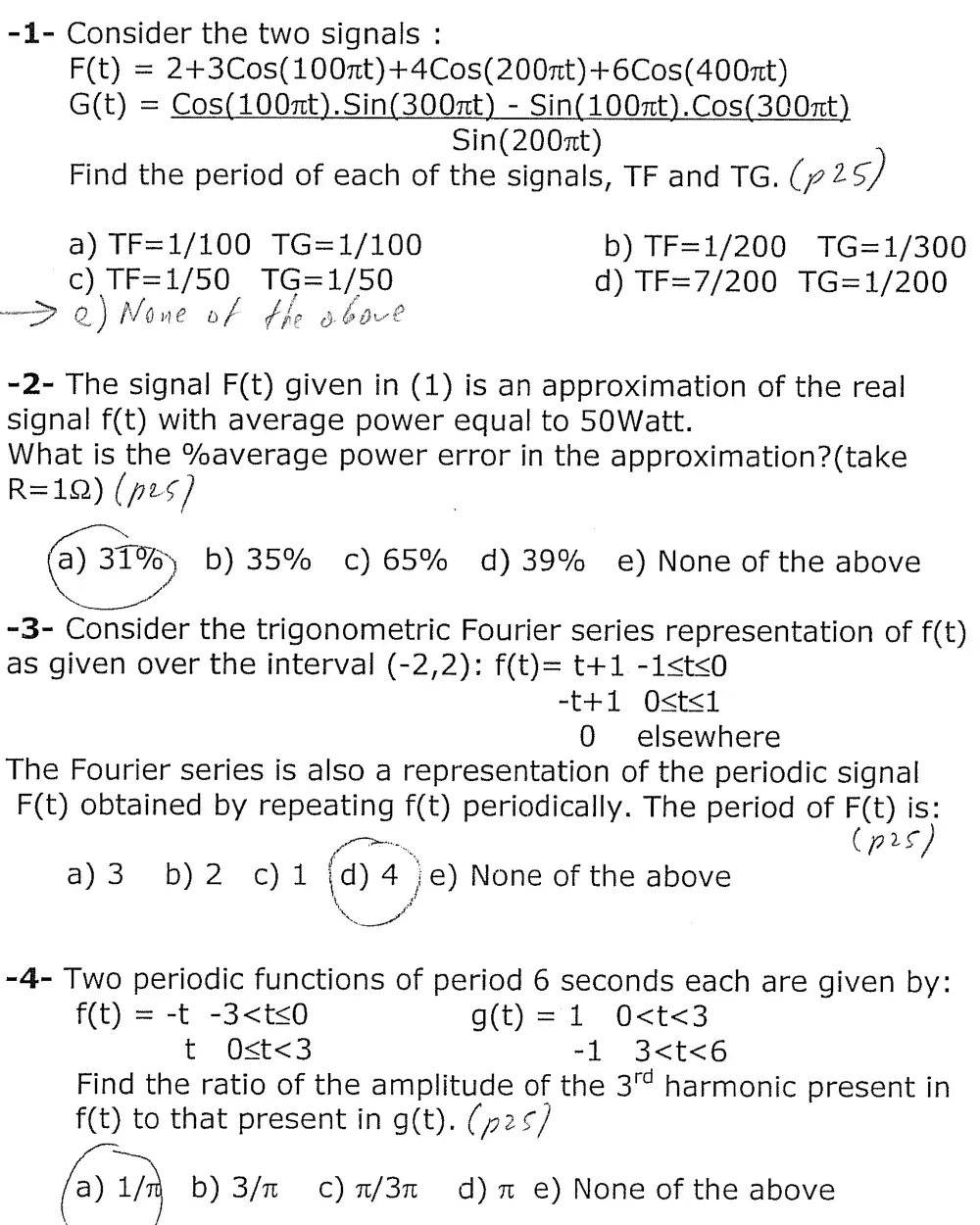
-1- Consider the two signals :
F(t) = 2+3Cos(100nt)+4Cos(200nt)+6Cos(400nt)
G(t) = Cos(100nt).Sin(300nt) - Sin(100nt).Cos(300nt)
Sin(200zt)
Find the period of each of the signals, TF and TG. (p25)
a) TF=1/100 TG=1/100 b) TF=1/200 TG=1/300
c) TF=1/50 TG=1/50 d) TF=7/200 TG=1/200
a 2) None of Pfe 9. bave
-2- The signal F(t) given in (1) is an approximation of the real
signal f(t) with average power equal to 50Watt.
What is the %average power error in the approximation?(take
R=1Q) (pes)
@ 3% b) 35% c)65% d)39% e) None of the above
a
~3- Consider the trigonometric Fourier series representation of f(t)
as given over the interval (-2,2): f(t)= t+1 -1ist<0
-t+1 Ost<i
0 elsewhere
The Fourier series is also a representation of the periodic signal
F(t) obtained by repeating f(t) periodically. The period of F(t) is:
oo, (p25)
a)3 b)2 c)i id)4 ;€) None of the above
KY
-4- Two periodic functions of period 6 seconds each are given by:
f(t) = -t -3<t<0 g(t)=1 O<t<3
t Ost<3 -1 3<t<6
Find the ratio of the amplitude of the 3 harmonic present in
f(t) to that present in g(t). (n25/
(a) 17 b) 3/n c)2/3x d)zx e) None of the above
enna 1 Se
piolt ECR
ieo lov folev
-5- Calculate the rms value of the (vy) ()
current flowing in the circuit shown. (p24)
a) 8.58 b) 54.85 - (c))42.58A
d) 25A___e)None of the above
-6- For the wave shown, calculate Ao,
As and Bs. (726)
a) Ao=1.5 , As=1.5 (oJAs=1.15
c) Bs=1.5 d) As=1.5, Bs=1.15
e) None of the above
w= o, ol ee
-7- Find the average power in a resistance R=2Q , if the voltage is
v= 32Sin(3t)Cos2(t/2) (p26 )
a) 256W b)5i2W c)i92W Ox: We) None of the above
-8- In a circuit : v(t) = 5Sin(t) +10Sin(3t),
I(t) = 7Sin(2t) + 50 Sin(8t)
What is the average power ? (pre )
a) 267.5 W (o)o W c)250W d)35W _ e) None of the above
-9- Two periodic voltages V1(t) and V2(t) of the same period
(T=2s)are applied to the circuit. Find the current in this circuit due
to the first harmonic. (726)
LANE) WA De
a iOmH
v(t) (*) |
4 . C= 2p
NAG) (t)
0) Cos(at) 6b) 12 Sin(at) c) 12Cos(nt)+12Sin(xt)
d) 0> e) None of the above
-10- The function e* (0<x<1) is to be represented by a cosine
series, find a2. ( 726/
a)-0.684 b)-0.0827 | c)0.0848) d)0.0424 e) None of the above
GOV
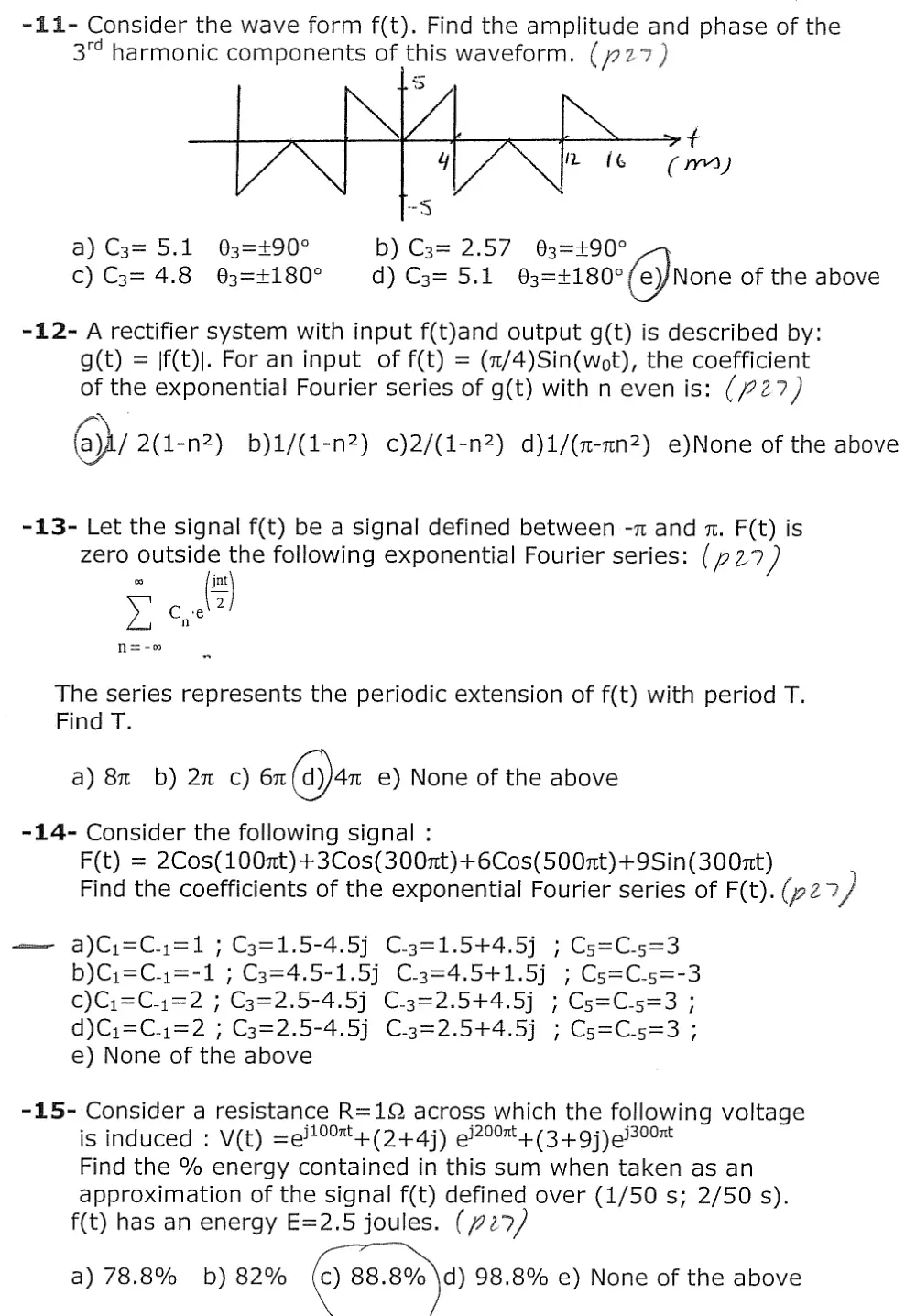
-Li- Consider the wave form f(t). Find the amplitude and phase of the
3™ harmonic components of this waveform. (227)
: Ns ¢
NG (6 cm)
5 .
a) C3= 5.1 63=+90° b) C3= 2.57 03=+90°
Cc) C3= 4.8 63=+180° d) C3= 5.1 03=#180° (¢))None of the above
-12- A rectifier system with input f(t)and output g(t) is described by:
g(t) = |f(t)|. For an input of f(t) = (a/4)Sin(wot), the coefficient
of the exponential Fourier series of g(t) with n even is: (p27)
On 2(1-n?) b)i/(1-n2) c)2/(1-n?) d)1/(m-nn2) e)None of the above
-13- Let the signal f(t) be a signal defined between -x and x. F(t) is
zero outside the following exponential Fourier series: (p27)
® int
y; Cc Gl
n=-o
The series represents the periodic extension of f(t) with period T.
Find T.
a) 8x b) 2x c) 6x (a))4n e) None of the above
-14- Consider the following signal :
F(t) = 2Cos(100xt)+3Cos(300nt)+6Cos(500nt)+9Sin(300nt)
Find the coefficients of the exponential Fourier series of F(t). (p22)
a= a)Cy=C1=1 5; C3=1.5-4.5] C3=1.54+4.5j 5 Cs=C5=3
b)C,=C.4=-1; C3=4.5-1.5j C3=4.54+1.5j ; Cs=C.5=-3
c)Cy=C4=2 ; C3=2.5-4.5j C3=2.544.5j) ; Cs=C5=3 ;
d)Cy=C.14=2 ; C3=2.5-4.5) C3=2.54+4.5j 5 Cs=C5=3 ;
e) None of the above
-15- Consider a resistance R=1Q across which the following voltage
is induced : V(t) =e)20*4 (2447) e)2t+ (34.9j) e300
Find the % energy contained in this sum when taken as an
approximation of the signal f(t) defined over (1/50 s; 2/50 s).
f(t) has an energy E=2.5 joules. (727/
a) 78.8% b) 82% (c) 88.8% \d) 98.8% e) None of the above
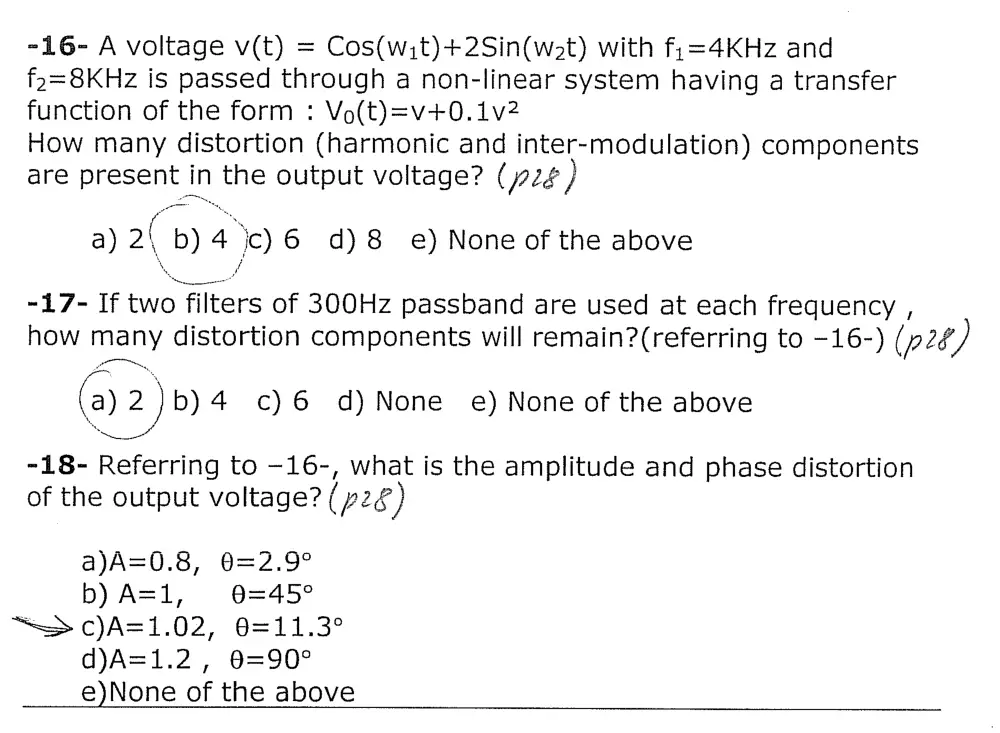
-16- A voltage v(t) = Cos(wit)+2Sin(wat) with f,=4KHz and
f2=8KHz is passed through a non-linear system having a transfer
function of the form : Vo(t)=v+0.1v2
How many distortion (harmonic and inter-modulation) components
are present in the output voltage? (2g)
a) 2 b) 4\c)6 d)8 e) None of the above
-17- If two filters of 300Hz passband are used at each frequency ,
how many distortion components will remain?(referring to -16-) (p28)
(@)2) b) 4 c)6 d)None e) None of the above
NN.
-18- Referring to -16-, what is the amplitude and phase distortion
of the output voltage? (p2¢)
a)A=0.8, 0=2.9°
b) A=1, 0=45°
“S=> c)A=1.02, 0=11.3°
d)A=1.2 , 0=90°
e)None of the above
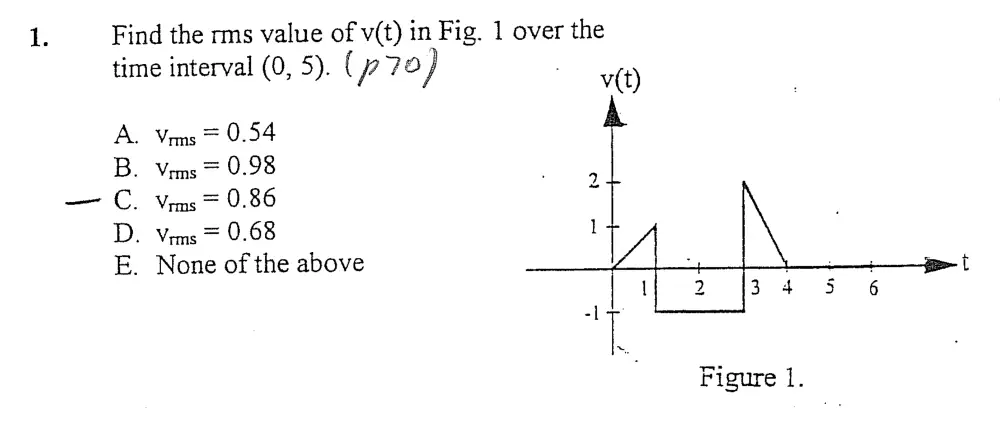
1. Find the rms value of v(t) in Fig. 1 over the
time interval (0, 5). (2 70)
A. Vans = 0.54
mouAw
Vims = 0.98
Vims = 0.86
Vems = 0.68
None of the above
v(t)
10.
iL.
Find the expression for the Fourier coefficients
C, for the periodic function shown in Fig. 9.(p7z )
A. 1/2mn,n# 0: 1/2, n=0
B. j/nn, n# 0; 0,n=0
C. j/2nn,n#0; 1/2,n=0
?
D. j/3nn,n¥0; . 1,n=0
E. None of the above .
A periodic function is represented by:
+co 120
t= = v, el On nt
n=—00
Fig. 10 shows the plot of the magnitude of
the coefficients Vn. Find the average and
the fundamental frequency of v(t). (2 72 ))
2:
>
5:
2
1Hz
10 Hz
0; 10 Hz
Figure 9.
n
V,
LL.
WAM
5; 100 Hz +
None of the above /
HOO pS
-2
.
* Figure 10.
A
5
3
!
-- 0 1
5
3
4
Se 0
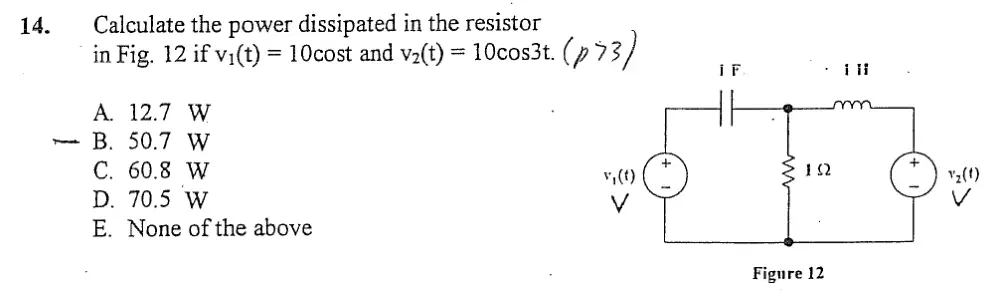
14. Calculate the power dissipated in the resistor
in Fig. 12 if vi(t) = 10cost and v2(t) = 10cos3t. (p 93)
iF an
A 12.7 W ||-—
~— B. 50.7 W
C. 60.8 WwW v(t) C) 1Q CC) y,(t)
D. 70.5 W Vain ~~“ V
E. None of the above :
Figure 12
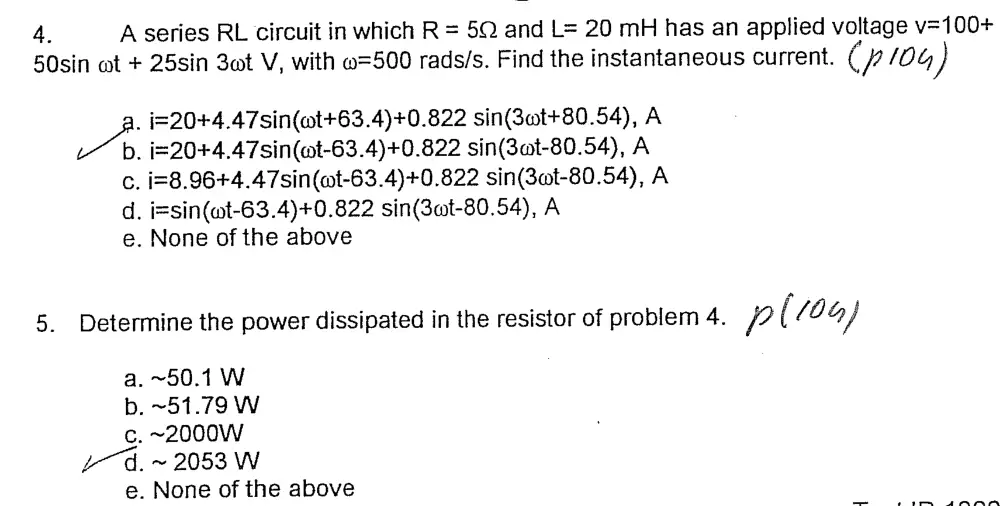
4. A series RL circuit in which R = 5Q and L= 20 mH has an applied voltage v=100+
50sin wt + 25sin 3at V, with w=500 rads/s. Find the instantaneous current. Cp /04)
. =20+4.47sin(wtt+63.4)+0.822 sin(3wt+80.54), A
b. i=20+4.47sin(wt-63.4)+0.822 sin(3at-80.54), A
C. i=8.96+4.47sin(wt-63.4)+0.822 sin(3wt-80.54), A
d. i=sin(wt-63.4)+0.822 sin(3ut-80.54), A
e. None of the above
5. Determine the power dissipated in the resistor of problem 4. /? ( (00)
~50.1 W
. ~51.79 W
~2000W
. ~ 2053 W
None of the above
\
ooo op
-— ~pamunrRer
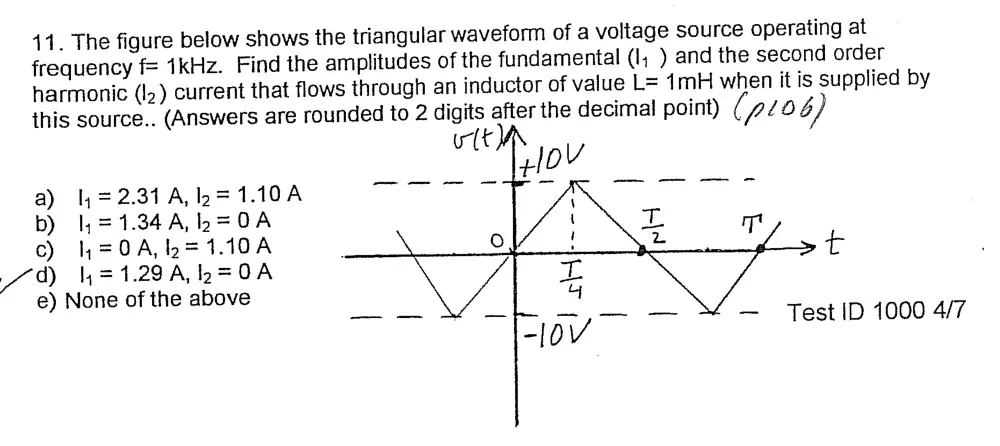
11. The figure below shows the triangular waveform of a voltage source operating at
frequency f= 1kHz. Find the amplitudes of the fundamental (1; ) and the second order
harmonic (lz) current that flows through an inductor of value L= 1mH when it is supplied by
this source.. (Answers are rounded to 2 digits after the decimal point) (2106)
ult
a) =2.31A,12=1.10A —
b) 1,=1.34A,L=0A
c) h=0A,b=1.10A ; [e)
oa) | =1.29A,l=0A
e) None of the above
Test ID 1000 4/7
6. Consider a periodic function f(t), described by the following sequence during one
period of time:
f(t) = 0 for -4s1t<-3
ft)=-Vm for -381t<-]
f(t) =0 for -Isi<+]l
ft)}=+Vm for +151<+43
f(t) =0 for +3575 +44
where Vm = 20. Find the amplitude “A” of the third order harmonic in the Fourrier
series, expressed by Acos(3at — @). (p /23 )
a) A=3
b) A=4
c) A=5
d) A=6
€) None of the above