
EECE 290 Exam with Solution, Spring 2011
American University of Beirut · Analog Signal Processing · 6 pages · with solution



More EECE 290 files
- Exam 1 Clean Copy · Spring 2019ExamView
- Exam 2 Clean Copy · Spring 2019ExamView
- Exam 1 with Solutions · Spring 2019Exam · with solutionView
- Exam 2 with Solutions · Spring 2018Exam · with solutionView
- Exam 1 with Solutions · Spring 2018Exam · with solutionView
- Exam 1 Quiz 1 2016 · Spring 2017ExamView
- Exam 2 Quiz 2 2016 · Spring 2017ExamView
- Exam 1 · Spring 2017ExamView
Show the text of this exam
EECE 290
Quiz 3, May 7, 2011
10 H
1
1’
2
2’
5 V
10 H
1 F
1 F
+
–
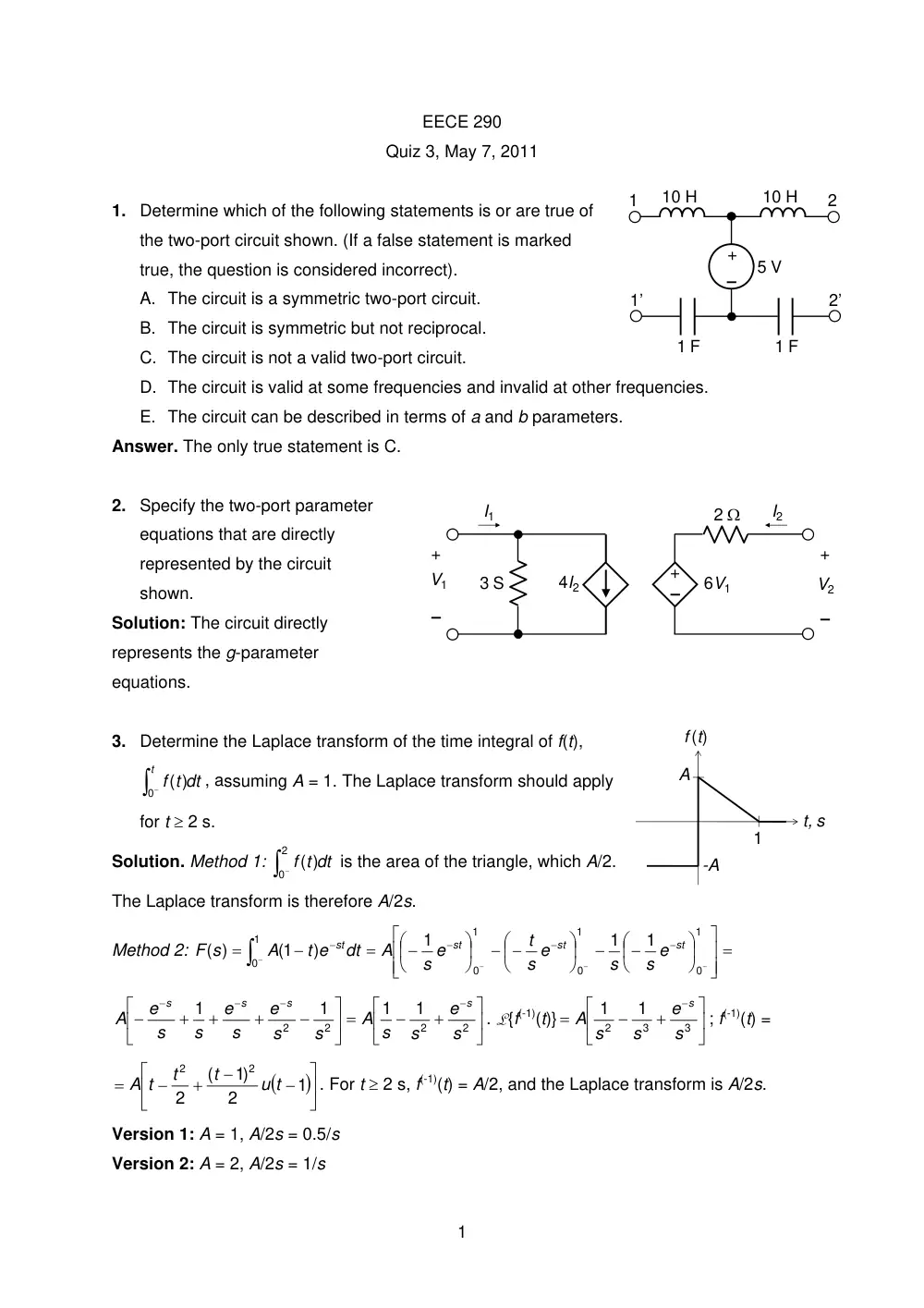
1. Determine which of the following statements is or are true of
the two-port circuit shown. (If a false statement is marked
true, the question is considered incorrect).
A. The circuit is a symmetric two-port circuit.
B. The circuit is symmetric but not reciprocal.
C. The circuit is not a valid two-port circuit.
D. The circuit is valid at some frequencies and invalid at other frequencies.
E. The circuit can be described in terms of a and b parameters.
Answer. The only true statement is C.
2. Specify the two-port parameter
equations that are directly
represented by the circuit
shown.
Solution: The circuit directly
represents
the g-parameter
quations.
3.
ssuming A = 1. The Laplace transform should apply
of the triangle, which A/2.
The Laplace
Method 2:
+
–
V1
+
–
V2
I2
I1
6V1
4I2
–
+
2 Ω
3 S
e
e the Laplace transform of the time integral of f(t),
∫ − f t dt
0
( )
, a
Determin
t
f (t)
t, s
1
A
for t ≥ 2 s.
Solution. Method 1:
∫ − f t dt
0
( )
is the area
2
-A
transform is therefore A/2s.
⎥ =
⎤
⎥⎦
⎢
⎡
⎟⎞
⎜⎛−
−
⎟⎞
⎜
⎝
− ⎛−
⎟⎞
⎜⎛−
=
−
=
−
−
−
−
∫
1
1
1
1
1
1
1
)
(1
)
(
st
st
st
st
e
s e
t
e
A
dt
t e
A
F s
⎢⎣
⎠
⎝
−
−
0
0
s
⎠
⎝
⎠
−
−
0
0
s
s
⎥
⎦
⎤
⎢
⎣
⎡
+
−
⎥ =
⎦
⎤
⎢
⎣
⎡
−
+
+
+
−
−
−
−
−
2
2
2
2
1
1
1
1
s
e
s
A s
s
s
e
s
e
s
s
e
A
s
s
s
s
. L {f(-1)(t)}
⎥
⎦
⎤
⎢
⎣
⎡
+
−
=
−
3
3
2
1
1
s
e
s
s
A
s
; f(-1)(t) =
(
)⎥
⎦
⎣
2
2
⎤
⎢
⎡
−
−
+
−
=
1
)1
(
2
2
u t
t
t
A t
. For t ≥ 2 s, f(-1)(t) = A/2, and the Laplace transform is A/2s.
Version 1: A = 1, A/2s = 0.5/s
Version 2: A = 2, A/2s = 1/s
1
Version 3: A = 3, A/2s = 1.5/s
Version 4: A = 4, A/2s = 2/s
Version 5: A = 5, A/2s = 2.5/s
4. Given that the Laplace transform of
(
)
( )
/
t u t
A e
−t
is
+ 1
s
A π , determine the Laplace
transform of (
)
t u(t)
Ae t
−
, assuming A = 1.
Solution. The function whose Laplace transform is required is
times the given function.
Hence, its Laplace transform is
t
ds
dF s
( )
−
, where
1
( )
+
=
s
A
F s
π . Thus,
(
)
+ 1 3/ 2
2
( )
=
−
s
A
ds
dF s
π
.
Version 1: A = 1, (
)
(
)
3/2
3/ 2
1
1
2
+
+
s
s
= 0.5
A
π
π
Version 2: A = 2, (
)
(
)
3/2
3/ 2
1
1
2
+
+
s
s
=
A
π
π
Version 3: A = 3, (
)
(
)
3/2
3/ 2
1
1
2
+
+
s
s
= 1.5
A
π
π
Version 4: A = 4, (
)
(
)
3/2
3/ 2
1
1
2
+
+
s
s
2
=
A
π
π
Version 5: A = 5, (
)
(
)
3/2
3/ 2
1
1
2
+
+
s
s
5.
e true. (If a false statement is
A.
e same circuit can be bounded for a certain input and unbounded
in complex conjugate pairs.
E.
e transfer function are in the right half of the s
is.
6.
f(t)∗g(t), with
f(t) = sint, g(t) = 2δ(t) + δ(2)(t), and δ(2)(t) being the second derivative of δ(t).
= 2.5
A
π
π
Determine which of the following statements is or ar
marked true, the question is considered incorrect).
The response of th
for another input.
B. The poles of a first-order circuit must always occur
C. A second-order circuit cannot have a double pole.
D. A pole of a voltage source at s = -2 corresponds to dc voltage of -2 V.
A circuit is unstable if the poles of th
plane including the imaginary ax
Answer. The only true statement is A.
Determine the value of the convolution integral y(t) at t = 0.5 s, where y(t) =
2
Solution. L {
}
s2 +1
, and L
1
sint =
{
}
2
(2)
2
2 ( )
s
t
+
=
+ δ
δ
;
1
1
1
1
2
)
(
2
2
2
+
+
=
+
+
=
s
s
s
Y s
;
t
t
y t
sin
( )
( )
+
= δ
. At t = T s, y(T) = sinT.
48
00
ersion 5: T = 2.5, sin(2.5) = 0.60
7.
n for the Laplace transform of f(t – b)u(t – a), where a and b are
ution. L
∫
∫
−
=
−
−
=
−
−
−
a
dt
b e
f t
dt
a e
b u t
f t
a
b u t
f t
)
(
)
) (
(
)
) (
(
0
. Substituting, t’ = t –
∫ −
′ =
−
′ +
=
−
−
0
)
(
)
) (
(
e
dt
b e
a
f t
a
b u t
f t
L
Version 1: T = 0.5, sin(0.5) = 0.
Version 2: T = 1, sin(1) = 0.84
Version 3: T = 1.5, sin(1.5) = 1.
Version 4: T = 2, sin(2) = 0.91
V
Derive an expressio
positive
Sol
constants.
{
}
∞
−
∞
−
st
st
a,
{
}
∞
−
′+
−
)
(
as
a
s t
{
})
(
b
a
f t
+
−
L
.
8. Determine
f(t) if
20
4
( )
=
Ks
F s
2
+
+
s
s
, assuming K = 1.
Solution.
(
)
(
)
16
2
2
2)
(
16
2
)
(
2
2
+
+
−
+
=
+
+
=
=
s
K
K s
Ks
s
s
Ks
F s
20
4
2
+
+
s
t
e
sin 4
− 2
K
t
Ke
f t
t
t
cos 4
( )
2
2
−
−
=
t
ersion 5: K = 5,
t
e
t
e
f t
t
t
sin 4
2.5
cos 4
5
( )
2
2
−
−
−
=
9. If
Version 1: K = 1,
4
e
t
e
f t
t
t
sin
0.5
cos 4
( )
2
2
−
−
−
=
Version 2: K = 2,
t
e
t
e
f t
t
t
sin4
cos 4
2
( )
2
2
−
−
−
=
Version 3: K = 3,
t
e
t
e
f t
t
t
sin 4
1.5
cos 4
3
( )
2
2
−
−
−
=
Version 4: K = 4,
t
e
t
e
f t
t
t
sin 4
2
cos 4
4
( )
2
2
−
−
−
=
V
1
1
)
(
2
+
+
=
s
s
K
F s
2
3
+
+
+
s
s
s
, determine f(t) for large values of t
Solution.
, assuming K = 1.
⎥
⎤
⎢⎣
⎡
+
+
+
+
=
+
+
+
+
=
+
+
+
+
+
1
1
1
2
)1
1)(
(
1
1
1
2
2
2
2
3
2
s
s
s
K
s
s
s
s
K
s
s
s
K
1⎦
s
s
.
[
]t
t
K e
f t
t
sin
cos
2
( )
+
+
=
−
.
For large values of t,
[
]
/ 4)
cos(
2
sin
cos
( )
− π
=
+
→
t
K
t
t
K
f t
. The final-value theorem does
2
3
not apply because of the poles at s = ±j.
Version 1: K = 1,
/ 4)
1 cos(
/ 4)
cos(
π
π
−
=
−
t
t
K
2
2
Version 2: K = 2,
/ 4)
2 cos(
/ 4)
cos(
2
π
π
−
=
−
t
t
K
Version 3: K = 3,
/ 4)
cos(
2
/ 4)
cos(
2
π
π
−
=
−
t
t
3
K
Version 4: K = 4,
/ 4)
2 2 cos(
/ 4)
cos(
2
π
π
−
=
−
t
t
K
Version 5: K = 5,
/ 4)
cos(
2
5
/ 4)
cos(
2
π
π
−
=
−
t
t
K
10.
The figure shows two identical, consecutive pulses,
each of duration a, the second pulse being inverted
with respect to the first. If F(s) is the Laplace transform
of the two pulses shown, determine, in terms of F(s
the Laplace tran
),
sform of f(t) shifted to the left by a.
t = a.
Then,
Assume a = 1.
Solutio
single pulse that extends from t = 0 to
n. Let G(s) be the Laplace tr
G s e as
G s
F s
−
−
=
( )
( )
( )
,
ansform of a
or
e as
F s
G s
−
−
=
1
( )
( )
.
f (t)
t
a
2a
When shifted to the left, the Laplace
transform of f(t + a) is
as
G s
−
−
=
−
1
( )
Version 1: a = 1,
e
− F s
)
(
e s
G s
−
−
=
−
1
( )
− F s
)
(
Version 2: a = 2,
s
e
G s
2
1
)
(
−
−
=
−
F s
( )
−
Version 3: a = 3,
s
e
G s
3
1
)
(
−
−
=
−
F s
( )
−
Version 4: a = 4,
s
e
G s
4
1
)
(
−
−
=
−
F s
( )
−
Version 5: a = 5,
s
e
F s
G s
5
1
( )
)
(
−
−
= −
−
11.
ng ω = 1 rad/s (5%
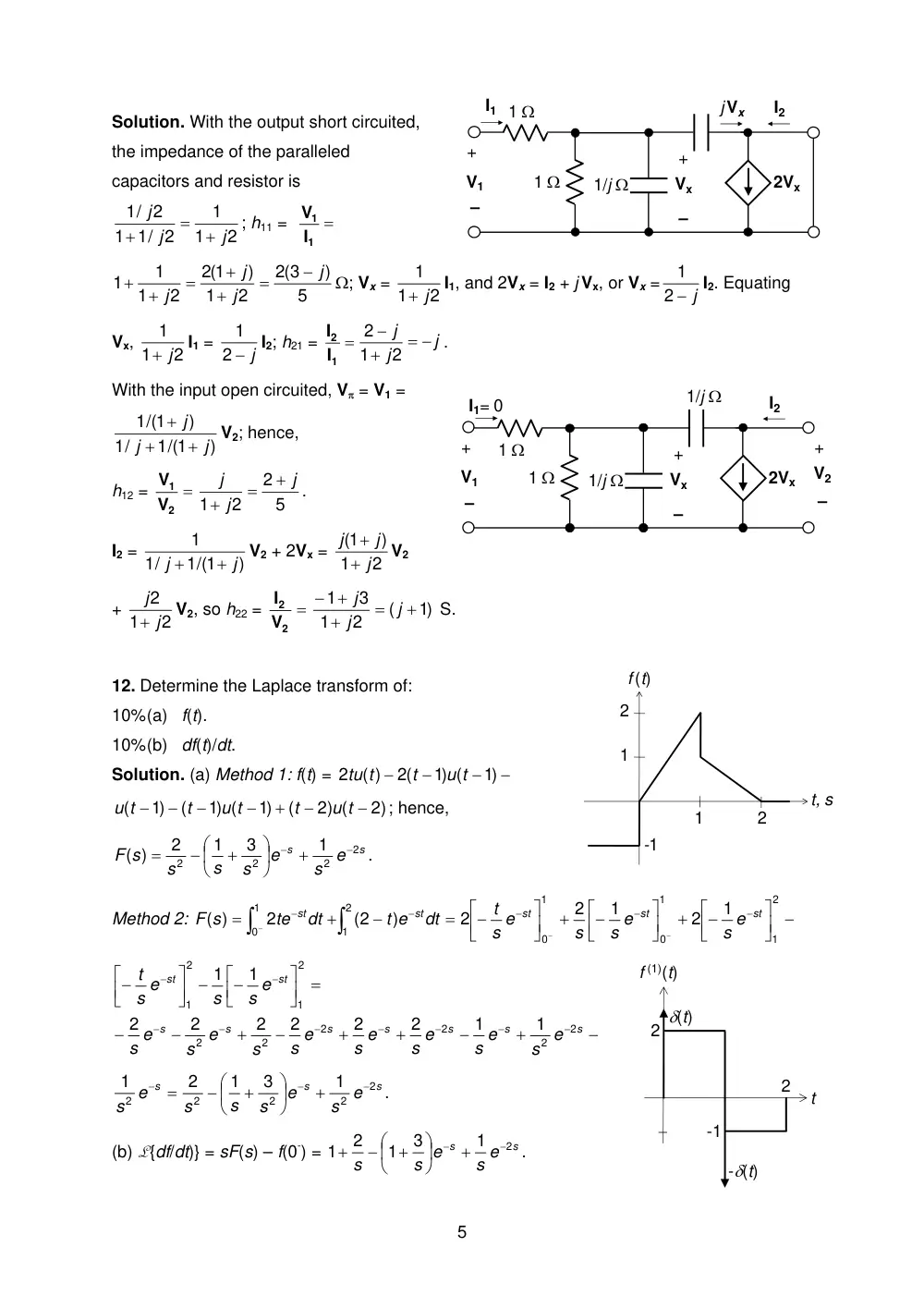
Determine the h parameters for the
circuit shown, assumi
for each parameter).
2vx
1 F
+
vx
–
1 Ω
1 Ω
1 F
4
Solution. With the output short circuited,
the impedance of the paralleled
capacitors and resistor is
2
1
1
1 1/ 2
1/ 2
j
j
j
+
=
+
; h11 =
=
1
1
I
V
5
2
1
2
1
j
j
+
+
x
)
2(3
)
2(1
1
1
j
j
−
=
+
=
+
Ω; V =
2
1+
1
I
j
1, and 2Vx = 2
x
x
I + j V , or V =
− j
2
1
I2. Equating
Vx,
2
1
1
+ j
I1 =
2 − j
I2; h21 =
1
=
1
2
I
I
j .
j
j
= −
+
−
2
1
2
Vπ = V1 =
With the input open circuited,
)
1/(1
j
j
+
+
2
=
1/
1
V ; hence,
h
)
/(1
j
+
12
=
2
1
V
V
5
2
2
1
j
j
j
+
=
+
.
I2 =
)
1/(1
1/
1
j
j
+
+
V2 + 2Vx =
2
1
+ j
2
)
(1
j
j
+
V
+
2
1
+ j
2
j2
V , so h22 =
=
2I
V2
)
1+ j2
1 S.
(
3
1
+
=
− +
j
j
12. Determine the Laplace transform of:
10% (a) f(t).
10% (b) df(t)/dt.
Solution. (a) Method 1: f(t) =
−
−
−
−
)1
)1 (
2(
u t
t
(
)1
(
)t(
2tu
2)
2) (
(
)1
)1 (
−
−
+
−
−
u t
t
u t
t
; hence,
−
t −
u
s
s
e
s
e
s
s
s 2
Method 2: F
F s
2
1
3
1
)
(
−
⎟⎞ − +
⎜⎛
+
−
=
.
−
2
st
2
2 ⎠
⎝
= ∫
−
−
1
0 2
( )
dt
te
s
st
2
∫
=
−
+
1
)
(2
dt
t e
−
⎥⎦
⎤
⎢⎣
⎡−
+
⎥⎦
⎤
⎢⎣
⎡−
+
⎥⎦
⎤
⎢⎣
⎡−
−
−
−
−
−
2
1
1
0
1
0
1
2
1
2
2
st
st
st
s e
s e
s
s e
t
2
1⎥⎦
⎤
⎢⎣
⎡−
s e−st
t
=
⎥⎦
⎤
⎢⎣
⎡−
−
−
2
1
1
1
s e st
s
−
−
−
−
s
s
s
e
s
s e
s e
s
2
2
2
2
2
1
1
2
+
−
+
+
−
+
−
−
−
s
s
s
e
e
e
2
2
2
2
− 2
−
e−s
2
s
s
s
s
1 e−s =
s2
s
s
e
e
2
1
3
1
2
−
⎟⎞ − +
⎜⎛
+
−
.
s
s
s
s
2
2
2
⎠
⎝
(b) L {df/dt)} = sF(s) – f(0-) =
s
1
3
1
2
1
⎟ − +
⎠
⎞
⎜
⎝
− ⎛ +
+
.
s
s e
s e
s
2
−
+
–
Vx
1 Ω
1 Ω
–
V2
–
V1
1/j Ω
+
+
I1= 0
I2
1/j Ω
2Vx
t
δ(t)
2
-δ(t)
-1
f (1)(t)
2
f (t)
1
1
-1
t, s
2
2
+
–
Vx
I1
j Vx
I2
1 Ω
1 Ω
–
V1
+
1/j Ω
2Vx
5
As a check, f(1)(t) = δ(t) + 2u(t) – 3u(t – 1) – δ(t – 1) + u(t – 2).
It follows that L {df/dt)} =
s
s
s
s e
e
s e
s
2
1
3
2
1
−
−
−
+
−
−
+
.
Note that in order to obtain the Laplace transfor
has an initial value of -1 at t = 0-, the
m of f(t) from f(1)(t), then because f(t)
correct expression is: F(s) =
6
s
1 L {df/dt)} +
s
f
(0 )
−
. Thus,
s
e
s
e
s
s
s
s
s
1
1
3
1
2
1
2
2
2
2
−
+
⎟
⎠
⎞
⎜
⎝
⎛
+
−
+
−
−
.
s
13. The d
ened at t = 0
osed for a long time.
s domain for
s shown. The
hown f
+
mutual
1/4s)I2
ouble switch is op
after having been cl
8% (a) Draw the circuit in the
t ≥ 0+.
6% (b) Derive VO(s).
6% (c) Derive vO(t) for t ≥ 0+.
Solution. (a) At t = 0-, there will be an initial
current of 2 A in each winding and an initial
voltage of 4 V across the capacitor a
circuit in the s domain is s
secondary inductor is L2 – M = 2
is (2 H)×(-2 A) = -4. The
current in the 4 H
or t ≥ 0 . The
H and the source
inductor is 2 + 2 = 4 A directed
downwards, and the source is
(4 H)×(4 A) = 16.
(b) From KVL: (6s + 2 +
+16 + 4 + 4/s = 0, which gives:
0.25
2
6
2
+ s +
s
)1
4(5
2
+
= −
s
I
;
0.25
2
0.25
2
6
3
24
1
25
1
5
1 4
4
4
1
4
4
2
2
2
2
2
2
+
+
⎥ =
⎦
⎤
⎢
⎣
⎡
+
+
+
=
⎥⎦
⎤
⎢
⎡
+
+
+
−
⎥ =
⎤
⎢
⎡
+
=
+
=
s
s
s
s
s
s
s
s
s
I
s
s
s
I
VO
.
(c)
6
)1
3(8
+
s
0.
2
6
⎣
⎦
⎣
s
s
(
)
(
)
(
)
(
)
2
2
2
2
2
1/ 6 2
/ 6
1
1/ 6 2
2
1/ 6 2
1/ 6
1/ 24
/ 3
+
+
−
+
+
=
+
+
=
s
s
s
s
VO
. It follows that
1/ 6)
4(
0.5
4
+
+
s
s
(
)
(
2)
sin 6 /
2
2
cos 6 /
4
( )
/6
/6
t
e
t
e
t
v
t
t
O
−
−
−
=
V.
2 Ω
4 H
5 H
6 H
4 F
1 Ω
3 Ω
t = 0
+
–
+
6 V
–
vO
2 Ω
+
–
+
–
+
–
+
–
2s Ω
s Ω
4s Ω
1/4s Ω
2
4
I2
16
4/s
+
VO
–
2 Ω
4 V
3 Ω
+
+
–
–
2 A
2 A
1 Ω