
EECE 320 Homework 1, Spring 2007
American University of Beirut · Digital Systems Design · 4 pages · Dr. Lama Hamandi


More EECE 320 files
Show the text of this homework
American University of Beirut
Department of Electrical and Computer Engineering
EECE 320 – Digital Systems Design
Assignment 1
Suggested problems: Solve the drill problems of chapter 2.
Problem 1: Complete the following table
Decimal
Octal
Hexad
ecimal
Unsigned Binary
Signed-
Magnitude
Signed 1’s
complement
Signed 2’s
complement
18.75
22.3
12.3
10010.11
010010.11
001101.11
001110.11
-12.875
-14.7
-C.7
1100.111
11100.111
10011.111
10100.111
63.26
76.32
3E.1A
111110.11010
0111110.11010
0000001.11010
0000010.11010
910.3
1616.3
38E.3
1110001110.0011
01110001110.0011
00001110001.0011
0001110010.0011
202
312
0CA
11001010
011001010
000110101
000110110
-74
-112
-04A
1001010
11001010
10110101
10110110
41
051
029
0101001
00101001
01010110
01010111
-5.375
-05.3
-5.3
0101.011
10101.011
11010.011
-5.3
-5.3
-5.3
101.11
1101.11
1010.11
1011.11
Problem 2: Find the 9’s complement of the decimal number 678 546 900.
Find the 16’s complement of the hexadecimal number AB45.
_ 9’s complement of 678 546 900: 999999999-678546900 = 321453099.
_ 15’s complement of AB45: 54BA (By substracting 15 from each digit).
16’s complement of AB45: 15’s complement+1 = 54BA+1 = 54BB.
Problem 3: Perform subtraction directly first then using the 2’s complement of the
subtrahend for the following numbers:
a) 110010 – 110101
Direct substraction:
110010
-
110101
1 111101 (the following number is in signed 2’s complement)
Using 2’s complement:
2’s complement of 110101 is 001010+1 = 001011.
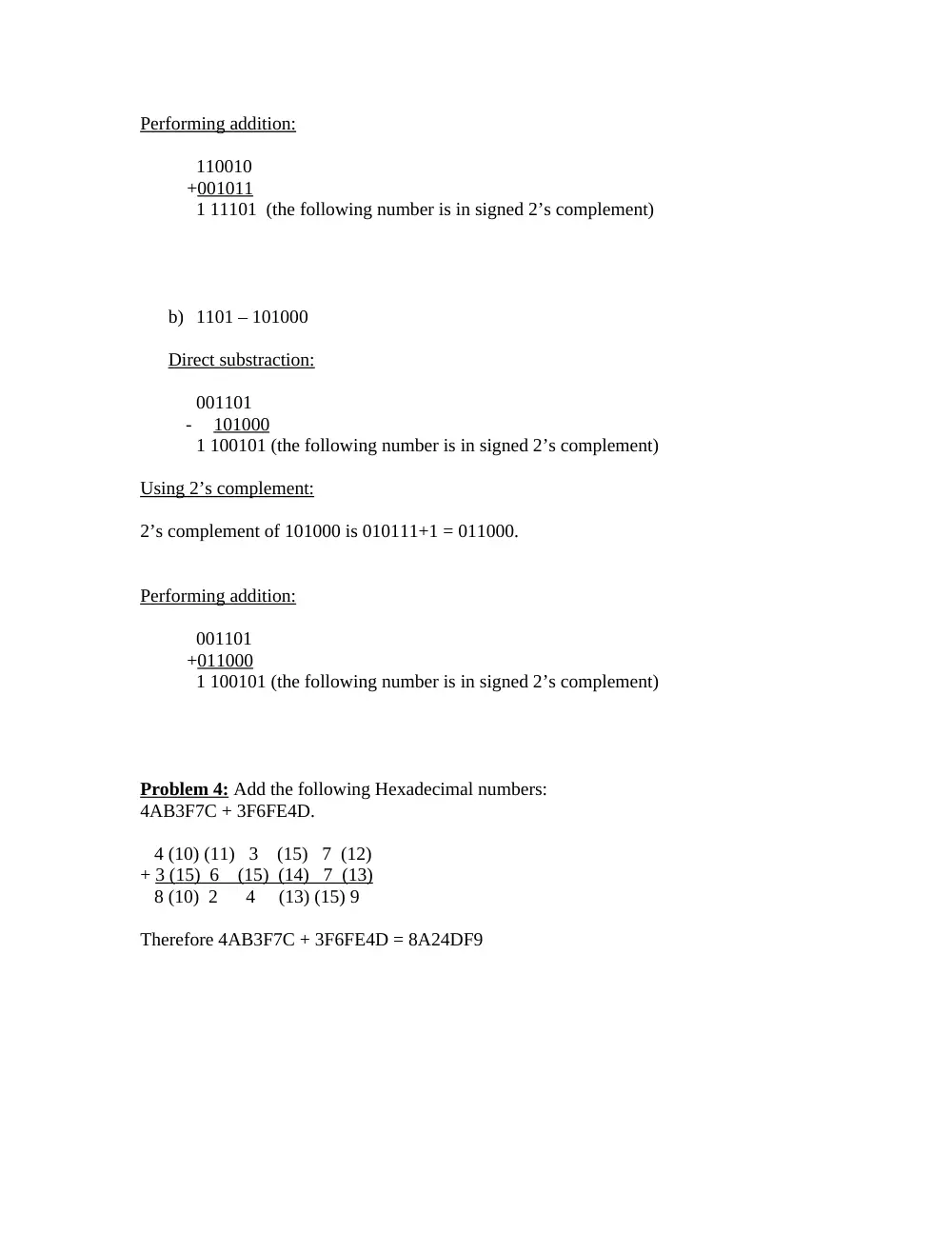
Performing addition:
110010
+001011
1 11101 (the following number is in signed 2’s complement)
b) 1101 – 101000
Direct substraction:
001101
-
101000
1 100101 (the following number is in signed 2’s complement)
Using 2’s complement:
2’s complement of 101000 is 010111+1 = 011000.
Performing addition:
001101
+011000
1 100101 (the following number is in signed 2’s complement)
Problem 4: Add the following Hexadecimal numbers:
4AB3F7C + 3F6FE4D.
4 (10) (11) 3 (15) 7 (12)
+ 3 (15) 6 (15) (14) 7 (13)
8 (10) 2 4 (13) (15) 9
Therefore 4AB3F7C + 3F6FE4D = 8A24DF9
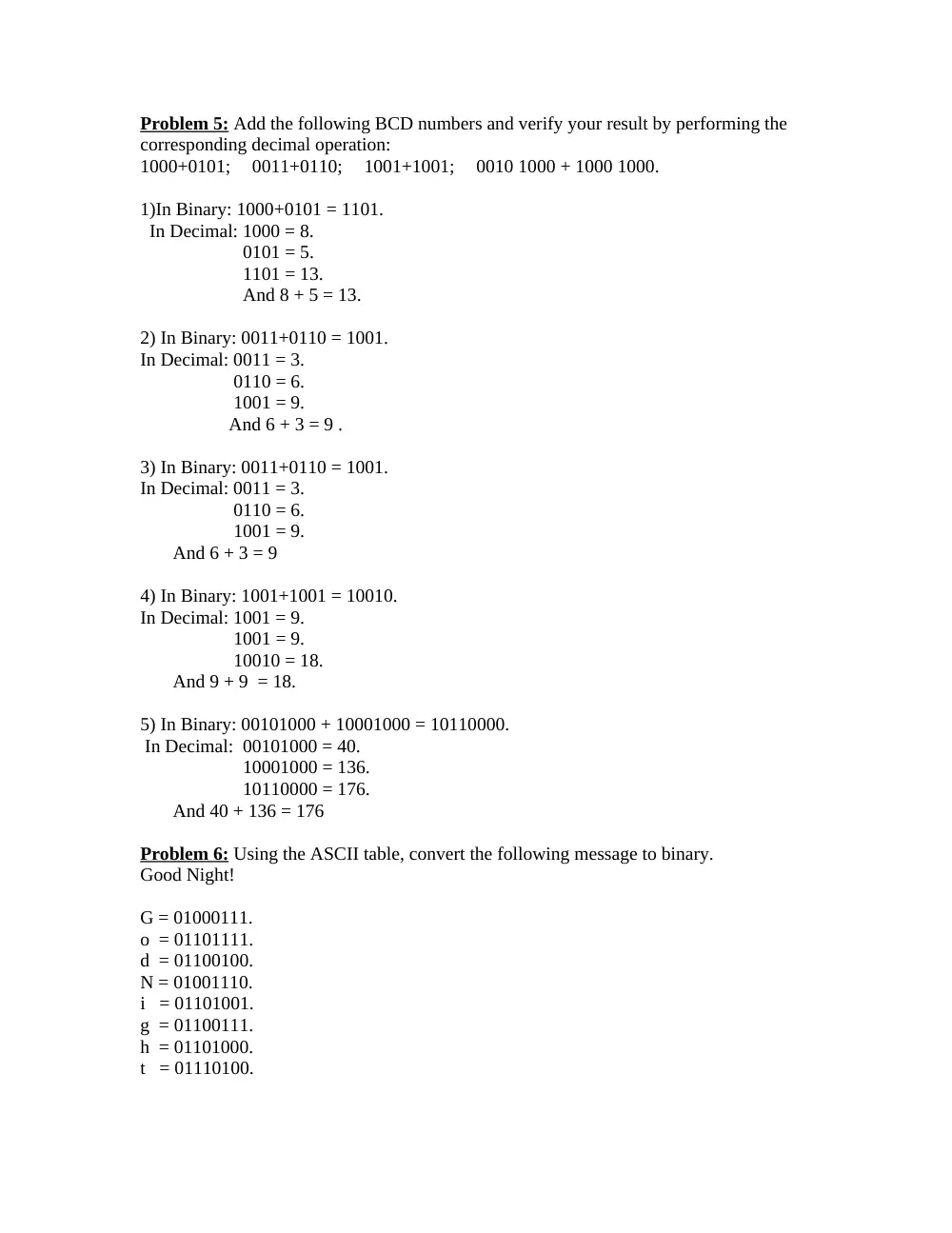
Problem 5: Add the following BCD numbers and verify your result by performing the
corresponding decimal operation:
1000+0101;
0011+0110;
1001+1001;
0010 1000 + 1000 1000.
1)In Binary: 1000+0101 = 1101.
In Decimal: 1000 = 8.
0101 = 5.
1101 = 13.
And 8 + 5 = 13.
2) In Binary: 0011+0110 = 1001.
In Decimal: 0011 = 3.
0110 = 6.
1001 = 9.
And 6 + 3 = 9 .
3) In Binary: 0011+0110 = 1001.
In Decimal: 0011 = 3.
0110 = 6.
1001 = 9.
And 6 + 3 = 9
4) In Binary: 1001+1001 = 10010.
In Decimal: 1001 = 9.
1001 = 9.
10010 = 18.
And 9 + 9 = 18.
5) In Binary: 00101000 + 10001000 = 10110000.
In Decimal: 00101000 = 40.
10001000 = 136.
10110000 = 176.
And 40 + 136 = 176
Problem 6: Using the ASCII table, convert the following message to binary.
Good Night!
G = 01000111.
o = 01101111.
d = 01100100.
N = 01001110.
i = 01101001.
g = 01100111.
h = 01101000.
t = 01110100.
Therefore
Good Night ==
01000111 0110111101101111 01100100 0100111001101001011001110110100001110100