
EECE 330 Homework, Spring 2008
American University of Beirut · Data Structures and Algorithms · 18 pages


Showing the first 10 of 18 pages. Download the PDF to see all of it.
More EECE 330 files
- Homework 1 · Fall 2015HomeworkView
- Homework 3 Assignment · Fall 2011HomeworkView
- Homework 2 Assignment · Fall 2011HomeworkView
- Homework 4 Assignment · Fall 2011HomeworkView
- Homework 1 Assignment · Fall 2011HomeworkView
- Homework · Spring 2008HomeworkView
- Other Extra Lecture About Dynamic Programming · Spring 2017LabView
- Useful File MCQ · Fall 2015FileView
Show the text of this homework
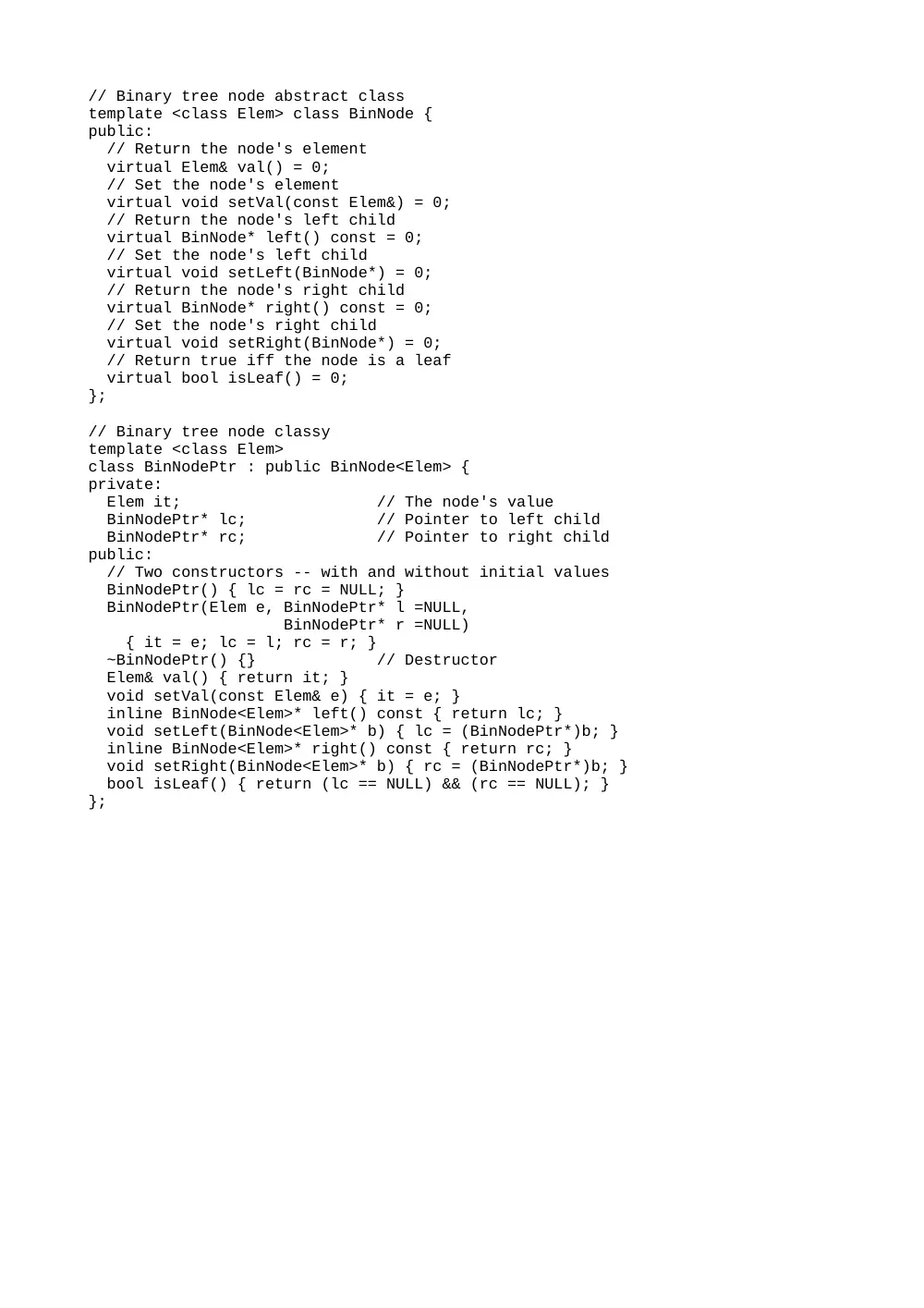
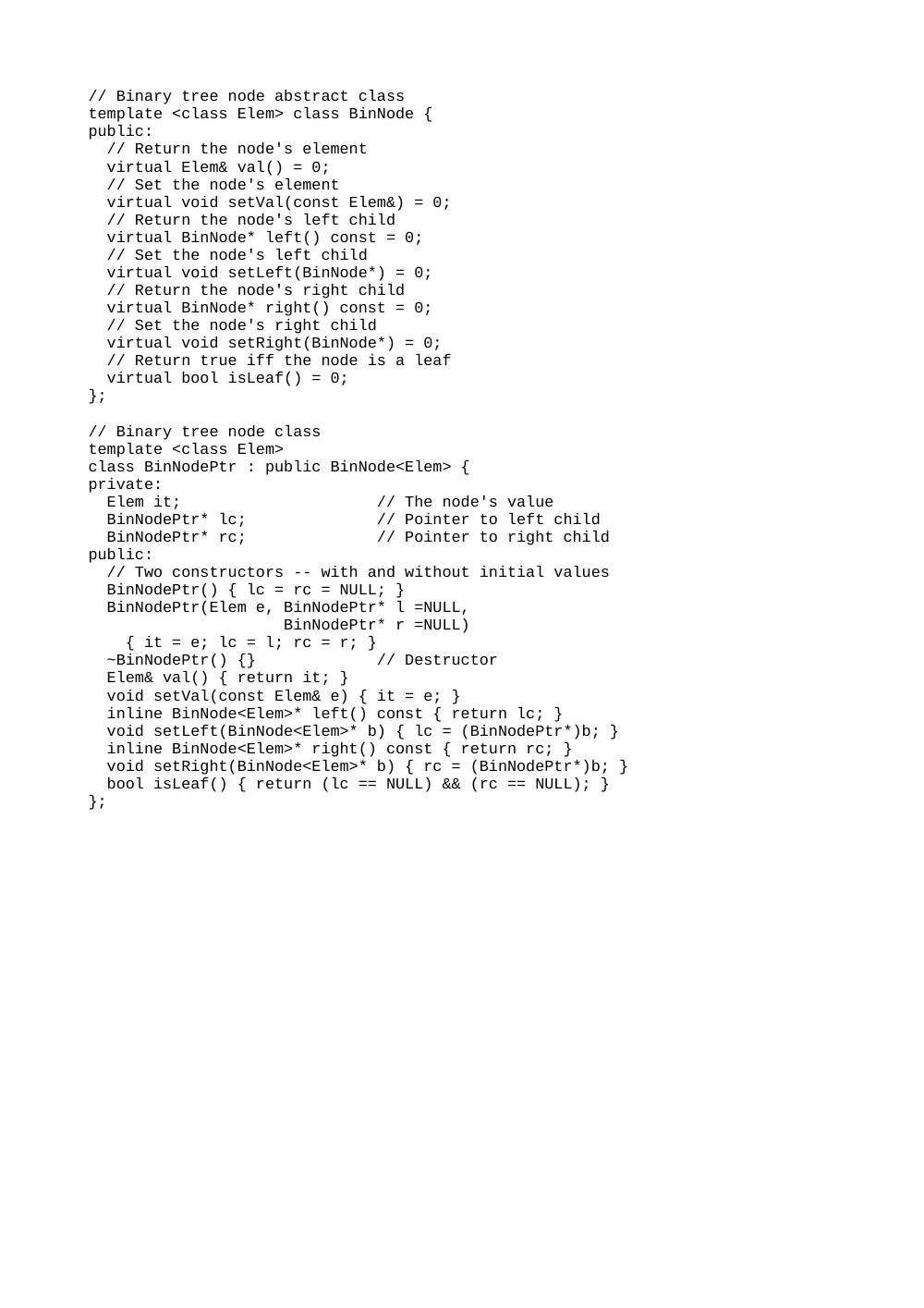
// Binary tree node abstract class
template <class Elem> class BinNode {
public:
// Return the node's element
virtual Elem& val() = 0;
// Set the node's element
virtual void setVal(const Elem&) = 0;
// Return the node's left child
virtual BinNode* left() const = 0;
// Set the node's left child
virtual void setLeft(BinNode*) = 0;
// Return the node's right child
virtual BinNode* right() const = 0;
// Set the node's right child
virtual void setRight(BinNode*) = 0;
// Return true iff the node is a leaf
virtual bool isLeaf() = 0;
};
// Binary tree node class
template <class Elem>
class BinNodePtr : public BinNode<Elem> {
private:
Elem it; // The node's value
BinNodePtr* lc; // Pointer to left child
BinNodePtr* rc; // Pointer to right child
public:
// Two constructors -- with and without initial values
BinNodePtr() { lc = rc = NULL; }
BinNodePtr(Elem e, BinNodePtr* l =NULL,
BinNodePtr* r =NULL)
{ it = e; lc = l; rc = r; }
~BinNodePtr() {} // Destructor
Elem& val() { return it; }
void setVal(const Elem& e) { it = e; }
inline BinNode<Elem>* left() const { return lc; }
void setLeft(BinNode<Elem>* b) { lc = (BinNodePtr*)b; }
inline BinNode<Elem>* right() const { return rc; }
void setRight(BinNode<Elem>* b) { rc = (BinNodePtr*)b; }
bool isLeaf() { return (lc == NULL) && (rc == NULL); }
};
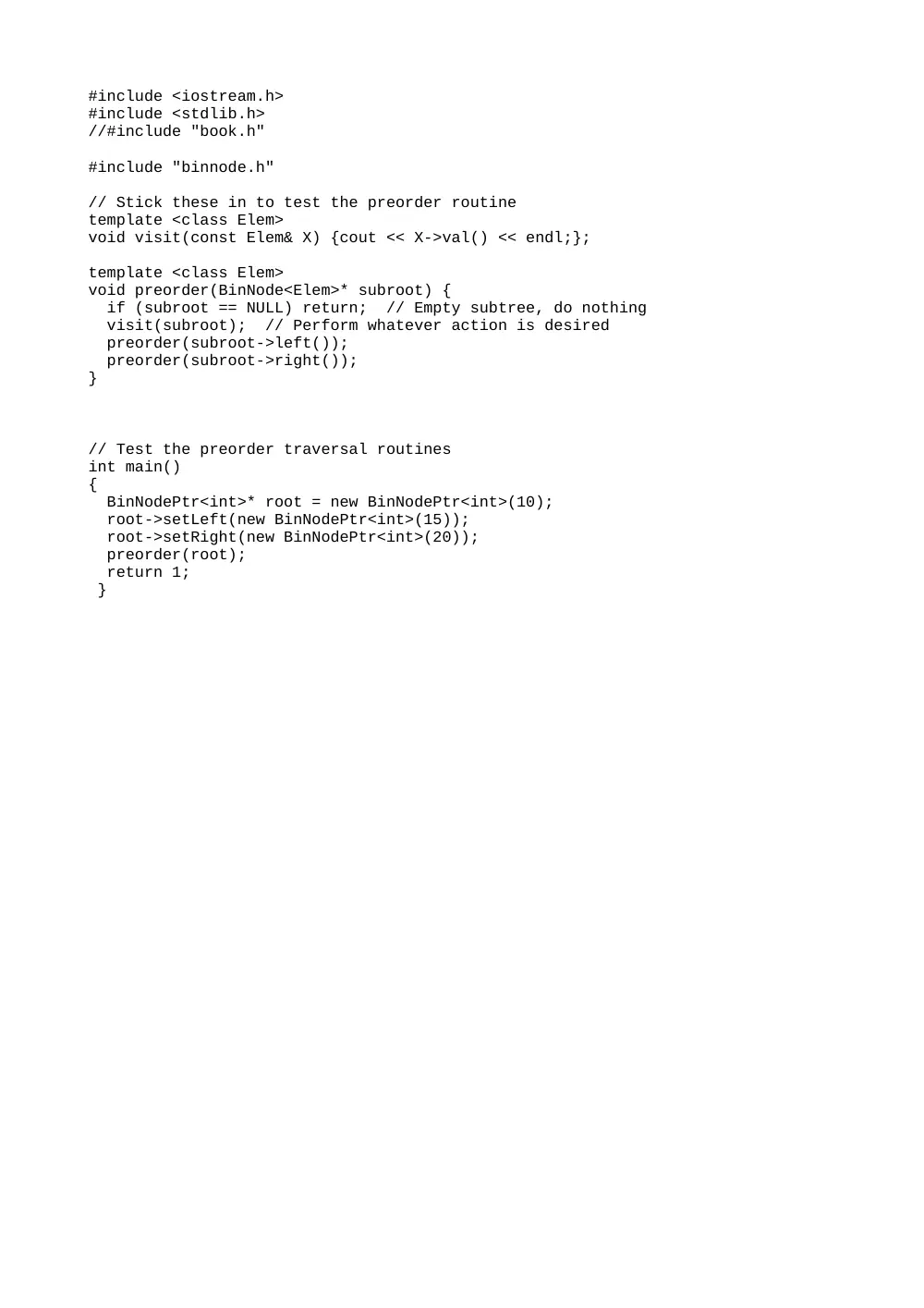
#include <iostream.h>
#include <stdlib.h>
//#include "book.h"
#include "binnode.h"
// Stick these in to test the preorder routine
template <class Elem>
void visit(const Elem& X) {cout << X->val() << endl;};
template <class Elem>
void preorder(BinNode<Elem>* subroot) {
if (subroot == NULL) return; // Empty subtree, do nothing
visit(subroot); // Perform whatever action is desired
preorder(subroot->left());
preorder(subroot->right());
}
// Test the preorder traversal routines
int main()
{
BinNodePtr<int>* root = new BinNodePtr<int>(10);
root->setLeft(new BinNodePtr<int>(15));
root->setRight(new BinNodePtr<int>(20));
preorder(root);
return 1;
}
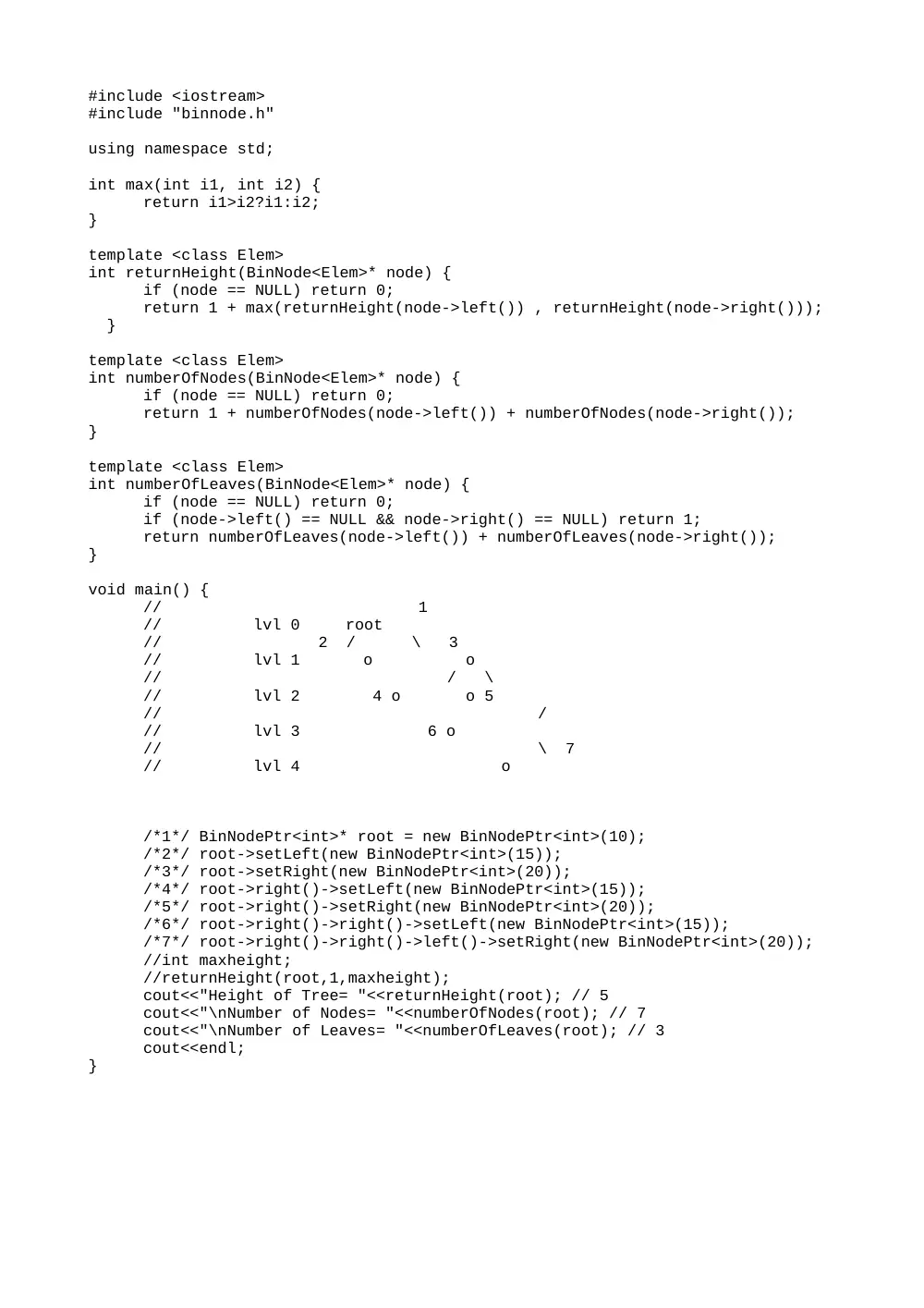
#include <iostream>
#include "binnode.h"
using namespace std;
int max(int i1, int i2) {
return i1>i2?i1:i2;
}
template <class Elem>
int returnHeight(BinNode<Elem>* node) {
if (node == NULL) return 0;
return 1 + max(returnHeight(node->left()) , returnHeight(node->right()));
}
template <class Elem>
int numberOfNodes(BinNode<Elem>* node) {
if (node == NULL) return 0;
return 1 + numberOfNodes(node->left()) + numberOfNodes(node->right());
}
template <class Elem>
int numberOfLeaves(BinNode<Elem>* node) {
if (node == NULL) return 0;
if (node->left() == NULL && node->right() == NULL) return 1;
return numberOfLeaves(node->left()) + numberOfLeaves(node->right());
}
void main() {
//
1
//
lvl 0 root
//
2 / \ 3
//
lvl 1
o o
//
/ \
//
lvl 2
4 o o 5
//
/
//
lvl 3
6 o
//
\ 7
//
lvl 4
o
/*1*/ BinNodePtr<int>* root = new BinNodePtr<int>(10);
/*2*/ root->setLeft(new BinNodePtr<int>(15));
/*3*/ root->setRight(new BinNodePtr<int>(20));
/*4*/ root->right()->setLeft(new BinNodePtr<int>(15));
/*5*/ root->right()->setRight(new BinNodePtr<int>(20));
/*6*/ root->right()->right()->setLeft(new BinNodePtr<int>(15));
/*7*/ root->right()->right()->left()->setRight(new BinNodePtr<int>(20));
//int maxheight;
//returnHeight(root,1,maxheight);
cout<<"Height of Tree= "<<returnHeight(root); // 5
cout<<"\nNumber of Nodes= "<<numberOfNodes(root); // 7
cout<<"\nNumber of Leaves= "<<numberOfLeaves(root); // 3
cout<<endl;
}
// Binary tree node abstract class
template <class Elem> class BinNode {
public:
// Return the node's element
virtual Elem& val() = 0;
// Set the node's element
virtual void setVal(const Elem&) = 0;
// Return the node's left child
virtual BinNode* left() const = 0;
// Set the node's left child
virtual void setLeft(BinNode*) = 0;
// Return the node's right child
virtual BinNode* right() const = 0;
// Set the node's right child
virtual void setRight(BinNode*) = 0;
// Return true iff the node is a leaf
virtual bool isLeaf() = 0;
};
// Binary tree node classy
template <class Elem>
class BinNodePtr : public BinNode<Elem> {
private:
Elem it; // The node's value
BinNodePtr* lc; // Pointer to left child
BinNodePtr* rc; // Pointer to right child
public:
// Two constructors -- with and without initial values
BinNodePtr() { lc = rc = NULL; }
BinNodePtr(Elem e, BinNodePtr* l =NULL,
BinNodePtr* r =NULL)
{ it = e; lc = l; rc = r; }
~BinNodePtr() {} // Destructor
Elem& val() { return it; }
void setVal(const Elem& e) { it = e; }
inline BinNode<Elem>* left() const { return lc; }
void setLeft(BinNode<Elem>* b) { lc = (BinNodePtr*)b; }
inline BinNode<Elem>* right() const { return rc; }
void setRight(BinNode<Elem>* b) { rc = (BinNodePtr*)b; }
bool isLeaf() { return (lc == NULL) && (rc == NULL); }
};
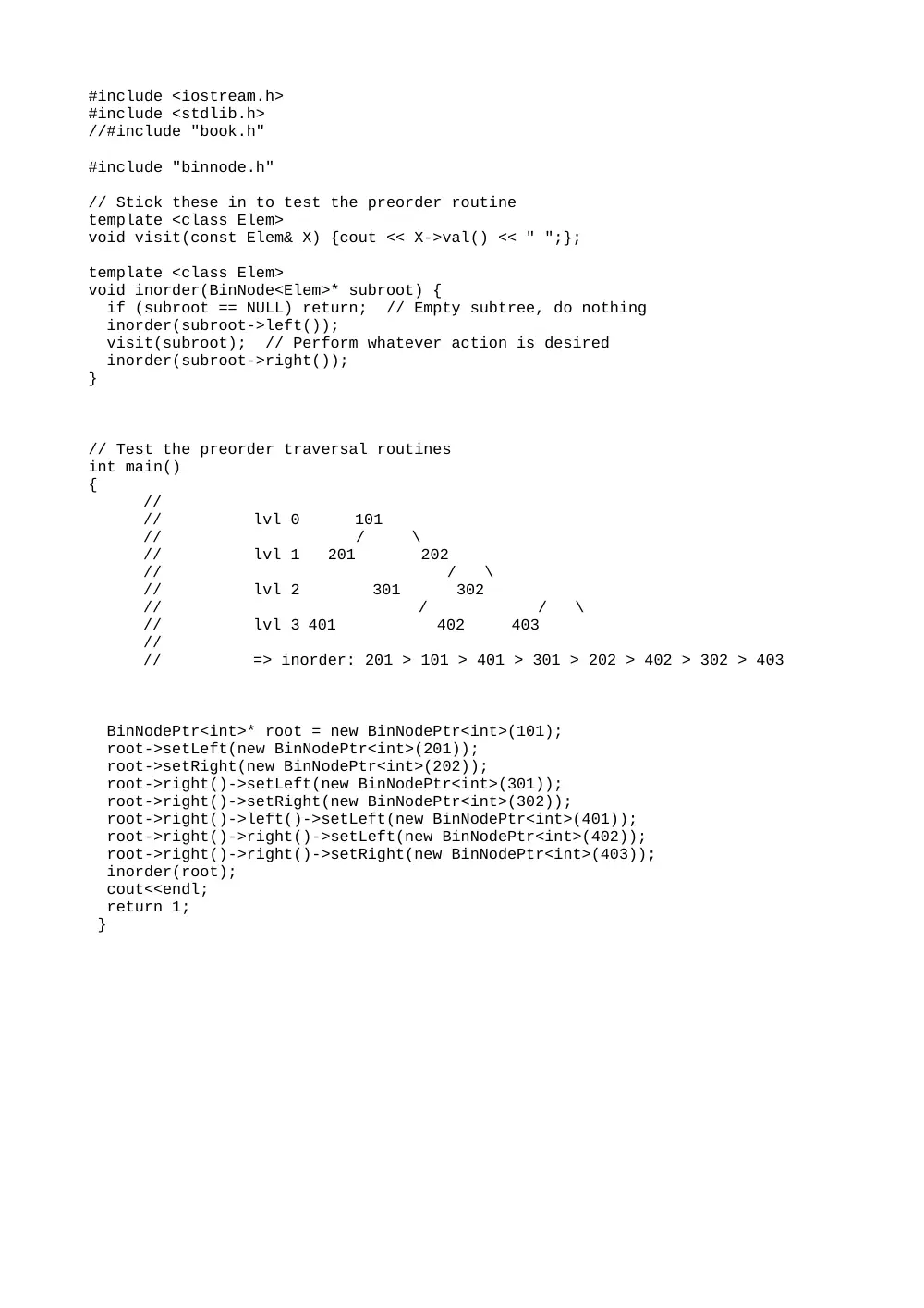
#include <iostream.h>
#include <stdlib.h>
//#include "book.h"
#include "binnode.h"
// Stick these in to test the preorder routine
template <class Elem>
void visit(const Elem& X) {cout << X->val() << " ";};
template <class Elem>
void inorder(BinNode<Elem>* subroot) {
if (subroot == NULL) return; // Empty subtree, do nothing
inorder(subroot->left());
visit(subroot); // Perform whatever action is desired
inorder(subroot->right());
}
// Test the preorder traversal routines
int main()
{
//
//
lvl 0 101
//
/ \
//
lvl 1 201 202
//
/ \
//
lvl 2
301 302
//
/
/ \
//
lvl 3 401
402 403
//
//
=> inorder: 201 > 101 > 401 > 301 > 202 > 402 > 302 > 403
BinNodePtr<int>* root = new BinNodePtr<int>(101);
root->setLeft(new BinNodePtr<int>(201));
root->setRight(new BinNodePtr<int>(202));
root->right()->setLeft(new BinNodePtr<int>(301));
root->right()->setRight(new BinNodePtr<int>(302));
root->right()->left()->setLeft(new BinNodePtr<int>(401));
root->right()->right()->setLeft(new BinNodePtr<int>(402));
root->right()->right()->setRight(new BinNodePtr<int>(403));
inorder(root);
cout<<endl;
return 1;
}
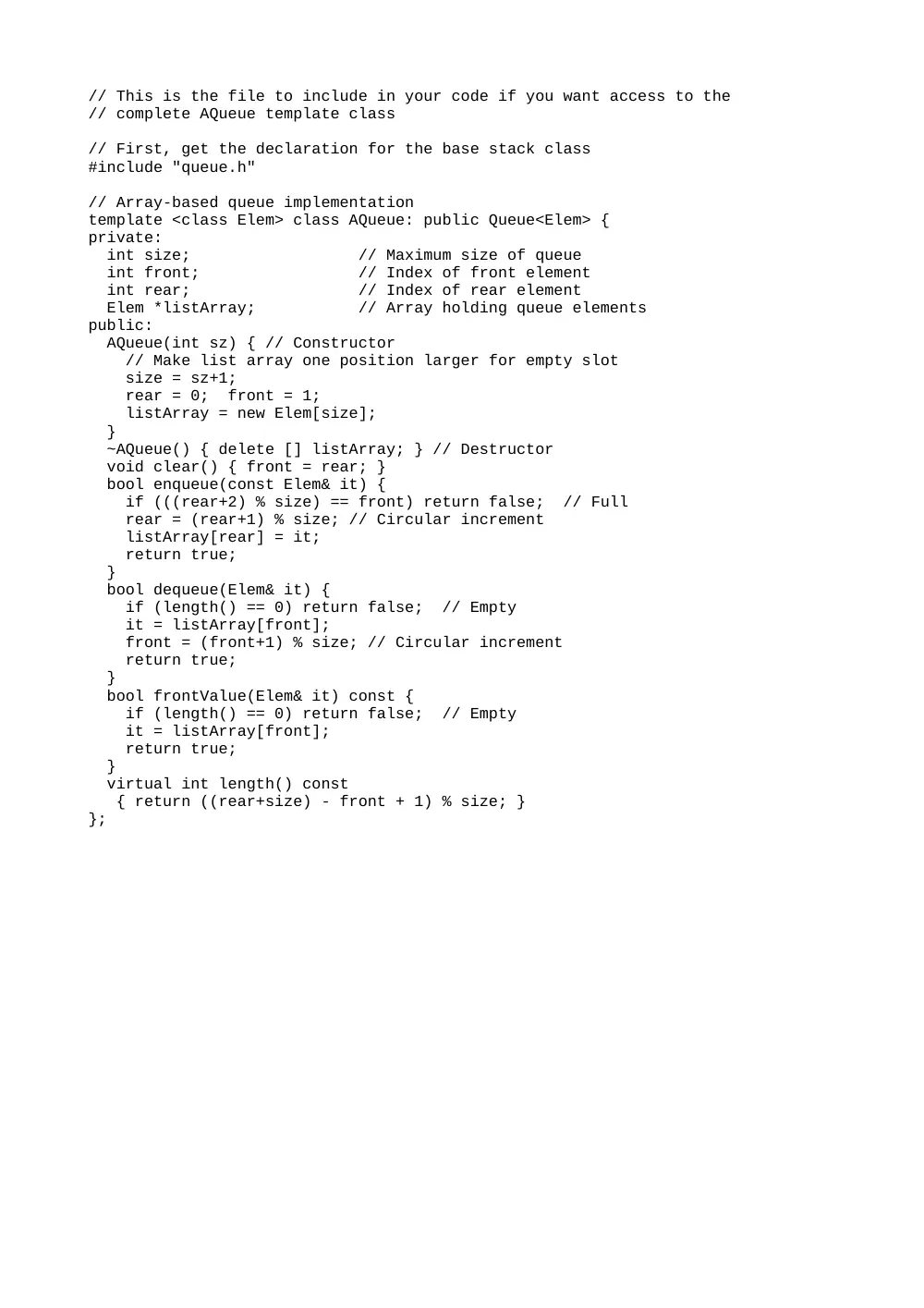
// This is the file to include in your code if you want access to the
// complete AQueue template class
// First, get the declaration for the base stack class
#include "queue.h"
// Array-based queue implementation
template <class Elem> class AQueue: public Queue<Elem> {
private:
int size; // Maximum size of queue
int front; // Index of front element
int rear; // Index of rear element
Elem *listArray; // Array holding queue elements
public:
AQueue(int sz) { // Constructor
// Make list array one position larger for empty slot
size = sz+1;
rear = 0; front = 1;
listArray = new Elem[size];
}
~AQueue() { delete [] listArray; } // Destructor
void clear() { front = rear; }
bool enqueue(const Elem& it) {
if (((rear+2) % size) == front) return false; // Full
rear = (rear+1) % size; // Circular increment
listArray[rear] = it;
return true;
}
bool dequeue(Elem& it) {
if (length() == 0) return false; // Empty
it = listArray[front];
front = (front+1) % size; // Circular increment
return true;
}
bool frontValue(Elem& it) const {
if (length() == 0) return false; // Empty
it = listArray[front];
return true;
}
virtual int length() const
{ return ((rear+size) - front + 1) % size; }
};
// Binary tree node abstract class
template <class Elem> class BinNode {
public:
// Return the node's element
virtual Elem& val() = 0;
// Set the node's element
virtual void setVal(const Elem&) = 0;
// Return the node's left child
virtual BinNode* left() const = 0;
// Set the node's left child
virtual void setLeft(BinNode*) = 0;
// Return the node's right child
virtual BinNode* right() const = 0;
// Set the node's right child
virtual void setRight(BinNode*) = 0;
// Return true iff the node is a leaf
virtual bool isLeaf() = 0;
};
// Binary tree node class
template <class Elem>
class BinNodePtr : public BinNode<Elem> {
private:
Elem it; // The node's value
BinNodePtr* lc; // Pointer to left child
BinNodePtr* rc; // Pointer to right child
public:
// Two constructors -- with and without initial values
BinNodePtr() { lc = rc = NULL; }
BinNodePtr(Elem e, BinNodePtr* l =NULL,
BinNodePtr* r =NULL)
{ it = e; lc = l; rc = r; }
~BinNodePtr() {} // Destructor
Elem& val() { return it; }
void setVal(const Elem& e) { it = e; }
inline BinNode<Elem>* left() const { return lc; }
void setLeft(BinNode<Elem>* b) { lc = (BinNodePtr*)b; }
inline BinNode<Elem>* right() const { return rc; }
void setRight(BinNode<Elem>* b) { rc = (BinNodePtr*)b; }
bool isLeaf() { return (lc == NULL) && (rc == NULL); }
};
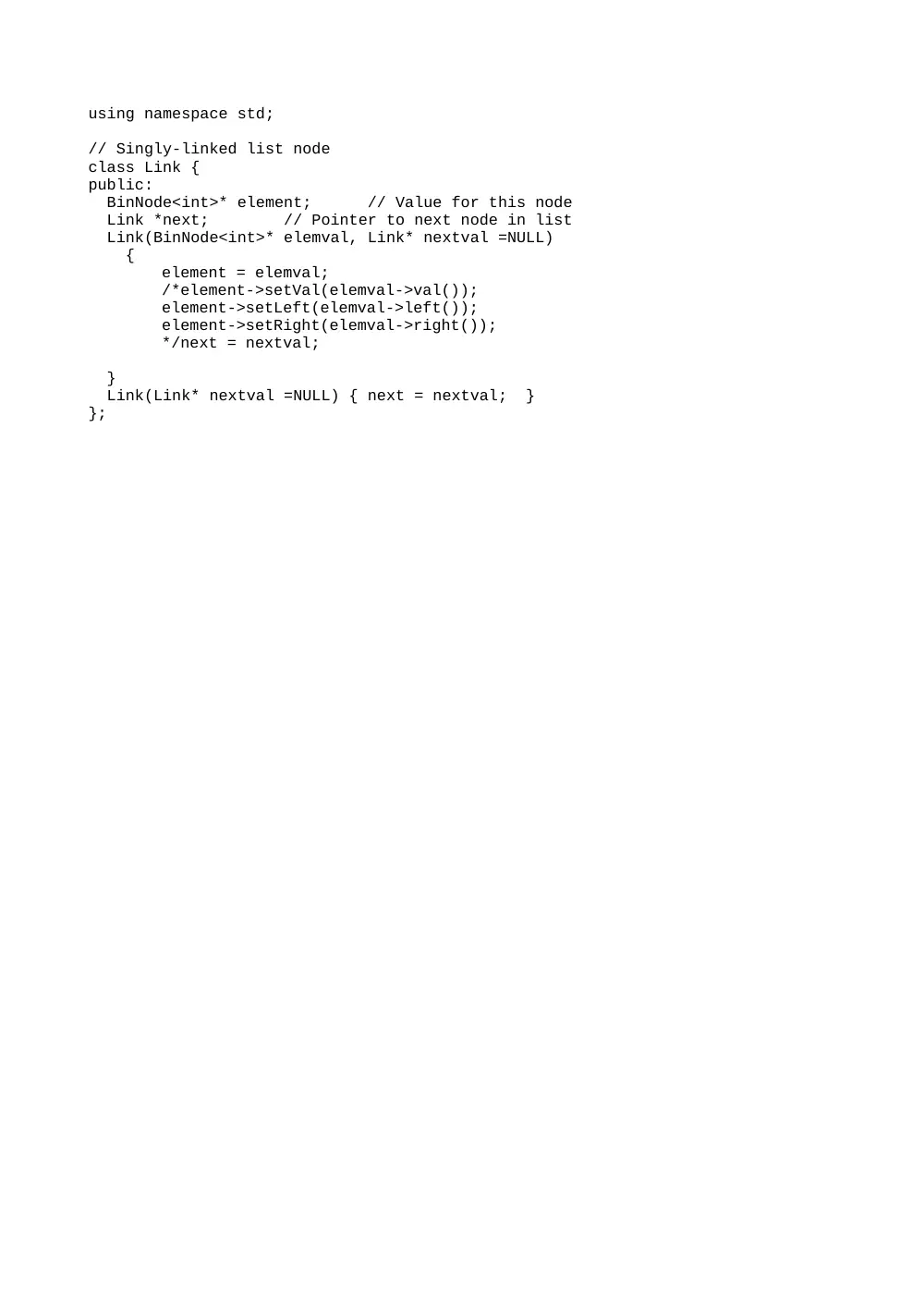
using namespace std;
// Singly-linked list node
class Link {
public:
BinNode<int>* element; // Value for this node
Link *next; // Pointer to next node in list
Link(BinNode<int>* elemval, Link* nextval =NULL)
{
element = elemval;
/*element->setVal(elemval->val());
element->setLeft(elemval->left());
element->setRight(elemval->right());
*/next = nextval;
}
Link(Link* nextval =NULL) { next = nextval; }
};
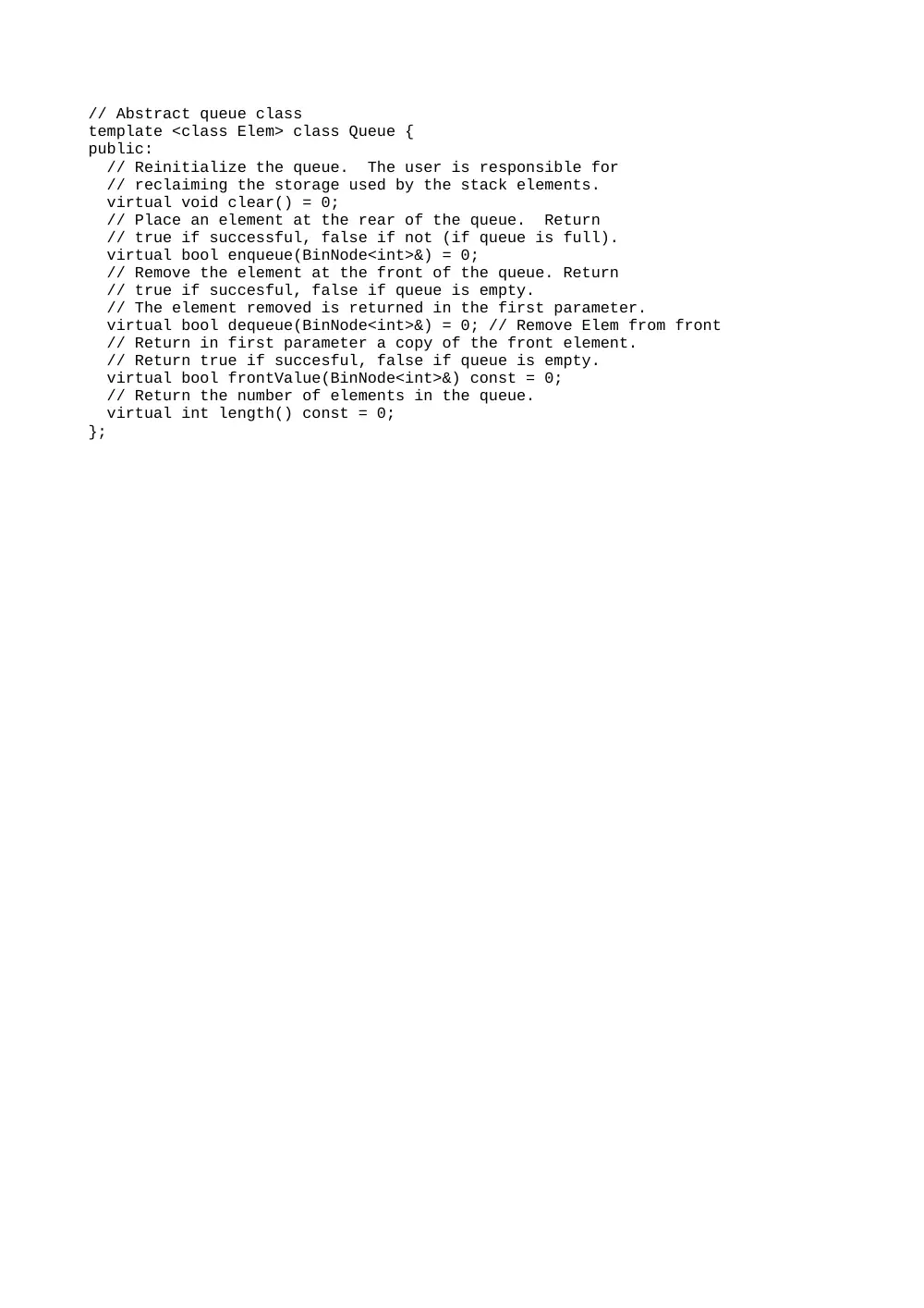
// Abstract queue class
template <class Elem> class Queue {
public:
// Reinitialize the queue. The user is responsible for
// reclaiming the storage used by the stack elements.
virtual void clear() = 0;
// Place an element at the rear of the queue. Return
// true if successful, false if not (if queue is full).
virtual bool enqueue(BinNode<int>&) = 0;
// Remove the element at the front of the queue. Return
// true if succesful, false if queue is empty.
// The element removed is returned in the first parameter.
virtual bool dequeue(BinNode<int>&) = 0; // Remove Elem from front
// Return in first parameter a copy of the front element.
// Return true if succesful, false if queue is empty.
virtual bool frontValue(BinNode<int>&) const = 0;
// Return the number of elements in the queue.
virtual int length() const = 0;
};
// This is the file to include in your code if you want access to the
// complete LQueue template class
// Include the link class
#include "bnlink.h"
// First, get the declaration for the base stack class
#include "bnlqueue.h"
// Linked queue implementation
template <class Elem> class LQueue: public Queue<Elem> {
private:
Link* front; // Pointer to front queue node
Link* rear; // Pointer to rear queue node
int size; // Number of elements in queue
public:
LQueue(int sz) // Constructor
{ front = NULL; rear = NULL; size = 0; }
~LQueue() { clear(); } // Destructor
void clear() { // Clear queue
while(front != NULL) { // Delete each link node
rear = front;
front = front->next;
delete rear;
}
rear = NULL;
size = 0;
}
bool enqueue(BinNode<int>& it) {
if (rear == NULL) // Empty queue
front = rear = new Link(&it, NULL);
else { // Append new node
rear->next = new Link(&it, NULL);
rear = rear->next;
}
size++;
return true;
}
bool dequeue(BinNode<int>& it) { // Remove Elem from front
if (size == 0) return false; // Empty
//it = front->element; // Store dequeued value
cout<<front->element->val()<<" ";
BinNode<int>* bn = front->element->left();
if (bn != NULL) enqueue(*bn);
bn = front->element->right();
if (bn != NULL) enqueue(*bn);
Link* ltemp = front; // Hold dequeued link
front = front->next; // Advance front
delete ltemp; // Delete link
if (front == NULL) rear = NULL; // Dequeued last element
size --;
dequeue(*bn);
return true; // Return element value
}
bool frontValue(BinNode<int>& it) const {
if (size == 0) return false;
//it = front->element;
return true;
}
virtual int length() const { return size; }
};
// Abstract queue class
template <class Elem> class Queue {
public:
// Reinitialize the queue. The user is responsible for
// reclaiming the storage used by the stack elements.
virtual void clear() = 0;
// Place an element at the rear of the queue. Return
// true if successful, false if not (if queue is full).
virtual bool enqueue(const Elem&) = 0;
// Remove the element at the front of the queue. Return
// true if succesful, false if queue is empty.
// The element removed is returned in the first parameter.
virtual bool dequeue(Elem&) = 0; // Remove Elem from front
// Return in first parameter a copy of the front element.
// Return true if succesful, false if queue is empty.
virtual bool frontValue(Elem&) const = 0;
// Return the number of elements in the queue.
virtual int length() const = 0;
};
#include <iostream>
#include "binnode.h"
//#include "BinaryNodeLinkedQueue.H"
#include "aqueue.h"
using namespace std;
template <class Elem>
void visit(const Elem& X) {cout << X->val() << " ";};
template <class Elem>
void printByLevel(BinNode<Elem>* subroot) {
AQueue<BinNode<Elem>*> q(999);
q.enqueue(subroot);
while (q.length()!=0) {
BinNode<Elem>* extracted;
q.dequeue(extracted);
visit(extracted);
if(extracted->left() != NULL) q.enqueue(extracted->left());
if(extracted->right()!= NULL) q.enqueue(extracted->right());
}
}
void main()
{
//
//
lvl 0 101
//
/ \
//
lvl 1 201 202
//
/ \
//
lvl 2
301 302
//
/
/ \
//
lvl 3 401
402 403
//
//
=> print by level: 101 > 201 > 202 > 301 > 302 > 401 > 402 >
403
BinNodePtr<int>* root = new BinNodePtr<int>(101);
root->setLeft(new BinNodePtr<int>(201));
root->setRight(new BinNodePtr<int>(202));
root->right()->setLeft(new BinNodePtr<int>(301));
root->right()->setRight(new BinNodePtr<int>(302));
root->right()->left()->setLeft(new BinNodePtr<int>(401));
root->right()->right()->setLeft(new BinNodePtr<int>(402));
root->right()->right()->setRight(new BinNodePtr<int>(403));
printByLevel(root);
cout<<endl;
}
// This is the file to include in your code if you want access to the
// complete AQueue template class
// First, get the declaration for the base stack class
#include "queue.h"
// Array-based queue implementation
template <class Elem> class AQueue: public Queue<Elem> {
private:
int size; // Maximum size of queue
int front; // Index of front element
int rear; // Index of rear element
Elem *listArray; // Array holding queue elements
public:
AQueue(int sz) { // Constructor
// Make list array one position larger for empty slot
size = sz+1;
rear = 0; front = 1;
listArray = new Elem[size];
}
~AQueue() { delete [] listArray; } // Destructor
void clear() { front = rear; }
bool enqueue(const Elem& it) {
if (((rear+2) % size) == front) return false; // Full
rear = (rear+1) % size; // Circular increment
listArray[rear] = it;
return true;
}
bool dequeue(Elem& it) {
if (length() == 0) return false; // Empty
it = listArray[front];
front = (front+1) % size; // Circular increment
return true;
}
bool frontValue(Elem& it) const {
if (length() == 0) return false; // Empty
it = listArray[front];
return true;
}
virtual int length() const
{ return ((rear+size) - front + 1) % size; }
};
// Binary tree node abstract class
template <class Elem> class BinNode {
public:
// Return the node's element
virtual Elem& val() = 0;
// Set the node's element
virtual void setVal(const Elem&) = 0;
// Return the node's left child
virtual BinNode* left() const = 0;
// Set the node's left child
virtual void setLeft(BinNode*) = 0;
// Return the node's right child
virtual BinNode* right() const = 0;
// Set the node's right child
virtual void setRight(BinNode*) = 0;
// Return true iff the node is a leaf
virtual bool isLeaf() = 0;
};
// Binary tree node class
template <class Elem>
class BinNodePtr : public BinNode<Elem> {
private:
Elem it; // The node's value
BinNodePtr* lc; // Pointer to left child
BinNodePtr* rc; // Pointer to right child
public:
// Two constructors -- with and without initial values
BinNodePtr() { lc = rc = NULL; }
BinNodePtr(Elem e, BinNodePtr* l =NULL,
BinNodePtr* r =NULL)
{ it = e; lc = l; rc = r; }
~BinNodePtr() {} // Destructor
Elem& val() { return it; }
void setVal(const Elem& e) { it = e; }
inline BinNode<Elem>* left() const { return lc; }
void setLeft(BinNode<Elem>* b) { lc = (BinNodePtr*)b; }
inline BinNode<Elem>* right() const { return rc; }
void setRight(BinNode<Elem>* b) { rc = (BinNodePtr*)b; }
bool isLeaf() { return (lc == NULL) && (rc == NULL); }
};
// Abstract queue class
template <class Elem> class Queue {
public:
// Reinitialize the queue. The user is responsible for
// reclaiming the storage used by the stack elements.
virtual void clear() = 0;
// Place an element at the rear of the queue. Return
// true if successful, false if not (if queue is full).
virtual bool enqueue(const Elem&) = 0;
// Remove the element at the front of the queue. Return
// true if succesful, false if queue is empty.
// The element removed is returned in the first parameter.
virtual bool dequeue(Elem&) = 0; // Remove Elem from front
// Return in first parameter a copy of the front element.
// Return true if succesful, false if queue is empty.
virtual bool frontValue(Elem&) const = 0;
// Return the number of elements in the queue.
virtual int length() const = 0;
};
#include <iostream.h>
#include <stdlib.h>
//#include "book.h"
#include "binnode.h"
#include "AQUEUE.h"
// Stick these in to test the preorder routine
template <class Elem>
void visit(const Elem& X) {cout << X->val() << endl;}
template <class Elem>
void inorder(BinNode<Elem>* subroot) {
if (subroot == NULL) return; // Empty subtree, do nothing
inorder(subroot->left());
visit(subroot); // Perform whatever action is desired
inorder(subroot->right());
}
int max(int x,int y)
{
if(x>y) return x;
else return y;
}
template <class Elem>
int height(BinNode<Elem>* subroot)
{
if(subroot == NULL) return 0;
return 1+max(height(subroot->left()),height(subroot->right()));
}
template <class Elem>
int count(BinNode<Elem>* subroot)
{
if(subroot == NULL) return 0;
return 1+ count(subroot->left()) + count(subroot->right());
}
template <class Elem>
int numLeaf(BinNode<Elem>* subroot)
{
if(subroot == NULL) return 0;
if(subroot->isLeaf() == true ) return 1;
else return numLeaf(subroot->left()) + numLeaf(subroot->right());
}
template <class Elem>
void level(BinNode<Elem>* subroot)
{
AQueue<BinNode<Elem>*> q(999);
q.enqueue(subroot);
while(q.length()!=0)
{
BinNode<Elem>* temp;
q.dequeue(temp);
visit(temp);
if(temp->left() != NULL) q.enqueue(temp->left());
if(temp->right()!= NULL) q.enqueue(temp->right());
}
}
// Test the preorder traversal routines
int main()
{
BinNodePtr<int>* root = new BinNodePtr<int>(10);
root->setLeft(new BinNodePtr<int>(15));
root->setRight(new BinNodePtr<int>(20));
cout<<"Height is :"<<height(root)<<endl;
cout<<"Count is :"<<count(root)<<endl;
cout<<"Number of leafs :"<<numLeaf(root)<<endl;
cout<<"Inorder traversal:"<<endl;
inorder(root);
cout<<endl;
cout<<"Level printing:"<<endl;
level(root);
cout<<endl;
return 1;
}