
EECE 330 Questions Midterm Sample, Fall 2011
American University of Beirut · Data Structures and Algorithms · 2 pages · Prof. Hassan Artail

More EECE 330 files
- Midterm · Fall 2014ExamView
- Midterm With Solutions · Fall 2013Exam · with solutionView
- Midterm Sample Questions · Fall 2011ExamView
- Exam 2 · Fall 2009ExamView
- Exam 1 · Fall 2009ExamView
- Exam 1 · Spring 2008ExamView
- Exam 1 with Answers · Spring 2008Exam · with solutionView
- Exam 1 · Spring 2008ExamView
Show the text of this exam
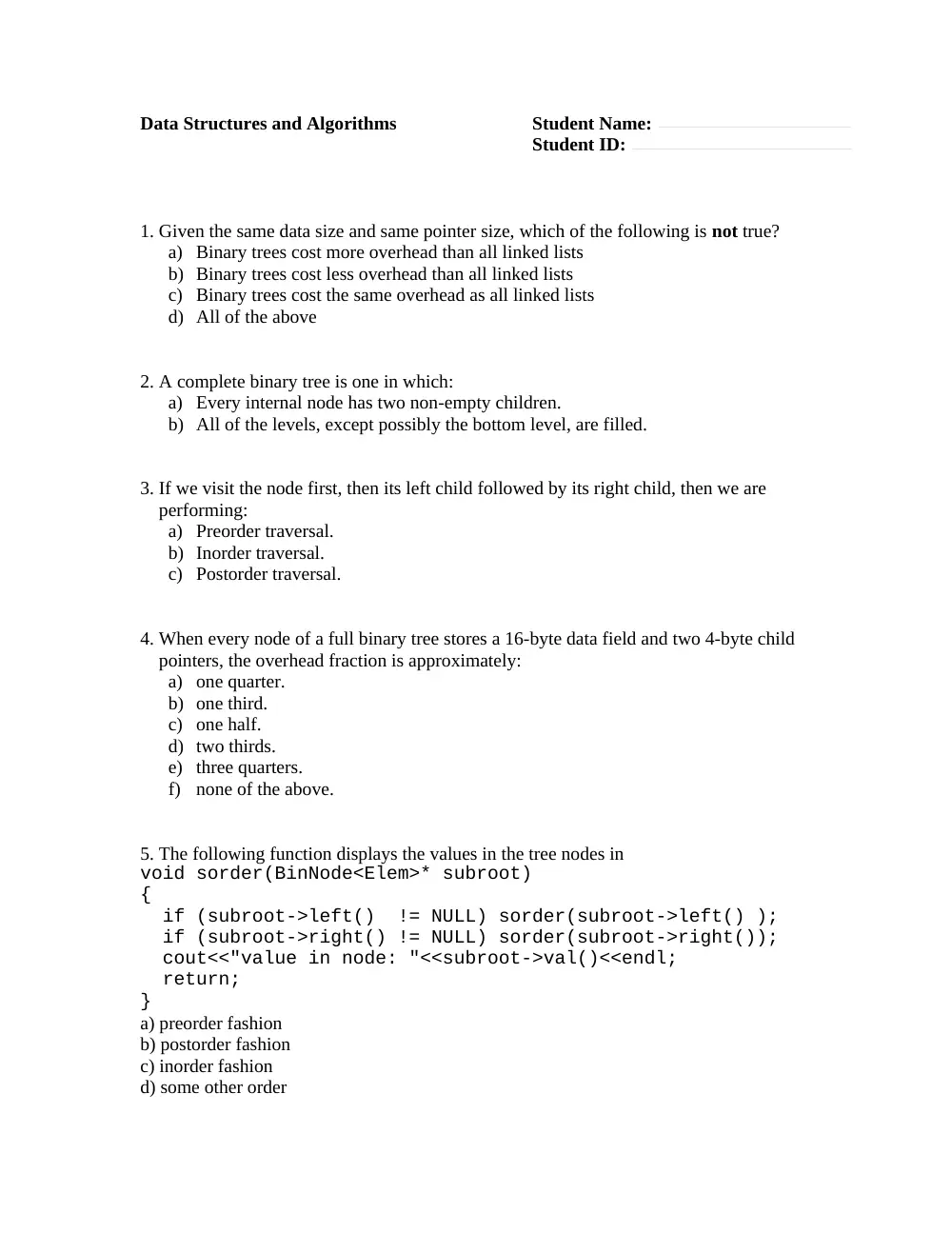
Data Structures and Algorithms
Student Name:
Student ID:
1. Given the same data size and same pointer size, which of the following is not true?
a) Binary trees cost more overhead than all linked lists
b) Binary trees cost less overhead than all linked lists
c) Binary trees cost the same overhead as all linked lists
d) All of the above
2. A complete binary tree is one in which:
a) Every internal node has two non-empty children.
b) All of the levels, except possibly the bottom level, are filled.
3. If we visit the node first, then its left child followed by its right child, then we are
performing:
a) Preorder traversal.
b) Inorder traversal.
c) Postorder traversal.
4. When every node of a full binary tree stores a 16-byte data field and two 4-byte child
pointers, the overhead fraction is approximately:
a) one quarter.
b) one third.
c) one half.
d) two thirds.
e) three quarters.
f)
none of the above.
5. The following function displays the values in the tree nodes in
void sorder(BinNode<Elem>* subroot)
{
if (subroot->left() != NULL) sorder(subroot->left() );
if (subroot->right() != NULL) sorder(subroot->right());
cout<<"value in node: "<<subroot->val()<<endl;
return;
}
a) preorder fashion
b) postorder fashion
c) inorder fashion
d) some other order
6. Given the array implementation of stacks, what is the third line displayed by the code:
AStack<int> s1(10);
for (int i=0; i<4;i++)
s1.push(i);
while(s1.pop(i))
cout<<i<<endl;
a- 0
b-1
c-2
d-3
7. The function push in the linked list implementation of stacks is modified and
implemented as follows:
bool push(const Elem& item) {
if(top==NULL)
top = new Link<Elem>(item, top);
else
top->next = new Link<Elem>(item, top->next);
size++;
return true; }
All other functions or code remain unchanged.
What is the second line displayed by the code:
LStack<int> s1(10);
for (int i=0; i<4;i++)
s1.push(i);
while(s1.pop(i))
cout<<i<<endl;
a-0
b-1
c-2
d-3
8. In which order the tree below is traversed by the code:
template<Elem>
void order (BinNode<Elem>* root)
{
if (root==NULL)
return;
cout<<root->val<<endl;
order(root->right);
order(root->left);
}
a- ABCFGIKLMN
b- AKNLMBCGIF
c- FCGIBALMKN
d- NKMLABIGCF