
EECE 380 Homework 6 Solution, Fall 2016
American University of Beirut · Engineering Electromagnetics · 14 pages · with solution


Showing the first 10 of 14 pages. Download the PDF to see all of it.
More EECE 380 files
- Other Formula Sheet 2 · Fall 2014FileView
- Exam 1 with Solution · Spring 2014Exam · with solutionView
- Exam 2 with Solutions · Spring 2014Exam · with solutionView
- Other Final Formula Sheet · Fall 2013Final examView
- Exam 2 With Solution · Fall 2013Exam · with solutionView
- Exam 1 · Spring 2013ExamView
- Exam 1 With Answers · Fall 2013Exam · with solutionView
- Exam 1 · Spring 2012ExamView
Show the text of this homework
Homework 6 Solution
Chapter 5
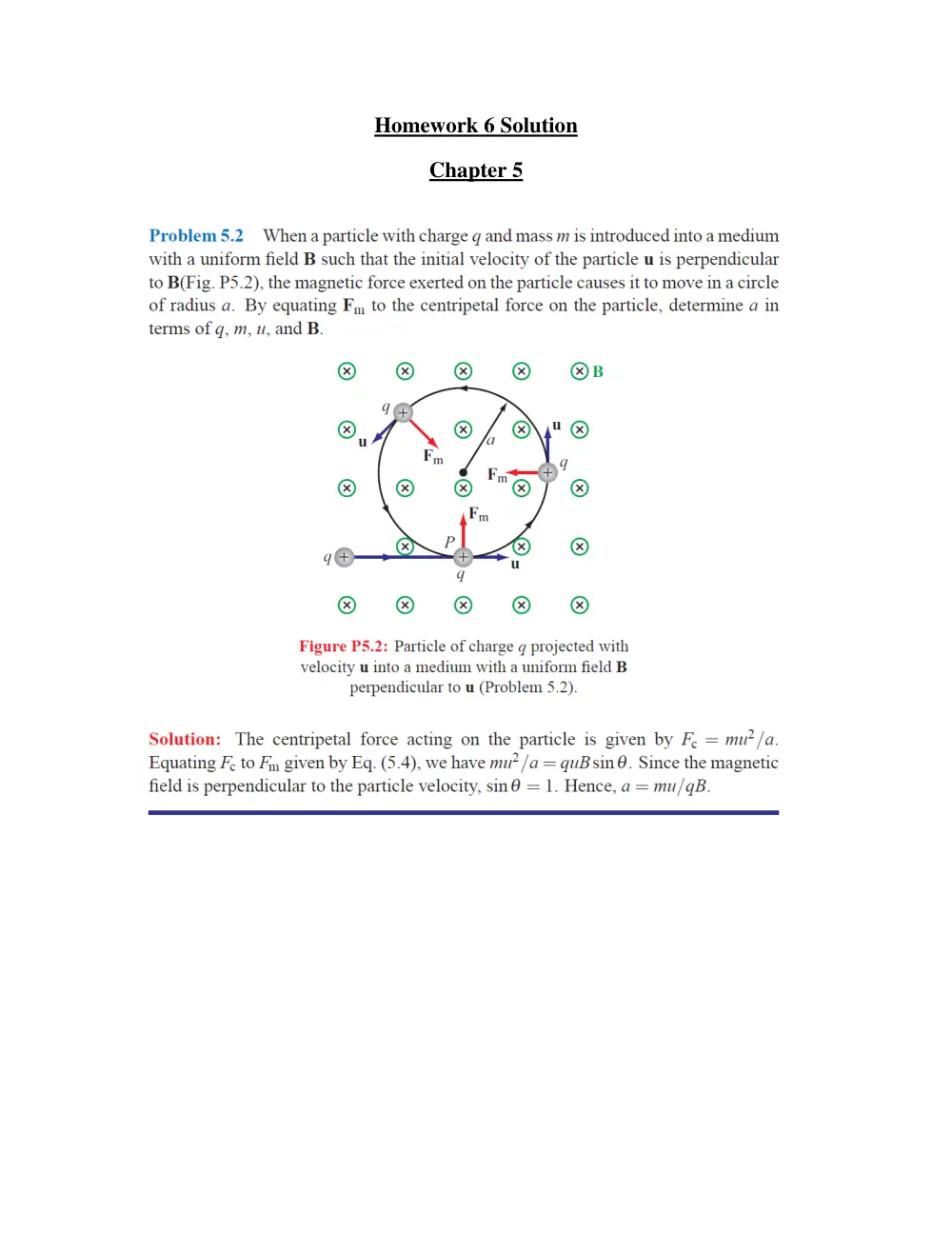
Problem 5.2 Whena particle with charge g and mass m is introduced into a medium
with a uniform field B such that the initial velocity of the particle u is perpendicular
to B(Fig. P5.2), the magnetic force exerted on the particle causes it to move in a circle
of radius a. By equating F,, to the centripetal force on the particle, determine a in
terms of g, m, u, and B.
© © ®© © ®
Figure P5.2: Particle of charge g projected with
velocity u into a medium with a uniform field B
perpendicular to u (Problem 5.2).
Solution: The centripetal force acting on the particle is given by K = mu?/a.
Equating F, to Fy given by Eq. (5.4), we have mu? /a = quBsin@. Since the magnetic
field is perpendicular to the particle velocity, sin @ = 1. Hence, a = mu/qB.
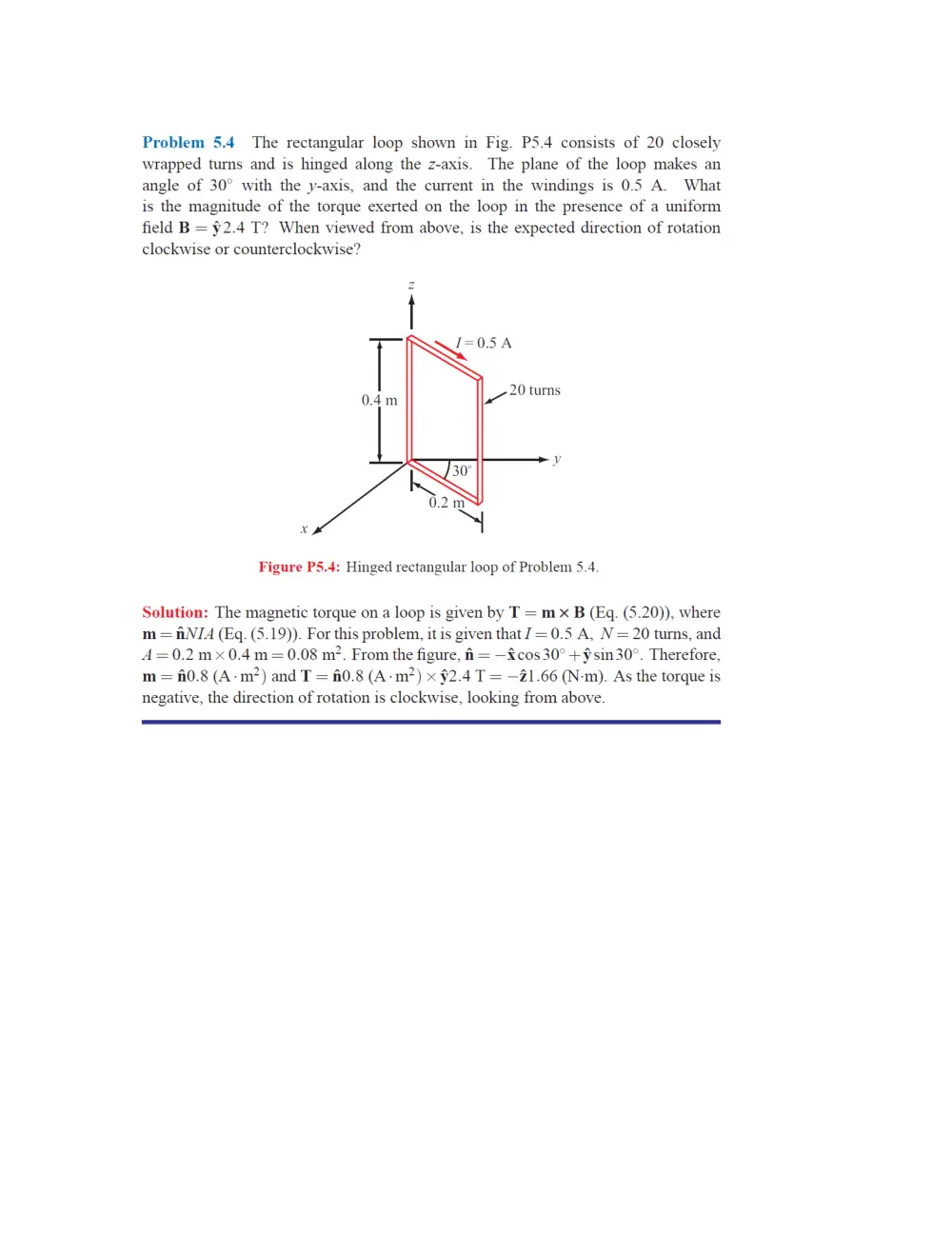
Problem 5.4 The rectangular loop shown in Fig. P5.4 consists of 20 closely
wrapped turns and is hinged along the z-axis. The plane of the loop makes an
angle of 30° with the y-axis, and the current in the windings is 0.5 A. What
is the magnitude of the torque exerted on the loop in the presence of a uniform
field B = y2.4 T? When viewed from above, is the expected direction of rotation
clockwise or counterclockwise?
|
SS
7 U2 turns
SJ y
KS m
in
>
KN
™
Figure P5.4: Hinged rectangular loop of Problem 5.4.
Solution: The magnetic torque on a loop is given by T = m x B (Eq. (5.20)), where
m= AaN/d (Eq. (5.19)). For this problem, it is given that J = 0.5 A, N = 20 turns, and
A=0.2 mx 0.4 m= 0.08 m?. From the figure, fi = —%cos30° + $sin30°. Therefore,
m = fi0.8 (A-m?) and T = 0.8 (A-m?) x $2.4 T = —21.66 (N-m). As the torque is
negative, the direction of rotation is clockwise, looking from above.
Problem 5.12 Two infinitely long, parallel wires are carrying 6-A currents in
opposite directions. Determine the magnetic flux density at point P in Fig. P5.12.
1,=6A Ih=6A
P
—-e
0.5 m
- 2m >
Figure P5.12: Arrangement for Problem 5.12.
Solution:
2 Ho 2 SHo
)7¢ 7 Ot2)=9 — (D-
3 Mol 2 Mol
B=o7705) 1? amas
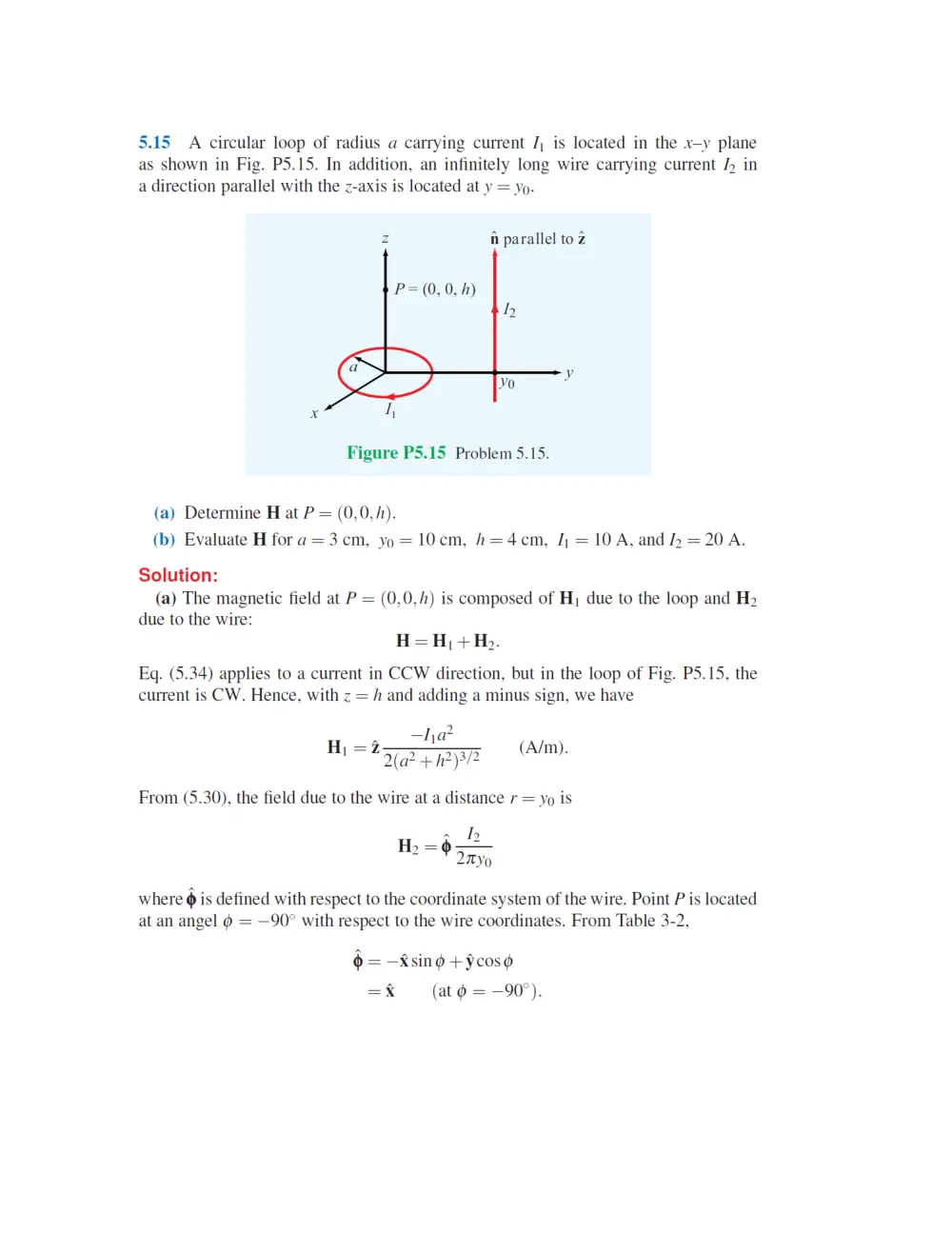
5.15 A circular loop of radius a carrying current /, is located in the x—y plane
as shown in Fig. P5.15. In addition, an infinitely long wire carrying current J; in
a direction parallel with the z-axis is located at y = yo.
N
N parallel to z
P= (0,0, h)
x I,
Figure P5.15 Problem 5.15.
(a) Determine H at P = (0,0,/).
(b) Evaluate H fora =3cm, yo = 10cm, h=4cm, J, = 10 A, and h = 20 A.
Solution:
(a) The magnetic field at P = (0,0,/) is composed of H; due to the loop and H>
due to the wire:
H=H,+H.
Eq. (5.34) applies to a current in CCW direction, but in the loop of Fig. P5.15, the
current is CW. Hence, with z = /) and adding a minus sign, we have
la’
H, =2——"“ __
14724 RpP
(A/m).
From (5.30), the field due to the wire at a distance r = yo is
h
I= 2myo
where 6 is defined with respect to the coordinate system of the wire. Point P is located
at an angel @ = —90° with respect to the wire coordinates. From Table 3-2,
$ = —Xsing + feos
= (at @ = —90°).
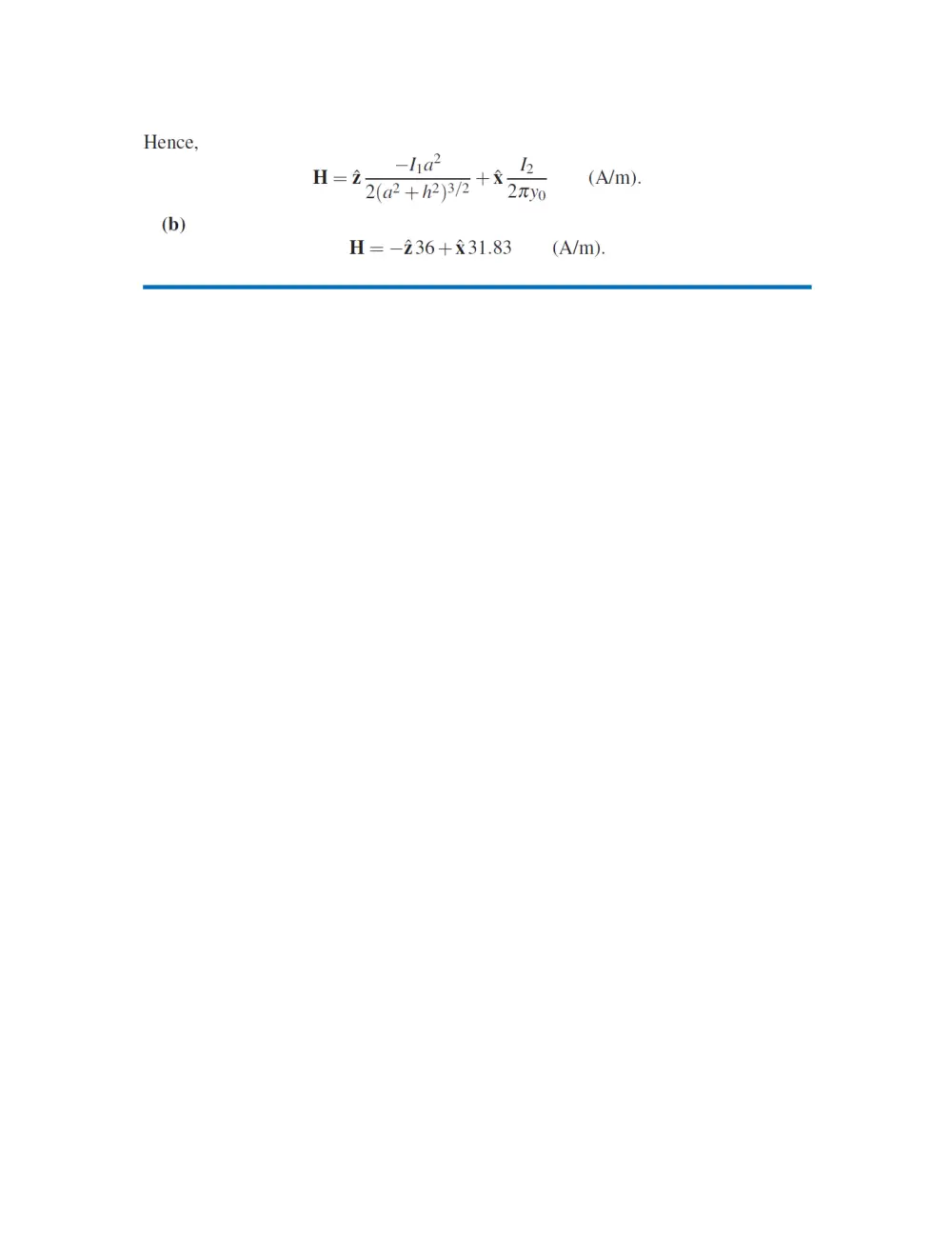
Hence,
—la* . b
Z x A/m).
2(a2 + h?)3/2 + 2m (A/m)
(b)
H = —236+X31.83 (A/m).
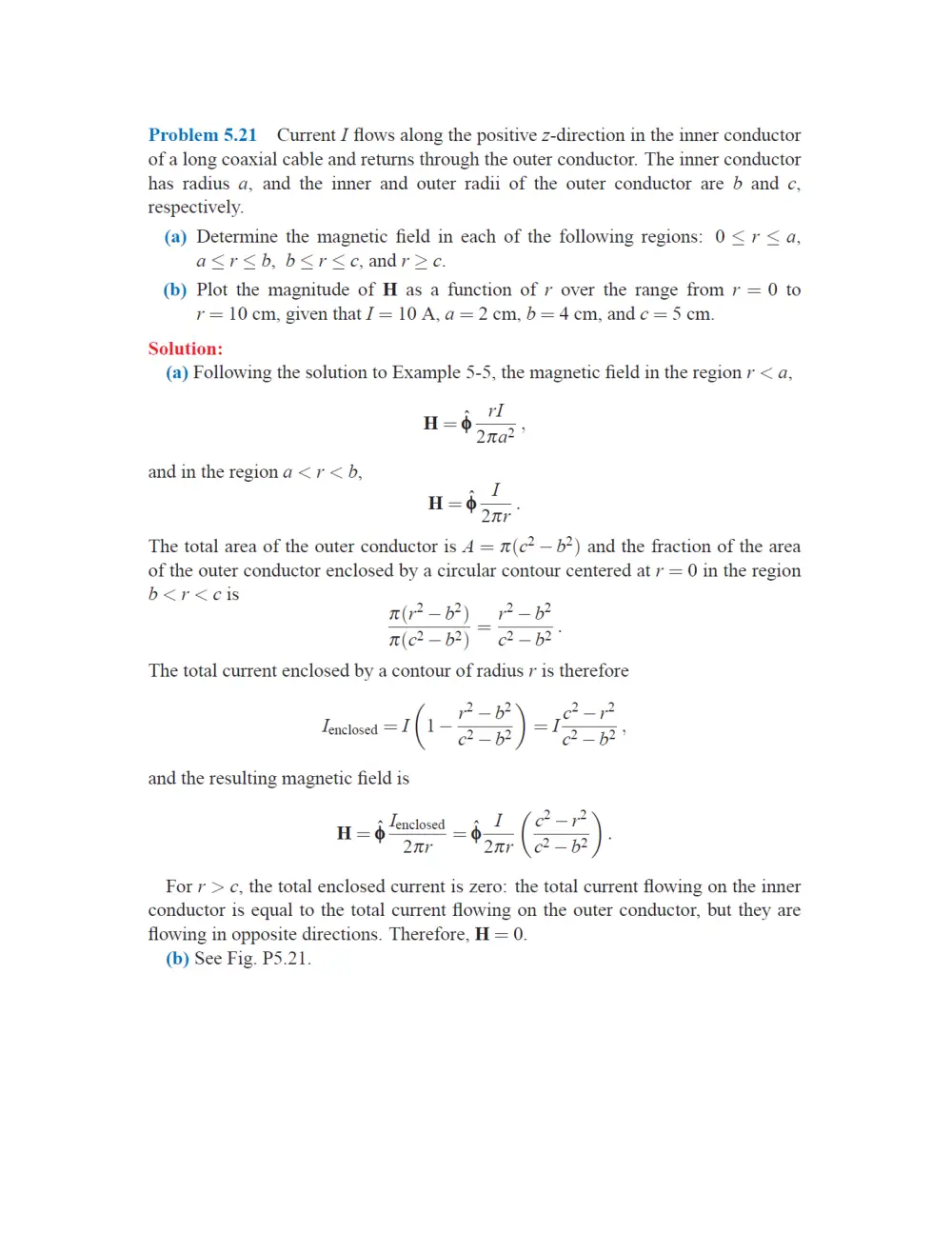
Problem 5.21 Current J flows along the positive z-direction in the inner conductor
of a long coaxial cable and returns through the outer conductor. The inner conductor
has radius a, and the inner and outer radii of the outer conductor are b and c,
respectively.
(a) Determine the magnetic field in each of the following regions: 0 <r <a,
a<r<b, b<r<c,andr>c.
(b) Plot the magnitude of H as a function of r over the range from r = 0 to
r= 10cm, given that 7 = 10 A,a=2 cm, b=4 cm, andc =5 cm.
Solution:
(a) Following the solution to Example 5-5, the magnetic field in the region r < a,
2 rT
H= ;
6 2na?
and in the region a <r <b,
H-$—
~ "Onr’
The total area of the outer conductor is A = 2(c* — b”) and the fraction of the area
of the outer conductor enclosed by a circular contour centered at r = 0 in the region
b<r<cis
n(?—b?) rr —b
m(c2—b?) c2—b?
The total current enclosed by a contour of radius r is therefore
>
rb ear
Tenclosed = I (1 _ ) =I
Cb cb”
and the resulting magnetic field is
+ Tenclosed » I ear
H= = .
° 2ar oor ( - =)
For r > c, the total enclosed current is zero: the total current flowing on the inner
conductor is equal to the total current flowing on the outer conductor, but they are
flowing in opposite directions. Therefore, H = 0.
(b) See Fig. PS.21.
Magnetic field magnitude H (A/cm)
0.8
0.7
0.6
0.5
04
Radial distance r (cm)
Figure P5.21: Problem 5.21.
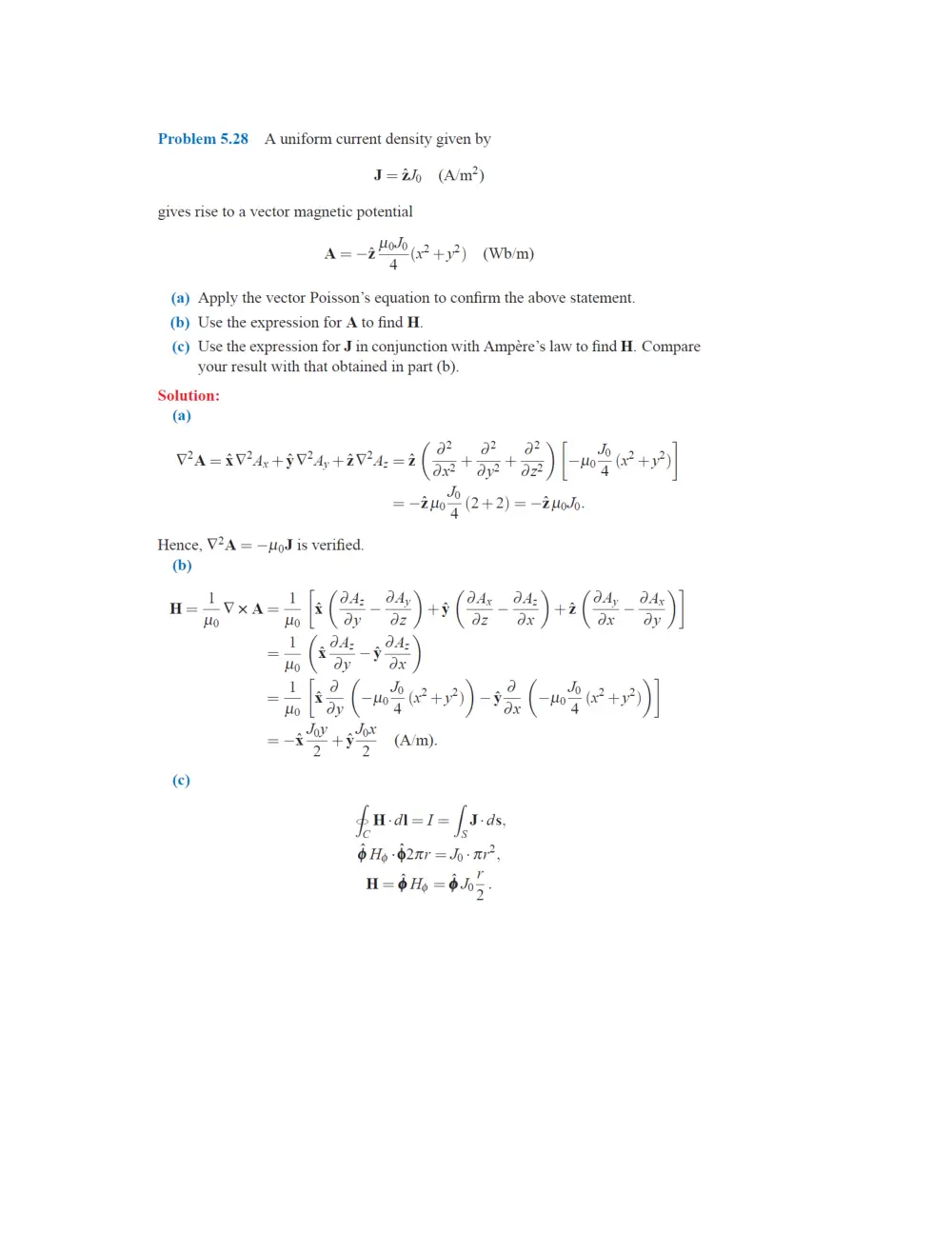
Problem 5.28 A uniform current density given by
J=ih (Alm?)
gives rise to a vector magnetic potential
A=-z Hod (42 +3?) (Wb/m)
(a) Apply the vector Poisson’s equation to confirm the above statement.
(b) Use the expression for A to find H.
(c) Use the expression for J in conjunction with Ampére’s law to find H. Compare
your result with that obtained in part (b).
Solution:
(a)
5 2 2 PP J
VAS SVE +902, +202 <2 ( )| °
_ 2,2
oe oy? +32 Hoy (ty |
~ J .
= two? (242) = —ZUoJo.
Hence, V7A = —[oJ is verified.
(b)
1 1 [. (0A: OA, . (OAy OA: . (OA, AAx
= Vv = = _ yy
Be A io (SS B30 (3 me (S ay
_ 1 (gad: _ 404:
~~ Uo oy vox
a1 fg? (pp 2-4yy) 92 (p19? 2 492
~ ho Ik ( Mo ( +¥") } —¥5_ | Hog @ +y¥)
(©)
pH-dl=I= [o.
$ Ho 420 = Jy nr,
H=$H, =bh5.
uy
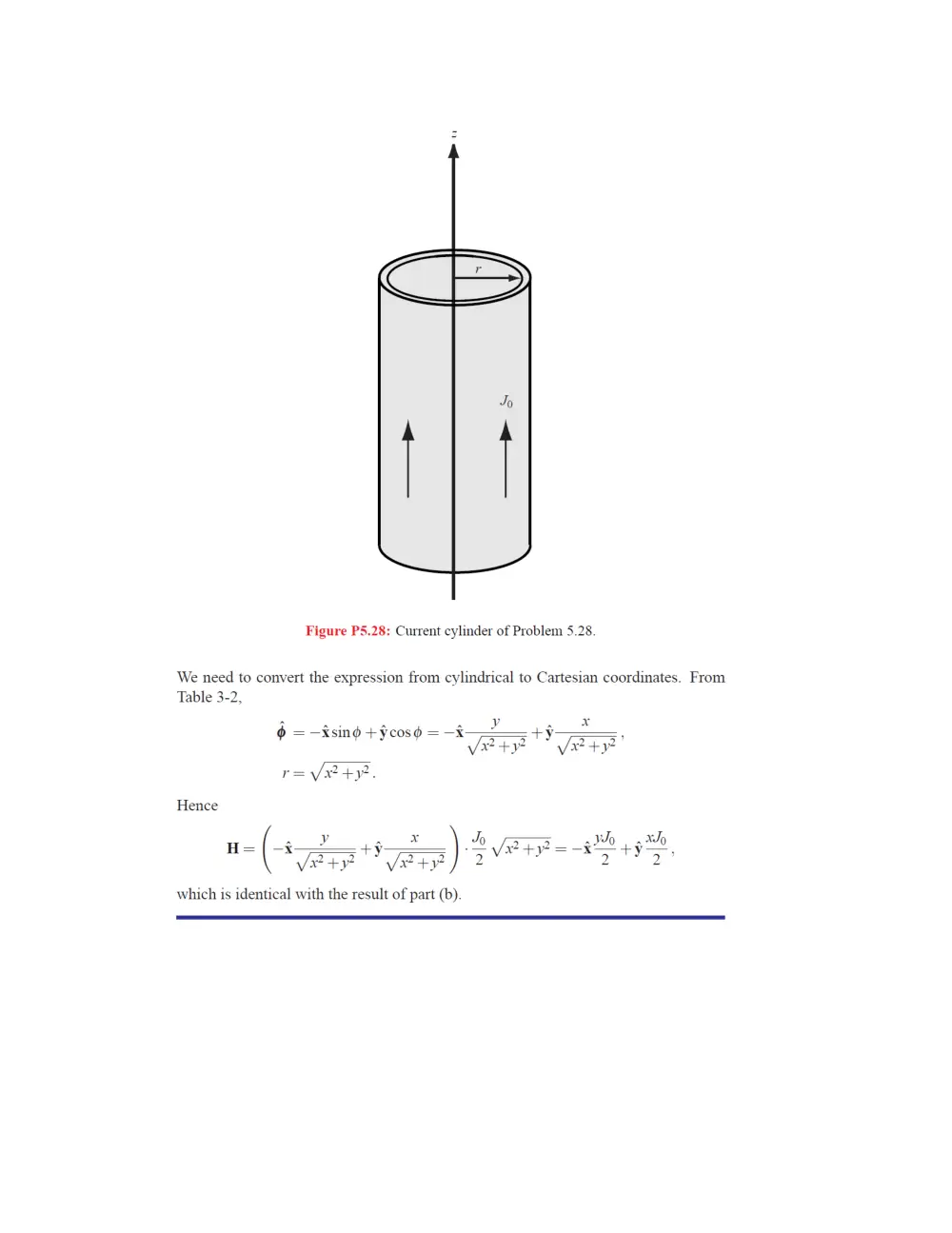
Figure P5.28: Current cylinder of Problem 5.28.
We need to convert the expression from cylindrical to Cartesian coordinates. From
Table 3-2,
: .. . . , x
@ = —Xsing + ycosd = -kK—=—— + J ——_,
Xx? +? x? +32
r=Vx+y.
Hence
7 y . x J 5 VJ XJ
H= | -%—=—= + y= ]- 9 ety as 98,
which is identical with the result of part (b).
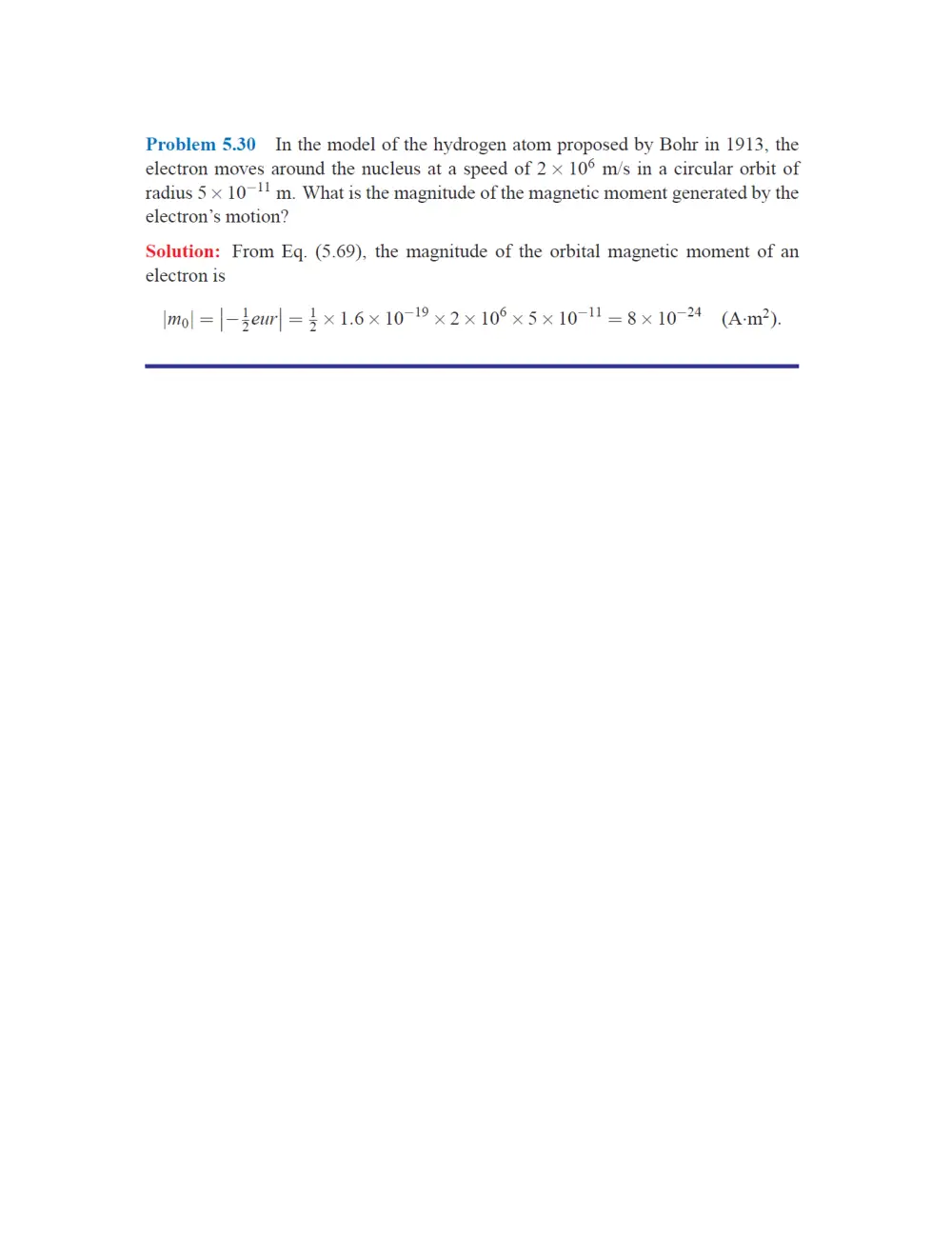
Problem 5.30 In the model of the hydrogen atom proposed by Bohr in 1913, the
electron moves around the nucleus at a speed of 2 x 10° m/s in a circular orbit of
radius 5 x 10~!! m. What is the magnitude of the magnetic moment generated by the
electron’s motion?
Solution: From Eq. (5.69), the magnitude of the orbital magnetic moment of an
electron is
|mo| = |—4eur| =4 x 1.6« 10°? x 2x 10°x 5x10 =8x10⁷ (Am’).