
EECE 431 Syllabus, Fall 2017
American University of Beirut · Design and Analysis of Algorithms · 3 pages · Dr. Louay Bazzi
More EECE 431 files
Show the text of this lab
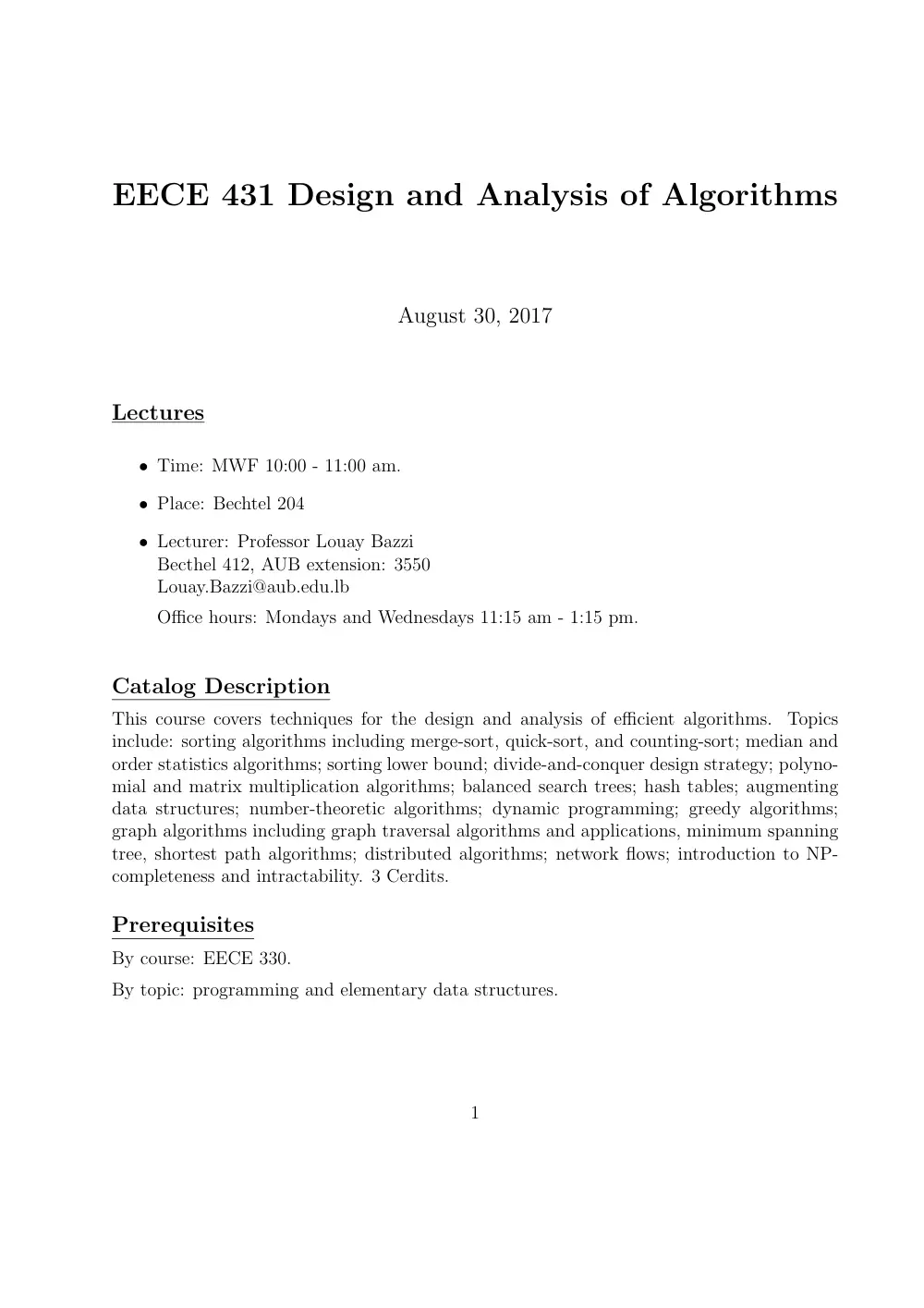
EECE 431 Design and Analysis of Algorithms
August 30, 2017
Lectures
• Time: MWF 10:00 - 11:00 am.
• Place: Bechtel 204
• Lecturer: Professor Louay Bazzi
Becthel 412, AUB extension: 3550
Louay.Bazzi@aub.edu.lb
Office hours: Mondays and Wednesdays 11:15 am - 1:15 pm.
Catalog Description
This course covers techniques for the design and analysis of efficient algorithms.
Topics
include: sorting algorithms including merge-sort, quick-sort, and counting-sort; median and
order statistics algorithms; sorting lower bound; divide-and-conquer design strategy; polyno-
mial and matrix multiplication algorithms; balanced search trees; hash tables; augmenting
data structures; number-theoretic algorithms; dynamic programming; greedy algorithms;
graph algorithms including graph traversal algorithms and applications, minimum spanning
tree, shortest path algorithms; distributed algorithms; network flows; introduction to NP-
completeness and intractability. 3 Cerdits.
Prerequisites
By course: EECE 330.
By topic: programming and elementary data structures.
1
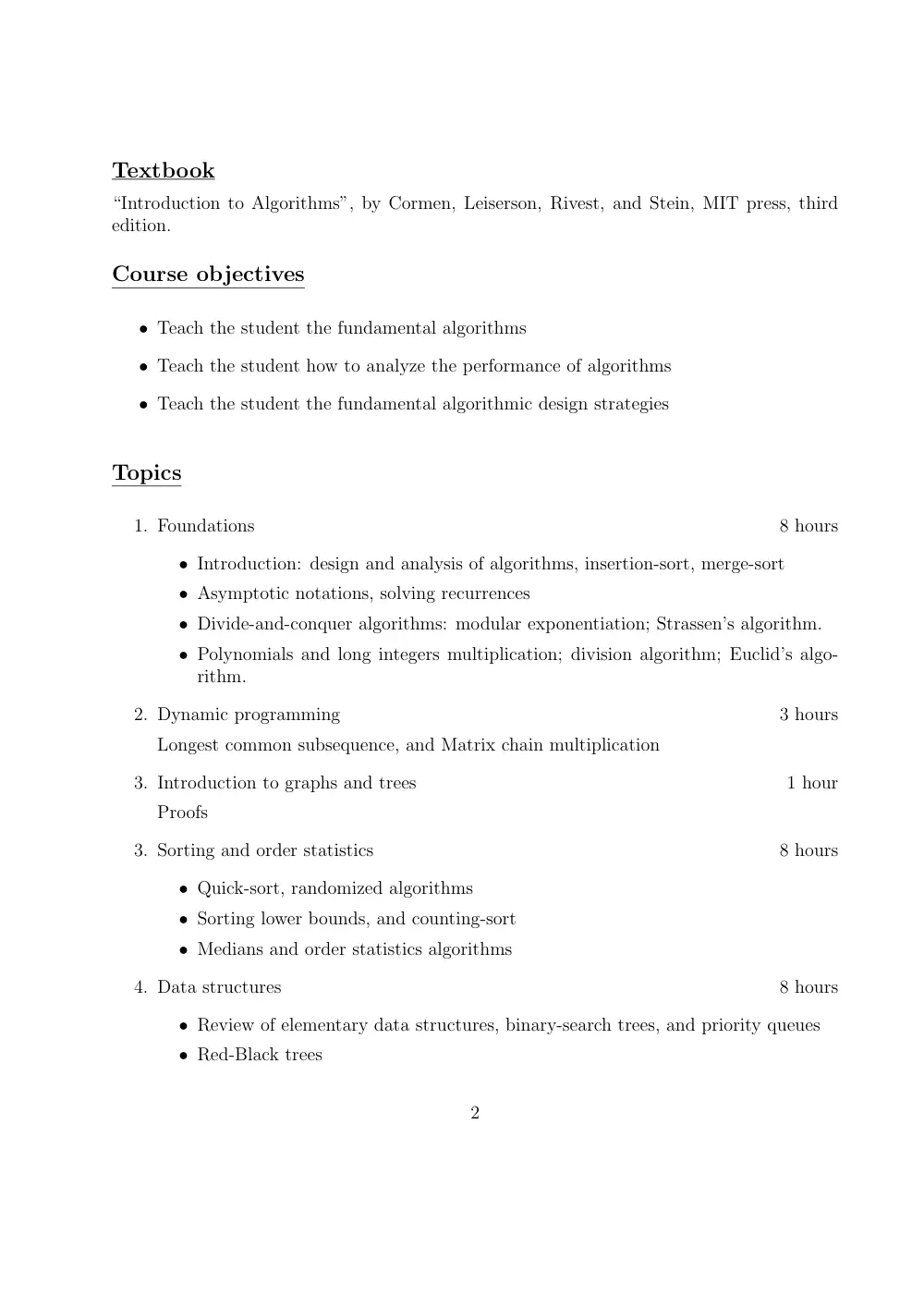
Textbook
“Introduction to Algorithms”, by Cormen, Leiserson, Rivest, and Stein, MIT press, third
edition.
Course objectives
• Teach the student the fundamental algorithms
• Teach the student how to analyze the performance of algorithms
• Teach the student the fundamental algorithmic design strategies
Topics
1. Foundations
8 hours
• Introduction: design and analysis of algorithms, insertion-sort, merge-sort
• Asymptotic notations, solving recurrences
• Divide-and-conquer algorithms: modular exponentiation; Strassen’s algorithm.
• Polynomials and long integers multiplication; division algorithm; Euclid’s algo-
rithm.
2. Dynamic programming
3 hours
Longest common subsequence, and Matrix chain multiplication
3. Introduction to graphs and trees
1 hour
Proofs
3. Sorting and order statistics
8 hours
• Quick-sort, randomized algorithms
• Sorting lower bounds, and counting-sort
• Medians and order statistics algorithms
4. Data structures
8 hours
• Review of elementary data structures, binary-search trees, and priority queues
• Red-Black trees
2
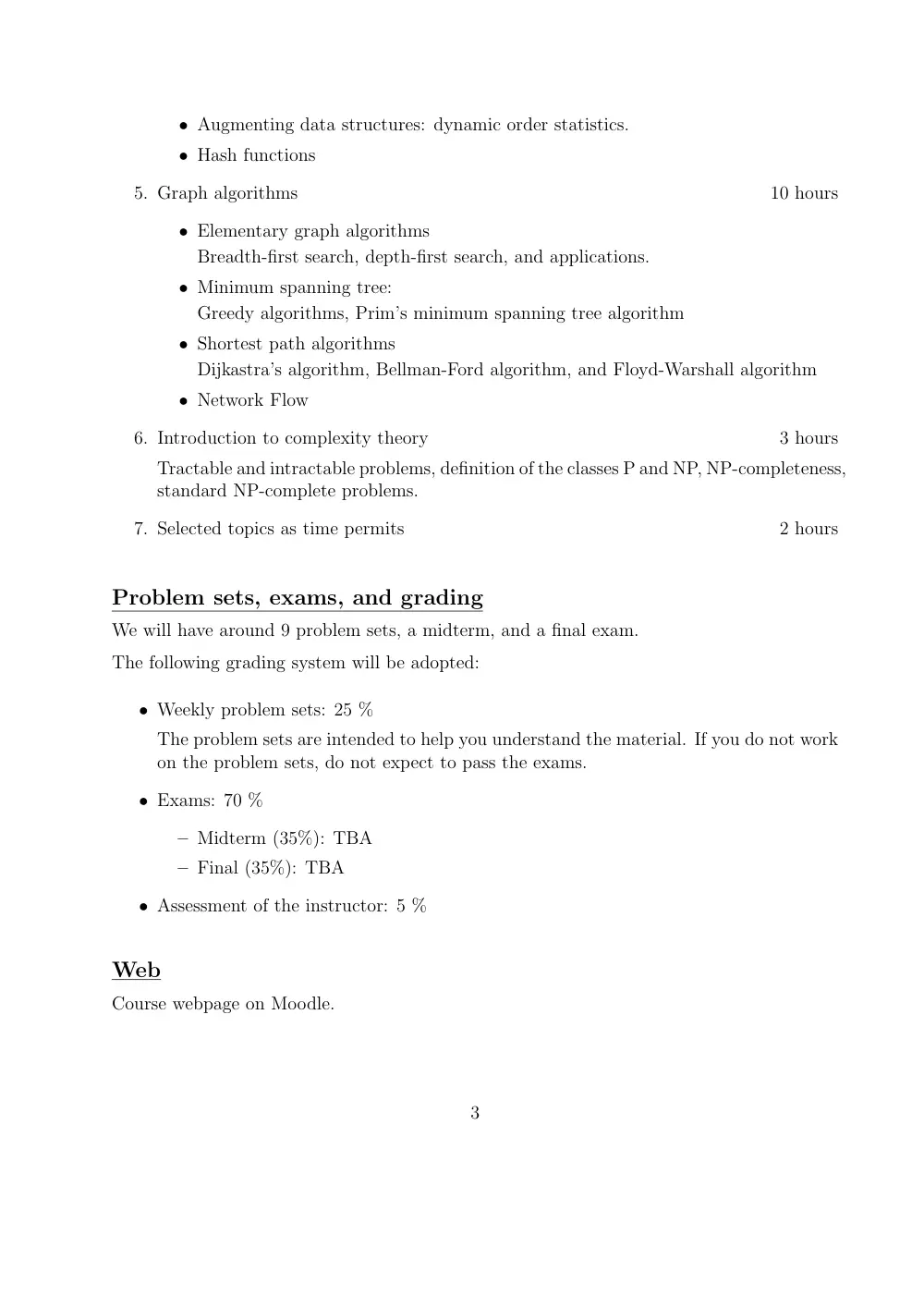
• Augmenting data structures: dynamic order statistics.
• Hash functions
5. Graph algorithms
10 hours
• Elementary graph algorithms
Breadth-first search, depth-first search, and applications.
• Minimum spanning tree:
Greedy algorithms, Prim’s minimum spanning tree algorithm
• Shortest path algorithms
Dijkastra’s algorithm, Bellman-Ford algorithm, and Floyd-Warshall algorithm
• Network Flow
6. Introduction to complexity theory
3 hours
Tractable and intractable problems, definition of the classes P and NP, NP-completeness,
standard NP-complete problems.
7. Selected topics as time permits
2 hours
Problem sets, exams, and grading
We will have around 9 problem sets, a midterm, and a final exam.
The following grading system will be adopted:
• Weekly problem sets: 25 %
The problem sets are intended to help you understand the material. If you do not work
on the problem sets, do not expect to pass the exams.
• Exams: 70 %
– Midterm (35%): TBA
– Final (35%): TBA
• Assessment of the instructor: 5 %
Web
Course webpage on Moodle.
3