
EECE 442 Midterm, Summer 2007
American University of Beirut · Communication Systems · 5 pages
More EECE 442 files
Show the text of this exam
EECE 442 — Communication Systems Midterm Exam Page 1 OF 5
Summer 2007
AMERICAN UNIVERSITY OF BEIRUT
FACULTY OF ENGINEERING AND ARCHITECTURE
ELECTRICAL AND COMPUTER ENGINEERING DEPARTMENT
EECE 442 - Communication Systems
MIDTERM EXAM
Closed book exam
FOUR SHEETS OF FORMULAS WITH NO PROBLEM SOLUTIONS ARE
ALLOWED
TIME: 1 % HOURS
JULY 26, 2007
INSTRUCTOR: Dr. JEAN J, SAADE
NAME : ID#:
INSTRUCTIONS
> Write your Name and ID # on this sheet, the computer card and the scratch
booklet in the provided spaces.
>» Provide your answer on the computer card and solution of each problem on
the scratch booklet.
> Random checking wilt be done to find out about any inconsistency between
the problem solutions on the scratch and provided answers on the computer
card.
> Return the computer card, this question sheet and the scratch booklet when
you finish the test.
All questions are equally weighted in grading.
y
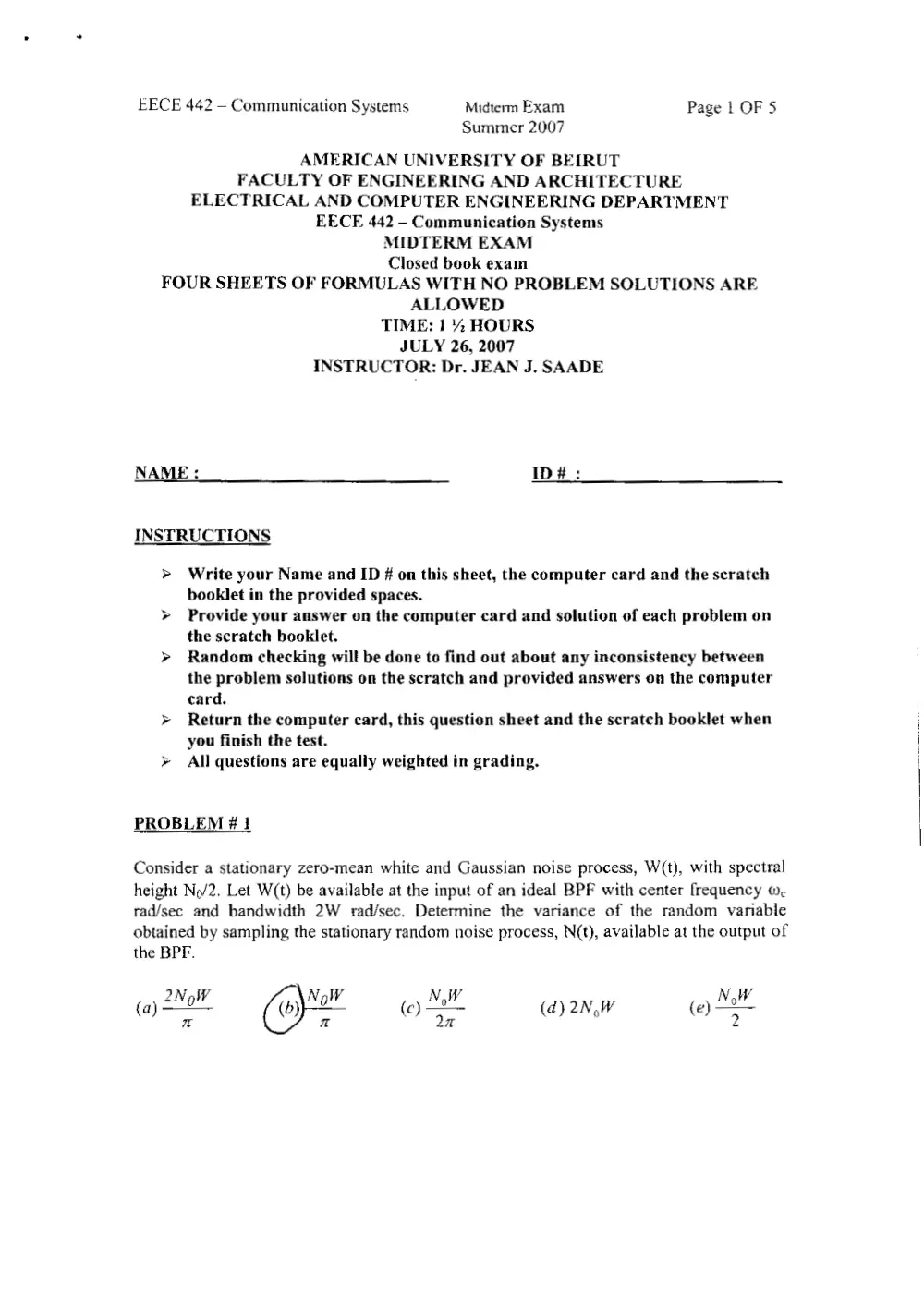
PROBLEM # 1
Consider a stationary zero-mean white and Gaussian noise process, W(t), with spectral
height No/2. Let W(t) be available at the input of an ideal BPF with center frequency @,
rad/sec and bandwidth 2W rad/sec. Determine the variance of the random variable
obtained by sampling the stationary random noise process, N(t), available at the output of
the BPF.
2 Ww NOW Ww
Nol (one (c) Me (4) 2N,W (Ms
7 ra Qa 2
{a)
EECE 442 — Communication Systems Midterm Exam Page 2 OF 5
Summer 2007
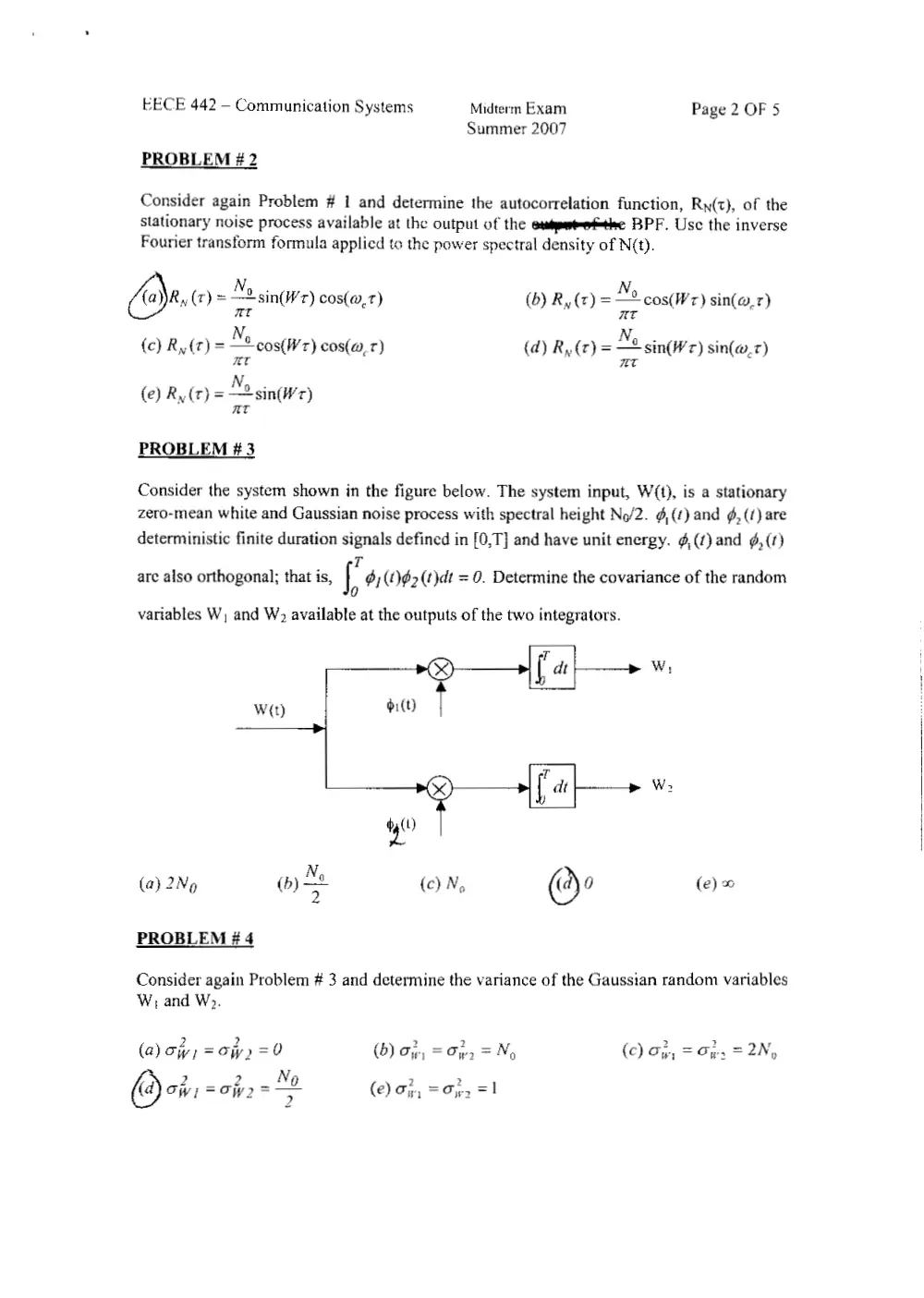
PROBLEM #2
Consider again Problem # 1 and determine the autocorrelation function, Ry(t}, of the
Stationary noise process available at the output of the eapemettec BPF. Usc the inverse
Fourier transform formula applied to the power spectral density of N(t).
Coe. (r)= No sin(Wr) cos(@,7) (6) Ry (7) = No cos(Wr) sin(@,7)
aT AT
(c) Ry{r) = Mo cos(r) cos(@,T) (A) Ry, @)= No gin(Wr) sin(@,T)
aT HU
(e) Ry (t} = No sin(Wr)
RT
PROBLEM # 3
Consider the system shown in the figure below. The system input, W(t), is a stationary
zero-mean white and Gaussian noise process with spectral height No/2. ¢,(1) and ¢, (i) are
deterministic finite duration signals defined in [0,T] and have unit energy. ¢,(f) and ¢,(r)
T
are also orthogonal; that is, [, ¢; ()¢2 (t)dt = 0. Determine the covariance of the random
variables W, and W>2 available at the outputs of the two integrators.
>) mf at > W,
wit) o(0 t
e > fa W>
(a) 2Np (b) a (c) N, ( 0 (e)~
PROBLEM #4
Consider again Problem # 3 and determine the variance of the Gaussian random variables
WwW, and W.
(8) Oy) = Fv. = No (ce) oi = Cis =2N,
EECE 442 — Communication Systems Midterm Exam Page 3 OF 5
Summer 2007
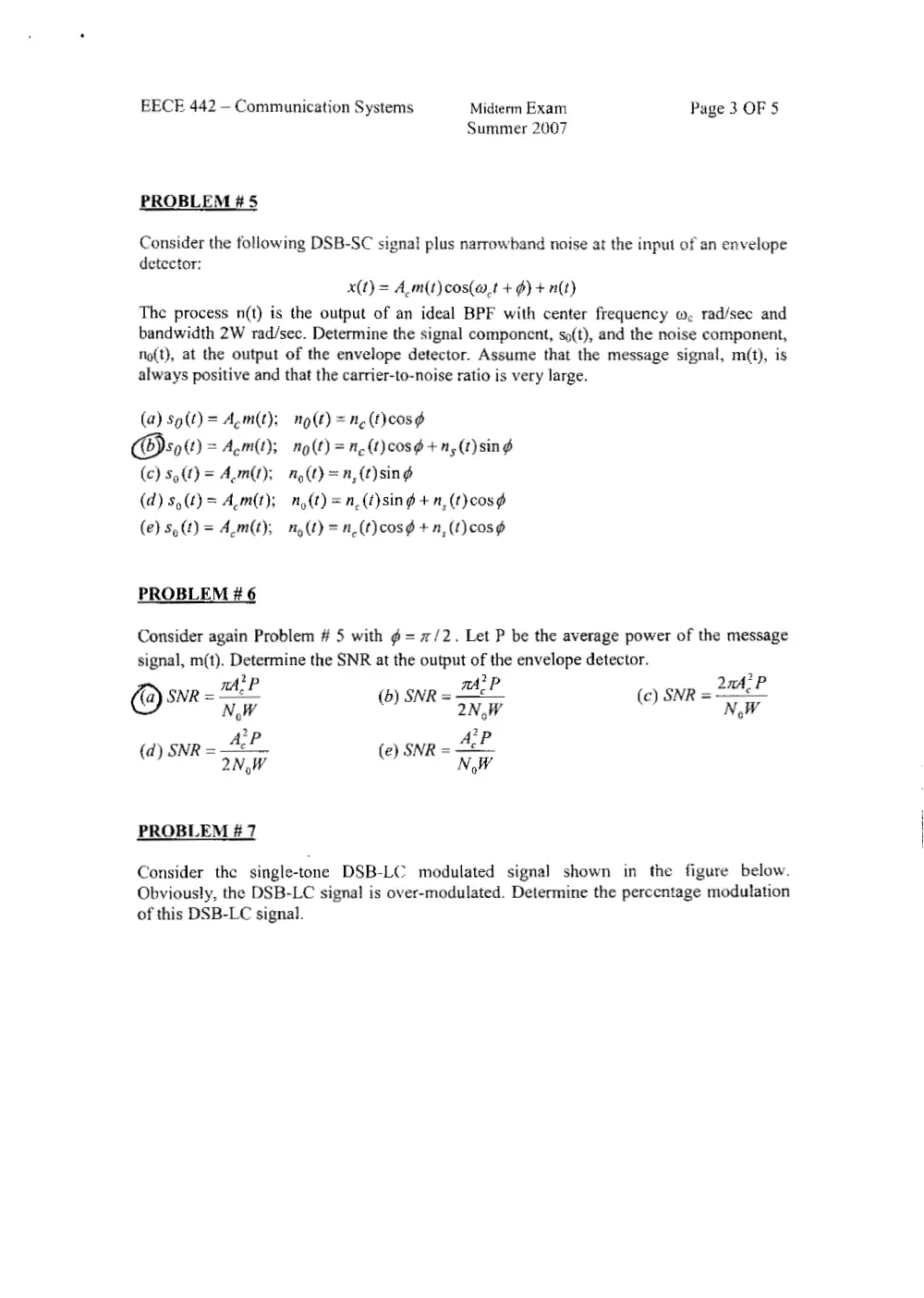
PROBLEM #5
Consider the following DSB-SC signal plus narrowband noise at the input of an envelope
detector:
X(f) = A_m(t)cos(@,t + ¢) + n(t)
The process n(t) is the output of an ideal BPF with center frequency @, rad/sec and
bandwidth 2W rad/sec. Determine the signal component, so(t), and the noise component,
no(t), at the output of the envelope detector. Assume that the message signal, m(t), is
always positive and that the carrier-to-noise ratio is very large.
(4) so(t)= Amt); no(t)=n,(t)cos¢
sot) =A.m(t); no) =n, (t)cosd+n,(t)sing
(c) sg(t)= Am); ay (t}=n, (sing
(d) s)(t)= A.m(t); ny(t)=n_(d)sing +n, (t)cos¢
(e) s(t) = A,m@); ny, (t) = 1, (A cosd +n, (t)cosd
PROBLEM # 6
Consider again Problem # 5 with ¢ = 7/2. Let P be the average power of the message
signal, m(t). Determine the SNR at the output of the envelope detector.
nA; P mA? P 2aA?P
SNR = — b) SNR = —<— c) SNR = ——*
@ NW @) 2NW tc) NW
AP AP
d) SNR = = SNR =—=
(a) 2N,W @) NW
PROBLEM #7
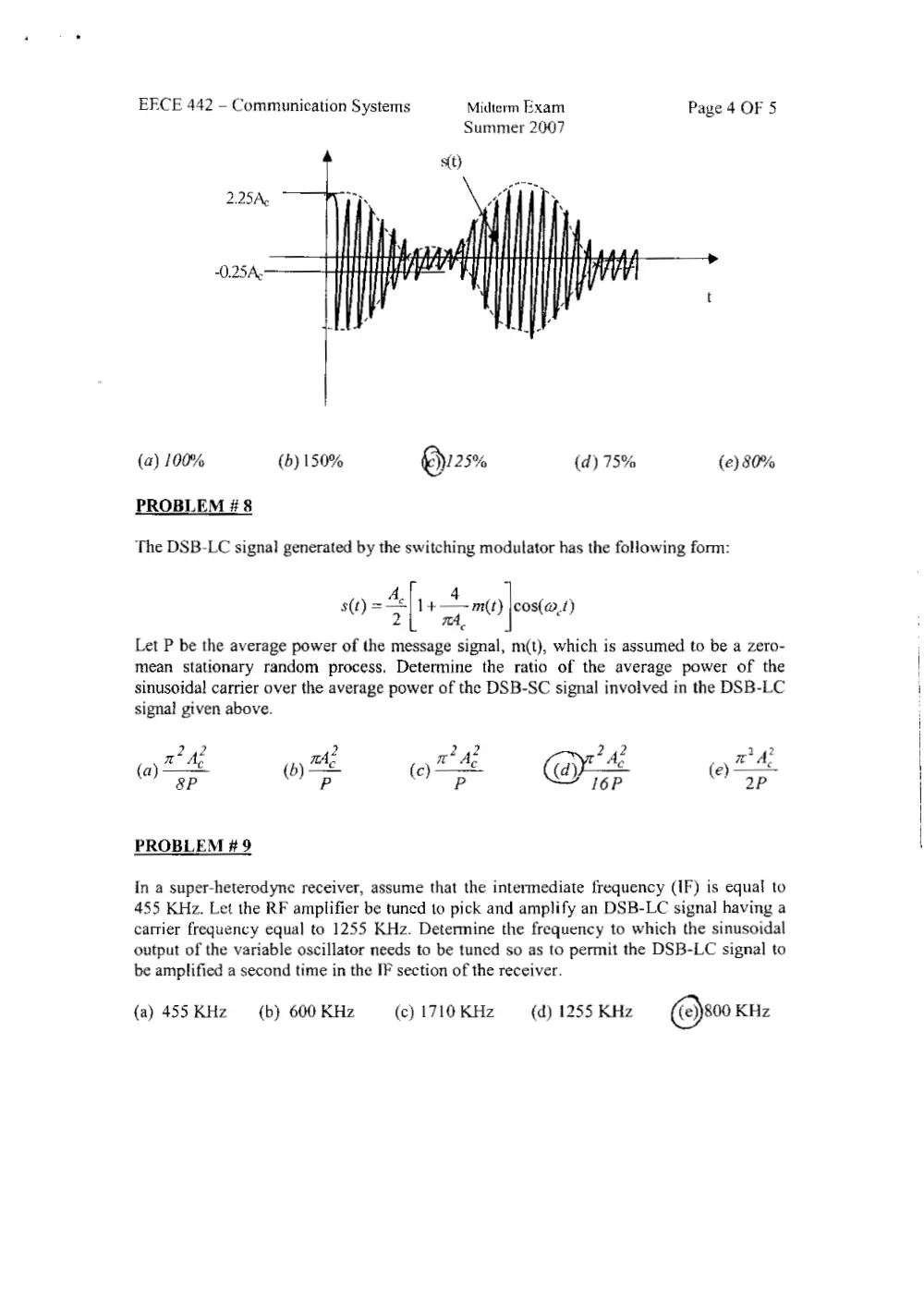
Consider the single-tone DSB-LC modulated signal shown in the figure below.
Obviously, the DSB-LC signal is over-modulated. Determine the percentage modulation
of this DSB-LC signal.
EFCE 442 —- Communication Systems Midterm Exam Page 4 OF 5
Summer 2007
4 st)
225A, Nip 4
025A,
} : }
(a) 100% (b) 150% G)125% (d) 75% (e) 80%
PROBLEM #8
The DSB-LC signal generated by the switching modulator has the following form:
s(t)= afi + = moose.
Let P be the average power of the message signal, m(t), which is assumed to be a zero-
mean stationary random process. Determine the ratio of the average power of the
sinusoidal carrier over the average power of the DSB-SC signal involved in the DSB-LC
signal given above.
2 42 2 2 42 2 42 2 42
a AE 7A mw A A mA
b c c d Cc c
(a) ry; (6) P (c) P (@) T6P (e) P
PROBLEM #9
In a super-heterodyne receiver, assume that the intermediate frequency (IF) is equal to
455 KHz. Let the RF amplifier be tuned to pick and amplify an DSB-LC signal having a
carrier frequency equal to 1255 KHz. Determine the frequency to which the sinusoidal
output of the variable oscillator needs to be tuned so as to permit the DSB-LC signal to
be amplified a second time in the IF section of the receiver.
(a) 455KHz (b) 600KHz = (c) ITO KHz —(d) 1255 KHz (©)s00 KHz
EECE 442 — Communication Systems Midterm Exam Page 5 OF 5
Summer 2007
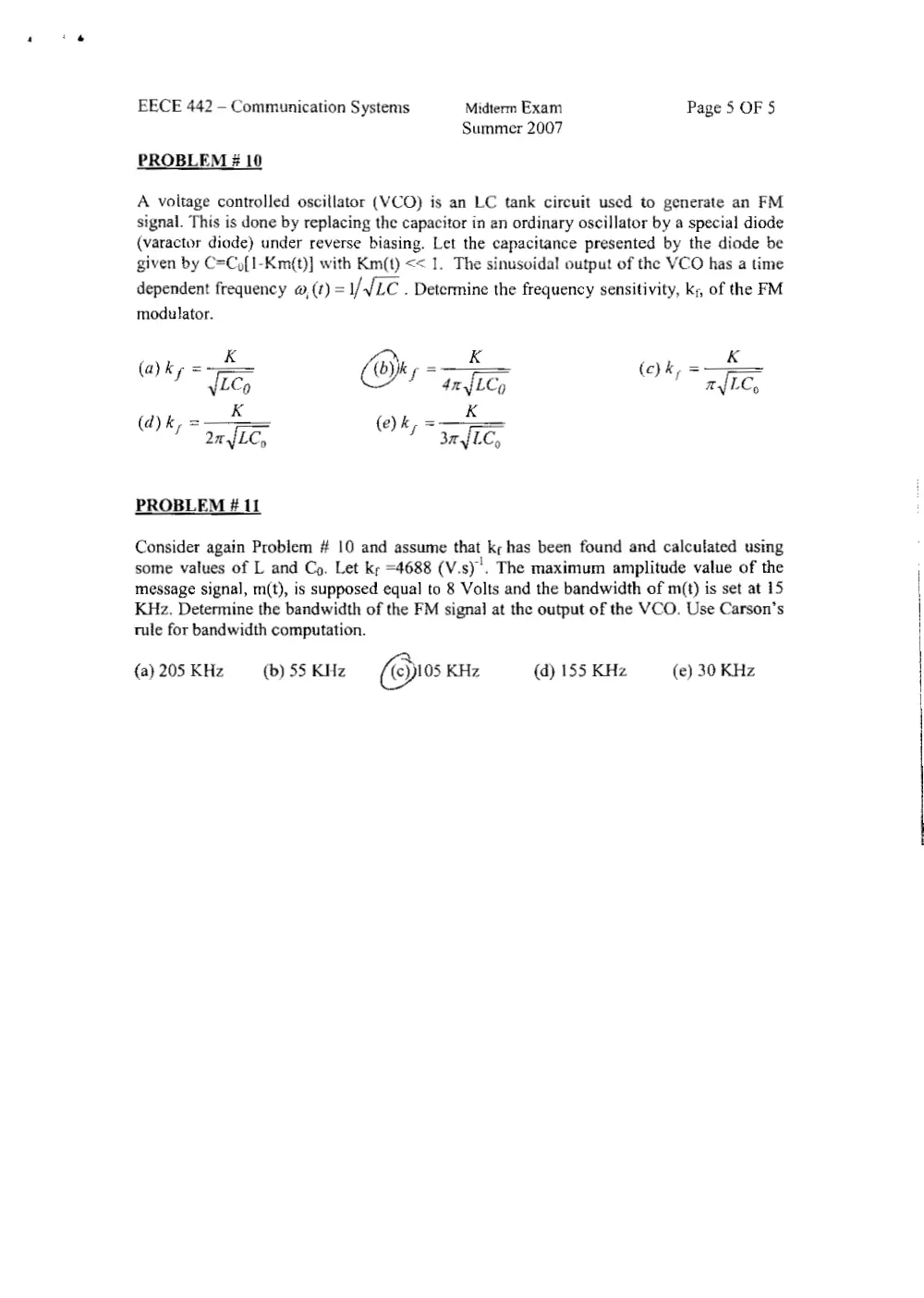
PROBLEM # 10
A voltage controlled oscillator (VCO) is an LC tank circuit used to generate an FM
signal. This is done by replacing the capacitor in an ordinary oscillator by a special diode
(varactor diode) under reverse biasing. Let the capacitance presented by the diode be
given by C=Cy[I-Km(t)] with Km(t) << 1. The sinusoidal output of the VCO has a time
dependent frequency «,(¢) = V VLC . Determine the frequency sensitivity, ky, of the FM
modulator.
K K K
ayky= (oe = c)k, =— se
(ky =e OI Te (Oke = Te
K K
—__—___ k,=—>
2x J LC, ky 32J LC,
(d)k, =
PROBLEM # 11
Consider again Problem # 10 and assume that kp has been found and calculated using
some values of L and Co. Let kp =4688 (V.s)'. The maximum amplitude value of the
message signal, m(t), is supposed equal to 8 Volts and the bandwidth of m(t) is set at 15
KHz. Determine the bandwidth of the FM signal at the output of the VCO. Use Carson’s
tule for bandwidth computation.
(a}205KHz — (b) 5S KHz Ox KHz (a) 1S5KHz — (e) 30 KHz