
EECE 451 Syllabus, Spring 2015
American University of Beirut · Mobile Networks and Applications · 3 pages

More EECE 451 files
Show the text of this lab
Department of Electrical and Computer Engineering
Faculty of Engineering and Architecture
American University of Beirut
EECE 451: Mobile Networks and Applications
Catalog description:
This course covers mobile networking topics with focus on wireless networking
technologies and mobile computing applications. It addresses the following topics:
fundamentals of mobile network design, mobile communications technologies and
standards, mobile networking protocols, mobile device platforms, and mobile
applications.
Credit hours: 3 credits
Required or elective:
Restricted elective for CCE students, and elective for ECE students
Prerequisites:
By course: EECE 350: Computer Networks
By topic:
Basic Computer Networking
Programming Language, C, C++, or Java
Textbook(s) and/or required materials
Instructor provided material through Moodle
References:
−
From GSM to LTE: An Introduction to Mobile Networks and Mobile Broadband,
Martin Sauter, Wiley
−
Computer Networking: A Top-Down Approach, J. Kurose and K. Ross, Addison
Wesley
−
Cloud Computing Bible, Barrie Sosinsky, Wiley
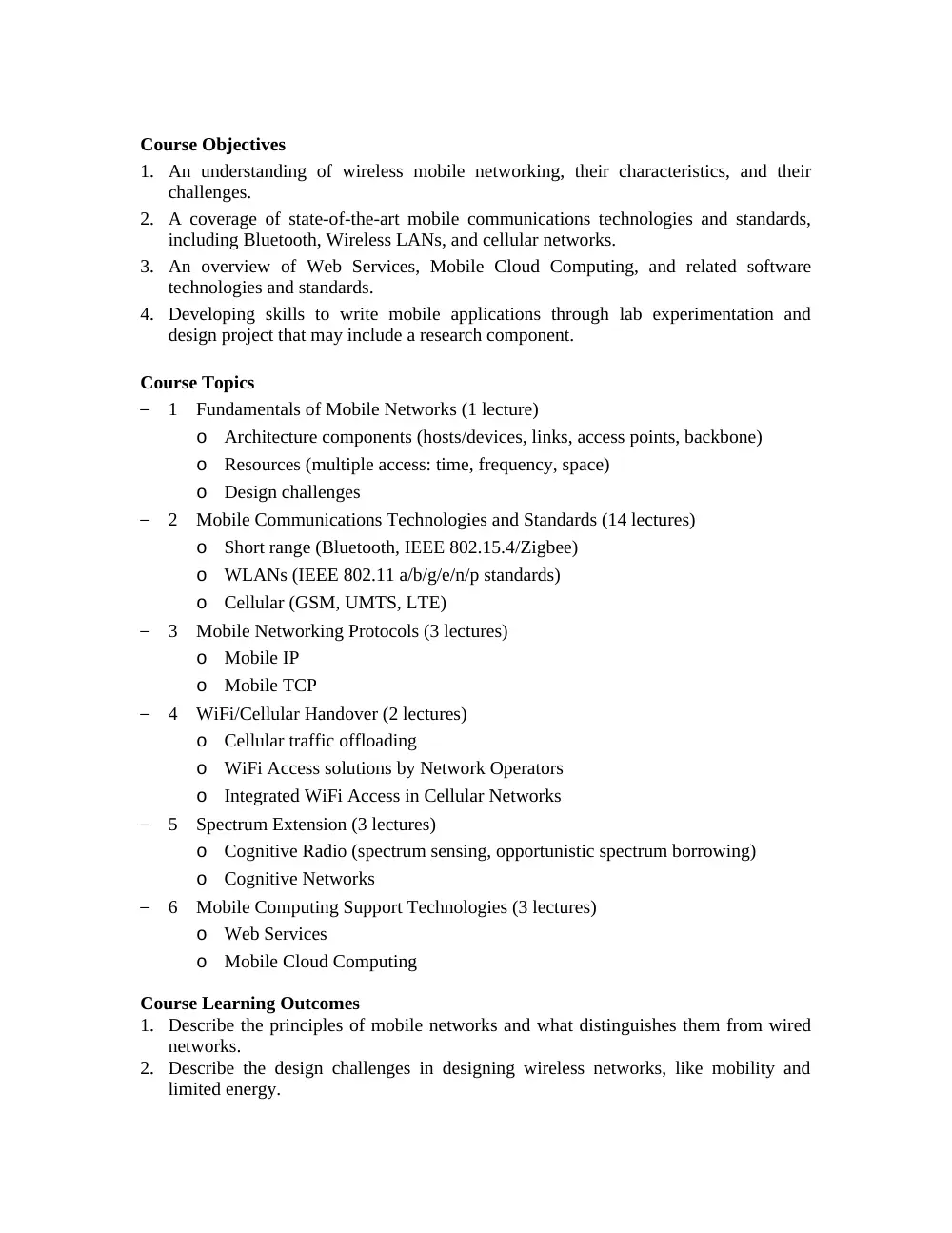
Course Objectives
1. An understanding of wireless mobile networking, their characteristics, and their
challenges.
2. A coverage of state-of-the-art mobile communications technologies and standards,
including Bluetooth, Wireless LANs, and cellular networks.
3. An overview of Web Services, Mobile Cloud Computing, and related software
technologies and standards.
4. Developing skills to write mobile applications through lab experimentation and
design project that may include a research component.
Course Topics
─
1
Fundamentals of Mobile Networks (1 lecture)
o
Architecture components (hosts/devices, links, access points, backbone)
o
Resources (multiple access: time, frequency, space)
o
Design challenges
─
2
Mobile Communications Technologies and Standards (14 lectures)
o
Short range (Bluetooth, IEEE 802.15.4/Zigbee)
o
WLANs (IEEE 802.11 a/b/g/e/n/p standards)
o
Cellular (GSM, UMTS, LTE)
─
3
Mobile Networking Protocols (3 lectures)
o
Mobile IP
o
Mobile TCP
─
4
WiFi/Cellular Handover (2 lectures)
o
Cellular traffic offloading
o
WiFi Access solutions by Network Operators
o
Integrated WiFi Access in Cellular Networks
─
5
Spectrum Extension (3 lectures)
o
Cognitive Radio (spectrum sensing, opportunistic spectrum borrowing)
o
Cognitive Networks
─
6
Mobile Computing Support Technologies (3 lectures)
o
Web Services
o
Mobile Cloud Computing
Course Learning Outcomes
1. Describe the principles of mobile networks and what distinguishes them from wired
networks.
2. Describe the design challenges in designing wireless networks, like mobility and
limited energy.
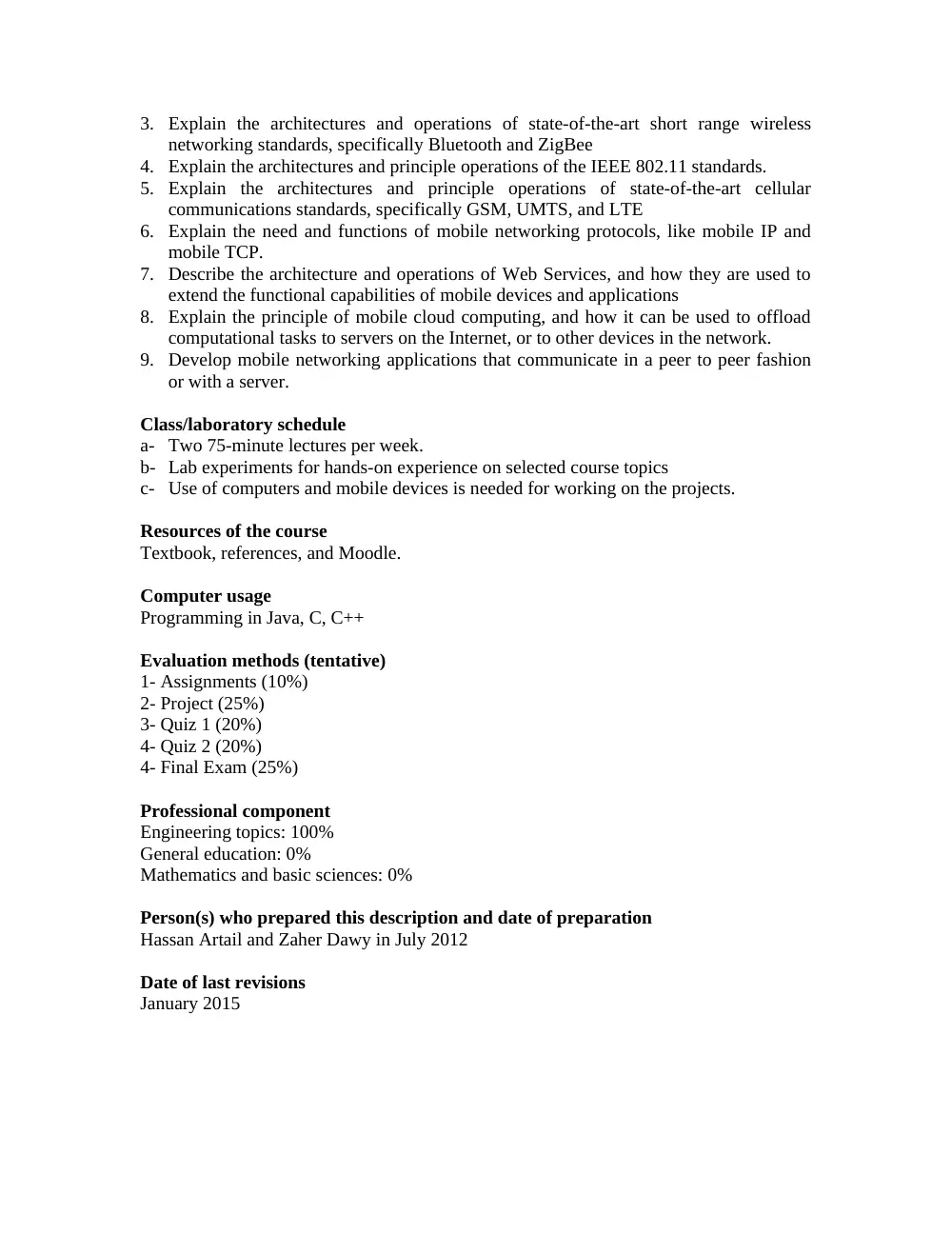
3. Explain the architectures and operations of state-of-the-art short range wireless
networking standards, specifically Bluetooth and ZigBee
4. Explain the architectures and principle operations of the IEEE 802.11 standards.
5. Explain the architectures and principle operations of state-of-the-art cellular
communications standards, specifically GSM, UMTS, and LTE
6. Explain the need and functions of mobile networking protocols, like mobile IP and
mobile TCP.
7. Describe the architecture and operations of Web Services, and how they are used to
extend the functional capabilities of mobile devices and applications
8. Explain the principle of mobile cloud computing, and how it can be used to offload
computational tasks to servers on the Internet, or to other devices in the network.
9. Develop mobile networking applications that communicate in a peer to peer fashion
or with a server.
Class/laboratory schedule
a- Two 75-minute lectures per week.
b- Lab experiments for hands-on experience on selected course topics
c- Use of computers and mobile devices is needed for working on the projects.
Resources of the course
Textbook, references, and Moodle.
Computer usage
Programming in Java, C, C++
Evaluation methods (tentative)
1- Assignments (10%)
2- Project (25%)
3- Quiz 1 (20%)
4- Quiz 2 (20%)
4- Final Exam (25%)
Professional component
Engineering topics: 100%
General education: 0%
Mathematics and basic sciences: 0%
Person(s) who prepared this description and date of preparation
Hassan Artail and Zaher Dawy in July 2012
Date of last revisions
January 2015