
EECE 461 Syllabus, Spring 2016
American University of Beirut · Instrumentation · 2 pages · Prof. Imad El Hajj
Show the text of this lab
Imad H. Elhajj
Page 1
American University of Beirut
EECE461 Syllabus
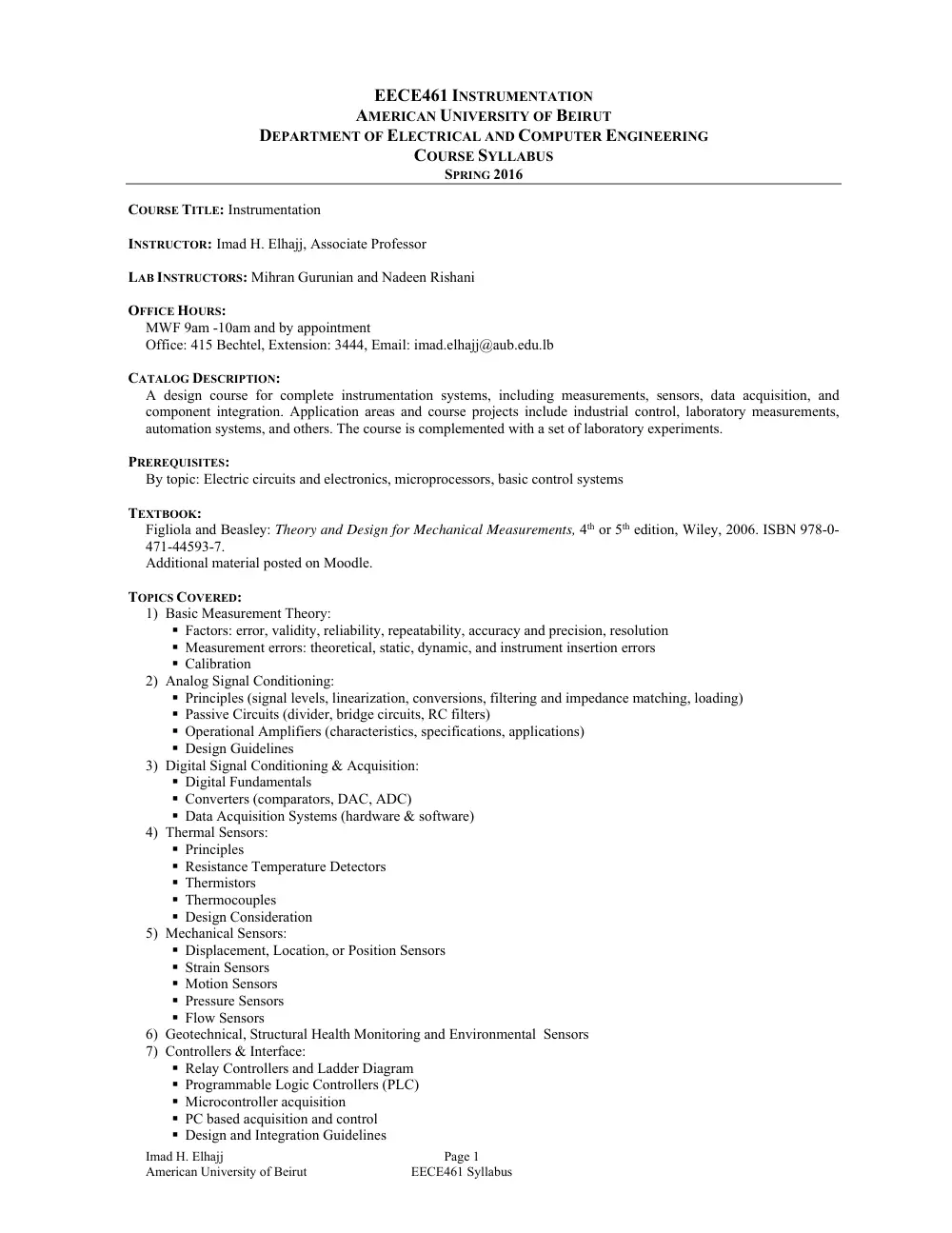
EECE461 INSTRUMENTATION
AMERICAN UNIVERSITY OF BEIRUT
DEPARTMENT OF ELECTRICAL AND COMPUTER ENGINEERING
COURSE SYLLABUS
SPRING 2016
COURSE TITLE: Instrumentation
INSTRUCTOR: Imad H. Elhajj, Associate Professor
LAB INSTRUCTORS: Mihran Gurunian and Nadeen Rishani
OFFICE HOURS:
MWF 9am -10am and by appointment
Office: 415 Bechtel, Extension: 3444, Email: imad.elhajj@aub.edu.lb
CATALOG DESCRIPTION:
A design course for complete instrumentation systems, including measurements, sensors, data acquisition, and
component integration. Application areas and course projects include industrial control, laboratory measurements,
automation systems, and others. The course is complemented with a set of laboratory experiments.
PREREQUISITES:
By topic: Electric circuits and electronics, microprocessors, basic control systems
TEXTBOOK:
Figliola and Beasley: Theory and Design for Mechanical Measurements, 4th or 5th edition, Wiley, 2006. ISBN 978-0-
471-44593-7.
Additional material posted on Moodle.
TOPICS COVERED:
1) Basic Measurement Theory:
Factors: error, validity, reliability, repeatability, accuracy and precision, resolution
Measurement errors: theoretical, static, dynamic, and instrument insertion errors
Calibration
2) Analog Signal Conditioning:
Principles (signal levels, linearization, conversions, filtering and impedance matching, loading)
Passive Circuits (divider, bridge circuits, RC filters)
Operational Amplifiers (characteristics, specifications, applications)
Design Guidelines
3) Digital Signal Conditioning & Acquisition:
Digital Fundamentals
Converters (comparators, DAC, ADC)
Data Acquisition Systems (hardware & software)
4) Thermal Sensors:
Principles
Resistance Temperature Detectors
Thermistors
Thermocouples
Design Consideration
5) Mechanical Sensors:
Displacement, Location, or Position Sensors
Strain Sensors
Motion Sensors
Pressure Sensors
Flow Sensors
6) Geotechnical, Structural Health Monitoring and Environmental Sensors
7) Controllers & Interface:
Relay Controllers and Ladder Diagram
Programmable Logic Controllers (PLC)
Microcontroller acquisition
PC based acquisition and control
Design and Integration Guidelines
Imad H. Elhajj
Page 2
American University of Beirut
EECE461 Syllabus
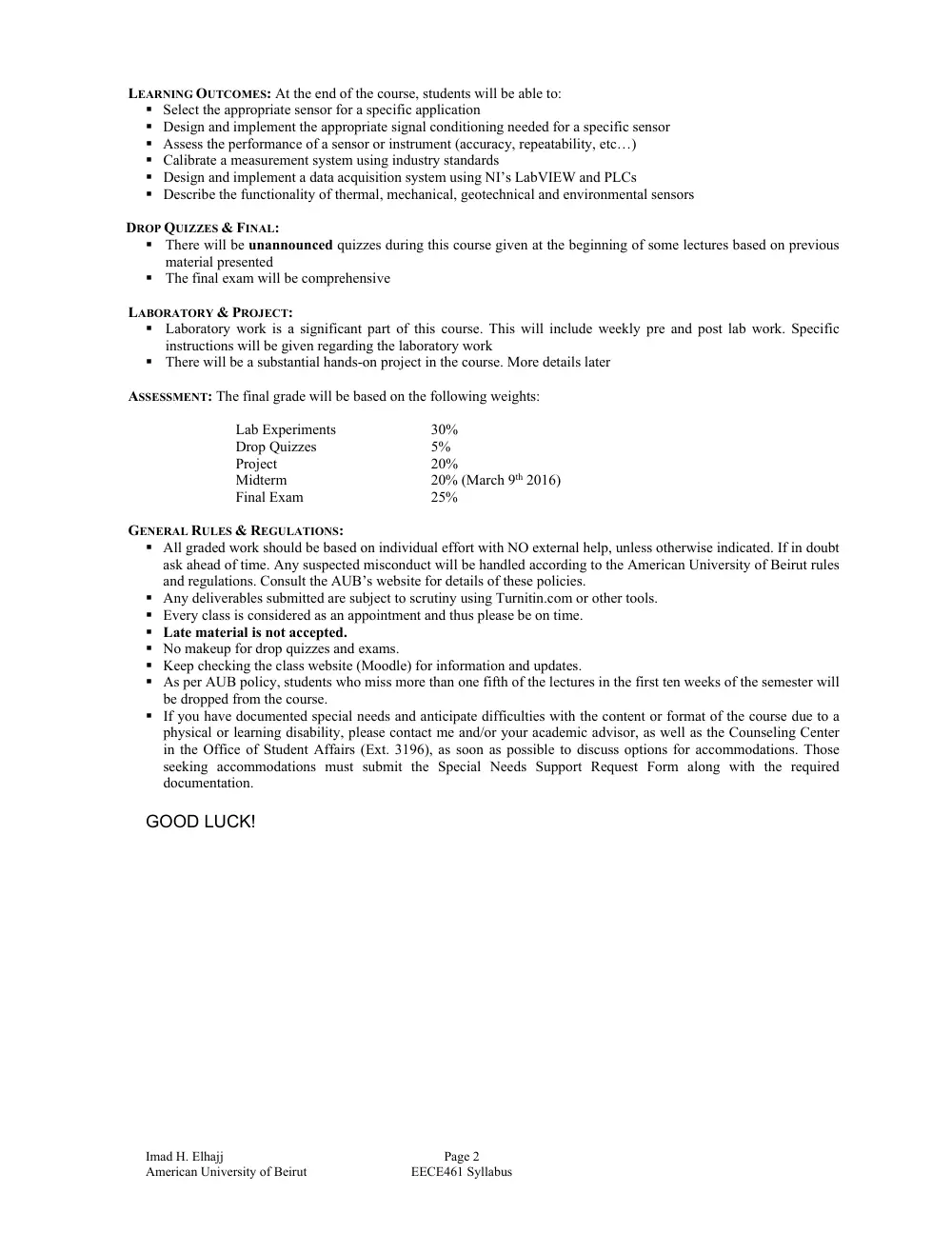
LEARNING OUTCOMES: At the end of the course, students will be able to:
Select the appropriate sensor for a specific application
Design and implement the appropriate signal conditioning needed for a specific sensor
Assess the performance of a sensor or instrument (accuracy, repeatability, etc…)
Calibrate a measurement system using industry standards
Design and implement a data acquisition system using NI’s LabVIEW and PLCs
Describe the functionality of thermal, mechanical, geotechnical and environmental sensors
DROP QUIZZES & FINAL:
There will be unannounced quizzes during this course given at the beginning of some lectures based on previous
material presented
The final exam will be comprehensive
LABORATORY & PROJECT:
Laboratory work is a significant part of this course. This will include weekly pre and post lab work. Specific
instructions will be given regarding the laboratory work
There will be a substantial hands-on project in the course. More details later
ASSESSMENT: The final grade will be based on the following weights:
Lab Experiments
30%
Drop Quizzes
5%
Project
Midterm
20%
20% (March 9th 2016)
Final Exam
25%
GENERAL RULES & REGULATIONS:
All graded work should be based on individual effort with NO external help, unless otherwise indicated. If in doubt
ask ahead of time. Any suspected misconduct will be handled according to the American University of Beirut rules
and regulations. Consult the AUB’s website for details of these policies.
Any deliverables submitted are subject to scrutiny using Turnitin.com or other tools.
Every class is considered as an appointment and thus please be on time.
Late material is not accepted.
No makeup for drop quizzes and exams.
Keep checking the class website (Moodle) for information and updates.
As per AUB policy, students who miss more than one fifth of the lectures in the first ten weeks of the semester will
be dropped from the course.
If you have documented special needs and anticipate difficulties with the content or format of the course due to a
physical or learning disability, please contact me and/or your academic advisor, as well as the Counseling Center
in the Office of Student Affairs (Ext. 3196), as soon as possible to discuss options for accommodations. Those
seeking accommodations must submit the Special Needs Support Request Form along with the required
documentation.
GOOD LUCK!