
EECE 678 Syllabus, Fall 2012
American University of Beirut · Advanced Power System Analysis · 2 pages · Prof. Rabih Jabr
More EECE 678 files
Show the text of this lab
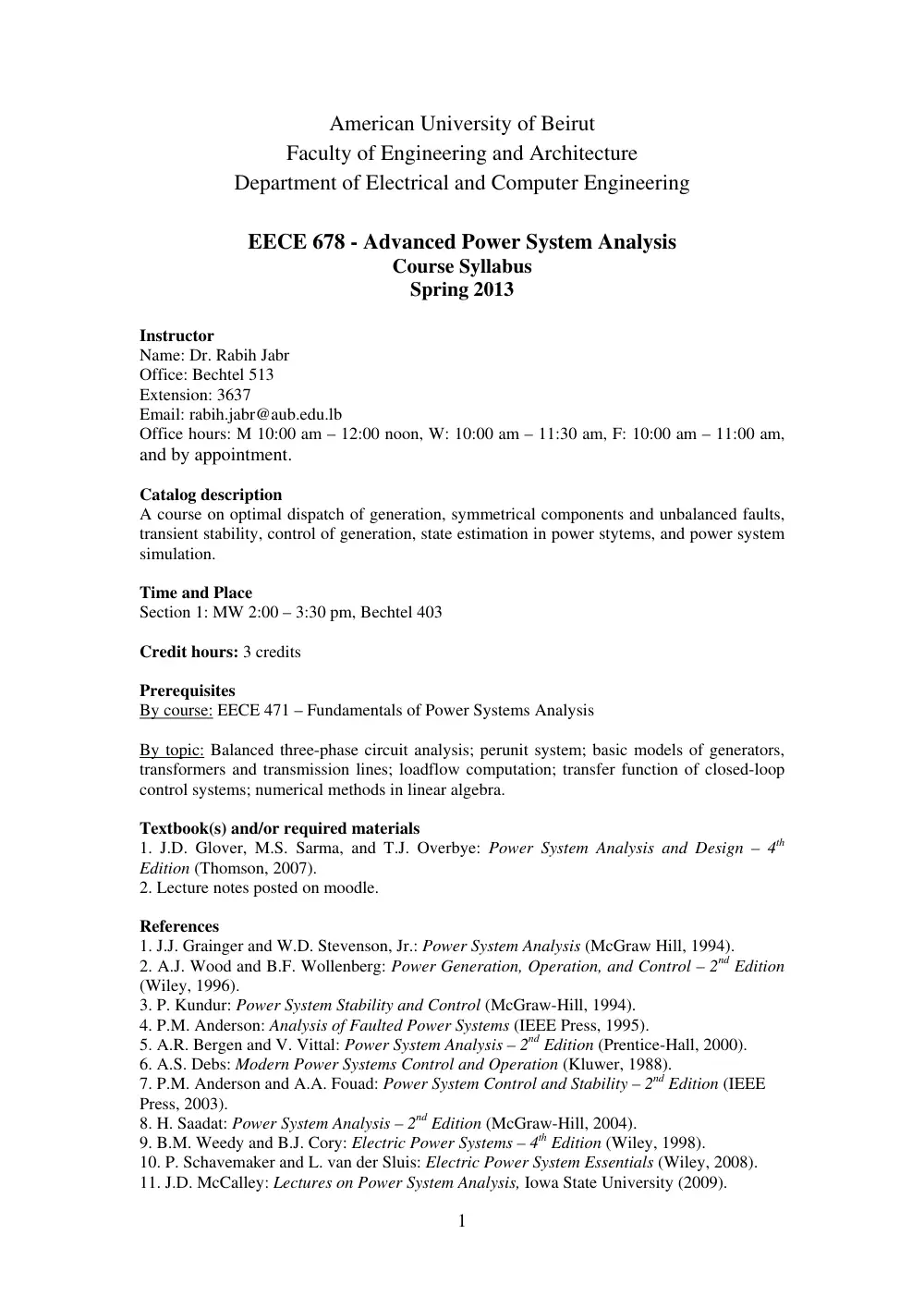
American University of Beirut
Faculty of Engineering and Architecture
Department of Electrical and Computer Engineering
EECE 678 - Advanced Power System Analysis
Course Syllabus
Spring 2013
Instructor
Name: Dr. Rabih Jabr
Office: Bechtel 513
Extension: 3637
Email: rabih.jabr@aub.edu.lb
Office hours: M 10:00 am – 12:00 noon, W: 10:00 am – 11:30 am, F: 10:00 am – 11:00 am,
and by appointment.
Catalog description
A course on optimal dispatch of generation, symmetrical components and unbalanced faults,
transient stability, control of generation, state estimation in power stytems, and power system
simulation.
Time and Place
Section 1: MW 2:00 – 3:30 pm, Bechtel 403
Credit hours: 3 credits
Prerequisites
By course: EECE 471 – Fundamentals of Power Systems Analysis
By topic: Balanced three-phase circuit analysis; perunit system; basic models of generators,
transformers and transmission lines; loadflow computation; transfer function of closed-loop
control systems; numerical methods in linear algebra.
Textbook(s) and/or required materials
1. J.D. Glover, M.S. Sarma, and T.J. Overbye: Power System Analysis and Design – 4th
Edition (Thomson, 2007).
2. Lecture notes posted on moodle.
References
1. J.J. Grainger and W.D. Stevenson, Jr.: Power System Analysis (McGraw Hill, 1994).
2. A.J. Wood and B.F. Wollenberg: Power Generation, Operation, and Control – 2nd Edition
(Wiley, 1996).
3. P. Kundur: Power System Stability and Control (McGraw-Hill, 1994).
4. P.M. Anderson: Analysis of Faulted Power Systems (IEEE Press, 1995).
5. A.R. Bergen and V. Vittal: Power System Analysis – 2nd Edition (Prentice-Hall, 2000).
6. A.S. Debs: Modern Power Systems Control and Operation (Kluwer, 1988).
7. P.M. Anderson and A.A. Fouad: Power System Control and Stability – 2nd Edition (IEEE
Press, 2003).
8. H. Saadat: Power System Analysis – 2nd Edition (McGraw-Hill, 2004).
9. B.M. Weedy and B.J. Cory: Electric Power Systems – 4th Edition (Wiley, 1998).
10. P. Schavemaker and L. van der Sluis: Electric Power System Essentials (Wiley, 2008).
11. J.D. McCalley: Lectures on Power System Analysis, Iowa State University (2009).
1
2
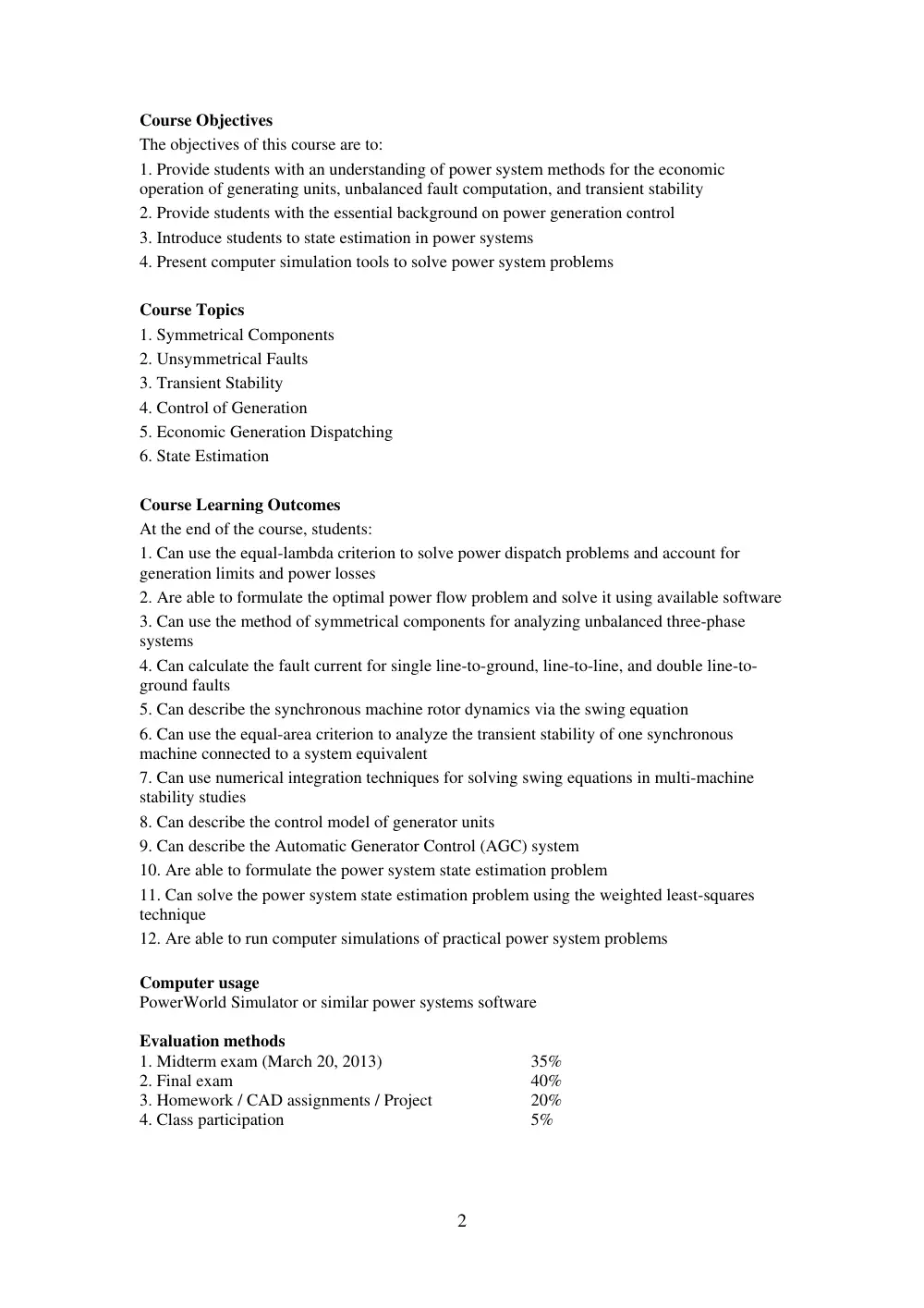
Course Objectives
The objectives of this course are to:
1. Provide students with an understanding of power system methods for the economic
operation of generating units, unbalanced fault computation, and transient stability
2. Provide students with the essential background on power generation control
3. Introduce students to state estimation in power systems
4. Present computer simulation tools to solve power system problems
Course Topics
1. Symmetrical Components
2. Unsymmetrical Faults
3. Transient Stability
4. Control of Generation
5. Economic Generation Dispatching
6. State Estimation
Course Learning Outcomes
At the end of the course, students:
1. Can use the equal-lambda criterion to solve power dispatch problems and account for
generation limits and power losses
2. Are able to formulate the optimal power flow problem and solve it using available software
3. Can use the method of symmetrical components for analyzing unbalanced three-phase
systems
4. Can calculate the fault current for single line-to-ground, line-to-line, and double line-to-
ground faults
5. Can describe the synchronous machine rotor dynamics via the swing equation
6. Can use the equal-area criterion to analyze the transient stability of one synchronous
machine connected to a system equivalent
7. Can use numerical integration techniques for solving swing equations in multi-machine
stability studies
8. Can describe the control model of generator units
9. Can describe the Automatic Generator Control (AGC) system
10. Are able to formulate the power system state estimation problem
11. Can solve the power system state estimation problem using the weighted least-squares
technique
12. Are able to run computer simulations of practical power system problems
Computer usage
PowerWorld Simulator or similar power systems software
Evaluation methods
1. Midterm exam (March 20, 2013)
35%
2. Final exam
40%
3. Homework / CAD assignments / Project
20%
4. Class participation
5%