
ENG 100 Final, Spring 2005
American University of Beirut · Intensive English · 7 pages


More ENG 100 files
Show the text of this final exam
PmrMCaS Care, ros
LIB AES 3
OF BCIRUT
AMERICAN UNIVERSITY OF BEIRUT
ENGLISH DEPARTMENT
ENGLISH 100- FINAL EXAM
5 Praeaegie ROG -_ Os
TIME ALLOWED: 90 minutes
Homeschooling* and the Myth of Socialization
By Manfred B. Zysk*
1. One of the silliest and most annoying comments made to homeschooling parents is,
“Aren’t you concerned about how your child will be able to socialize with others?” What
is being implied here is that the homeschooled child is some kind of introverted misfit
who cannot relate to other people, children and the outside world. In reality, most of the
homeschooled children that I have known and met are not only outgoing, but polite and
respectful, too. This is a sharp contrast to the public school children that I have known,
who can’t relate to adults and whose behavior is rude and inconsiderate. Realistically,
there are some exceptions on both sides.
2. Isn’t it interesting that amid all of the public schoo! shootings over the past few years,
the only comment that opponents of homeschooling can come up with is the red herring
of “socialization”? You may have noticed, there haven’t been shootings at private
schools, or shootings inside of the homes of homeschooled children.
3. Opponents of homeschooling can’t complain about average test scores, since
homeschooled children consistently outscore public school children, so they instead make
a problem that doesn’t exist.
4. Who is responsible for creating this “socialization” problem? This myth has been
perpetrated by sociologists, psychologists, public school administrators, the NEA (and
local teacher’s unions), etc., whenever they comment on homeschooling to the news
media. These are the same people who give Ritalin* (a very strong narcotic) and other
drugs to schoolchildren, in place of discipline.
5. A family member asked my wife, “Aren’t you concerned about his (our son’s)
socialization with other kids?”. My wife gave this response: “Go to your local middle
school, junior high, or high school, walk down the hallways, and tell me which behavior
you see that you think your son should emulate.” Good answer.
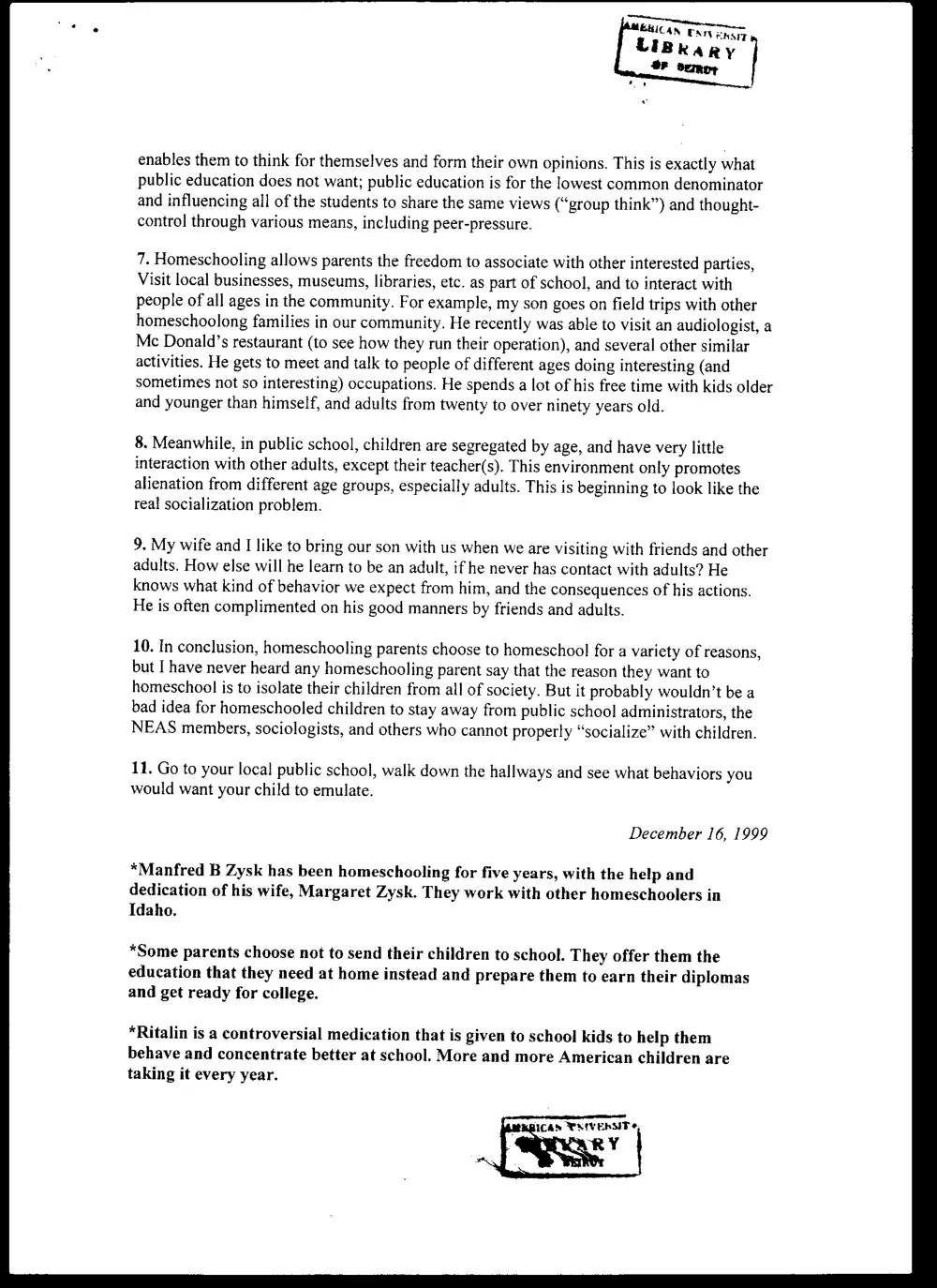
6. In order for children to become assimilated into society properly, it is important to
have a variety of experiences and be exposed to differing opinions and views. This
enables them to think for themselves and form their own opinions. This is exactly what
public education does not want; public education is for the lowest common denominator
and influencing all of the students to share the same views (“group think”) and thought-
control through various means, including peer-pressure.
7. Homeschooling allows parents the freedom to associate with other interested parties,
Visit local businesses, museums, libraries, etc. as part of school, and to interact with
people of all ages in the community. For example, my son goes on field trips with other
homeschoolong families in our community. He recently was able to visit an audiologist, a
Mc Donald’s restaurant (to see how they run their operation), and several other similar
activities. He gets to meet and talk to people of different ages doing interesting (and
sometimes not so interesting) occupations. He spends a lot of his free time with kids older
and younger than himself, and adults from twenty to over ninety years old.
8. Meanwhile, in public school, children are segregated by age, and have very little
interaction with other adults, except their teacher(s). This environment only promotes
alienation from different age groups, especially adults. This is beginning to look like the
real socialization problem.
9. My wife and I like to bring our son with us when we are visiting with friends and other
adults. How else will he learn to be an adult, if he never has contact with adults? He
knows what kind of behavior we expect from him, and the consequences of his actions.
He is often complimented on his good manners by friends and adults.
10. In conclusion, homeschooling parents choose to homeschool for a variety of reasons,
but I have never heard any homeschooling parent say that the reason they want to
homeschool is to isolate their children from all of society. But it probably wouldn’t be a
bad idea for homeschooled children to stay away from public school administrators, the
NEAS members, sociologists, and others who cannot properly “socialize” with children.
11. Go to your local public school, walk down the hallways and see what behaviors you
would want your child to emulate.
December 16, 1999
*Manfred B Zysk has been homeschooling for five years, with the help and
dedication of his wife, Margaret Zysk. They work with other homeschoolers in
Idaho.
*Some parents choose not to send their children to school. They offer them the
education that they need at home instead and prepare them to earn their diplomas
and get ready for college.
*Ritalin is a controversial medication that is given to school kids to help them
behave and concentrate better at school. More and more American children are
taking it every year.
AMERICAN UNIVERSITY OF BEIRUT
ENGLISH DEPARTMENT
FINAL EXAM — ENGLISH 100
SPRING 2004- 2005
Name of student: ID #:
Name of instructor: Section #:
Directions: Answer the following questions. Fill in the given space or select a,b,c, or
d, Remember that ’4 of the grade goes to assessing grammar and language.
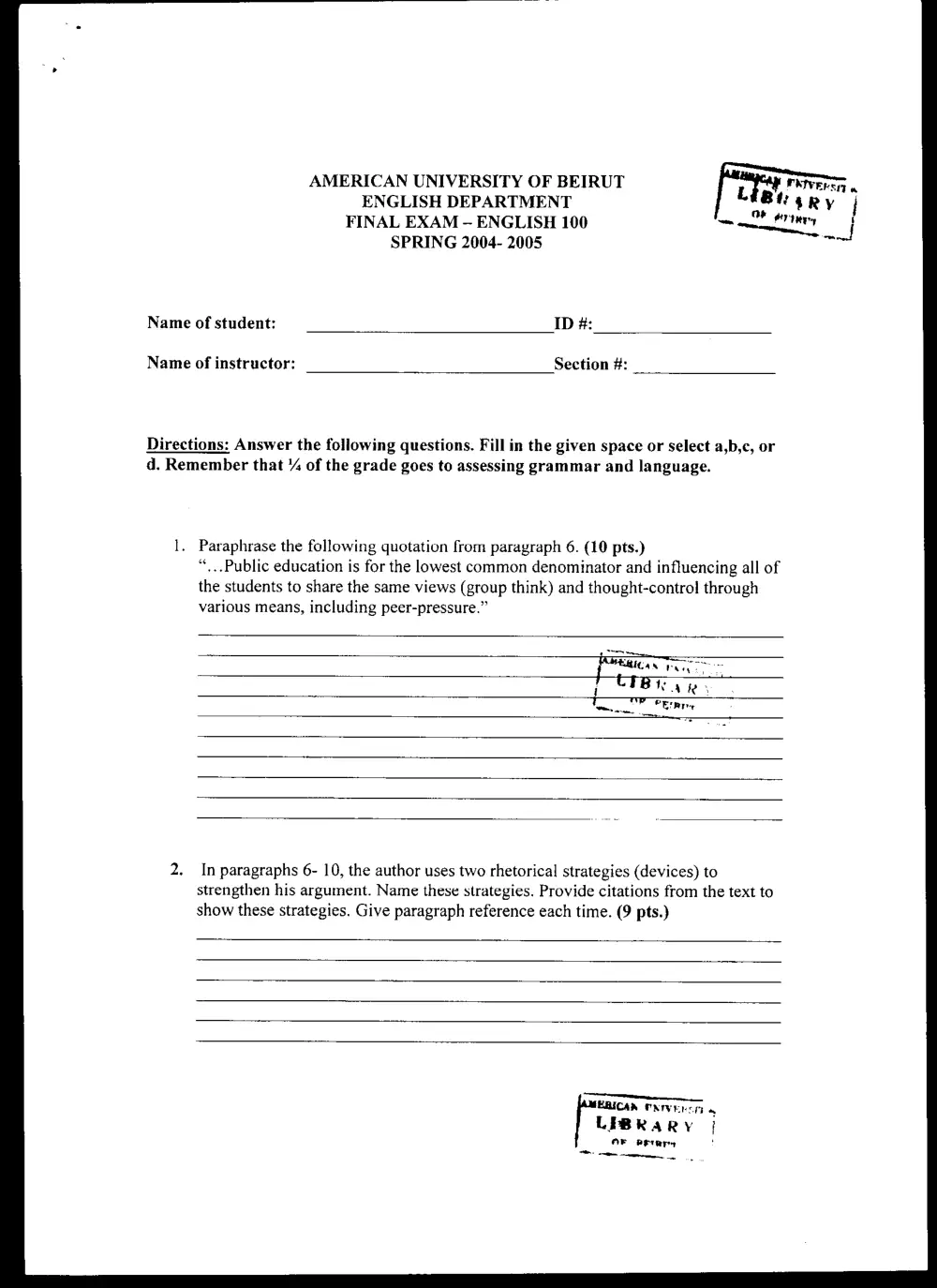
. Paraphrase the following quotation from paragraph 6. (10 pts.)
“...Public education is for the lowest common denominator and influencing all of
the students to share the same views (group think) and thought-control through
various means, including peer-pressure.”
2. In paragraphs 6- 10, the author uses two rhetorical strategies (devices) to
strengthen his argument. Name these strategies. Provide citations from the text to
show these strategies. Give paragraph reference each time. (9 pts.)
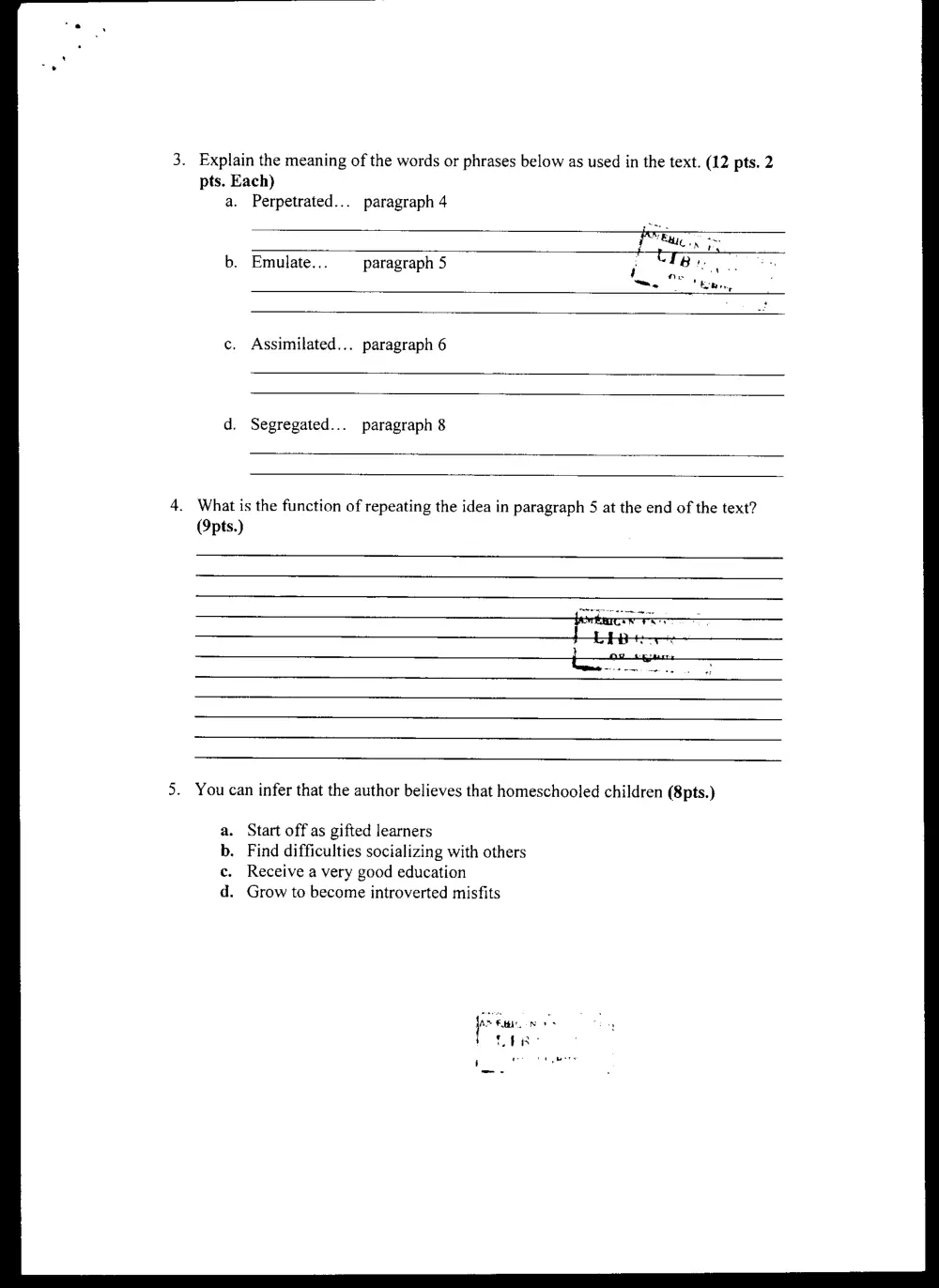
3. Explain the meaning of the words or phrases below as used in the text. (12 pts. 2
pts. Each)
a. Perpetrated... paragraph 4
b. Emulate... paragraph 5
c. Assimilated... paragraph 6
d. Segregated... paragraph 8
4. What is the function of repeating the idea in paragraph 5 at the end of the text?
(9pts.)
or
s rR
TH
=
es
5. You can infer that the author believes that homeschooled children (8pts.)
a. Start off as gifted learners
b. Find difficulties socializing with others
c. Receive a very good education
d. Grow to become introverted misfits
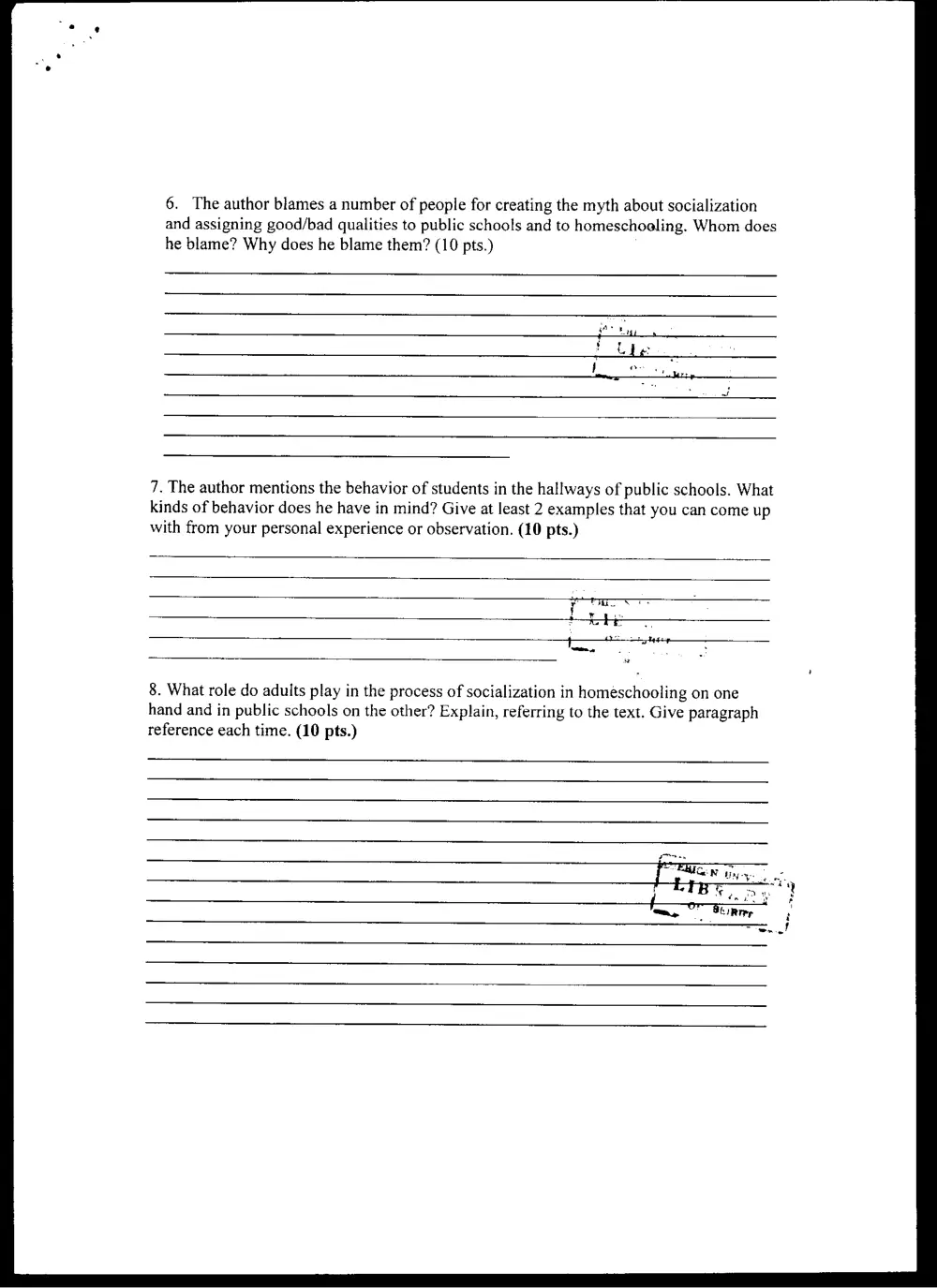
6. The author blames a number of people for creating the myth about socialization
and assigning good/bad qualities to public schools and to homeschoeling. Whom does
he blame? Why does he blame them? (10 pts.)
7. The author mentions the behavior of students in the hallways of public schools. What
kinds of behavior does he have in mind? Give at least 2 examples that you can come up
with from your personal experience or observation. (10 pts.)
8. What role do adults play in the process of socialization in homeschooling on one
hand and in public schools on the other? Explain, referring to the text. Give paragraph
reference each time. (10 pts.)
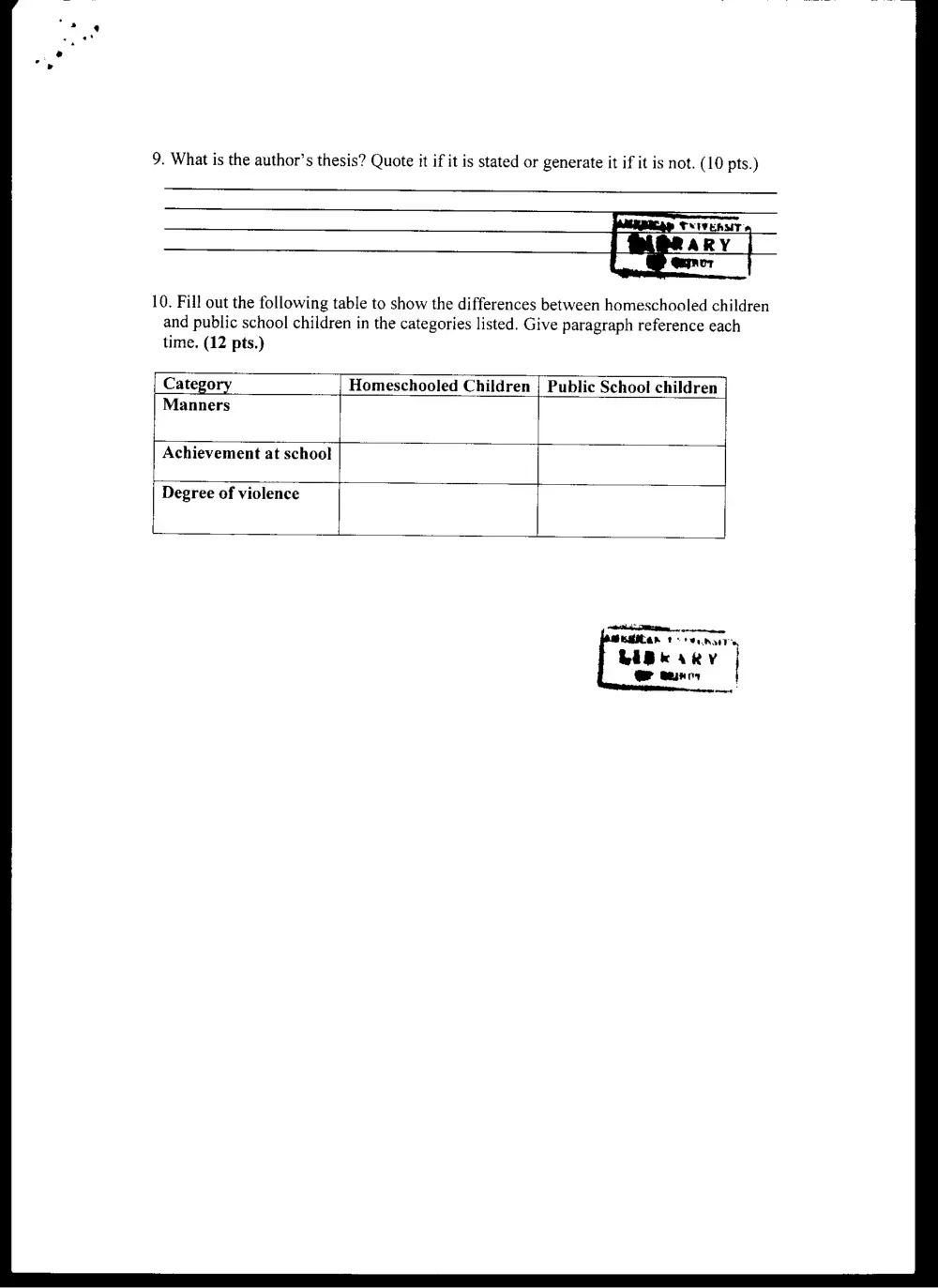
9. What is the author’s thesis? Quote it if it is stated or generate it if it is not. (10 pts.)
10. Fill out the following table to show the differences between homeschooled children
and public school children in the categories listed. Give paragraph reference each
time. (12 pts.)
Category Homeschooled Children | Public School children
Manners
Achievement at school
Degree of violence
Sesletmeestn en
BEILOR tHe more,
BEIBKARY
FF QeHe
BEBKARY
AMERICAN UNIVERSITY OF BEIRUT @ tere
ENGLISH DEPARTMENT
ENGLISH 100- FINAL EXAM
SPRING 2004- 2005
TIME ALLOWED: 90 minutes
Directions: Develop one of the following topics into a well organized essay of 4-5
paragraphs.
1. “Face-to-face communication is better than other types of communication,
such as letters, e-mails, or phone calls.” Compare and contrast the different
types of communication and show which you prefer?
2. You must have lived through experiences that ended with either success or
failure. Analyze the causes that brought about your success or failure in ONE
of those experiences.
3. Discuss the influence that advertising has on your life and the lives of your
friends.
Haiak ews ls
LIBKAR:
oa BEIROT :
ERICAR FAH Ent:
4