
ENG 101 Final, Spring 1999
American University of Beirut · English Communication Skills · 7 pages


Show the text of this final exam
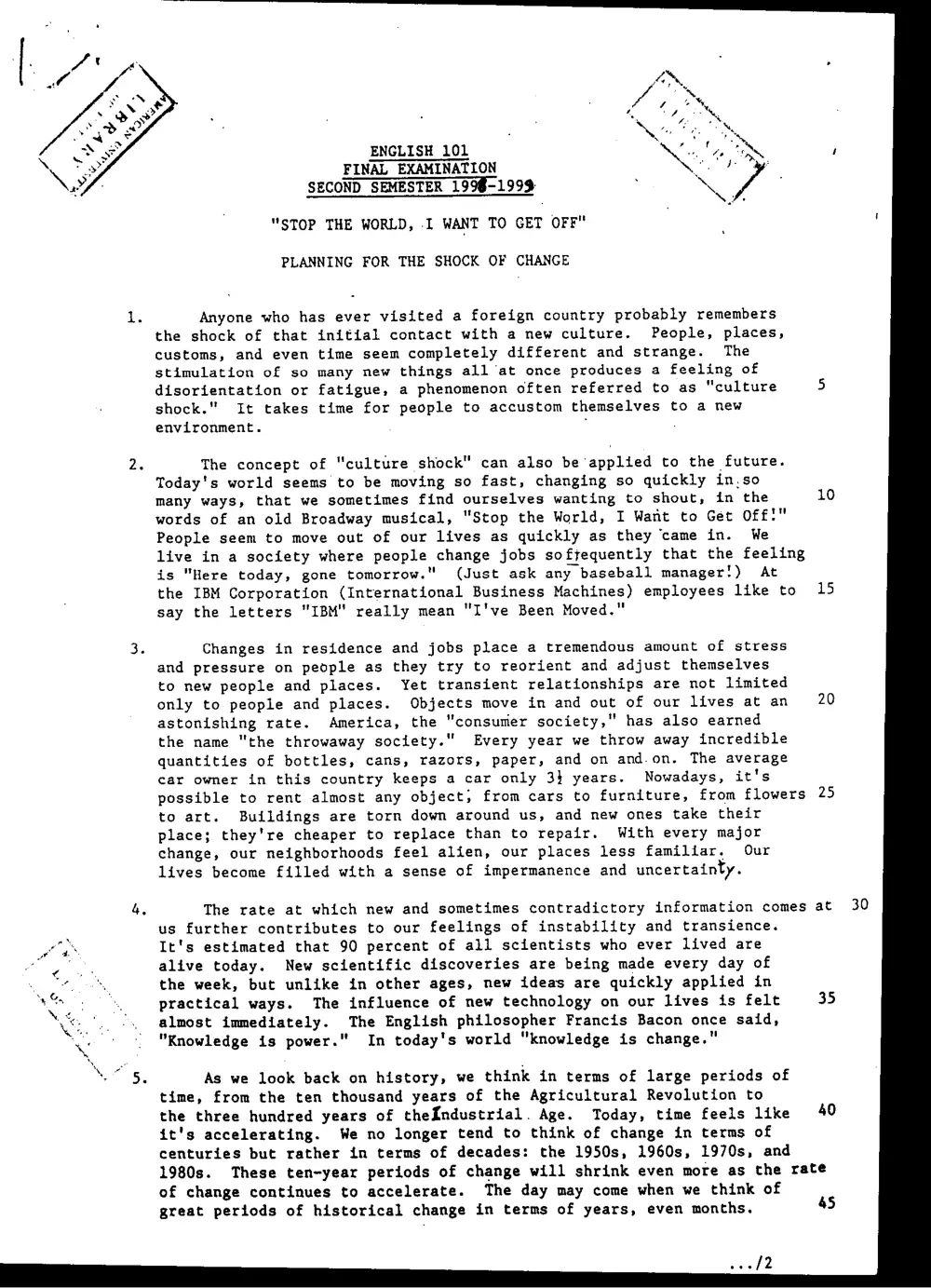
ENGLISH 101
FINAL EXAMINATION
SECOND SEMESTER 1998-1999
“STOP THE WORLD, 1 WANT TO GET OFF" '
PLANNING FOR THE SHOCK OF CHANGE
1. Anyone who has ever visited a foreign country probably remembers
the shock of that initial contact with a new culture. People, places,
customs, and even time seem completely different and strange. The
stimulation of so many new things all ‘at once produces a feeling of
disorientation or fatigue, a phenomenon often referred to as "culture 5
shock." It takes time for people to accustom themselves to a new
environment. ,
2. The concept of “culture shock" can also be applied to the future.
Today's world seems to be moving so fast, changing so quickly in,so
many ways, that we sometimes find ourselves wanting to shout, in the 10
words of an old Broadway musical, "Stop the World, I Want to Get Off:"
People seem to move out of our lives as quickly as they ‘came in. We
live in a society where people change jobs sofyequently that the feeling
is "Here today, gone tomorrow." (Just ask any baseball manager!) At
the IBM Corporation (International Business Machines) employees like to 15
say the letters "IBM" really mean "I've Been Moved."
3. Changes in residence and jobs place a tremendous amount of stress
and pressure on people as they try to reorient and adjust themselves
to new people and places. Yet transient relationships are not limited
only to people and places. Objects move in and out of our lives at an 20
astonishing rate. America, the "consumer society," has also earned
the name "the throwaway society." Every year we throw away incredible
quantities of bottles, cans, razors, paper, and on and.on. The average
car owner in this country keeps a car only 3} years. Nowadays, it's
possible to rent almost any object, from cars to furniture, from flowers 25
to art. Buildings are torn down around us, and new ones take their
place; they're cheaper to replace than to repair. With every major
change, our neighborhoods feel alien, our places less familiar. Our
lives become filled with a sense of impermanence and uncertainty.
4. The rate at which new and sometimes contradictory information comes at 30
us further contributes to our feelings of instability and transience.
ey It's estimated that 90 percent of all scientists who ever lived are
eon: alive today. New scientific discoveries are being made every day of
a Se the week, but unlike in other ages, new ideas are quickly applied in
LO practical ways. The influence of new technology on our lives is felt 35
almost immediately. The English philosopher Francis Bacon once said,
"Knowledge is power." In today's world "knowledge is change."
5. As we look back on history, we think in terms of large periods of
time, from the ten thousand years of the Agricultural Revolution to
the three hundred years of theZndustrial. Age. Today, time feels like 40
it's accelerating. We no longer tend to think of change in terms of
centuries but rather in terms of decades: the 1950s, 1960s, 1970s, and
1980s. These ten-year periods of change will shrink even more as the rate
of change continues to accelerate. The day may come when we think of
great periods of historical change in terms of years, even months. 45
oo /2
6.
Sern
‘
As our sense of time and change continues ta, accelerate, we begin”
to feel lost and disoriented, like "strangers in*strange Land." If
we are to maintain a sense of stability and well-being, we must be able
to cope with-rapid change. One way to prepare for "future shock" is
to try to anticipate what may lie ahead, for it is in thinking and
speculating about the future that we prepare ourselves for the challenge
and change of tomorrow.
People's need to know and talk about the future is of course nothing
new. Throughout history, gypsies, paim readers, and doomsayers have all
come forth to offer their opinions and predictions about what lay ahead.
However, in today's rapidly changing world, the need to anticipate the
future in a more systematic way has brought forth a new kind of prophet:
the think tank. A think tank is a group of experts from different
fields of study who come together to scientifically analyze past and
present trends, By analyzing tremendous’ quantities of available
information, think tanks are often able to predict events and trends
that are likely to occur. Previous periods of unemployment, labor
strikes, economic crises, revolutions, and wars have all been.predicted
by think tanks. In fact, the "findings" of think tanks are often sought
by governments and business, and many times they form the basis of future
policy decisions. .
One such think tank is Forecasting, International, located just
outside Washington, D.C., in Arlington, Virginia. Its president, Dr.
Marvin Cetron, has written a book entitled Encounters with the Future:
A Forecast of Life into the 2lst Century. In attempting to forecast
change, Dr. Cetron states that he relies on the answers to three
fundamental questions: (1) Is the change technically feasible? (2)
Is it economically feasible? (3) Is it socially acceptable? In other
words, what Dr. Cetron is asking is the following: Do we have the
knowledge and ability to bring about the change? Is the change now
or can it soon be cheap enough to carry out? Will most people accept
the change, or does the change go against people's morals, values, or
ability to adapt?
Most people, however, find it difficult to envision the future.
When asked to talk about the future, people tend to describe a world
that is more or less a continuation of the present one. Others,
greatly troubled by the grave threats of nuclear war and global
pollution, have difficulty seeing any future at all. While these
threats to people's survival on Earth certainly are very real and
frightening, there are those who feel that these threats can and will be
overcome. These are people who have a strorig faith in humanity's
ability to survive and who share a positive and hopeful view of the
future.
50
55
60
65
70
75
80
85
x
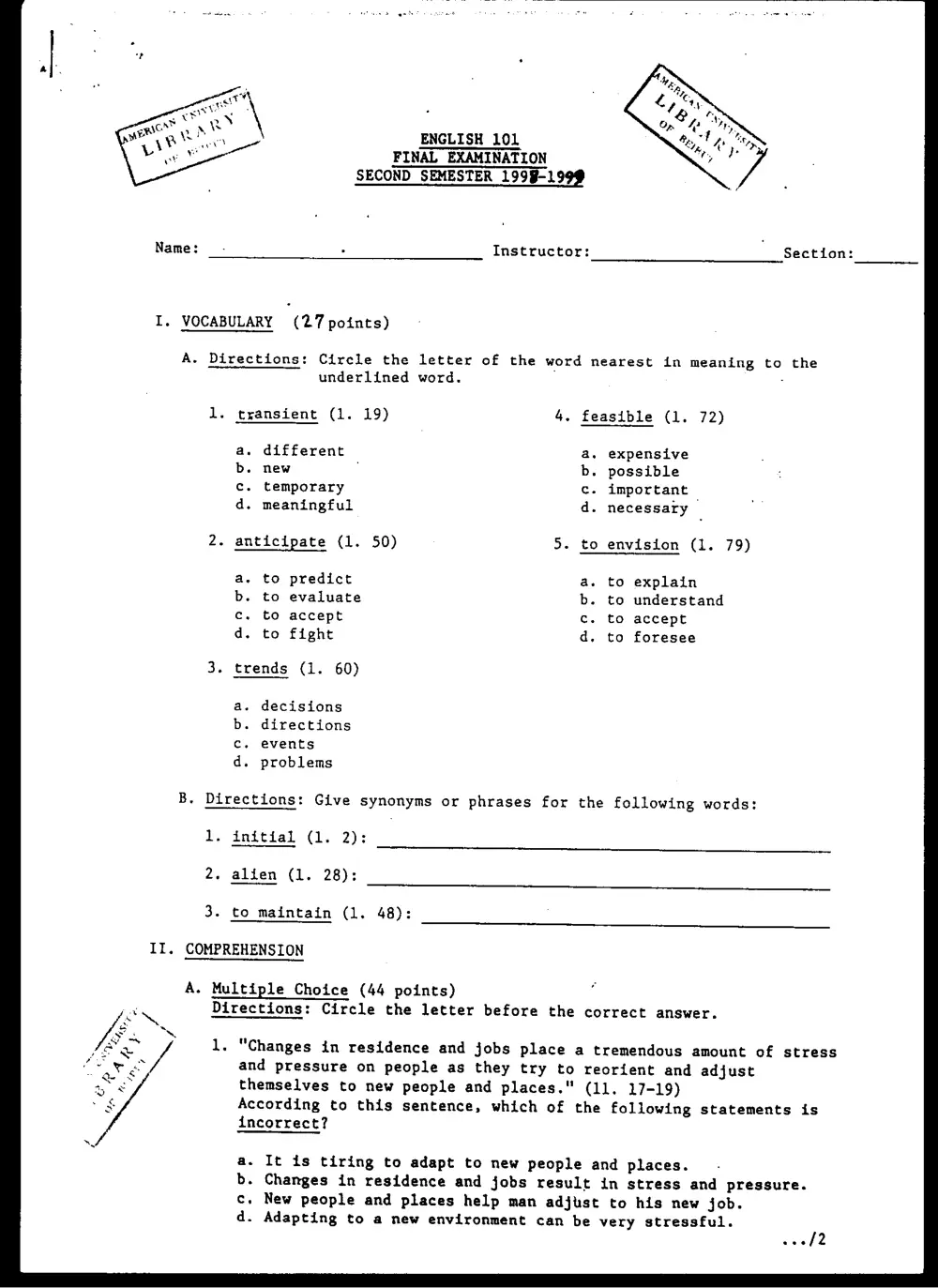
ENGLISH 101
FINAL EXAMINATION
SECOND SEMESTER 1999-1999
Name: - . Instructor: Section:
I. VOCABULARY (27 points)
A. Directions: Circle the letter of the word nearest in meaning to the
underlined word. .
1. transient (1. 19) 4. feasible (1. 72)
a. different a. expensive
b. new , b. possible
c. temporary c. important —
d. meaningful d. necessary
2. anticipate (1. 50) 5. to envision (1. 79)
a. to predict a. to explain
b. to evaluate b. to understand
c. to accept ce. to accept
d. to fight d. to foresee
3. trends (1. 60)
a. decisions
b. directions
c. events
d. problems
B. Directions: Give synonyms or phrases for the following words:
1. initial (1. 2):
2. alien (1. 28):
3. to maintain (1. 48):
II. COMPREHENSION
A. Multiple Choice (44 points)
Directions: Circle the letter before the correct answer.
1. "Changes in residence and jobs place a tremendous amount of stress
and pressure on people as they try to reorient and adjust
themselves to new people and places." (11. 17-19)
According to this sentence, which of the following statements is
incorrect?
a. It is tiring to adapt to new people and places.
b. Changes in residence and jobs result in stress and pressure.
c. New people and places help man adjust to his new job.
d. Adapting to a new environment can be very stressful.
wee /2
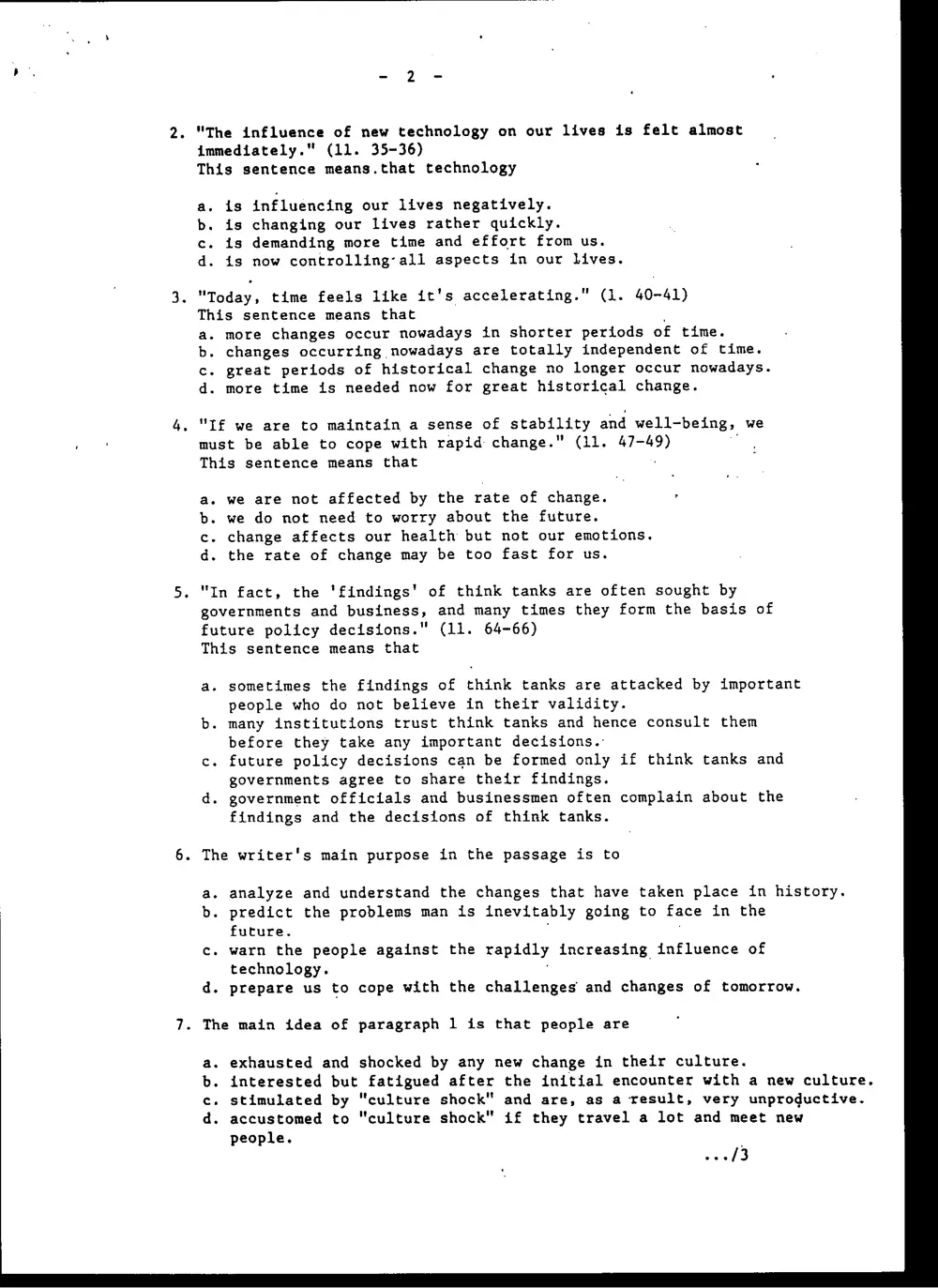
"The influence of new technology on our lives is felt almost
immediately." (11. 35-36)
This sentence means.that technology
a. is influencing our lives negatively.
b. is changing our lives rather quickly.
c. is demanding more time and effort from us.
d. is now controlling-all aspects in our lives.
"Today, time feels like it's accelerating." (1. 40-41)
This sentence means that
a. more changes occur nowadays in shorter periods of time.
b. changes occurring nowadays are totally independent of time.
c. great periods of historical change no longer occur nowadays.
d. more time is needed now for great historical change.
"Tf we are to maintain a sense of stability and well- being, we
must be able to cope with rapid change." (11. 47- 49)
This sentence means that
a. we are not affected by the rate of change. ,
b. we do not need to worry about the future.
c. change affects our health but not our emotions.
d. the rate of change may be too fast for us.
"In fact, the 'findings' of think tanks are often sought by
governments and business, and many times they form the basis of
future policy decisions." (11. 64-66)
This sentence means that
a. sometimes the findings of think tanks are attacked by important
people who do not believe in their validity.
b. many institutions trust think tanks and hence consult them
before they take any important decisions.:
c. future policy decisions can be formed only if think tanks and
governments agree to share their findings.
d. government officials and businessmen often complain about the
findings and the decisions of think tanks.
The writer's main purpose in the passage is to
a. analyze and understand the changes that have taken place in history.
b. predict the problems man is inevitably going to face in the
future.
c. warn the people against the rapidly increasing influence of
technology.
d. prepare us to cope with the challenges and changes of tomorrow.
The main idea of paragraph 1 is that people are
a. exhausted and shocked by any new change in their culture.
b. interested but fatigued after the initial encounter with a new culture.
c. stimulated by "culture shock" and are, as a result, very unproductive.
d. accustomed to “culture shock" if they travel a lot and meet new
people.
++ /3
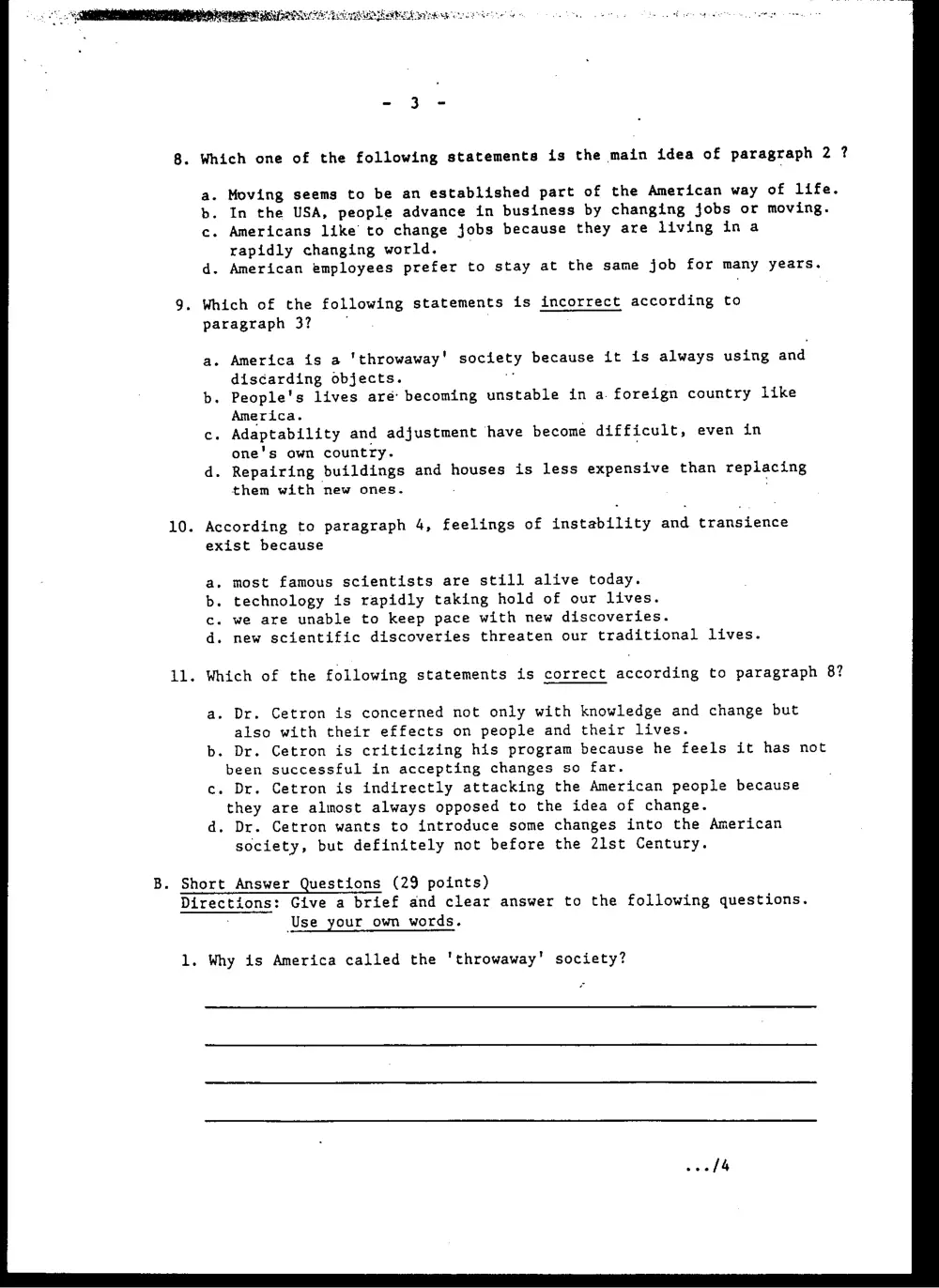
8. Which one of the following statements is the main idea of paragraph 27
a. Moving seems to be an established part of the American way of life.
b. In the USA, people advance in business by changing jobs or moving.
c. Americans like to change jobs because they are living in a
rapidly changing world.
d. American employees prefer to stay at the same job for many years.
9. Which of the following statements is incorrect according to
paragraph 3? ‘
a. America is a 'throwaway' society because it is always using and
discarding objects. 7
b. People's lives aré becoming unstable in a. foreign country like
America.
c. Adaptability and adjustment have become difficult, even in
one's own country. ‘
d. Repairing buildings and houses is less expensive than replacing
them with new ones. :
10. According to paragraph 4, feelings of instability and transience
exist because
a. most famous scientists are still alive today.
b. technology is rapidly taking hold of our lives.
c. we are unable to keep pace with new discoveries.
d. new scientific discoveries threaten our traditional lives.
11. Which of the following statements is correct according to paragraph 8?
a. Dr. Cetron is concerned not only with knowledge and change but
also with their effects on people and their lives.
b. Dr. Cetron is criticizing his program because he feels it has not
been successful in accepting changes so far.
c. Dr. Cetron is indirectly attacking the American people because
they are almost always opposed to the idea of change.
d. Dr. Cetron wants to introduce some changes into the American
society, but definitely not before the 21st Century.
B. Short Answer Questions (29 points)
Directions: Give a brief and clear answer to the following questions.
Use_your own words.
1. Why is America called the ‘throwaway’ society?
o/h
LES RR Chee mE OE GN ie OA de a eae as See tN
2. The author suggests a solution to "future shock" in the passage.
What is it? '
3. How is paragraph 3 developed?
a. Examples
b. Reasons
c. Comparison
d. Contrast
4. What do the words of the musical "Stop the World, I want to
Get Off!" imply about people's attitude towards change?
5. According to paragraph 9, people view the future in different
ways. The author presents three of these views; explain each
briefly in your own words.
(i)
(ii)
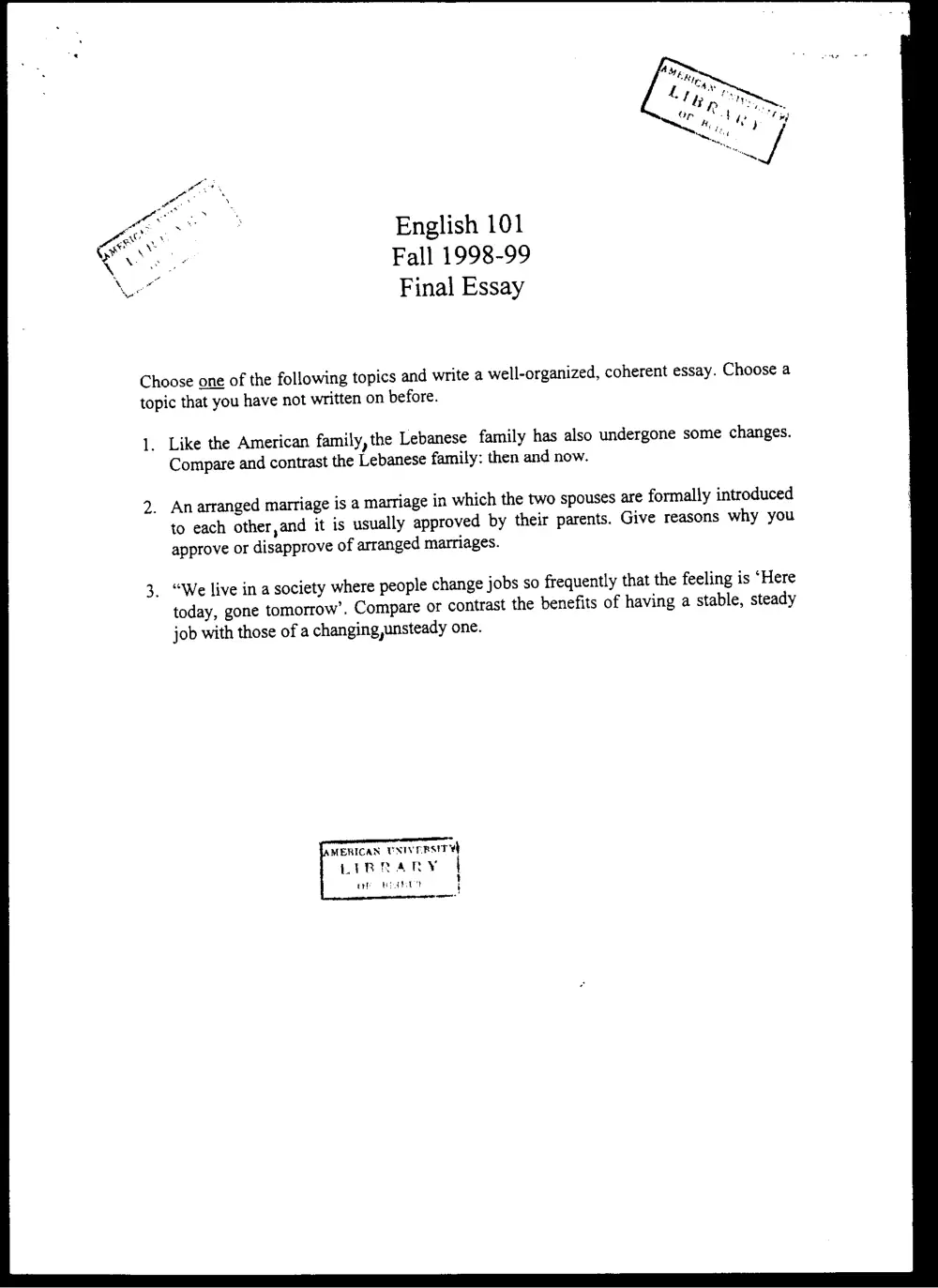
English 101
Fall 1998-99
Final Essay
Choose one of the following topics and write a well-organized, coherent essay. Choose a
topic that you have not written on before.
1. Like the American family, the Lebanese family has also undergone some changes.
Compare and contrast the Lebanese family: then and now.
_ Anarranged marriage is a marriage in which the two spouses are formally introduced
to each other,and it is usually approved by their parents. Give reasons why you
approve or disapprove of arranged marriages.
_ “We live in a society where people change jobs so frequently that the feeling is ‘Here
today, gone tomorrow’. Compare or contrast the benefits of having a stable, steady
job with those of a changing,unsteady one.
MERICAN UNIVERSITY)
Linrary |
!
ee Kaho?