
ENG 103 Final, Fall 2007
American University of Beirut · Introduction to English Drama · 2 pages

Show the text of this final exam
ENGLISH 103: FINAL EXAMINATION
TIME: 2 hours
January 2008
Prof. Nassar
PART ONE (40%): Choose TWO of the quotations below. In each case: (1) Analyze
the ideas and stylistic devices. (2) Link to something else you have come across in
English 103 this semester.
1. POZZO: Help! I’ll pay you!
ESTRAGON: How much?
POZZO: One hundred francs!
ESTRAGON: It’s not enough.
POZZO: Two hundred!
VLADIMIR: We’re coming!
(He tries to pull Pozzo to his feet, fails, tries again, stumbles, falls, tries to get up,
fails.)
VLADIMIR: Help!
( Beckett, WAITING FOR GODOT)
2. BEN: We send him up all we’ve got and he’s not satisfied. Why did you send
him up all that stuff? (Thoughtfully.) Why did I send it up? (Pause.) Who
knows what he’s got upstairs? They must have something up there. They won’t
get much from down here. They’ve probably got a salad bowl up there. Cold
meat, radishes, cucumbers. Hardboiled eggs. The lot.
(Pinter, THE DUMB WAITER)
3. MRS. WARREN: Why shouldn’t I have done it? The house in Brussels was real
high class—a much better place for a woman to be in than the factory where Anne
Jane got poisoned. What is any respectable girl brought up to do but to catch
some rich man’s fancy and get the benefit of his money by marrying him—as if a
marriage ceremony could make any difference in the right or wrong of the thing!
Oh, the hypocrisy of the world makes me sick!
(Shaw, MRS WARREN’S PROFESSION)
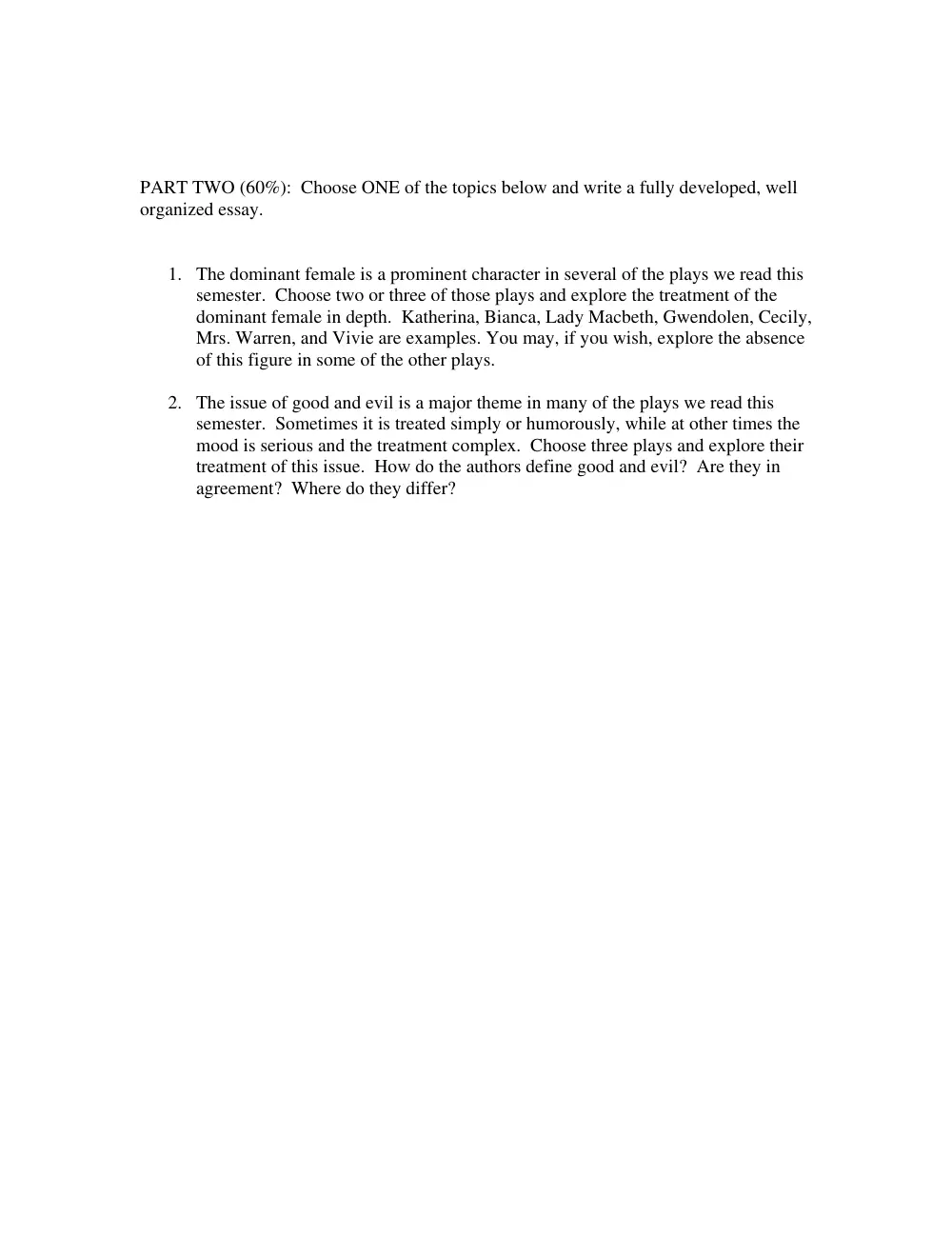
PART TWO (60%): Choose ONE of the topics below and write a fully developed, well
organized essay.
1. The dominant female is a prominent character in several of the plays we read this
semester. Choose two or three of those plays and explore the treatment of the
dominant female in depth. Katherina, Bianca, Lady Macbeth, Gwendolen, Cecily,
Mrs. Warren, and Vivie are examples. You may, if you wish, explore the absence
of this figure in some of the other plays.
2. The issue of good and evil is a major theme in many of the plays we read this
semester. Sometimes it is treated simply or humorously, while at other times the
mood is serious and the treatment complex. Choose three plays and explore their
treatment of this issue. How do the authors define good and evil? Are they in
agreement? Where do they differ?