
ENG 214 Final, Spring 2008
American University of Beirut · Victorian Literature · 4 pages


More ENG 214 files
Show the text of this final exam
1
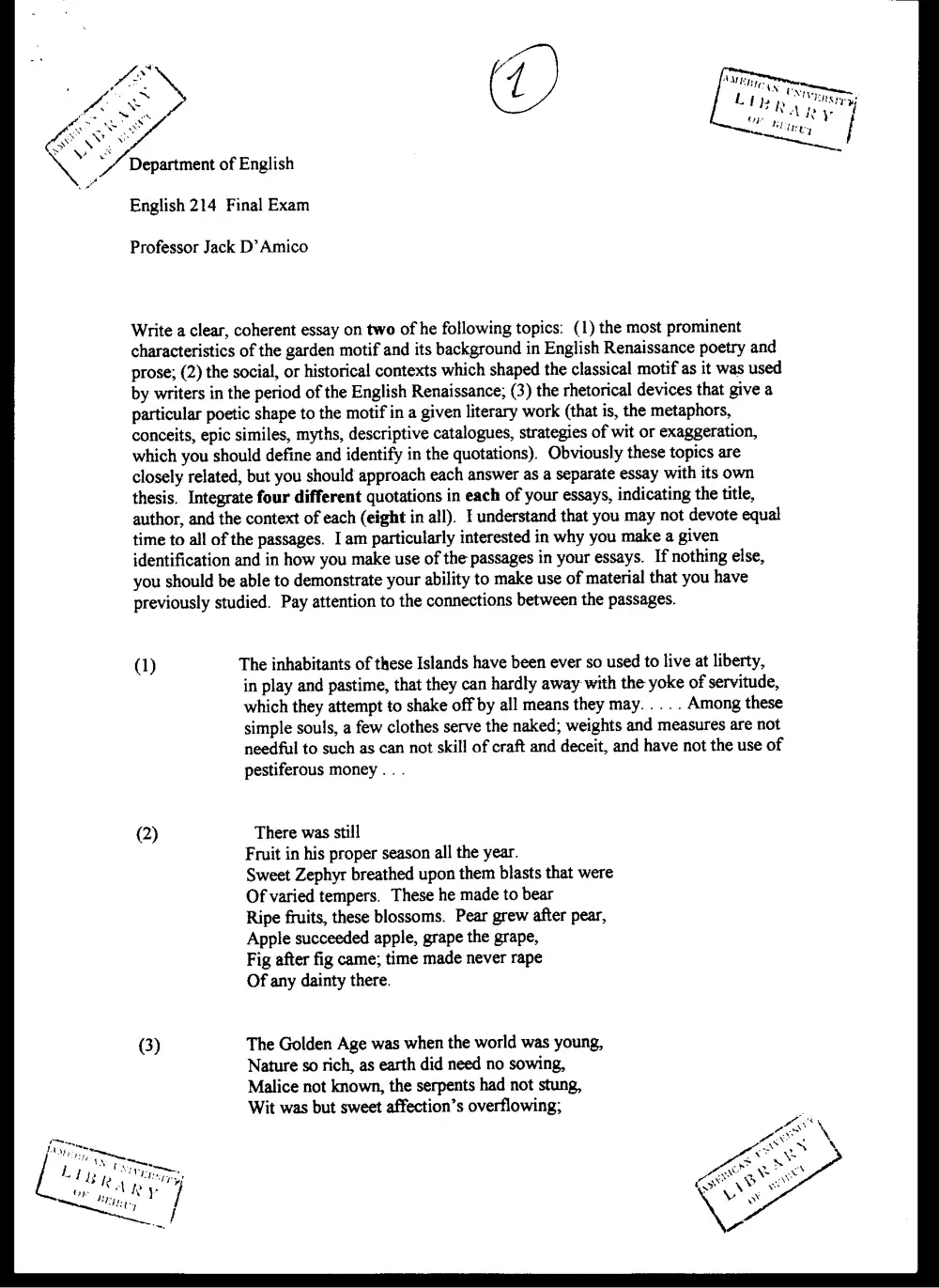
Department of English
English 214 Final Exam
Professor Jack D’ Amico
Write a clear, coherent essay on two of he following topics: (1) the most prominent
characteristics of the garden motif and its background in English Renaissance poetry and
prose; (2) the social, or historical contexts which shaped the classical motif as it was used
by writers in the period of the English Renaissance; (3) the rhetorical devices that give a
particular poetic shape to the motif in a given literary work (that is, the metaphors,
conceits, epic similes, myths, descriptive catalogues, strategies of wit or exaggeration,
which you should define and identify in the quotations). Obviously these topics are
closely related, but you should approach each answer as a separate essay with its own
thesis. Integrate four different quotations in each of your essays, indicating the title,
author, and the context of each (eight in all). I understand that you may not devote equal
time to all of the passages. I am particularly interested in why you make a given
identification and in how you make use of the passages in your essays. If nothing else,
you should be able to demonstrate your ability to make use of material that you have
previously studied. Pay attention to the connections between the passages.
(1) The inhabitants of these Islands have been ever so used to live at liberty,
in play and pastime, that they can hardly away with the yoke of servitude,
which they attempt to shake off by all means they may..... Among these
simple souls, a few clothes serve the naked; weights and measures are not
needful to such as can not skill of craft and deceit, and have not the use of
pestiferous money .. .
(2) There was still
Fruit in his proper season all the year.
Sweet Zephyr breathed upon them blasts that were
Of varied tempers. These he made to bear
Ripe fruits, these blossoms. Pear grew after pear,
Apple succeeded apple, grape the grape,
Fig after fig came; time made never rape
Of any dainty there.
(3) The Golden Age was when the world was young,
Nature so rich, as earth did need no sowing,
Malice not known, the serpents had not stung,
Wit was but sweet affection’s overflowing;
Desire was free, and beauty’s first-begotten;
Beauty then neither net, nor made by art,
Words out of thoughts brought forth, and not forgotten,
The laws were inward that did rule the heart.
As that faire Starre, the messenger of morne,
His deawy face out of the sea doth reare:
Or as the Cyprian goddesse, newly borne
Of th’Oceans fruitfull froth, did first appear:
Such seemed they, and so their yellow heare
Christalline humour dropped downe apace.
Whom such when Guyon saw, he drew him neare,
And somewhat gan relent his earnest pace,
His stubborne brest gan secret pleasaunce to embrace.
And sooth it seemes they say: for he may not
For ever die, and ever buried bee
Tn balefull night, where all things are forgot;
All be he subject to mortalitie,
Yet is eterne in mutabilitie,
And by succession made perpetuall,
Transformed oft, and chaunged diverslie:
For him the Father of all formes, they call;
Therefore needs mote he live, that living gives to all.
Coming to kisse her lyps, (such grace I found)
me seemd I smelt a gardin of sweet flowres:
that dainty odours from them threw around
for damzels fit to decke their lovers bowres.
Her lips did smell lyke unto Gillyflowers,
her ruddy cheekes lyke unto Roses red;
her snowy browes lyke budded Bellamoures,
her lovely eyes lyke Pincks but newly spred.
Her goodly bosome lyke a Strawberry bed,
her neck lyke to a bounch of Cullambynes:
her brest lyke lillyes, ere theyr leaves be shed,
her nipples lyke young blossomd Jessemynes.
Such fragrant flowres doe give most odorous smell,
But her sweet odour did them all excell.
(7) I the commonwealth I would be contraries
Execute all things; for no kind of traffic
Would I admit; no name of magistrate;
Letters should not be known; riches, poverty,
And use of service, none; contract, succession,
Bourn, bound of land, tilth, vineyard, none;
No use of metal, corn, or wine, or oil;
No occupation; all men idle, all;
And women too, but innocent and pure:
No sovereignty;--
(8) The expense of spirit in a waste of shame
Is lust in action; and till action, lust
Is perjured, murderous, bloody, full of blame,
Savage, extreme, rude, cruel, not to trust;
Enjoyed no sooner but despised straight;
Past reason hunted; and so sooner had,
Past reason hated, as a swallowed bait
On purpose laid to make the taker mad;
Mad in pursuit, and in possession so;
Had, having, and in quest to have, extreme;
A bliss in proof; and proved a very woe;
Before, a joy proposed; behind, a dream.
All this the world well knows, yet none knows well
To shun the heaven that leads men to this hell.
(9) Come live with me and be my love,
And we will all the pleasures prove
That valleys, groves, hills, and fields,
Woods, or steepy mountain yields.
And we will sit upon the rocks,
Seeing the shepherds feed their flocks,
By shallow rivers to whose falls
Melodious birds sing madrigals.
(10) Come live with me, and be my love,
And we will some new pleasures prove
Of golden sands, and crystal brooks,
With silken lives, and silver hooks.
qty
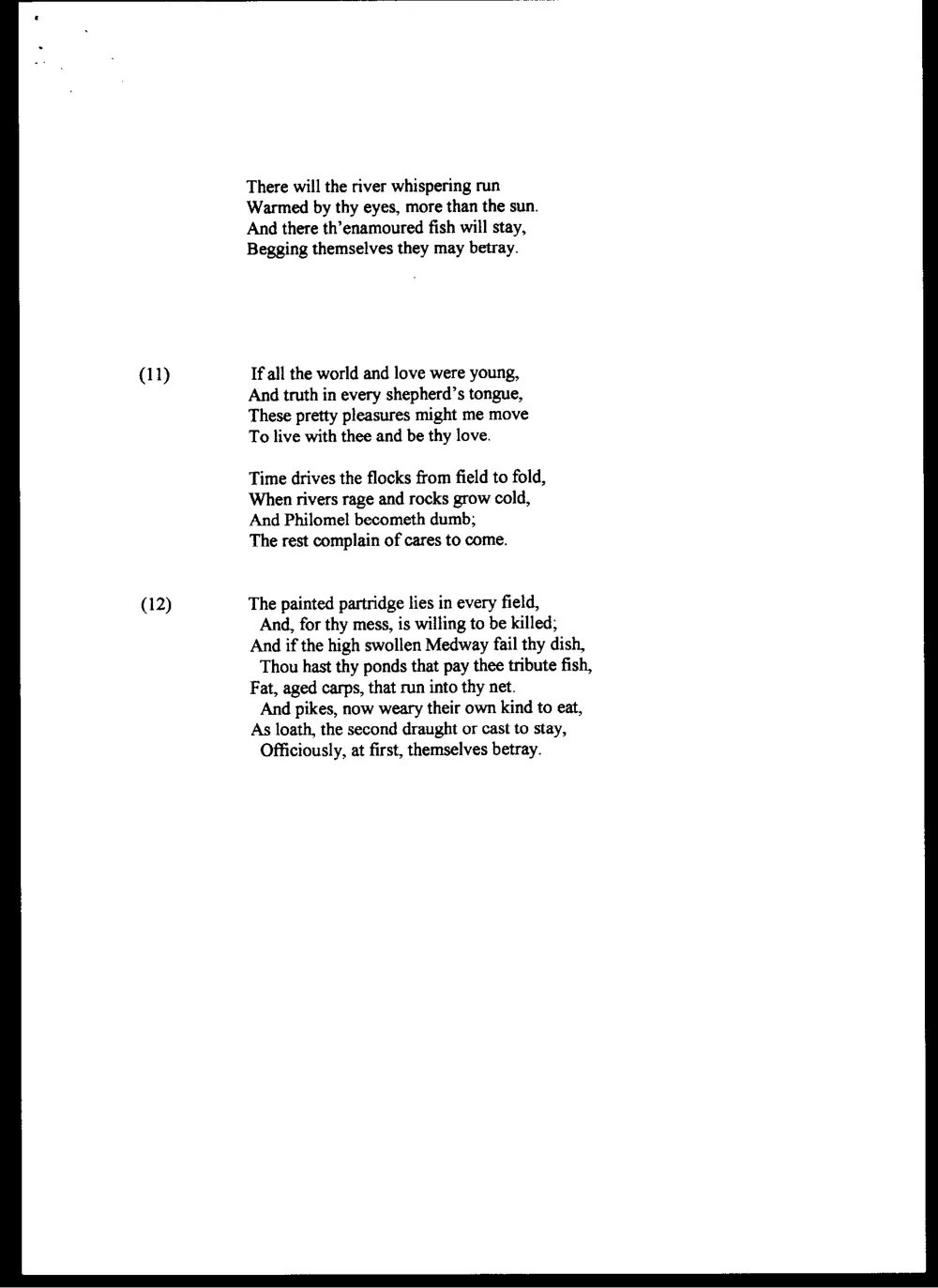
(12)
There will the river whispering run
Warmed by thy eyes, more than the sun.
And there th’enamoured fish will stay,
Begging themselves they may betray.
If all the world and love were young,
And truth in every shepherd’s tongue,
These pretty pleasures might me move
To live with thee and be thy love.
Time drives the flocks from field to fold,
When rivers rage and rocks grow cold,
And Philomel becometh dumb;
The rest complain of cares to come.
The painted partridge lies in every field,
And, for thy mess, is willing to be killed;
And if the high swollen Medway fail thy dish,
Thou hast thy ponds that pay thee tribute fish,
Fat, aged carps, that run into thy net.
And pikes, now weary their own kind to eat,
As loath, the second draught or cast to stay,
Officiously, at first, themselves betray.