
ENG 224 Final, Spring 2008
American University of Beirut · American Literature to 1900 · 2 pages
More ENG 224 files
Show the text of this final exam
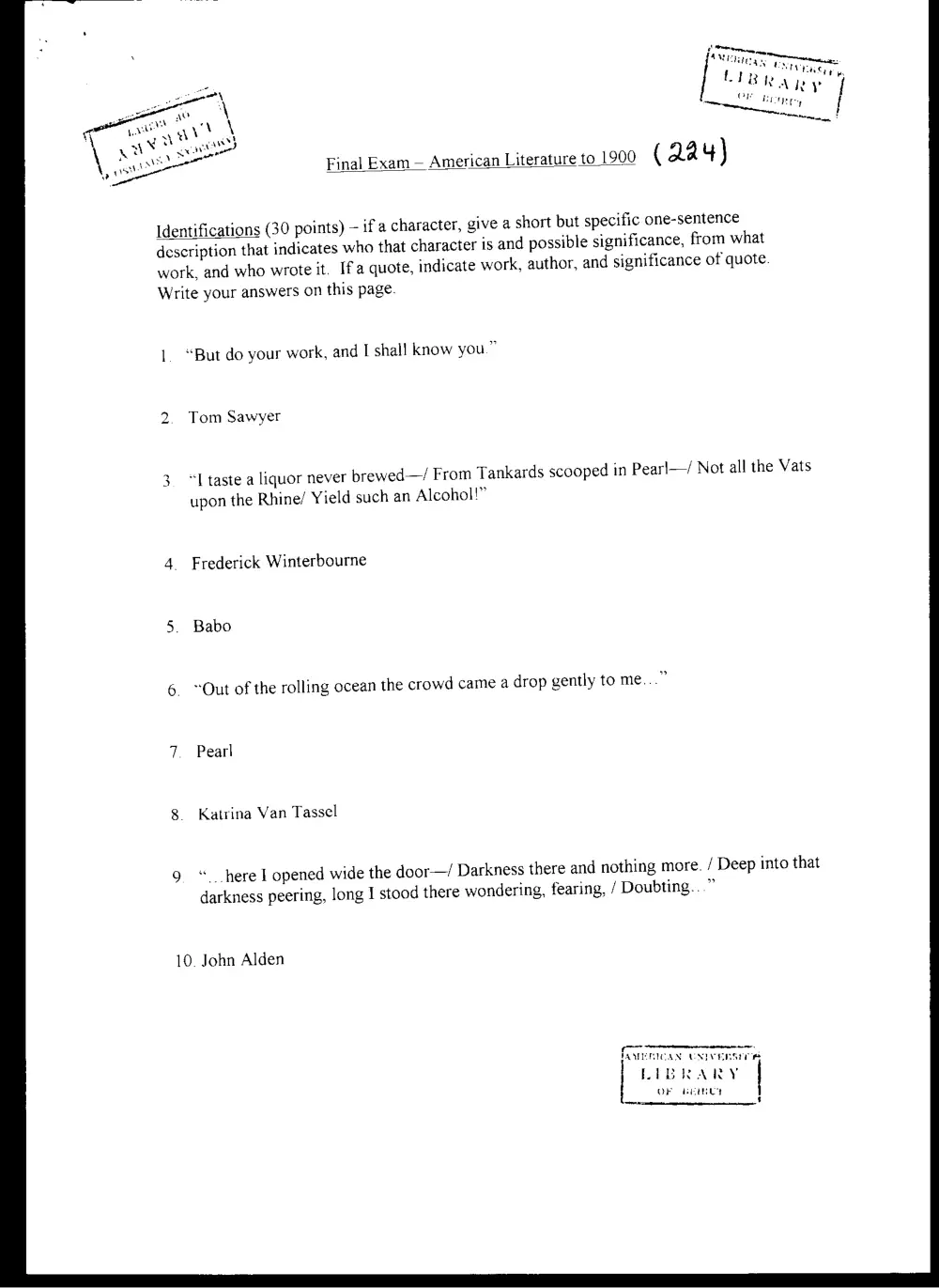
Final Exam — American Literature to 1900 ( aa 4)
Identifications (30 points) — if a character, give a short but specific one-sentence
description that indicates who that character is and possible significance, from what
work, and who wrote it. If a quote, indicate work, author, and significance of quote.
Write your answers on this page.
1. “But do your work, and I shall know you.”
Tom Sawyer
“I taste a liquor never brewed—/ From Tankards scooped in Pear!—/ Not all the Vats
upon the Rhine/ Yield such an Alcohol!”
Frederick Winterbourne
Babo
“Out of the rolling ocean the crowd came a drop gently to me...”
Pearl
Katrina Van Tassel
“here 1 opened wide the door—/ Darkness there and nothing more. / Deep into that
darkness peering, long I stood there wondering, fearing, / Doubting...”
10. John Alden
co: .
FAMERICAN UNIVERSIOS
LIBRARY
OF BEIRUT
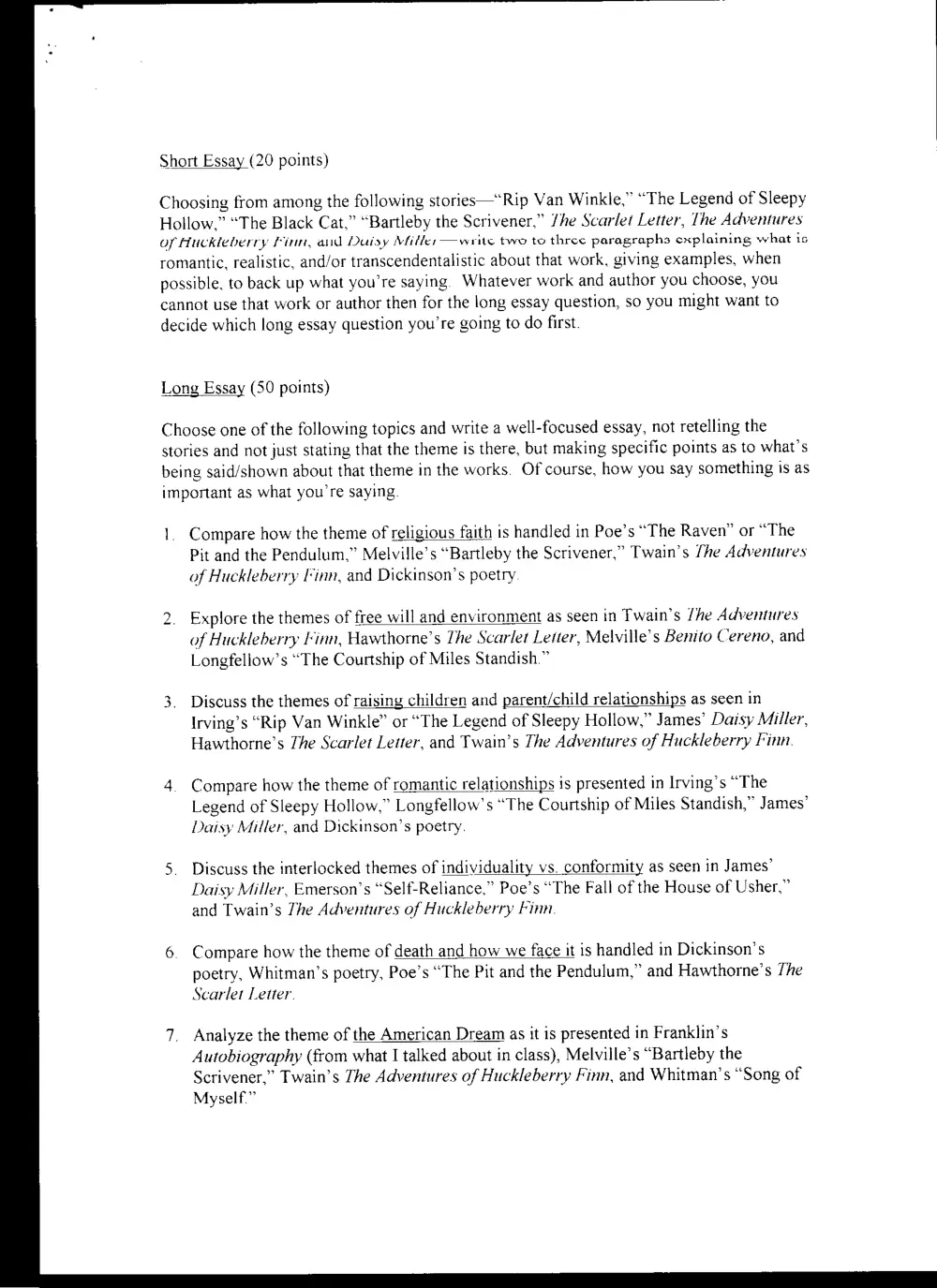
Short Essay (20 points)
Choosing from among the following stories—“Rip Van Winkle,” “The Legend of Sleepy
Hollow,” “The Black Cat,” “Bartleby the Scrivener,” /he Scarlet Letter, The Adventures
of Huckleberry Finn, aid Duisy Miller —write two to three paragraphs explaining what is
romantic, realistic, and/or transcendentalistic about that work, giving examples, when
possible, to back up what you’re saying. Whatever work and author you choose, you
cannot use that work or author then for the long essay question, so you might want to
decide which long essay question you’re going to do first.
Long Essay (50 points)
Choose one of the following topics and write a well-focused essay, not retelling the
stories and not just stating that the theme is there, but making specific points as to what’s
being said/shown about that theme in the works. Of course, how you say something is as
important as what you’re saying.
1. Compare how the theme of religious faith is handled in Poe’s “The Raven” or “The
Pit and the Pendulum,” Melville’s “Bartleby the Scrivener,” Twain’s fhe Adventures
of Huckleberry Finn, and Dickinson’s poetry
2. Explore the themes of free will and environment as seen in Twain’s /he Adventures
of Huckleberry Finn, Hawthorne’s The Scarlet Letter, Melville’s Benito Cereno, and
Longfellow’s “The Courtship of Miles Standish.”
3, Discuss the themes of raising children and parent/child relationships as seen in
Irving’s “Rip Van Winkle” or “The Legend of Sleepy Hollow,” James’ Daisy Miller,
Hawthorne’s Zhe Scarlet Letter, and Twain’s The Adventures of Huckleberry Finn.
4. Compare how the theme of romantic relationships 1s presented in Irving’s “The
Legend of Sleepy Hollow,” Longfellow’s “The Courtship of Miles Standish,” James’
Daisy Miller, and Dickinson’s poetry.
5. Discuss the interlocked themes of individuality vs. conformity as seen in James’
Daisy Miller, Emerson’s “Self-Reliance,” Poe’s “The Fall of the House of Usher,”
and Twain’s The Adventures of Huckleberry Finn.
6. Compare how the theme of death and how we face it is handled in Dickinson’s
poetry, Whitman’s poetry, Poe’s “The Pit and the Pendulum,” and Hawthorne’s The
Scarlet Letter.
7. Analyze the theme of the American Dream as it is presented in Franklin’s
Autobiography (from what I talked about in class), Melville’s “Bartleby the
anes
Scrivener,” Twain’s The Adventures of Huckleberry Finn, and Whitman’ s
Myself.”
Song of