
ENG 227 Final, Fall 2003
American University of Beirut · Introduction to Language · 2 pages
More ENG 227 files
Show the text of this final exam
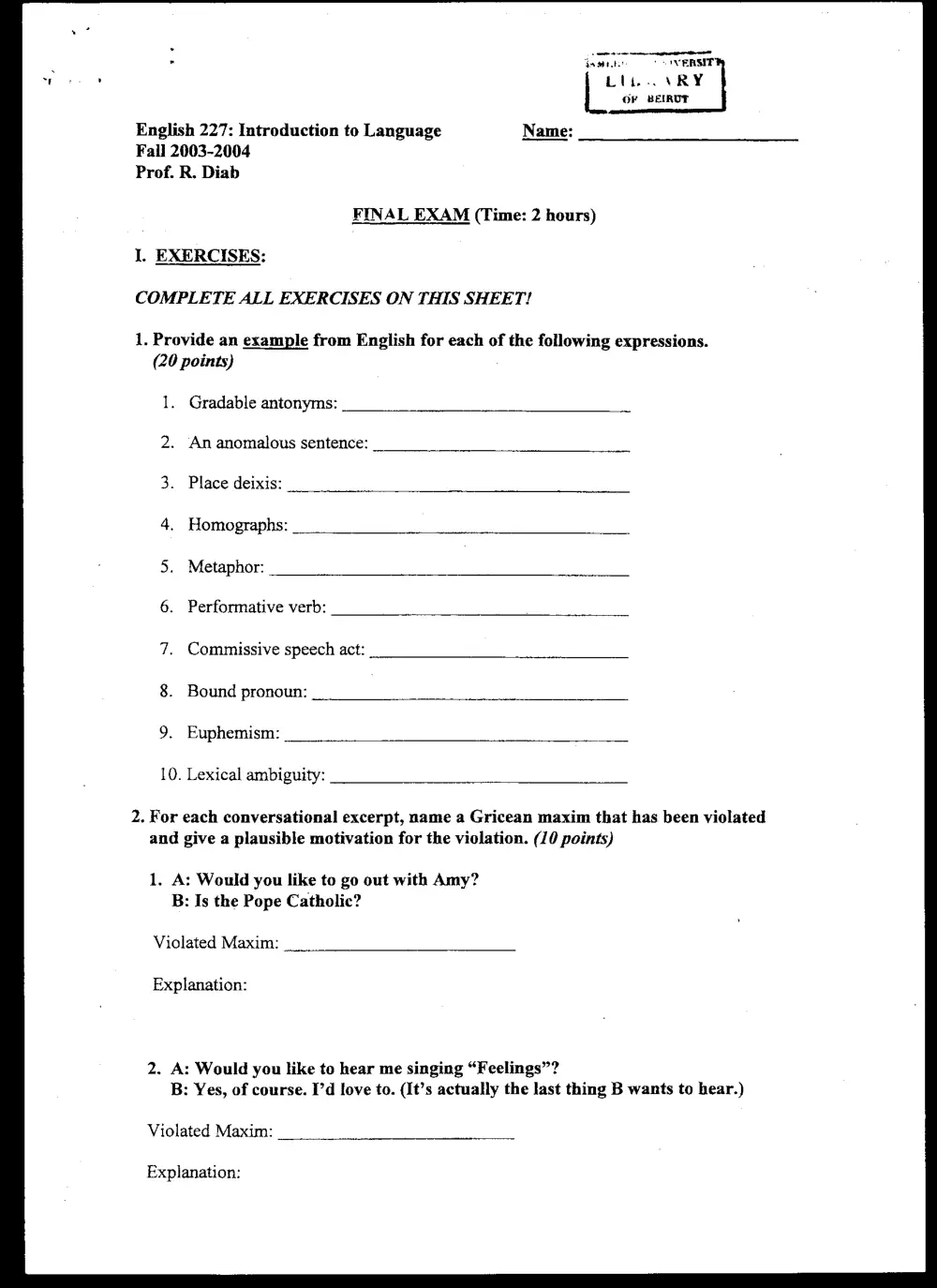
Jasete OVERSIT
Lili. \RY
OF BEIRUT
FINAL EXAM (Time: 2 hours)
English 227: Introduction to Language
Fall 2003-2004
Prof. R. Diab
I. EXERCISES:
COMPLETE ALL EXERCISES ON THIS SHEET!
1. Provide an example from English for each of the following expressions.
(20 points)
1. Gradable antonyms:
2. ‘An anomalous sentence:
. Place deixis:
. Homographs:
. Metaphor:
. Performative verb:
. Commissive speech act:
8. Bound pronoun:
9. Euphemism:
10. Lexical ambiguity:
2. For each conversational excerpt, name a Gricean maxim that has been violated
and give a plausible motivation for the violation. (10 points)
1. A: Would you like to go out with Amy?
B: Is the Pope Catholic?
Violated Maxim:
Explanation:
2. A: Would you like to hear me singing “Feelings”?
B: Yes, of course. I’d love to. (It’s actually the last thing B wants to bear.)
Violated Maxim:
Explanation:
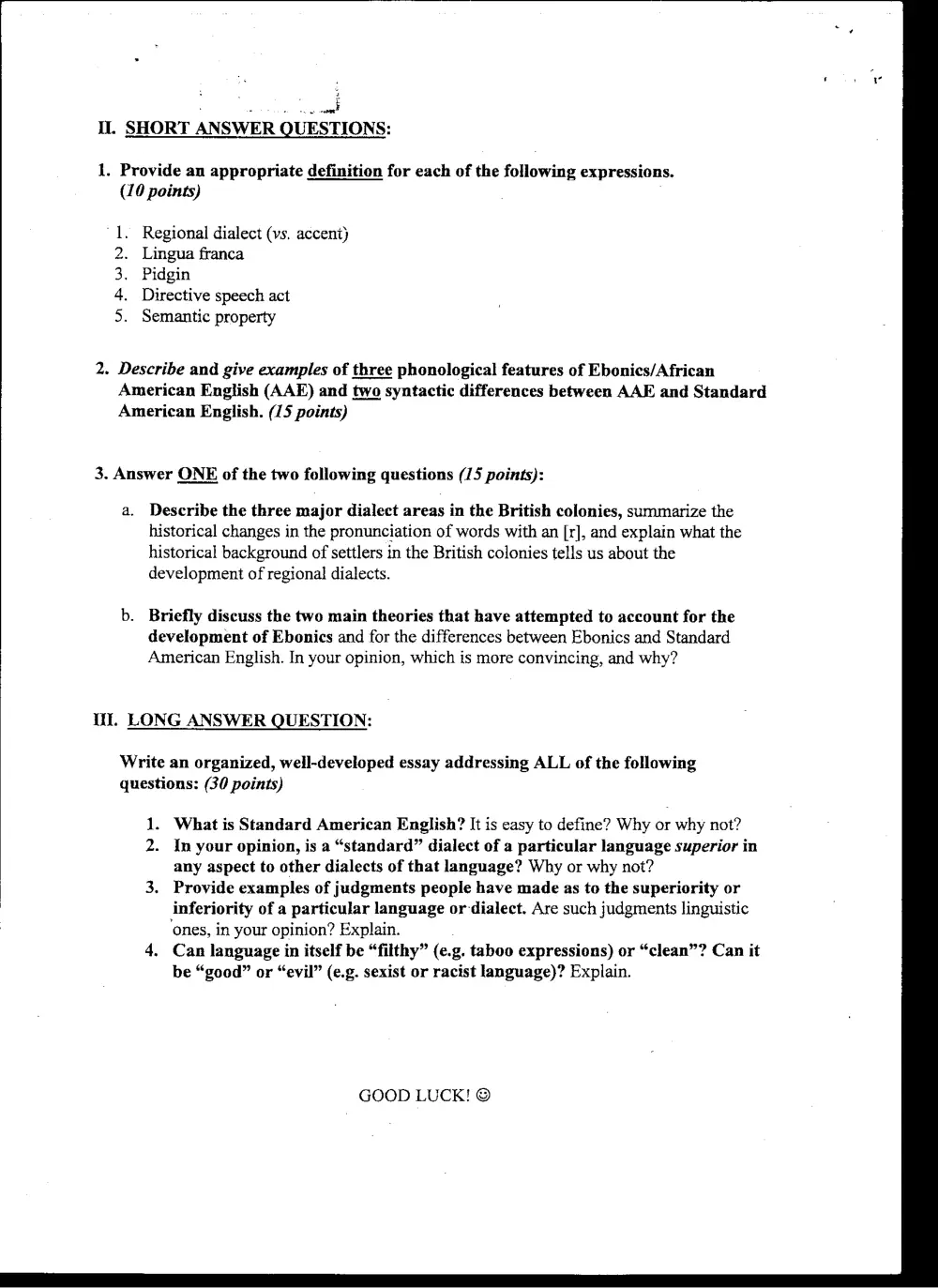
Il. SHORT ANSWER QUESTIONS:
1. Provide an appropriate definition for each of the following expressions.
(10 points)
Regional dialect (vs. accent)
Lingua franca
Pidgin
Directive speech act
Semantic property
wR
2. Describe and give examples of three phonological features of Ebonies/African
American English (AAE) and two syntactic differences between AAE and Standard
American English. (15 points)
3. Answer ONE of the two following questions (15 points):
a. Describe the three major dialect areas in the British colonies, summarize the
historical changes in the pronunciation of words with an [r], and explain what the
historical background of settlers in the British colonies tells us about the
development of regional dialects.
b. Briefly discuss the two main theories that have attempted to account for the
development of Ebonics and for the differences between Ebonics and Standard
American English. In your opinion, which is more convincing, and why?
I. LONG ANSWER QUESTION:
Write an organized, well-developed essay addressing ALL of the following
questions: (30 points)
1. What is Standard American English? It is easy to define? Why or why not?
2. In your opinion, is a “standard” dialect of a particular language superior in
any aspect to other dialects of that language? Why or why not?
3. Provide examples of judgments people have made as to the superiority or
inferiority of a particular language or-dialect. Are such judgments linguistic
‘ones, in your opinion? Explain.
4. Can language in itself be “filthy” (e.g. taboo expressions) or “clean”? Can it
be “good” or “evil” (e.g. sexist or racist language)? Explain.
GOOD LUCK! ©