
ENG 227 Final, Spring 2003
American University of Beirut · Introduction to Language · 2 pages

More ENG 227 files
Show the text of this final exam
MERICAS ENIVERSIT’
LIBRARY
OF BEIRUT
English 227: Introduction to Language Name:
Spring 2002-2003
Dr. R. Diab
FINAL EXAM (Time: 2 hours)
L DEFINITIONS: Provide an appropriate definition and an example for
each of the following expressions. (20 points)
1. Meaning shift
2. Regional dialect (vs. accent)
3. Logographic writing system
4. Pidgin
5. Loan translation
6. Broadening
7. Syllabic writing system
8. Euphemism
9. Lingua franca
1
Il. SHORT ANSWER QUESTIONS: Answer number 1 and TWO of the
remaining three questions (numbers 2, 3, and 4).
1. Describe and give examples of three phonological features of
Ebonics/African American English (AAE) and two syntactic
differences between AAE and Standard American English. (20 points)
2. How does the study of loan words in English help us in following the
history of English-speaking peoples? In answering this question, make
sure you provide examples of loan words in English from different
languages and discuss the kinds of loan words and the (approximate) time
they entered English. (15 points)
3. Answer the following questions concerning language families:
(15 points)
a. What major family of languages does English belong to?
b. Name three genetically related languages in this family (and
specify their ancestral protolanguage).
c. Identify three other major language families and name one
language that belongs to each.
4. Discuss the two main theories that have attempted to account for the
development of Ebonics and for the differences between Ebonics and
Standard American English. [n your opinion, which is more convincing,
and why? U5 points)
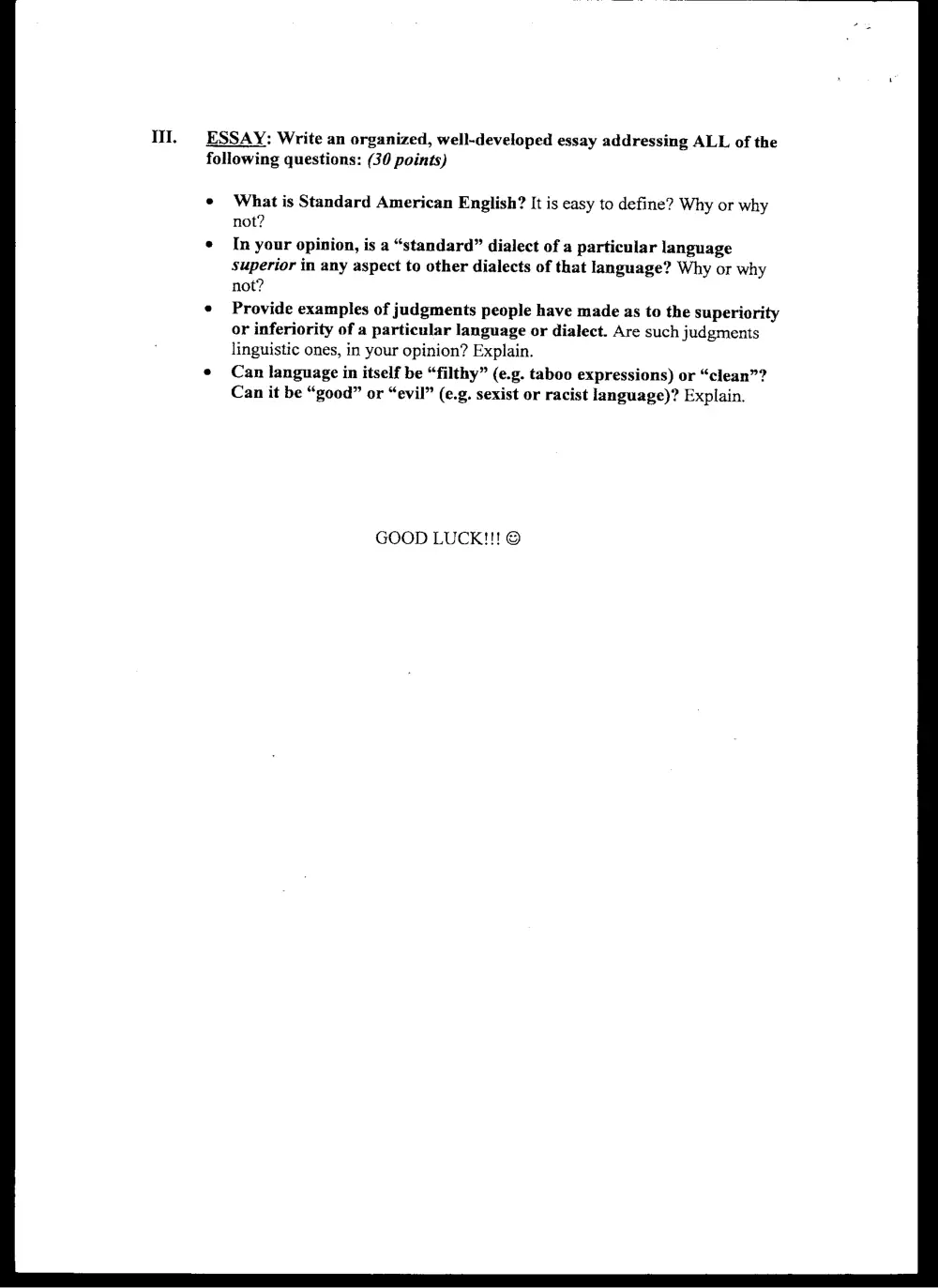
Ill. ESSAY: Write an organized, well-developed essay addressing ALL of the
following questions: (30 points)
What is Standard American English? It is easy to define? Why or why
not?
In your opinion, is a “standard” dialect of a particular language
superior in any aspect to other dialects of that language? Why or why
not?
Provide examples of judgments people have made as to the superiority
or inferiority of a particular language or dialect. Are such judgments
linguistic ones, in your opinion? Explain.
Can language in itself be “filthy” (e.g. taboo expressions) or “clean”?
Can it be “good” or “evil” (e.g. sexist or racist language)? Explain.
GOOD LUCK!!! ©