
ENG 244 Final, Spring 2008
American University of Beirut · Selected Topics in Literature · 3 pages

Show the text of this final exam
”
English 244: Nobel Prize Winners
Final Examination
Dr. Lisa Salem
1.
IDENTIFICATIONS {30 pts.]. Choose SIX only and write a paragraph
- identifying the author, text, speaker [when relevant],and, most
importantly, the significance of the quotation.
. Who asked you to buy two tickets. You said nothing to me. Don’t you think you
must discuss? No, you are used to making all decisions, you do what you like, no
father, no mother, nobody must ever tell you. And me—what am I, don’t speak to
me, don’t ask me—you cannot live in my country, it’s not for you, you can’t
understand what it is to live there, you can wish you were dead, if you have to live
there. Can’t you understand? I can’t be for you—responsible—
. Our engagement was announced on a happy day. In those days, a dream could
still come true. But the moment we started working we had to face a new set of
problems. Three years went by, and we turned twenty-six. I was in love then, but
now I am exhausted, helpless, and burdened with responsibilities. We no longer
meet just to talk but to engage in endless discussions, enough to allow us to
qualify for the Economics Group: the flat, the furniture, the burdens of a life
together. Neither she nor I have a solution.
. My friend’s from England, he’s asking if you’ve been waiting a long time for a
lift. So I tell them—A long time? Madame! And because they white, I tell them
about the blacks, how when they stop they ask you to pay. This time I understand
what the young man’s saying, he say, And most whites don’t stop? And I’m
careful what I say, I tell them about the blacks, how too many people spoil it for
us, they robbing and killing, you can’t blame white people.
She asks about his home, does he have photographs—when she makes
assumptions, she doesn’t even have a photograph to go by, faces to learn from.
His figure, a slim taut vertical as he comes out of the dank dimness of the place he
works in, the lines of his back, in the sun, as he strolls to the water to give some
left-overs to the ducks—he’s a cut-out from a background that she surely
imagines only wrongly. Palm trees, camels, alleys hung with carpets and brass
vessels. Dhows, those sea-bird ships manned by men to whom she can’t fit his
face. No, he has no photographs.
. “Thad been given to understand that you were financially secure,” I said.
“Only in this sense. Other than that there’s no sense of security for anyone with
this perpetual rise in prices!” he answered blatantly. I was totally dumbfounded
while he went on excitedly: “God won’t forgive you if you don’t amass an
incredible fortune under these circumstances.”
“Isn’t it enough to have what will allow us to live comfortably?”
“Comfortably?” We’re in a merciless rat race, my dear.”
10.
I.
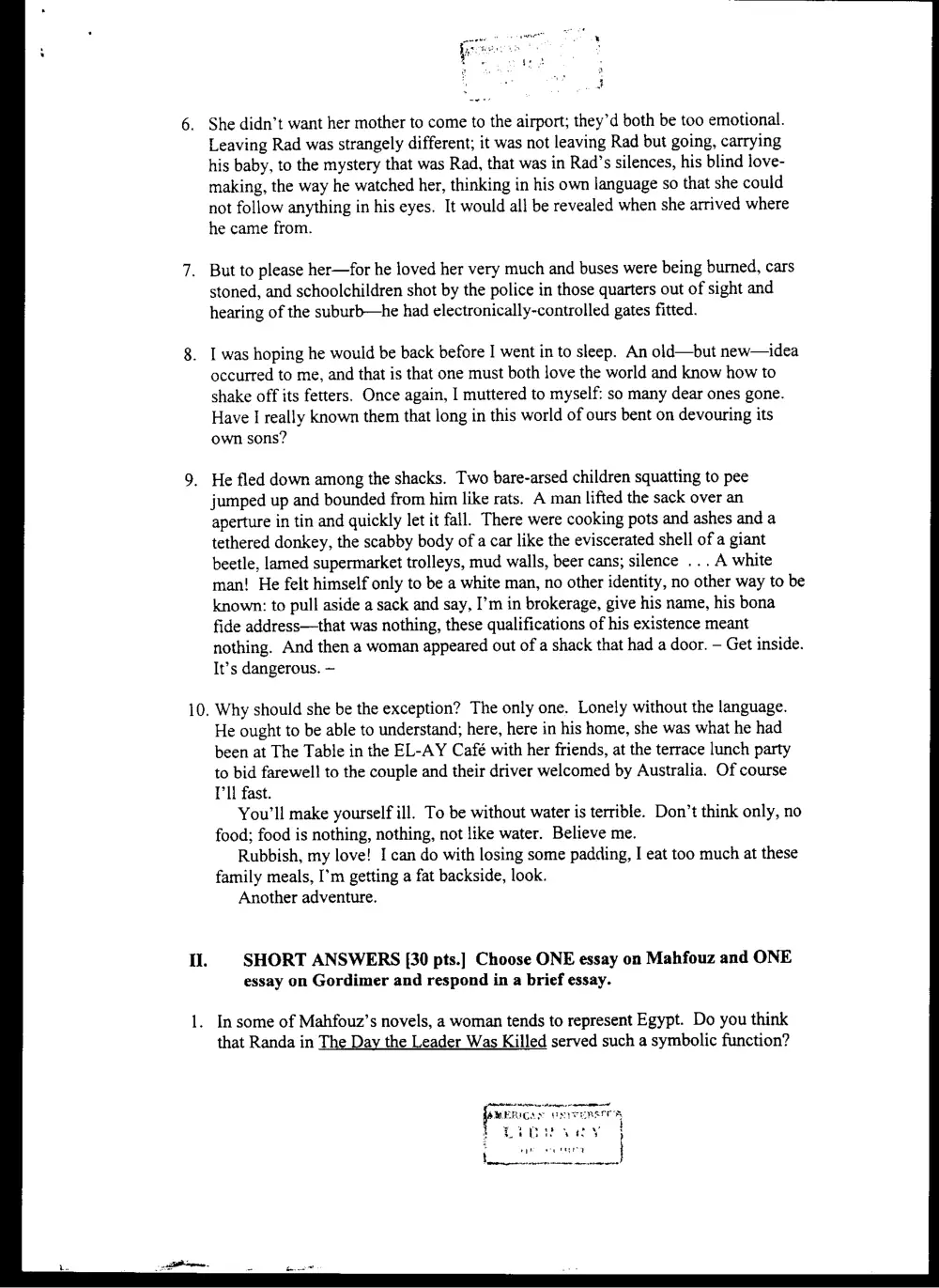
She didn’t want her mother to come to the airport; they’d both be too emotional.
Leaving Rad was strangely different; it was not leaving Rad but going, carrying
his baby, to the mystery that was Rad, that was in Rad’s silences, his blind love-
making, the way he watched her, thinking in his own language so that she could
not follow anything in his eyes. It would all be revealed when she arrived where
he came from.
But to please her—for he loved her very much and buses were being burned, cars
stoned, and schoolchildren shot by the police in those quarters out of sight and
hearing of the suburb—he had electronically-controlled gates fitted.
I was hoping he would be back before I went in to sleep. An old—but new—idea
occurred to me, and that is that one must both love the world and know how to
shake off its fetters. Once again, I muttered to myself: so many dear ones gone.
Have I really known them that long in this world of ours bent on devouring its
own sons?
He fled down among the shacks. Two bare-arsed children squatting to pee
jumped up and bounded from him like rats. A man lifted the sack over an
aperture in tin and quickly let it fall. There were cooking pots and ashes and a
tethered donkey, the scabby body of a car like the eviscerated shell of a giant
beetle, lamed supermarket trolleys, mud walls, beer cans; silence . .. A white
man! He felt himself only to be a white man, no other identity, no other way to be
known: to pull aside a sack and say, I’m in brokerage, give his name, his bona
fide address—that was nothing, these qualifications of his existence meant
nothing. And then a woman appeared out of a shack that had a door. — Get inside.
It’s dangerous. ~
Why should she be the exception? The only one. Lonely without the language.
He ought to be able to understand; here, here in his home, she was what he had
been at The Table in the EL-AY Café with her friends, at the terrace lunch party
to bid farewell to the couple and their driver welcomed by Australia. Of course
Pll fast.
You’ll make yourself ill. To be without water is terrible. Don’t think only, no
food; food is nothing, nothing, not like water. Believe me.
Rubbish, my love! I can do with losing some padding, I eat too much at these
family meals, I’m getting a fat backside, look.
Another adventure.
SHORT ANSWERS [30 pts.] Choose ONE essay on Mahfouz and ONE
essay on Gordimer and respond in a brief essay.
. In some of Mahfouz’s novels, a woman tends to represent Egypt. Do you think
that Randa in The Day the Leader Was Killed served such a symbolic function?
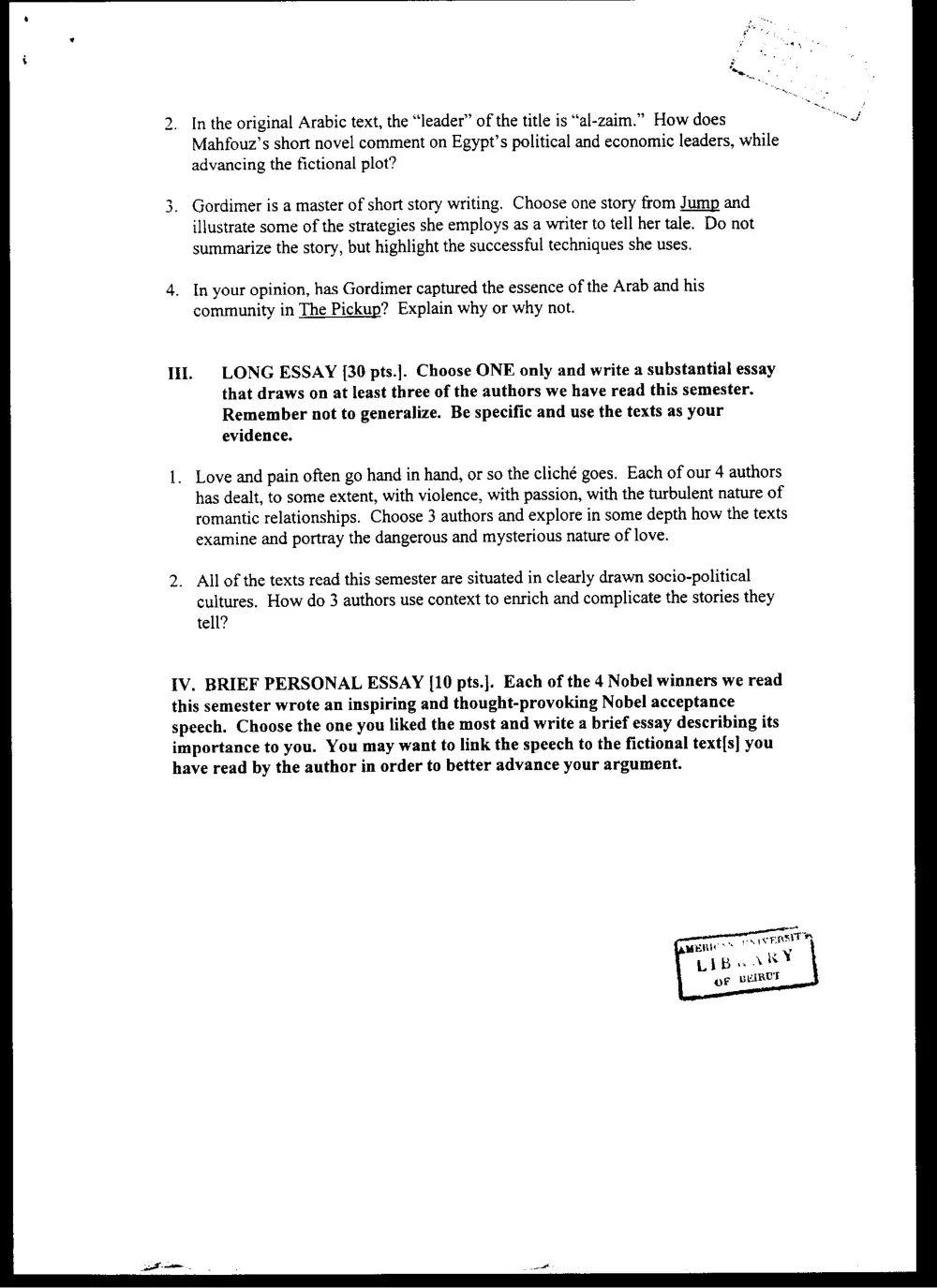
In the original Arabic text, the “leader” of the title is “al-zaim.” How does
Mahfouz’s short novel comment on Egypt’s political and economic leaders, while
advancing the fictional plot?
_ Gordimer is a master of short story writing. Choose one story from Jump and
illustrate some of the strategies she employs as a writer to tell her tale. Do not
summarize the story, but highlight the successful techniques she uses.
. In your opinion, has Gordimer captured the essence of the Arab and his
community in The Pickup? Explain why or why not.
LONG ESSAY {30 pts.]. Choose ONE only and write a substantial essay
that draws on at least three of the authors we have read this semester.
Remember not to generalize. Be specific and use the texts as your
evidence.
Love and pain often go hand in hand, or so the cliché goes. Each of our 4 authors
has dealt, to some extent, with violence, with passion, with the turbulent nature of
romantic relationships. Choose 3 authors and explore in some depth how the texts
examine and portray the dangerous and mysterious nature of love.
_ All of the texts read this semester are situated in clearly drawn socio-political
cultures. How do 3 authors use context to enrich and complicate the stories they
tell?
IV. BRIEF PERSONAL ESSAY {10 pts.]. Each of the 4 Nobel winners we read
this semester wrote an inspiring and thought-provoking Nobel acceptance
speech. Choose the one you liked the most and write a brief essay describing its
importance to you. You may want to link the speech to the fictional text(s] you
have read by the author in order to better advance your argument.