
ENG 246 Final, Fall 2004
American University of Beirut · Applied Linguistics · 2 pages

More ENG 246 files
Show the text of this final exam
OC
LIBR a zt y
oF RuIRDT |
English 246:Applied Linguistics Name:
Fall 2004-2005
Dr. R. Diab
FINAL EXAM (Time: 2 hours)
Provide an appropriate (and brief) definition for TEN of the following
expressions. (30 points)
Concurrent validity
Cloze test
Language-in-education policy
Diagnostic test
BICS
Communicative competence test
Discrete-point testing
Unitary Trait Hypothesis
Inter-rater reliability
10. Face validity
11. Proficiency test
12. Institutional framework/qualification
CP RADARWN
Answer THREE of the following four short-answer questions.
(15 points each)
1. Choose two of the language teaching methodologies that we have
become acquainted with in class, namely grammar translation
method, audio-lingualism, the direct method, community language
learning, suggestopedia, the natural approach, and communicative
language teaching:
a. Describe the major characteristics of the approach.
b. Discuss the strengths/benefits and any drawbacks/limitations.
. Why and how should change be initiated in language teacher
education programs? What are the different types of research on
teaching practice and teacher development in considering such change?
. In class, we discussed Eliott Judd’s description of what he called
the “contradictory” language-in-education policy in the USA. Why
does he call it contradictory, how does he explain the apparent
contradictions, and what future trends in American foreign-language
education policy and policies on non-English speakers does he predict?
. One debatable issue in language teacher education is the native vs.
non-native language teacher. List the major reasons behind the
desirability of the native language teacher and provide your own
opinion: Is it necessary or “better” (if so, how?) for the language
teacher to be a native speaker of the target language? Is there any
advantage to having a non-native language teacher rather than a native
speaker? Elaborate.
AWERINAN Peovernstr
LIBRARY
OF REIRUT
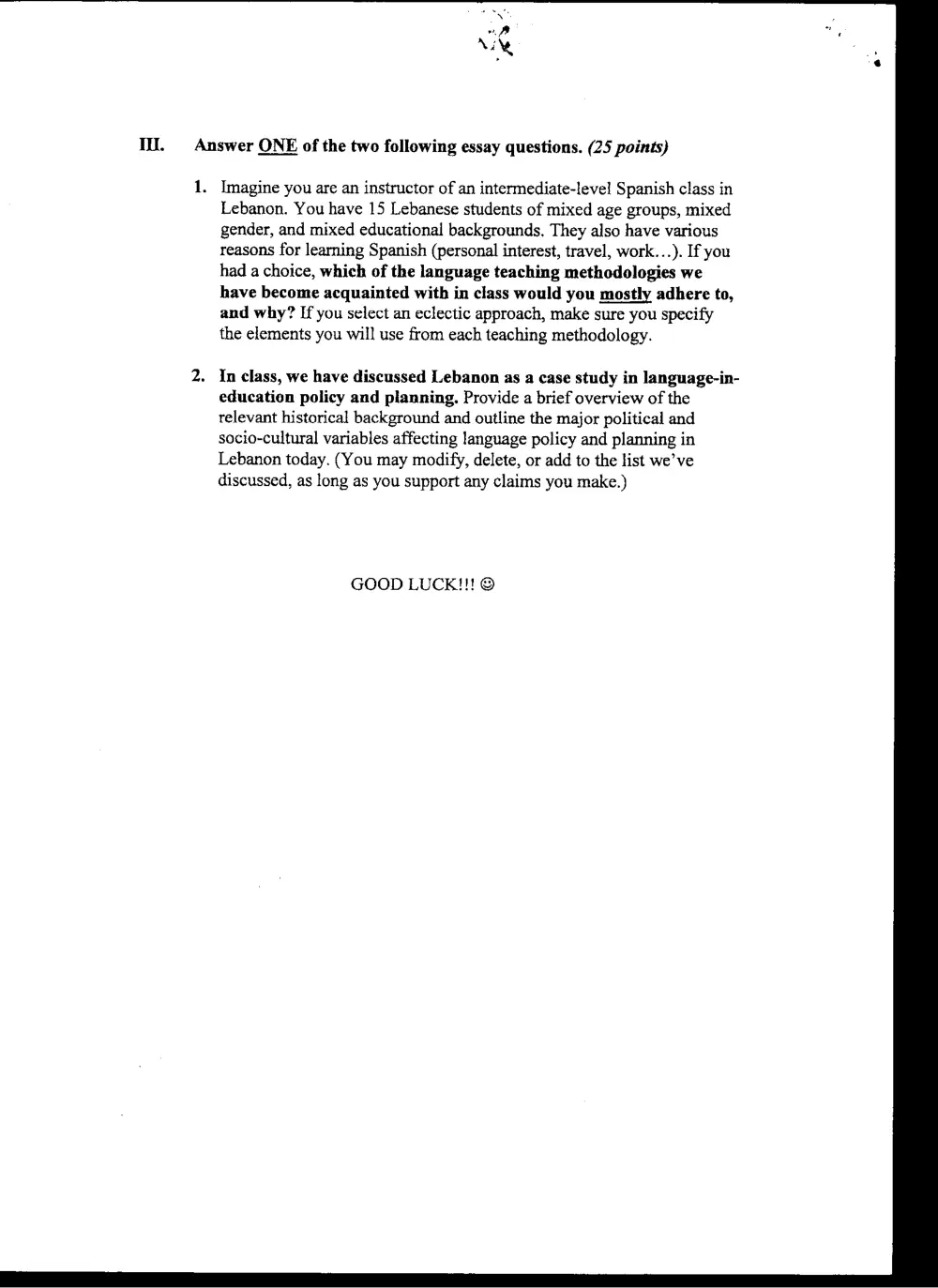
TH. Answer ONE of the two following essay questions. (25 points)
1. Imagine you are an instructor of an intermediate-level Spanish class in
Lebanon. You have 15 Lebanese students of mixed age groups, mixed
gender, and mixed educational backgrounds. They also have various
reasons for learning Spanish (personal interest, travel, work...). If you
had a choice, which of the language teaching methodologies we
have become acquainted with in class would you mostly adhere to,
and why? If you select an eclectic approach, make sure you specify
the elements you will use from each teaching methodology.
2. In class, we have discussed Lebanon as a case study in language-in-
education policy and planning. Provide a brief overview of the
relevant historical background and outline the major political and
socio-cultural variables affecting language policy and planning in
Lebanon today. (You may modify, delete, or add to the list we’ve
discussed, as long as you support any claims you make.)
GOOD LUCK!!! ©