
ENG 301 Final, Spring 2004
American University of Beirut · Introduction to Bibliography and Methods of Research · 2 pages

More ENG 301 files
Show the text of this final exam
ene ey
ara Thaw
P LEB aRY |
Or BeQRUT
Seth re LRT
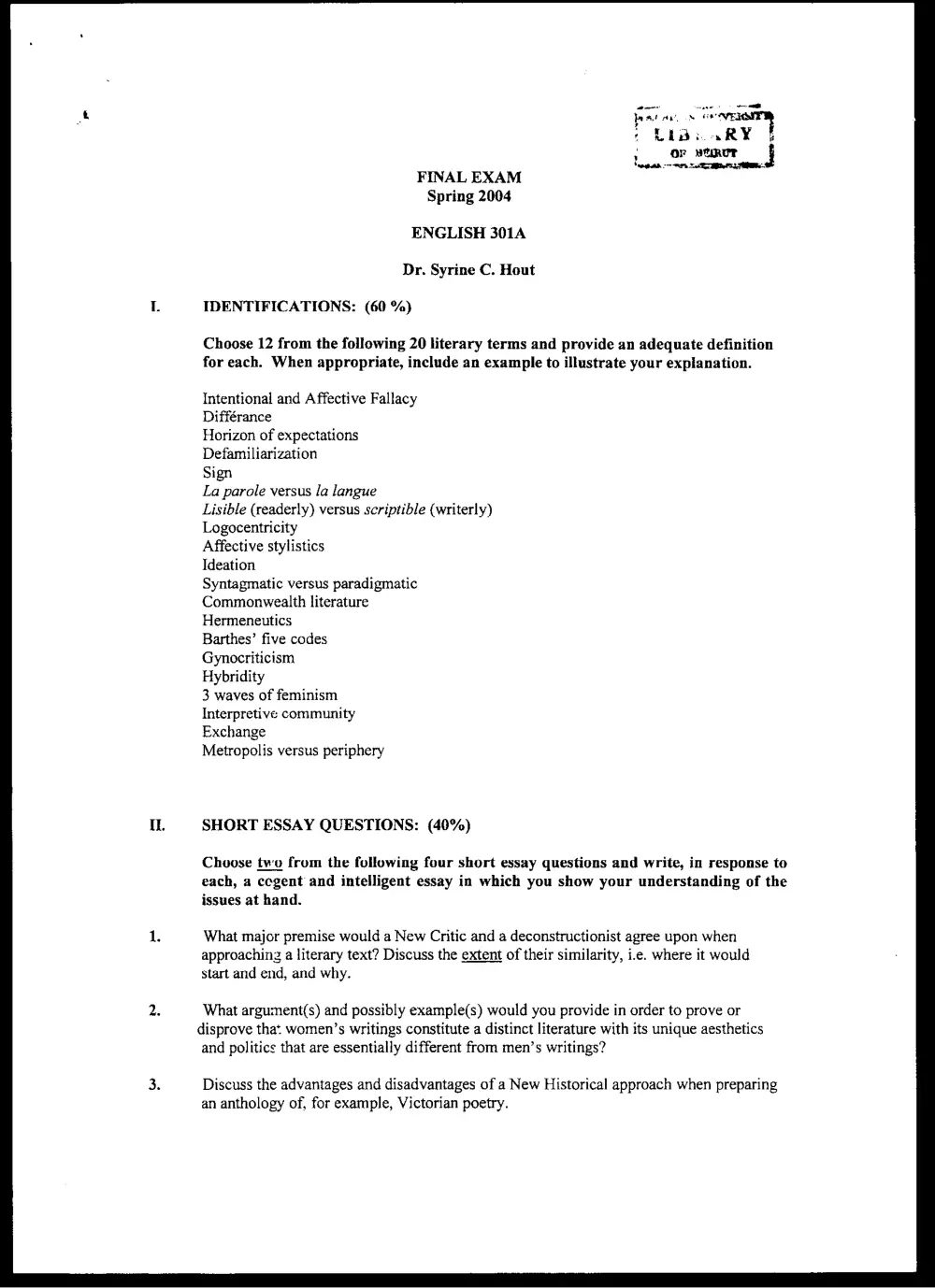
FINAL EXAM
Spring 2004
ENGLISH 301A
Dr. Syrine C. Hout
IDENTIFICATIONS: (60 %)
Choose 12 from the following 20 literary terms and provide an adequate definition
for each. When appropriate, include an example to illustrate your explanation.
Intentional and Affective Fallacy
Différance
Horizon of expectations
Defamiliarization
Sign
La parole versus la langue
Lisible (readerly) versus scriptible (writerly)
Logocentricity
Affective stylistics
Ideation
Syntagmatic versus paradigmatic
Commonwealth literature
Hermeneutics
Barthes’ five codes
Gynocriticism
Hybridity
3 waves of feminism
Interpretive community
Exchange
Metropolis versus periphery
SHORT ESSAY QUESTIONS: (40%)
Choose two from the following four short essay questions and write, in response to
each, a cogent and intelligent essay in which you show your understanding of the
issues at hand.
What major premise would a New Critic and a deconstructionist agree upon when
approaching a literary text? Discuss the extent of their similarity, ie. where it would
start and end, and why.
What arguent(s) and possibly example(s) would you provide in order to prove or
disprove tha: women’s writings constitute a distinct literature with its unique aesthetics
and politics that are essentially different from men’s writings?
Discuss the advantages and disadvantages of a New Historical approach when preparing
an anthology of, for example, Victorian poetry.
ee anennltl
jAmERICaN ©
- LEBWARY
ae PACT
4, Do you believe that there is such a thing as an ideal reader? How would the following
four types of critics - the New Critic, the structuralist, the reader-response practitioner,
and the postcolonialist critic — respond to such a concept?
GOOD LUCK!