
ENG 341 Final, Spring 2008
American University of Beirut · Advanced Phonology · 3 pages

Show the text of this final exam
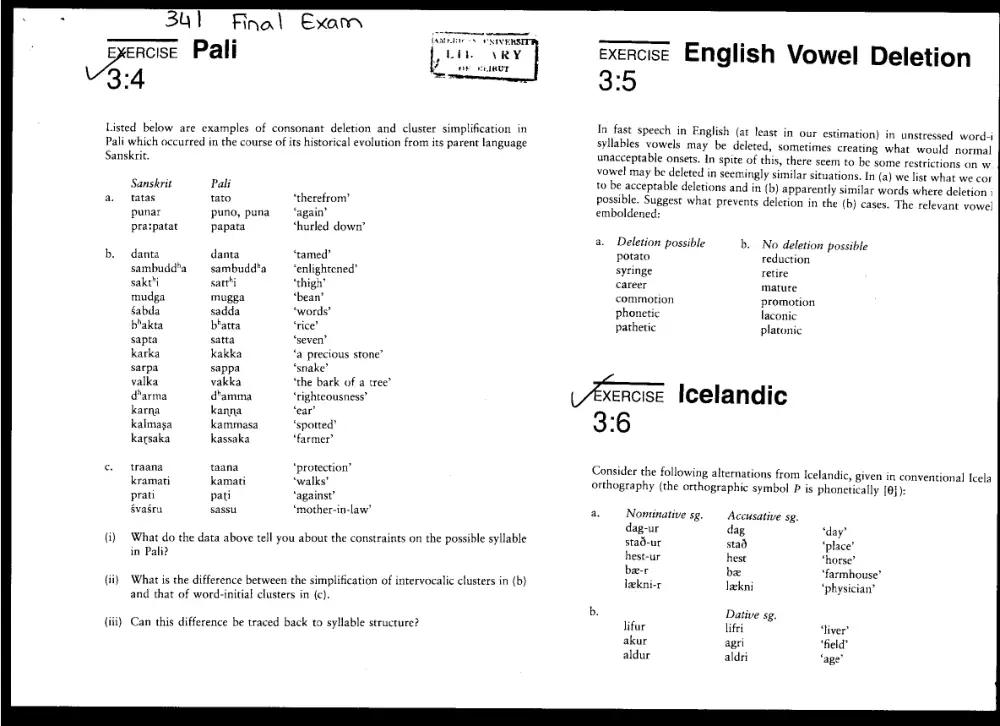
Pali
Deron
3:4
Listed below are examples of consonant deletion and cluster simplification in
Pali which occurred in the course of its historical evolution from its parent language
341 Final Exam
FAMEIOE SCNTVERSI
, LER VRY
foe eedRur
Sanskrit.
Sanskrit Pali
a. tatas tato ‘therefrom’
punar puno, puna ‘again’
pratpatat papata ‘hurled down’
b. danta danta ‘tamed’
sambudd’a — sambudd*a ‘enlightened’
sakti satt'i ‘thigh’
mudga mugga ‘bean’
Sabda sadda ‘words’
brakta b'atta ‘rice’
sapta satta ‘seven’
karka kakka ‘a precious stone’
sarpa sappa ‘snake’
valka vakka ‘the bark of a tree’
d*arma d'amma ‘righteousness’
karna kanna ‘ear’
kalmasa kammasa ‘spotted’
karsaka kassaka ‘farmer’
c. traana taana ‘protection’
kramati kamati ‘walks’
prati pati ‘against’
Svasru sassu ‘mother-in-law’
What do the data above tell you about the constraints on the possible syllable
in Pali?
What is the difference between the simplification of intervocalic clusters in (b)
and that of word-initial clusters in (c).
Can this difference be traced back to syllable structure?
—_——.
exercise English Vowel Deletion
3:5
In fast speech in English (at least in our estimation) in unstressed word-i
syllables vowels may be deleted, sometimes creating what would normal
unacceptable onsets. In spite of this, there seem to be some restrictions on w.
vowel may be deleted in seemingly similar situations. In (a) we list what we cor
to be acceptable deletions and in (b) apparently similar words where deletion
possible. Suggest what prevents deletion in the (b) cases. The relevant vowel
emboldened:
a. Deletion possible b. No deletion possible
potato reduction
syringe retire
career mature
commotion promotion
phonetic laconic
pathetic platonic
AAxercise Icelandic
3:6
Consider the following alternations from Icelandic, given in conventional Icela
orthography (the orthographic symbol P is phonetically [6}):
a. Nominative sg. Accusative sg.
dag-ur dag ‘day’
stad-ur stad ‘place’
hest-ur hest ‘horse’
be-r be ‘farmhouse’
lakni-r Jeekni ‘physician’
b. Dative sg.
lifur lifri ‘liver’
akur agri ‘field?
aldur aldri ‘age’
36 Syllables Fy CEST
| bli RY
(i) What are the variants of the nominative singular suffix? OF wakUT —— . . .
~ exercise Anxiang Suffixation
(ii) Do the data in(b) give you a clue as to the lexical form of this suffix? 3 7
Now consider the folbwing data:
c. Nom. sg. Ac. sg. Gen. sg. Dat. pl. Gen. pl. The diminutive form in the Chinese langiage Anxiang is formed by the addition of
lyf-ur lyf lyf-s lyfj-um ——lyfj-a ‘medicine’ the suffix -ar to a reduplicated form cf the base. (Tones are omitted from the
byl-ur by byl-s bylj-um bylj-a ‘snowstorm representations.)
sOng-ur séag sOng-s s6ngy-um — sO6ngv-a ‘song
. . tie tie tior ‘small dish, plate’
(iii) What in these :xamples helps to confirm your hypothesis as to the lexical mian = mian miar — ‘face’ _—
form of the nominative singular suffix? tai tai tor “belt”
. oe - . pau pau par ‘bud?
(iv) What are the lexical forms of the genitive singular, genitive plural and dative ke ke kor ‘check, chequer’
plural suffixes? fa fa for ‘Jaw, way”
. o oar ‘bird’s nest
(v) Give a reason for the stem alternations observed in (c). ti ti tior “bamboo flite”
tin tin tier ‘nail’
Consider the further data in (d): p'u pfu ptuar ‘spread’
4 N Dat. pl tcy tey tcyar ‘pearl’
: om. sg. . pl.
barn oa béra-um boge-ull ‘child’ ° Say which part of the base participates in the reduplicated forms, and why. (Hint:
pass ak ice’ joeutl “flacies" Anxiang is basically a monosyllabic language.)
jak-i diece of ice’ -ul-| cier”
Page-a ‘o silence’ Bég-ul-! “taciturn’
kalla ‘all’ (1st sg.) kéll-um ‘call’ (1st pl.)
(vi) Give a reason for the stem alternations in (d). EXERCISE Diola Fogny
(vii) In what way do the data in (e) below provide further evidence about the 3 ‘8
lexical form o' the nominative suffix? .
e. akur 6kram ‘field’ . . . . .
aldur éld-um ‘age’ In Diola Fogny, a Niger-Congo language spoken in Guinea-Bissau and Gambia,
stadur —stddum ‘place’ simplification occurs in cases where the concatenation of morphemes creates an
unsyllabifiable consonant cluster, as we show in (a) (we have followed the transcrip-
(viii) Provide a fornal account of all the alternations observed. tion from the source; the symbol j represents a palatal obstruent and y represents [j]).
a. /let-ku-jaw/ lekujaw ‘they won't go”
Jajuk-jal ujuja ‘if you sce’
/-kob-kob-en/ kokoben ‘yearn, long for’
/-tey-tey-or/ teteyor ‘disentangle’
Jjaw-bu-nar/ jabuyar ‘voyager’
/na-lap-lap/ nalalan ‘he returned’
/na-yoken-yoken/ nayokeyok:n “he tires’
Ina-wan-aam-wan/ ——- nwanaawan ‘he cultivated for me’
vervauurial ineory TU
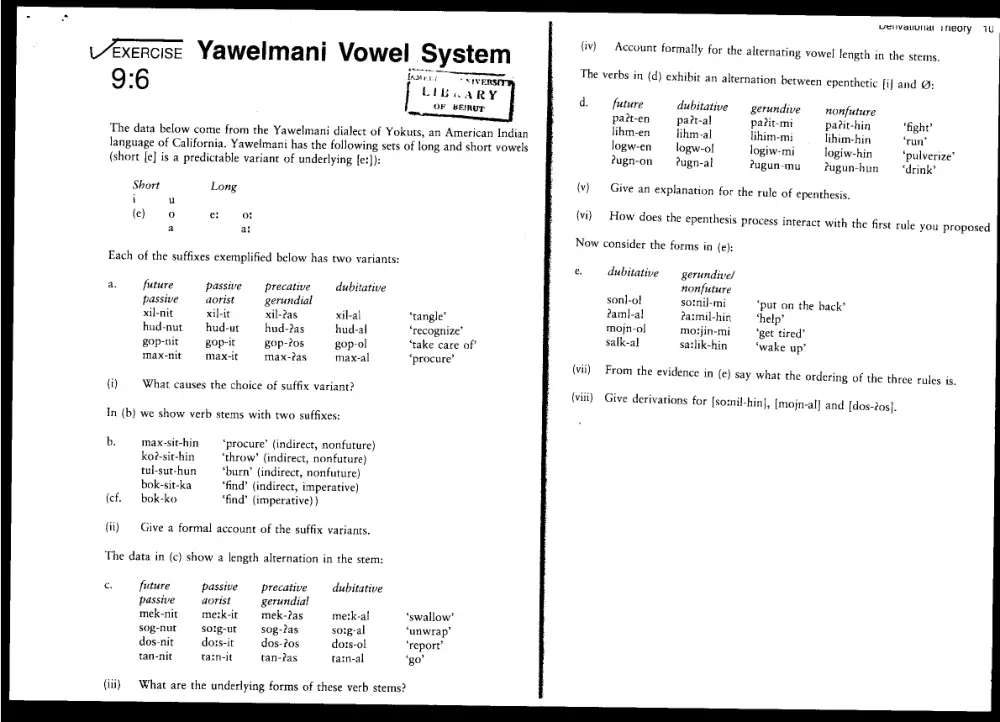
{ AEXERCIS Yawelmani Vowel System (iv) Account formally for the alternating vowel length in the stems,
9 6 town eres The verbs in (d) exhibit an alternation between epenthctic [i] and Q:
LIBLARY .
oF seIRUn d. future dubitative —_gerundive nonfuture
pagt-en pa?t-al pa?it-mi parit-hin ‘fight’
The data below come from the Yawelmani dialect of Yokuts, an American Indian lihm-en —ihm-al lihim-mi lihim-hin ‘run’
language of California. Yawelmani has the following sets of long and short vowels logw-en —_logw-ol logiw-mi —_logiw-hin ‘pulverize’
(short [e] is a predictable variant of underlying {e:]): ?ugn-on — ?ugn-al Pugun-mu = ugun-hun ‘drink’
Short Long (v) Give an explanation for the rule of epenthesis.
i u
(ec) 0 } (vi) How does the epenthesis Process interact with the first rule you proposed
a
Now consider the forms in (e):
Each of the suffixes exemplified below has two variants: oo
e. — dubitative —_gerundivel
a. future passive precative dubitative nonfuture
passive aorist gerundial sonl-ol sornil-mi ‘put on the back’
xil-nit xibit xil-2as xilal ‘tangle’ ?aml-al ?aimil-hin ‘help’
hud-nut — hud-ut = hud-2as——hud-al ‘recognize’ mojn-ol mozjin-mi ‘get tired’
gop-nit — gop-it_ — gop-20s._—gop-ol ‘take care of salk-al salik-hin wake up’
max-nit max-it max-?as max-al ‘procure’ .
(vii) From the evidence in (e) say what the ordering of the three rules is.
What causes the choice of suffix variant?
(viii) Give derivations for [so:nil-hin}, [mojn-al] and [dos-2os}.
we show verb stems with two suffixes: .
‘procure’ (indirect, nonfuture)
‘throw’ (indirect, nonfuture)
tul-sut-hun ‘burn’ (indirect, nonfuture)
bok-sit-ka ‘find’ (indirect, imperative)
(cf. bok-ko ‘find’ (imperative) )
{ii) Give a formal account of the suffix variants.
The data in (c) show a length alternation in the stem:
c future passive precative dubitative
passive aorist gerundial
mek-nit — mezk-it_ ~— mek-?as metk-al ‘swallow’
sog-nut sotg-ut sog-?as soig-al ‘unwrap’
dos-nit dois-it dos-?os dois-ol ‘report’
tan-nit tamn-it tan-?as tam-al “go”
What are the underlying forms of these verb stems?