
ENMG 501 Homework Solution, Spring 2015
American University of Beirut · Engineering Management II · 2 pages · with solution
More ENMG 501 files
Show the text of this homework
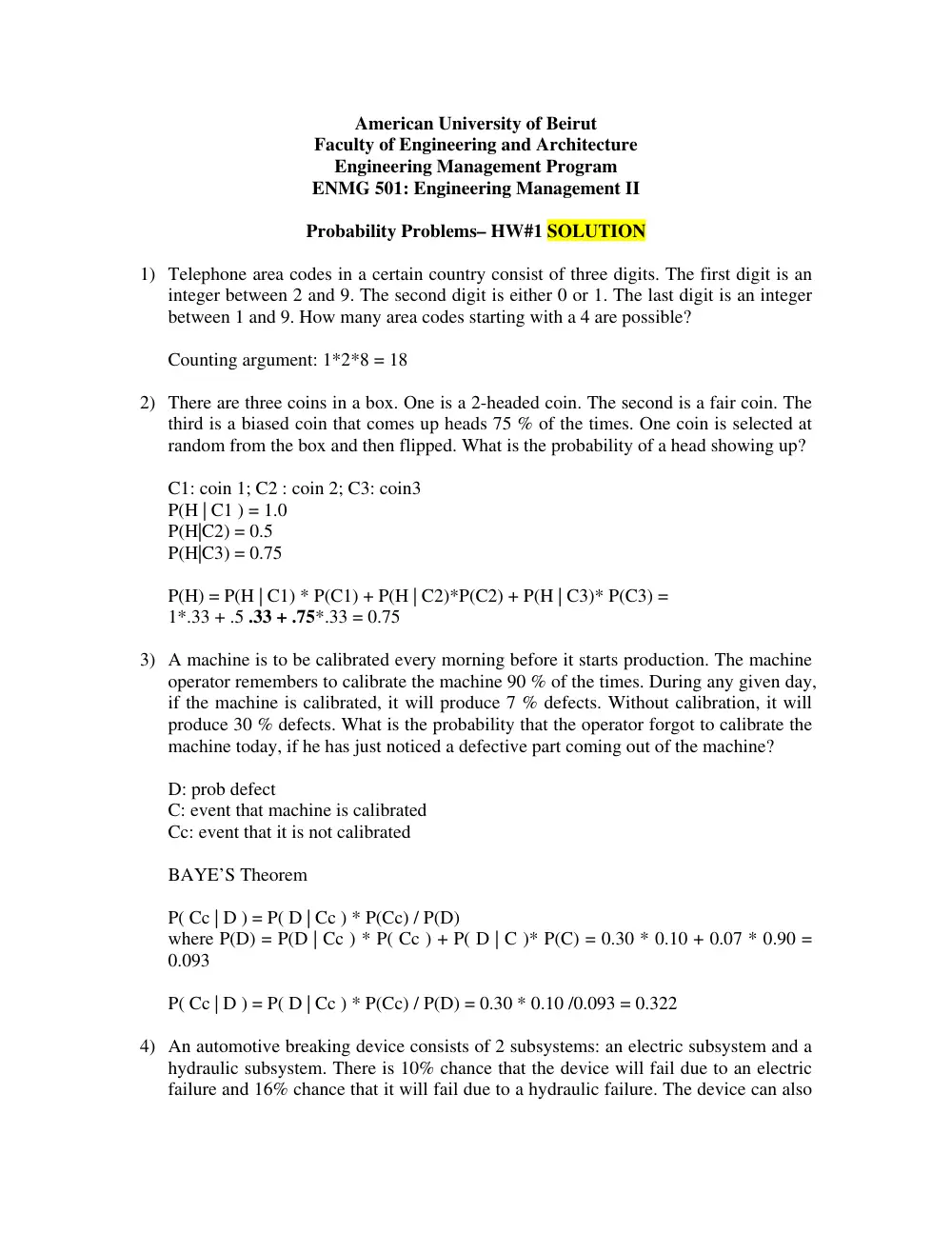
American University of Beirut
Faculty of Engineering and Architecture
Engineering Management Program
ENMG 501: Engineering Management II
Probability Problems– HW#1 SOLUTION
1) Telephone area codes in a certain country consist of three digits. The first digit is an
integer between 2 and 9. The second digit is either 0 or 1. The last digit is an integer
between 1 and 9. How many area codes starting with a 4 are possible?
Counting argument: 1*2*8 = 18
2) There are three coins in a box. One is a 2-headed coin. The second is a fair coin. The
third is a biased coin that comes up heads 75 % of the times. One coin is selected at
random from the box and then flipped. What is the probability of a head showing up?
C1: coin 1; C2 : coin 2; C3: coin3
P(H | C1 ) = 1.0
P(H|C2) = 0.5
P(H|C3) = 0.75
P(H) = P(H | C1) * P(C1) + P(H | C2)*P(C2) + P(H | C3)* P(C3) =
1*.33 + .5 .33 + .75*.33 = 0.75
3) A machine is to be calibrated every morning before it starts production. The machine
operator remembers to calibrate the machine 90 % of the times. During any given day,
if the machine is calibrated, it will produce 7 % defects. Without calibration, it will
produce 30 % defects. What is the probability that the operator forgot to calibrate the
machine today, if he has just noticed a defective part coming out of the machine?
D: prob defect
C: event that machine is calibrated
Cc: event that it is not calibrated
BAYE’S Theorem
P( Cc | D ) = P( D | Cc ) * P(Cc) / P(D)
where P(D) = P(D | Cc ) * P( Cc ) + P( D | C )* P(C) = 0.30 * 0.10 + 0.07 * 0.90 =
0.093
P( Cc | D ) = P( D | Cc ) * P(Cc) / P(D) = 0.30 * 0.10 /0.093 = 0.322
4) An automotive breaking device consists of 2 subsystems: an electric subsystem and a
hydraulic subsystem. There is 10% chance that the device will fail due to an electric
failure and 16% chance that it will fail due to a hydraulic failure. The device can also
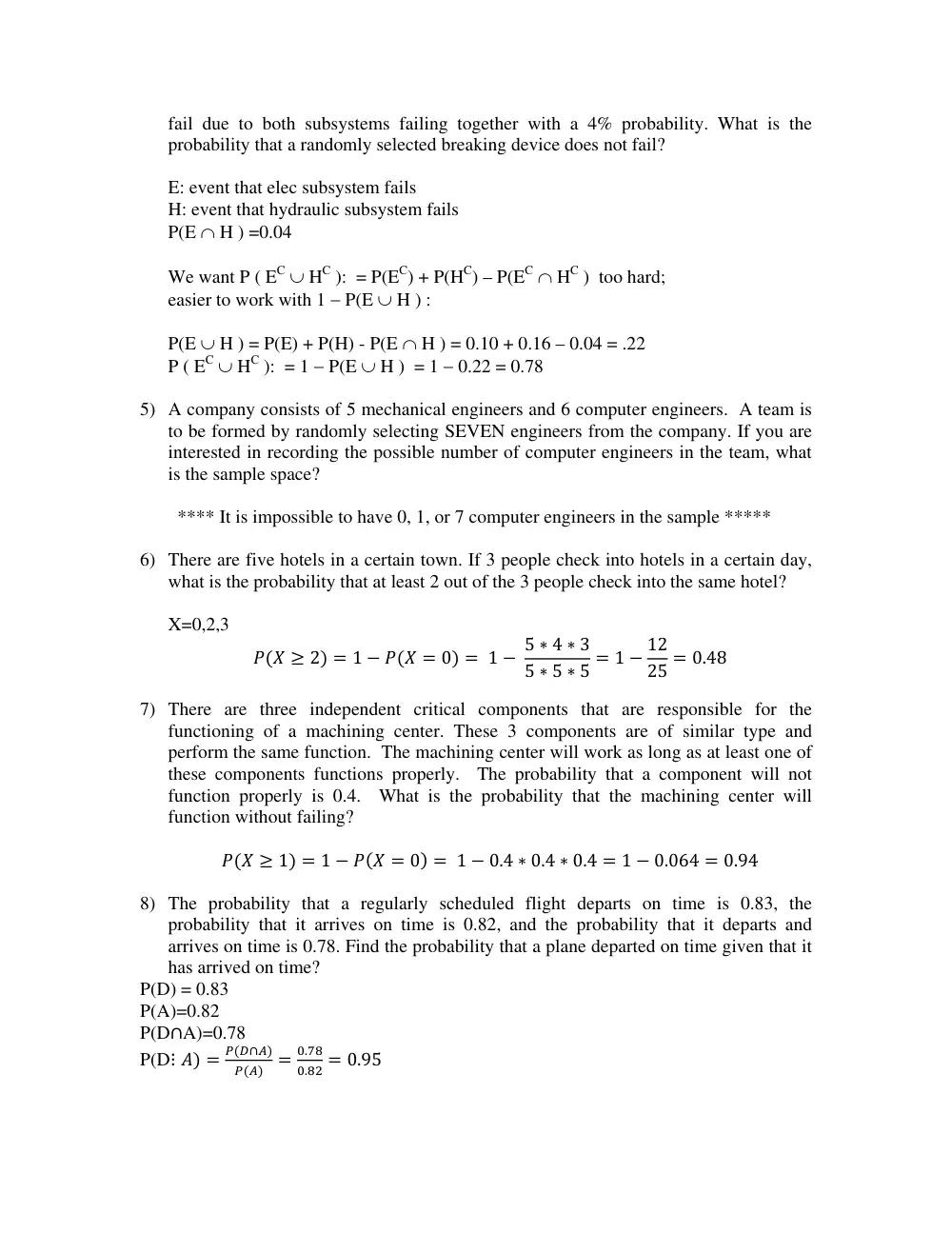
fail due to both subsystems failing together with a 4% probability. What is the
probability that a randomly selected breaking device does not fail?
E: event that elec subsystem fails
H: event that hydraulic subsystem fails
P(E ∩ H ) =0.04
We want P ( EC ∪ HC ): = P(EC) + P(HC) – P(EC ∩ HC ) too hard;
easier to work with 1 − P(E ∪ H ) :
P(E ∪ H ) = P(E) + P(H) - P(E ∩ H ) = 0.10 + 0.16 – 0.04 = .22
P ( EC ∪ HC ): = 1 − P(E ∪ H ) = 1 − 0.22 = 0.78
5) A company consists of 5 mechanical engineers and 6 computer engineers. A team is
to be formed by randomly selecting SEVEN engineers from the company. If you are
interested in recording the possible number of computer engineers in the team, what
is the sample space?
**** It is impossible to have 0, 1, or 7 computer engineers in the sample *****
6) There are five hotels in a certain town. If 3 people check into hotels in a certain day,
what is the probability that at least 2 out of the 3 people check into the same hotel?
X=0,2,3
��� � 2� � 1 � ��� � 0� � 1 � 5 � 4 � 3
5 � 5 � 5 � 1 � 12
25 � 0.48
7) There are three independent critical components that are responsible for the
functioning of a machining center. These 3 components are of similar type and
perform the same function. The machining center will work as long as at least one of
these components functions properly. The probability that a component will not
function properly is 0.4. What is the probability that the machining center will
function without failing?
��� � 1� � 1 � ��� � 0� � 1 � 0.4 � 0.4 � 0.4 � 1 � 0.064 � 0.94
8) The probability that a regularly scheduled flight departs on time is 0.83, the
probability that it arrives on time is 0.82, and the probability that it departs and
arrives on time is 0.78. Find the probability that a plane departed on time given that it
has arrived on time?
P(D) = 0.83
P(A)=0.82
P(D�A)=0.78
P(D� �� �
������
���� �
�.��
�.�� � 0.95