
FINA 210 Midterm, Spring 2004
American University of Beirut · Business Finance · 13 pages


Showing the first 10 of 13 pages. Download the PDF to see all of it.
More FINA 210 files
- Problems Midterm · Spring 2013ExamView
- Exam 2 · Spring 2011ExamView
- Exam 2 Solution · Spring 2011Exam · with solutionView
- Exam 1 with Solution · Spring 2011Exam · with solutionView
- Exam 2 with Solution · Spring 2010Exam · with solutionView
- Exam 1 with Solution · Spring 2010Exam · with solutionView
- Exam 1 with Solution · Spring 2010Exam · with solutionView
- Exam 1 with Answers · Summer 2006Exam · with solutionView
Show the text of this exam
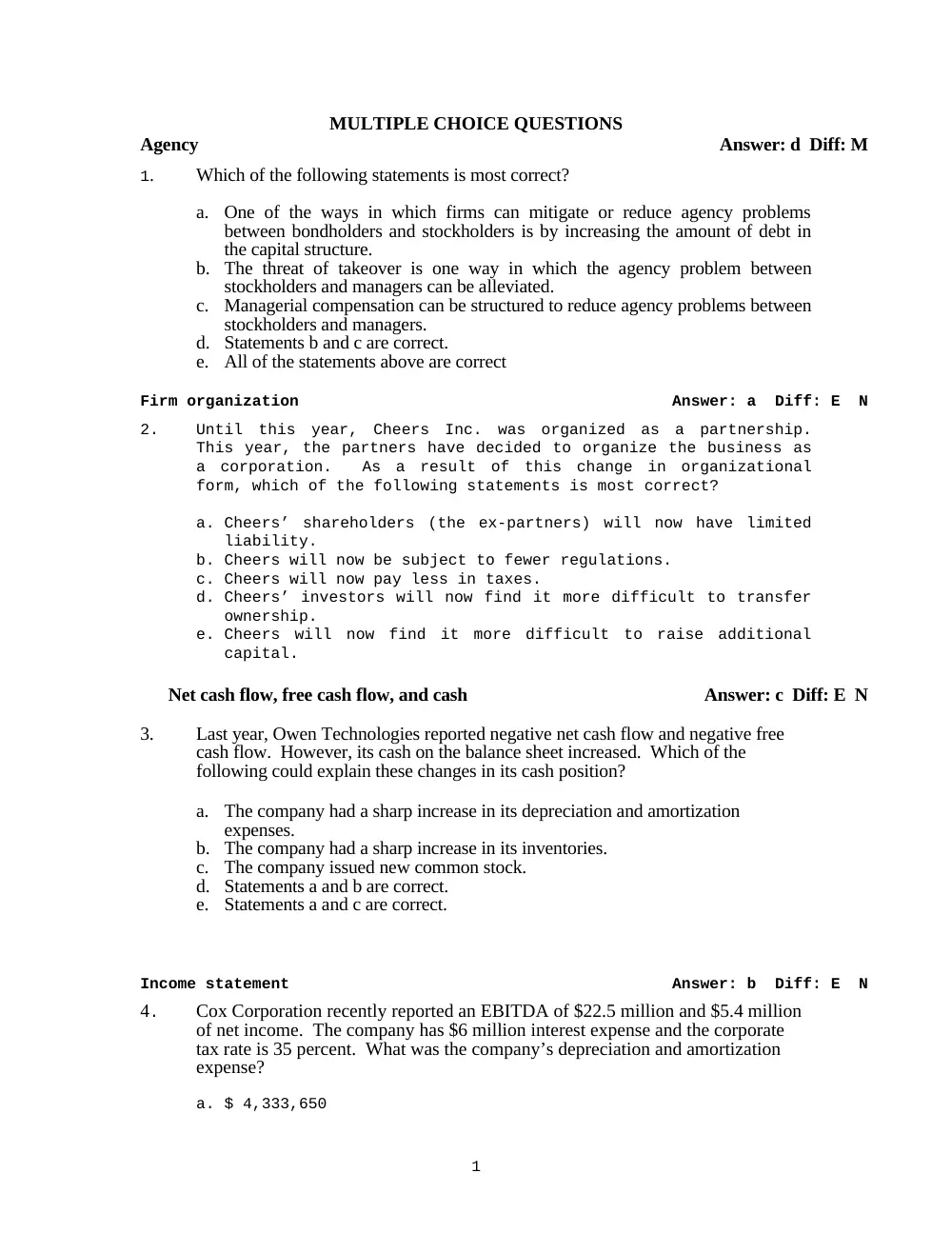
MULTIPLE CHOICE QUESTIONS
Agency
Answer: d Diff: M
1.
Which of the following statements is most correct?
a.
One of the ways in which firms can mitigate or reduce agency problems
between bondholders and stockholders is by increasing the amount of debt in
the capital structure.
b. The threat of takeover is one way in which the agency problem between
stockholders and managers can be alleviated.
c.
Managerial compensation can be structured to reduce agency problems between
stockholders and managers.
d. Statements b and c are correct.
e.
All of the statements above are correct
Firm organization
Answer: a Diff: E N
2.
Until this year, Cheers Inc. was organized as a partnership.
This year, the partners have decided to organize the business as
a corporation. As a result of this change in organizational
form, which of the following statements is most correct?
a. Cheers’ shareholders (the ex-partners) will now have limited
liability.
b. Cheers will now be subject to fewer regulations.
c. Cheers will now pay less in taxes.
d. Cheers’ investors will now find it more difficult to transfer
ownership.
e. Cheers will now find it more difficult to raise additional
capital.
Net cash flow, free cash flow, and cash
Answer: c Diff: E N
3.
Last year, Owen Technologies reported negative net cash flow and negative free
cash flow. However, its cash on the balance sheet increased. Which of the
following could explain these changes in its cash position?
a.
The company had a sharp increase in its depreciation and amortization
expenses.
b. The company had a sharp increase in its inventories.
c.
The company issued new common stock.
d. Statements a and b are correct.
e.
Statements a and c are correct.
Income statement
Answer: b Diff: E N
4.
Cox Corporation recently reported an EBITDA of $22.5 million and $5.4 million
of net income. The company has $6 million interest expense and the corporate
tax rate is 35 percent. What was the company’s depreciation and amortization
expense?
a. $ 4,333,650
1
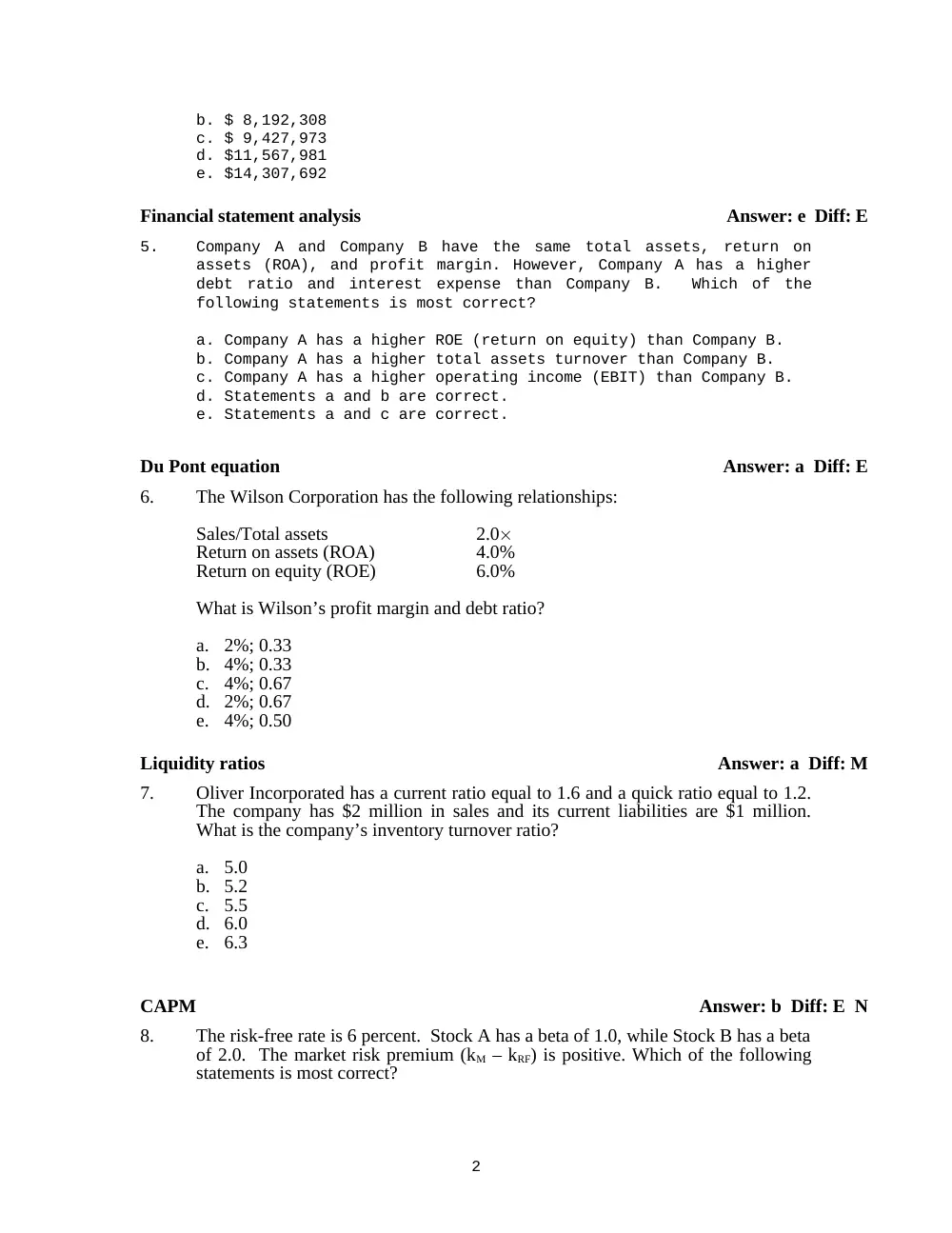
b. $ 8,192,308
c. $ 9,427,973
d. $11,567,981
e. $14,307,692
Financial statement analysis
Answer: e Diff: E
5.
Company A and Company B have the same total assets, return on
assets (ROA), and profit margin. However, Company A has a higher
debt ratio and interest expense than Company B. Which of the
following statements is most correct?
a. Company A has a higher ROE (return on equity) than Company B.
b. Company A has a higher total assets turnover than Company B.
c. Company A has a higher operating income (EBIT) than Company B.
d. Statements a and b are correct.
e. Statements a and c are correct.
Du Pont equation
Answer: a Diff: E
6.
The Wilson Corporation has the following relationships:
Sales/Total assets
2.0´
Return on assets (ROA)
4.0%
Return on equity (ROE)
6.0%
What is Wilson’s profit margin and debt ratio?
a.
2%; 0.33
b. 4%; 0.33
c.
4%; 0.67
d. 2%; 0.67
e.
4%; 0.50
Liquidity ratios
Answer: a Diff: M
7.
Oliver Incorporated has a current ratio equal to 1.6 and a quick ratio equal to 1.2.
The company has $2 million in sales and its current liabilities are $1 million.
What is the company’s inventory turnover ratio?
a.
5.0
b. 5.2
c.
5.5
d. 6.0
e.
6.3
CAPM
Answer: b Diff: E N
8.
The risk-free rate is 6 percent. Stock A has a beta of 1.0, while Stock B has a beta
of 2.0. The market risk premium (kM – kRF) is positive. Which of the following
statements is most correct?
2
a.
Stock B’s required rate of return is twice that of Stock A.
b. If Stock A’s required return is 11 percent, the market risk premium is 5
percent.
c.
If the risk-free rate increases (but the market risk premium stays unchanged),
Stock B’s required return will increase by more than Stock A’s.
d. Statements b and c are correct.
e.
All of the statements above are correct.
CAPM and required return
Answer: a Diff: M
9.
Bradley Hotels has a beta of 1.3, while Douglas Farms has a beta
of 0.7. The market return is 12 percent. The risk-free rate of
interest is 7 percent. By how much does Bradley’s required
return exceed Douglas’ required return?
a. 3.0%
b. 6.5%
c. 5.0%
d. 6.0%
e. 7.0%
Portfolio return
Answer: a Diff: E
10.
An investor is forming a portfolio by investing $50,000 in stock A that has a beta
of 1.50, and $25,000 in stock B that has a beta of 0.90. The return on the market is
equal to 6 percent and Treasury bonds have a yield of 4 percent. What is the
required rate of return on the investor’s portfolio?
a.
6.6%
b.
6.8%
c.
5.8%
d.
7.0%
e.
7.5%
Portfolio beta
Answer: e Diff: M
11.
Walter Jasper currently manages a $500,000 portfolio. He is expecting to receive an
additional $250,000 from a new client. The existing portfolio has a required return of
10.75 percent. The risk-free rate is 4 percent and the return on the market is 9
percent. If Walter wants the required return on the new portfolio to be 11.5 percent,
what should be the average beta for the new stocks added to the portfolio?
a.
1.50
b.
2.00
c.
1.67
d.
1.35
e.
1.80
Required return Answer: c Diff: M
12.
You are holding a stock that has a beta of 2.0 and is currently in equilibrium. The
required return on the stock is 15 percent, and the market return is 10 percent.
What would be the percentage change in the return on the stock, if the market
return increased by 30 percent while the risk-free rate remained unchanged?
3
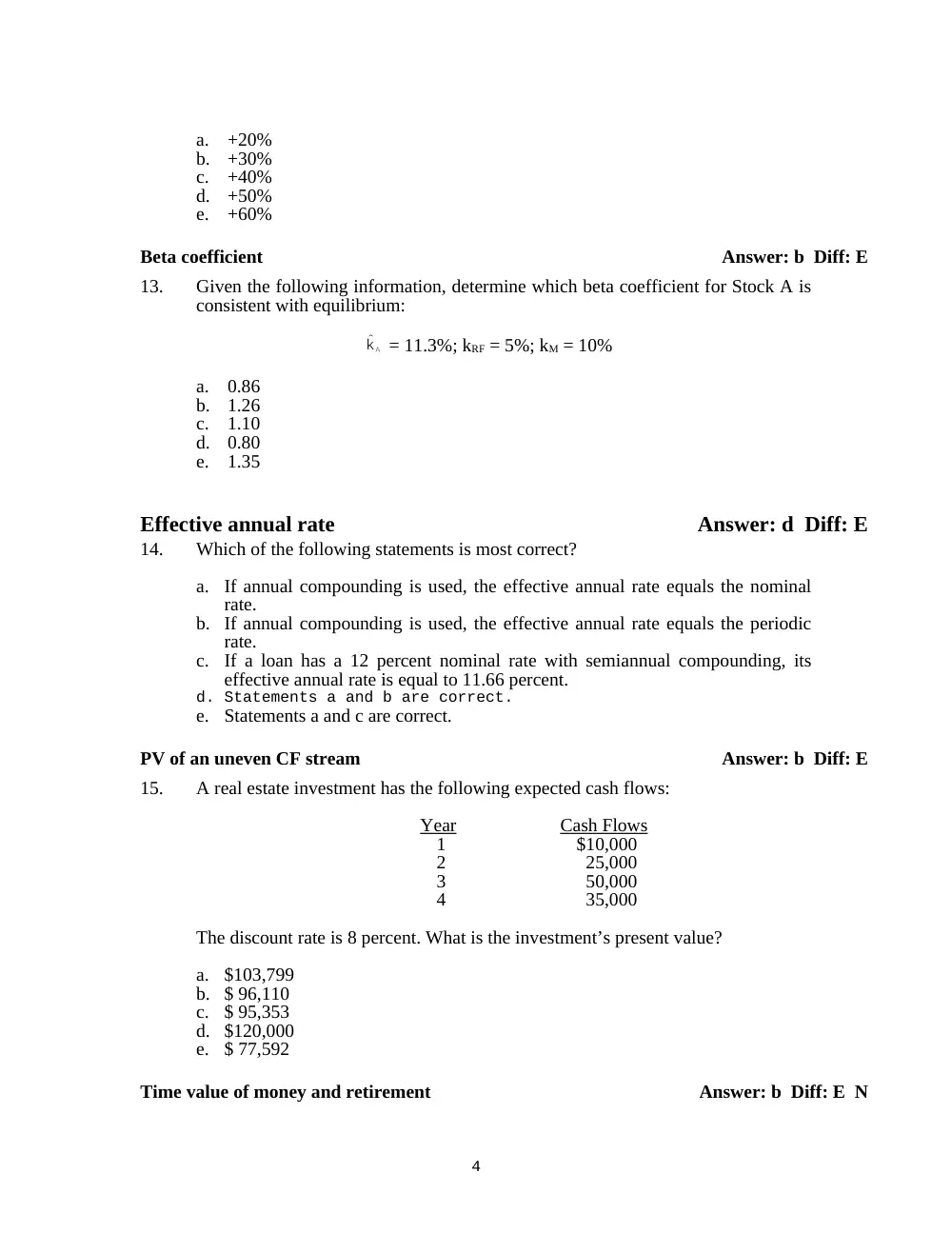
a.
+20%
b.
+30%
c.
+40%
d.
+50%
e.
+60%
Beta coefficient
Answer: b Diff: E
13.
Given the following information, determine which beta coefficient for Stock A is
consistent with equilibrium:
= 11.3%; kRF = 5%; kM = 10%
a.
0.86
b.
1.26
c.
1.10
d.
0.80
e.
1.35
Effective annual rate
Answer: d Diff: E
14.
Which of the following statements is most correct?
a.
If annual compounding is used, the effective annual rate equals the nominal
rate.
b. If annual compounding is used, the effective annual rate equals the periodic
rate.
c.
If a loan has a 12 percent nominal rate with semiannual compounding, its
effective annual rate is equal to 11.66 percent.
d. Statements a and b are correct.
e.
Statements a and c are correct.
PV of an uneven CF stream
Answer: b Diff: E
15.
A real estate investment has the following expected cash flows:
Year
Cash Flows
1
$10,000
2
25,000
3
50,000
4
35,000
The discount rate is 8 percent. What is the investment’s present value?
a.
$103,799
b. $ 96,110
c.
$ 95,353
d. $120,000
e.
$ 77,592
Time value of money and retirement
Answer: b Diff: E N
4
16.
Today, Bruce and Brenda each have $150,000 in an investment
account. No other contributions will be made to their investment
accounts. Both have the same goal: They each want their account
to reach $1 million, at which time each will retire. Bruce has
his money invested in risk-free securities with an expected
annual return of 5 percent. Brenda has her money invested in a
stock
fund
with
an
expected
annual
return
of
10 percent. How many years after Brenda retires will Bruce
retire?
a.
12.6
b. 19.0
c.
19.9
d. 29.4
e.
38.9
Answer a
17.
A bank recently loaned you $15,000 to buy a car. The loan is for
five years (60 months) and is fully amortized. The nominal rate
on the loan is 12 percent, and payments are made at the end of
each month. What will be the remaining balance on the loan after
you make the 30th payment?
a.
$ 8,611.17
b. $ 8,363.62
c.
$14,515.50
d. $ 8,637.38
e.
$ 7,599.03
Required annuity payments
The following information is needed to answer the next two questions
Karen and her twin sister, Kathy, are celebrating their 30th birthday today. Karen
has been saving for her retirement ever since their 25th birthday. On their 25th
birthday, she made a $5,000 contribution to her retirement account. Every year
thereafter on their birthday, she has added another $5,000 to the account. Her
plan is to continue contributing $5,000 every year on their birthday. Her 41st, and
final, $5,000 contribution will occur on their 65th birthday.
So far, Kathy has not saved anything for her retirement but she wants to begin
today. Kathy’s plan is to also contribute a fixed amount every year. Her first
contribution will occur today, and her 36th, and final, contribution will occur on
their 65th birthday. Assume that both investment accounts earn an annual return
of 10 percent.
Answer c
5
18
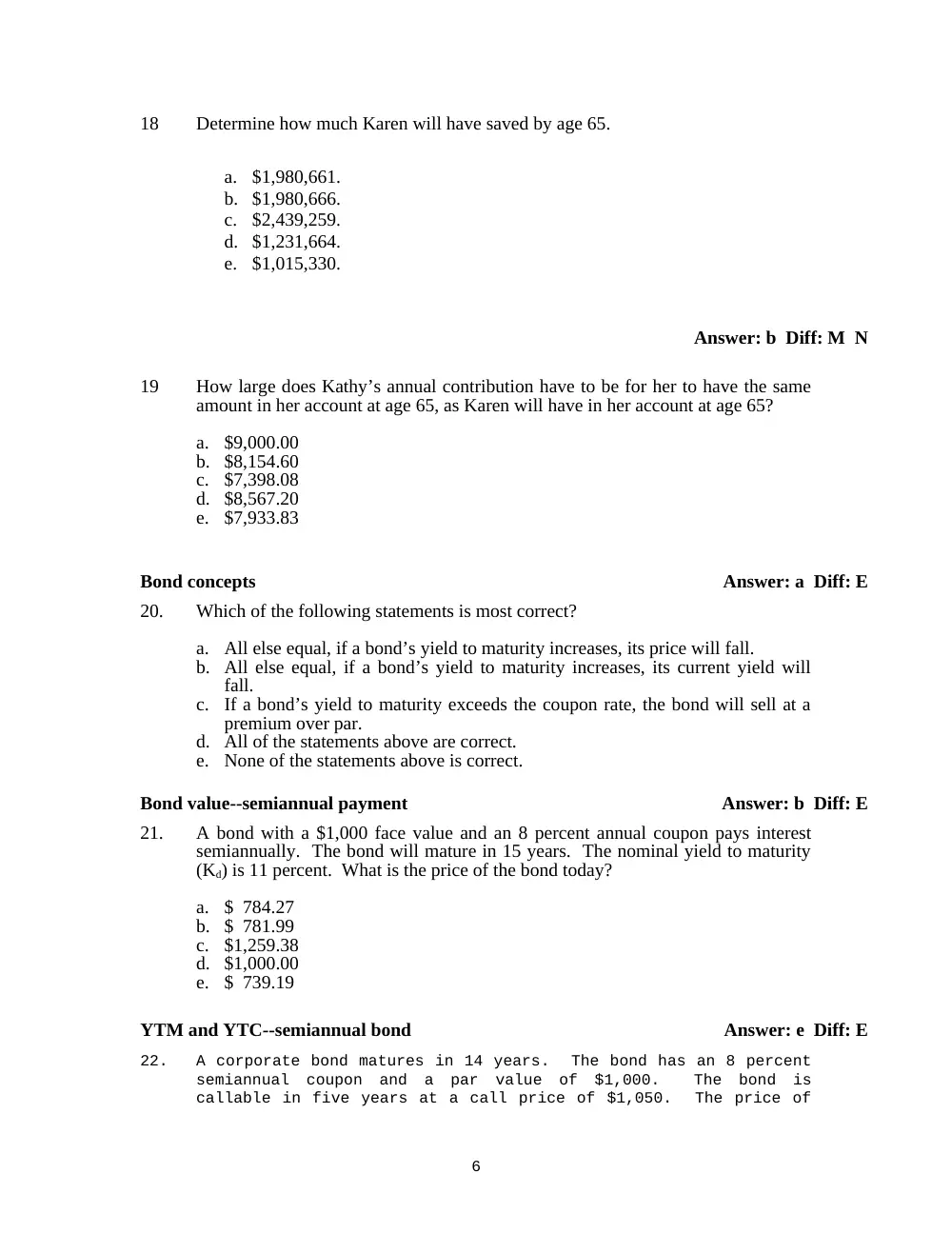
Determine how much Karen will have saved by age 65.
a.
$1,980,661.
b. $1,980,666.
c.
$2,439,259.
d. $1,231,664.
e.
$1,015,330.
Answer: b Diff: M N
19
How large does Kathy’s annual contribution have to be for her to have the same
amount in her account at age 65, as Karen will have in her account at age 65?
a.
$9,000.00
b. $8,154.60
c.
$7,398.08
d. $8,567.20
e.
$7,933.83
Bond concepts
Answer: a Diff: E
20.
Which of the following statements is most correct?
a.
All else equal, if a bond’s yield to maturity increases, its price will fall.
b. All else equal, if a bond’s yield to maturity increases, its current yield will
fall.
c.
If a bond’s yield to maturity exceeds the coupon rate, the bond will sell at a
premium over par.
d. All of the statements above are correct.
e.
None of the statements above is correct.
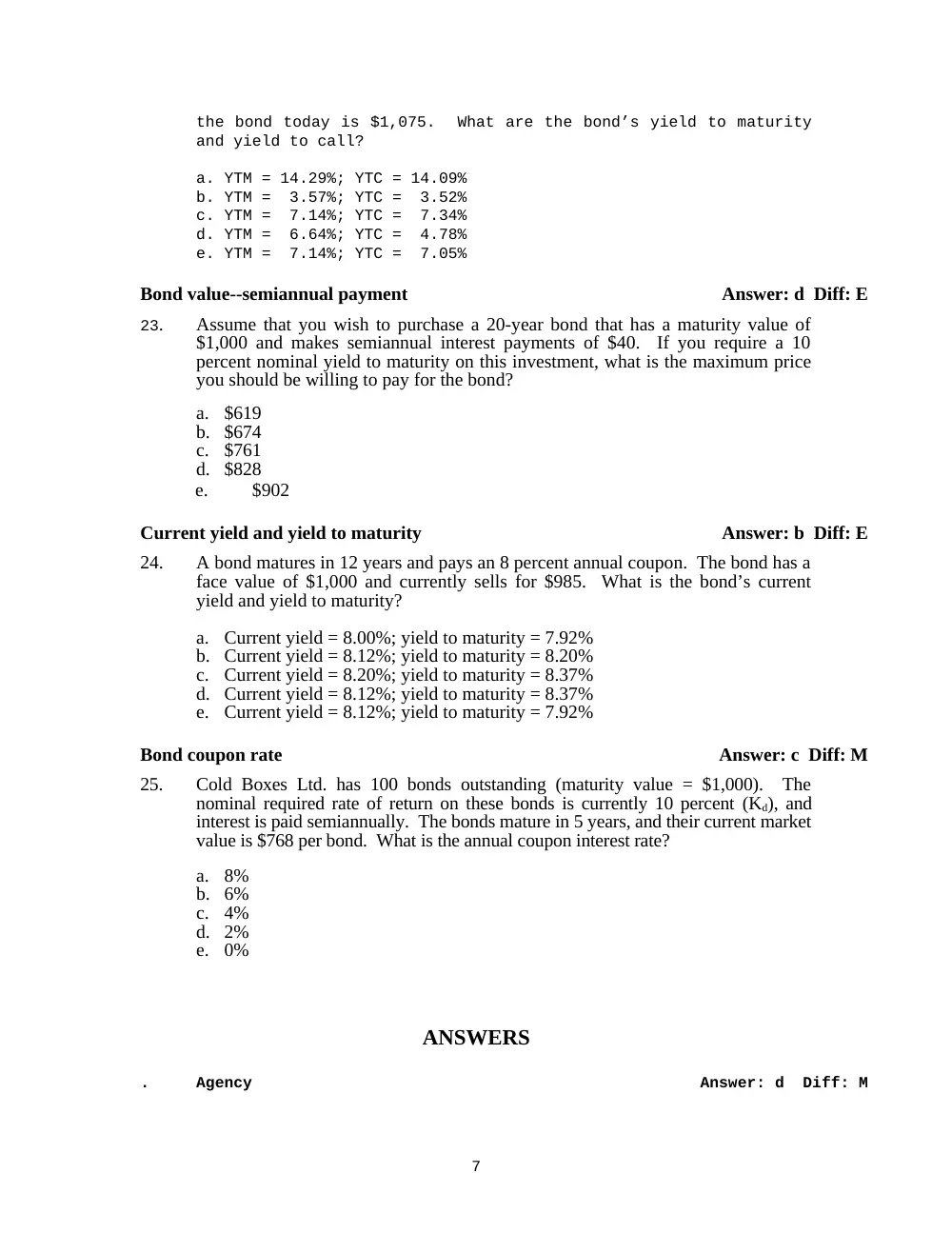
Bond value--semiannual payment
Answer: b Diff: E
21.
A bond with a $1,000 face value and an 8 percent annual coupon pays interest
semiannually. The bond will mature in 15 years. The nominal yield to maturity
(Kd) is 11 percent. What is the price of the bond today?
a.
$ 784.27
b. $ 781.99
c.
$1,259.38
d. $1,000.00
e.
$ 739.19
YTM and YTC--semiannual bond
Answer: e Diff: E
22.
A corporate bond matures in 14 years. The bond has an 8 percent
semiannual coupon and a par value of $1,000. The bond is
callable in five years at a call price of $1,050. The price of
6
the bond today is $1,075. What are the bond’s yield to maturity
and yield to call?
a. YTM = 14.29%; YTC = 14.09%
b. YTM = 3.57%; YTC = 3.52%
c. YTM = 7.14%; YTC = 7.34%
d. YTM = 6.64%; YTC = 4.78%
e. YTM = 7.14%; YTC = 7.05%
Bond value--semiannual payment
Answer: d Diff: E
23.
Assume that you wish to purchase a 20-year bond that has a maturity value of
$1,000 and makes semiannual interest payments of $40. If you require a 10
percent nominal yield to maturity on this investment, what is the maximum price
you should be willing to pay for the bond?
a.
$619
b. $674
c.
$761
d. $828
e.
$902
Current yield and yield to maturity
Answer: b Diff: E
24.
A bond matures in 12 years and pays an 8 percent annual coupon. The bond has a
face value of $1,000 and currently sells for $985. What is the bond’s current
yield and yield to maturity?
a.
Current yield = 8.00%; yield to maturity = 7.92%
b. Current yield = 8.12%; yield to maturity = 8.20%
c.
Current yield = 8.20%; yield to maturity = 8.37%
d. Current yield = 8.12%; yield to maturity = 8.37%
e.
Current yield = 8.12%; yield to maturity = 7.92%
Bond coupon rate
Answer: c Diff: M
25.
Cold Boxes Ltd. has 100 bonds outstanding (maturity value = $1,000). The
nominal required rate of return on these bonds is currently 10 percent (Kd), and
interest is paid semiannually. The bonds mature in 5 years, and their current market
value is $768 per bond. What is the annual coupon interest rate?
a.
8%
b. 6%
c.
4%
d. 2%
e.
0%
ANSWERS
.
Agency
Answer: d Diff: M
7
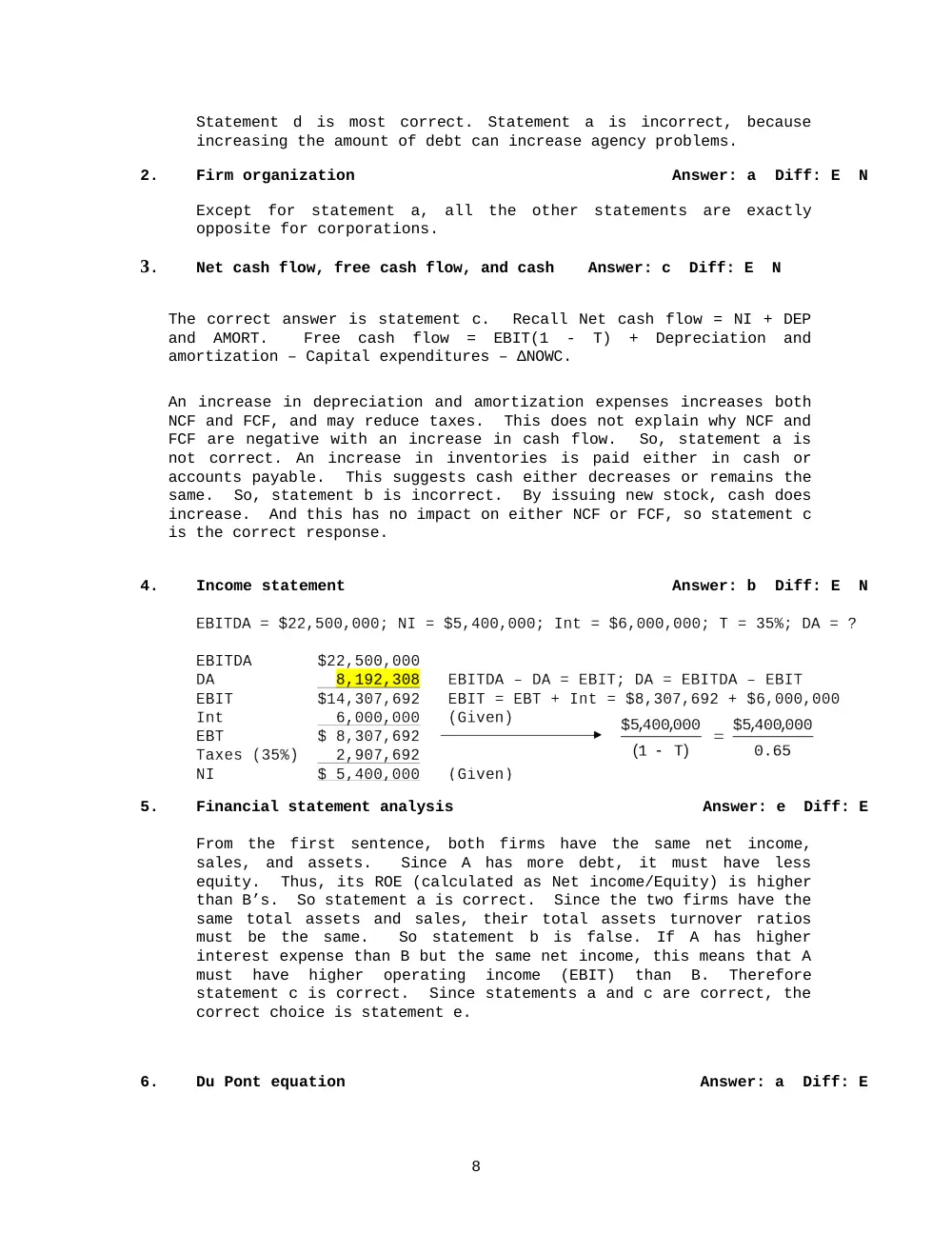
Statement d is most correct. Statement a is incorrect, because
increasing the amount of debt can increase agency problems.
2.
Firm organization
Answer: a Diff: E N
Except for statement a, all the other statements are exactly
opposite for corporations.
3.
Net cash flow, free cash flow, and cash
Answer: c Diff: E N
The correct answer is statement c. Recall Net cash flow = NI + DEP
and AMORT. Free cash flow = EBIT(1 - T) + Depreciation and
amortization – Capital expenditures – ΔNOWC.
An increase in depreciation and amortization expenses increases both
NCF and FCF, and may reduce taxes. This does not explain why NCF and
FCF are negative with an increase in cash flow. So, statement a is
not correct. An increase in inventories is paid either in cash or
accounts payable. This suggests cash either decreases or remains the
same. So, statement b is incorrect. By issuing new stock, cash does
increase. And this has no impact on either NCF or FCF, so statement c
is the correct response.
4.
Income statement
Answer: b Diff: E N
5.
Financial statement analysis
Answer: e Diff: E
From the first sentence, both firms have the same net income,
sales, and assets. Since A has more debt, it must have less
equity. Thus, its ROE (calculated as Net income/Equity) is higher
than B’s. So statement a is correct. Since the two firms have the
same total assets and sales, their total assets turnover ratios
must be the same. So statement b is false. If A has higher
interest expense than B but the same net income, this means that A
must have higher operating income (EBIT) than B. Therefore
statement c is correct. Since statements a and c are correct, the
correct choice is statement e.
6.
Du Pont equation
Answer: a Diff: E
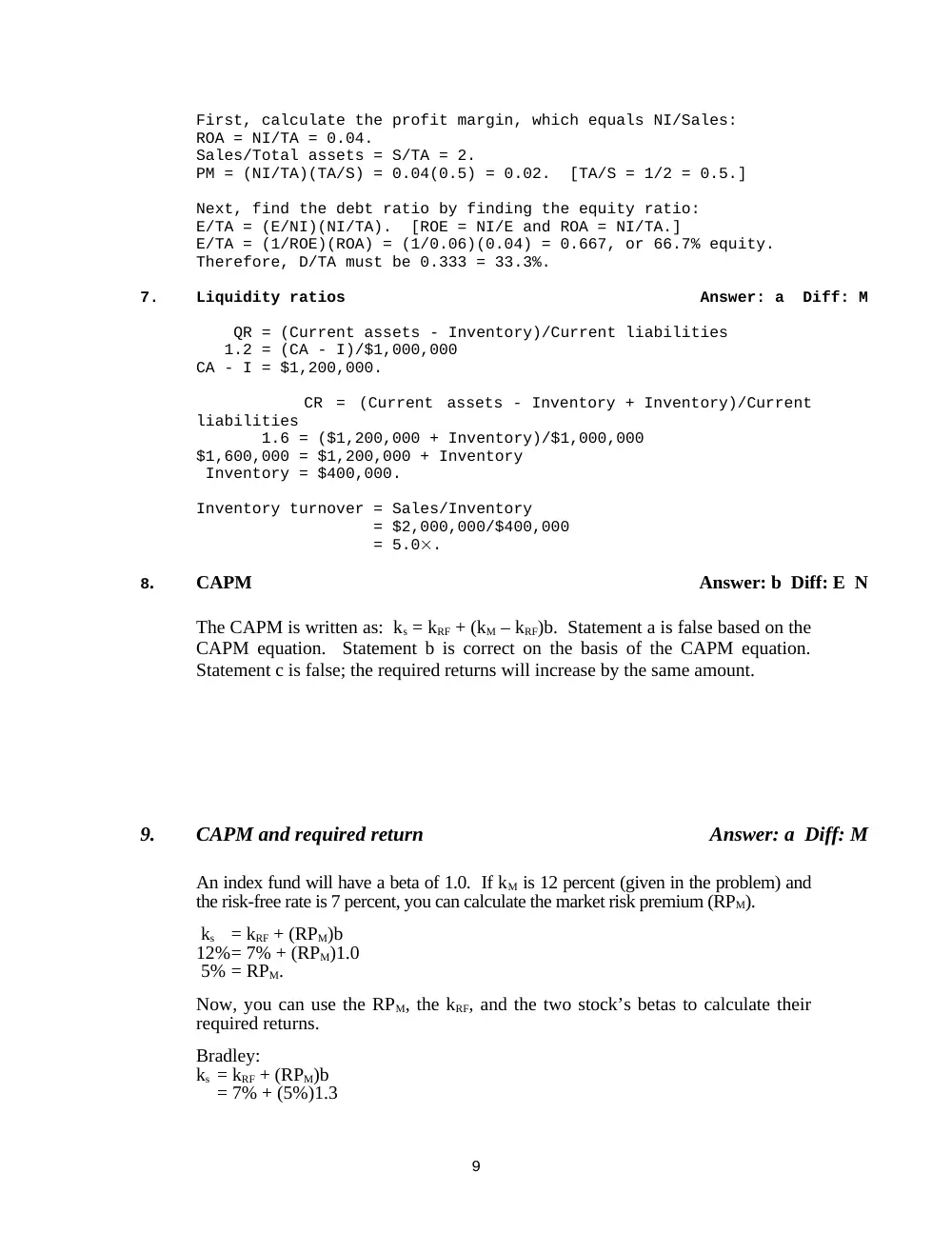
8
First, calculate the profit margin, which equals NI/Sales:
ROA = NI/TA = 0.04.
Sales/Total assets = S/TA = 2.
PM = (NI/TA)(TA/S) = 0.04(0.5) = 0.02. [TA/S = 1/2 = 0.5.]
Next, find the debt ratio by finding the equity ratio:
E/TA = (E/NI)(NI/TA). [ROE = NI/E and ROA = NI/TA.]
E/TA = (1/ROE)(ROA) = (1/0.06)(0.04) = 0.667, or 66.7% equity.
Therefore, D/TA must be 0.333 = 33.3%.
7.
Liquidity ratios
Answer: a Diff: M
QR = (Current assets - Inventory)/Current liabilities
1.2 = (CA - I)/$1,000,000
CA - I = $1,200,000.
CR = (Current assets - Inventory + Inventory)/Current
liabilities
1.6 = ($1,200,000 + Inventory)/$1,000,000
$1,600,000 = $1,200,000 + Inventory
Inventory = $400,000.
Inventory turnover = Sales/Inventory
= $2,000,000/$400,000
= 5.0´.
8.
CAPM
Answer: b Diff: E N
The CAPM is written as: ks = kRF + (kM – kRF)b. Statement a is false based on the
CAPM equation. Statement b is correct on the basis of the CAPM equation.
Statement c is false; the required returns will increase by the same amount.
9.
CAPM and required return
Answer: a Diff: M
An index fund will have a beta of 1.0. If kM is 12 percent (given in the problem) and
the risk-free rate is 7 percent, you can calculate the market risk premium (RPM).
ks
= kRF + (RPM)b
12%= 7% + (RPM)1.0
5% = RPM.
Now, you can use the RPM, the kRF, and the two stock’s betas to calculate their
required returns.
Bradley:
ks = kRF + (RPM)b
= 7% + (5%)1.3
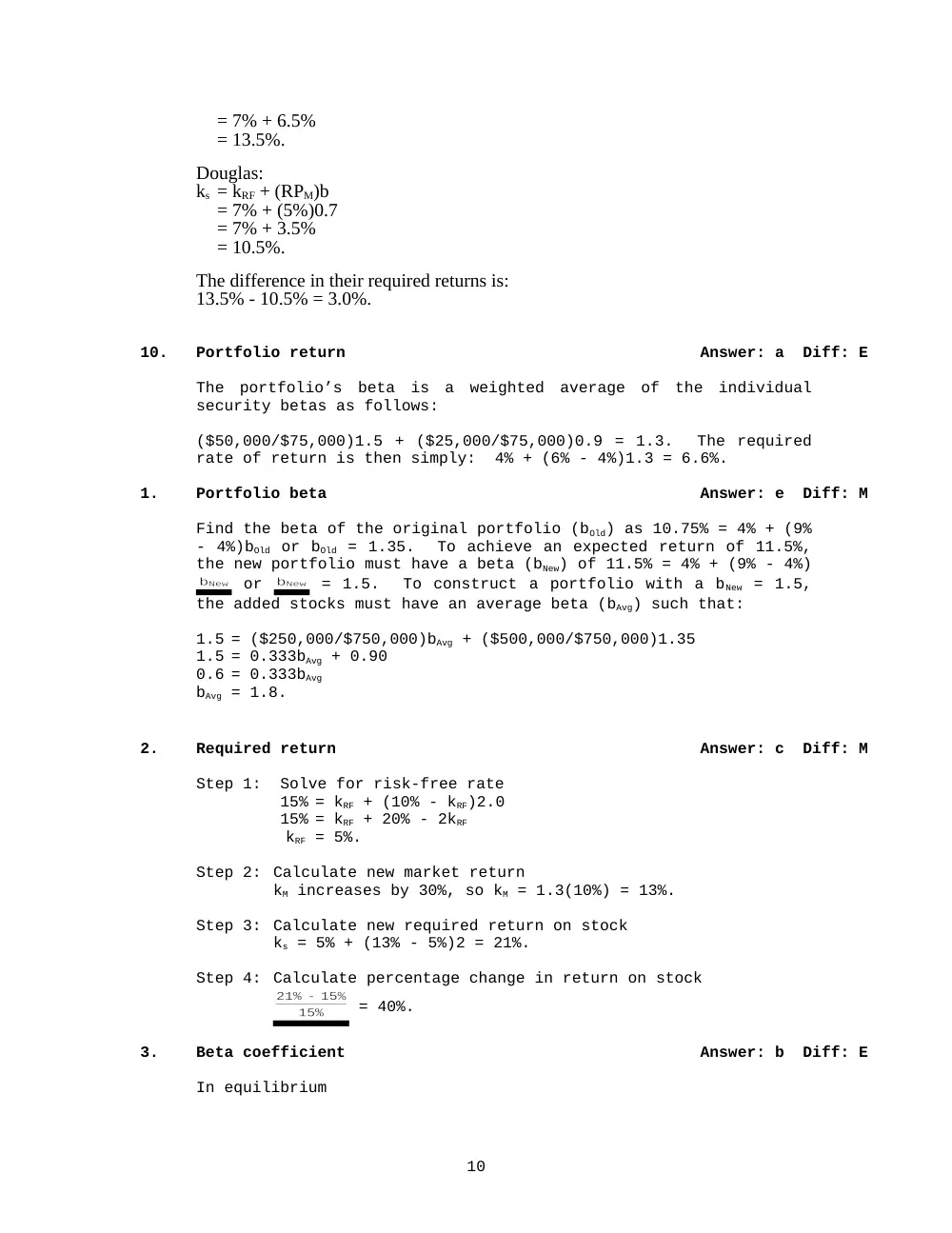
9
= 7% + 6.5%
= 13.5%.
Douglas:
ks = kRF + (RPM)b
= 7% + (5%)0.7
= 7% + 3.5%
= 10.5%.
The difference in their required returns is:
13.5% - 10.5% = 3.0%.
10.
Portfolio return
Answer: a Diff: E
The portfolio’s beta is a weighted average of the individual
security betas as follows:
($50,000/$75,000)1.5 + ($25,000/$75,000)0.9 = 1.3. The required
rate of return is then simply: 4% + (6% - 4%)1.3 = 6.6%.
1.
Portfolio beta
Answer: e Diff: M
Find the beta of the original portfolio (bOld) as 10.75% = 4% + (9%
- 4%)bOld or bOld = 1.35. To achieve an expected return of 11.5%,
the new portfolio must have a beta (bNew) of 11.5% = 4% + (9% - 4%)
or
= 1.5. To construct a portfolio with a bNew = 1.5,
the added stocks must have an average beta (bAvg) such that:
1.5 = ($250,000/$750,000)bAvg + ($500,000/$750,000)1.35
1.5 = 0.333bAvg + 0.90
0.6 = 0.333bAvg
bAvg = 1.8.
2.
Required return
Answer: c Diff: M
Step 1:
Solve for risk-free rate
15% = kRF + (10% - kRF)2.0
15% = kRF + 20% - 2kRF
kRF = 5%.
Step 2: Calculate new market return
kM increases by 30%, so kM = 1.3(10%) = 13%.
Step 3: Calculate new required return on stock
ks = 5% + (13% - 5%)2 = 21%.
Step 4: Calculate percentage change in return on stock
= 40%.
3.
Beta coefficient
Answer: b Diff: E
In equilibrium
10
kA =
= 11.3%.
kA = kRF + (kM - kRF)b
11.3% = 5% + (10% - 5%)b
b = 1.26.
4.
Effective annual rate
Answer: d Diff: E
Statement d is correct. The equation for EAR is as follows:
EAR =
.
If annual compounding is used, m = 1 and the equation above
reduces to EAR = kNom. The equation for the periodic rate is:
.
If annual compounding is used then m = 1 and kPER = kNom, and since
EAR = kNom then kPER = EAR.
5.
PV of an uneven CF stream
Answer: b Diff: E
NPV = $10,000/1.08 + $25,000/(1.08)2 + $50,000/(1.08)3 + $35,000/(1.08)4
= $9,259.26 + $21,433.47 + $39,691.61 + $25,726.04
= $96,110.38 $96,110.
Financial calculator solution:
Using cash flows
Inputs: CF0 = 0; CF1 = 10000; CF2 = 25000; CF3 = 50000; CF4 = 35000; I = 8.
Output: NPV = $96,110.39 $96,110.
6.
Time value of money and retirement
Answer: b Diff: E N
Step 1:
Find the number of years it will take for each $150,000 investment to
grow to $1,000,000.
BRUCE:
I/YR = 5; PV = -150,000; PMT = 0; FV = 1,000,000; and then solve
for N = 38.88.
BRENDA:
I/YR = 10; PV = -150,000; PMT = 0; FV = 1,000,000; and then solve
for N = 19.90.
Step 2:
Calculate the difference in the length of time for the
accounts to reach $1 million:
Bruce will be able to retire in 38.88 years, or 38.88 –
19.90 = 19.0 years after Brenda does.
11
17.
Remaining loan balance
Answer: a Diff: E N
Step 1:
Solve for the monthly payment:
Enter the following input data in the calculator:
N = 60; I = 12/12 = 1; PV = -15,000; FV = 0; and then solve for PMT
= $333.6667.
Step 2:
Determine the loan balance remaining after the 30th payment:
1 INPUT 30 n AMORT
= displays Int: $3,621.1746
= displays Prin: $6,388.8264
= displays Bal: $8,611.1736.
Therefore, the balance will be $8,611.17.
18
Work out how much Karen will have saved by age 65:
Enter the following inputs in the calculator:
N = 41; I = 10; PV = 0; PMT = 5,000; and then solve for FV =
$2,439,259.
Required annuity paymentsAnswer: b Diff: M N
19:
Figure the payments Kathy will need to make to have the same amount saved as
Karen:
Enter the following inputs in the calculator:
N = 36; I = 10; PV = 0; FV = 2,439,259; and then solve
for PMT = $8,154.60.
20.
Bond concepts
Answer: a Diff: E
Statement a is correct; the other statements are false. A bond’s
price and YTM are negatively related. If a bond’s YTM is greater
than its coupon rate, it will sell at a discount.
2.
Bond value--semiannual payment
Answer: b Diff: E
N = 15 ´ 2 = 30; I/YR = 11/2 = 5.5; PMT = 1,000 ´ 0.08/2 = 40; FV
= 1000; and then solve for PV = -$781.99. VB = $781.99.
22.
YTM and YTC--semiannual bond
Answer: e Diff: E
To calculate YTM:
N = 28; PV = -1075; PMT = 40; FV = 1000; and then solve for I/YR
= 3.57% ´ 2 = 7.14%.
To calculate YTC:
N = 10; PV = -1075; PMT = 40; FV = 1050; and then solve for I/YR
= 3.52% ´ 2 = 7.05%.
12
23.
Bond value--semiannual payment
Answer: d Diff: E
Financial calculator solution:
Inputs: N = 40; I = 5; PMT = 40; FV = 1000.
Output: PV = -$828.41; VB $828.
24.
Current yield and yield to maturity
Answer: b Diff: E
Current yield is calculated as: $80/$985 = 8.12%.
N = 12; PV = -985; PMT = 80; FV = 1000; and then solve for I/YR
(YTM) = 8.20%.
25.
Bond coupon rate
Answer: c Diff: M
Tabular solution:
$768 = (PMT/2)(PVIFA5%,10) + $1,000(PVIF5%,10)
= (PMT/2)(7.7217) + $1,000(0.6139)
154.10 = (PMT/2)(7.7217)
PMT/2 = $19.96 $20
PMT $40 and coupon rate 4%.
Financial calculator solution:
Inputs: N = 10; I = 5; PV = -768; FV = 1,000.
Output: PMT = $19.955 (semiannual PMT).
Annual coupon rate = (PMT ´ 2)/M = ($19.955 ´ 2)/$1,000 = 3.99%
4%.
13