
GEOL 104 Final, Spring 2007
American University of Beirut · Natural Disasters · 9 pages
More GEOL 104 files
Show the text of this final exam
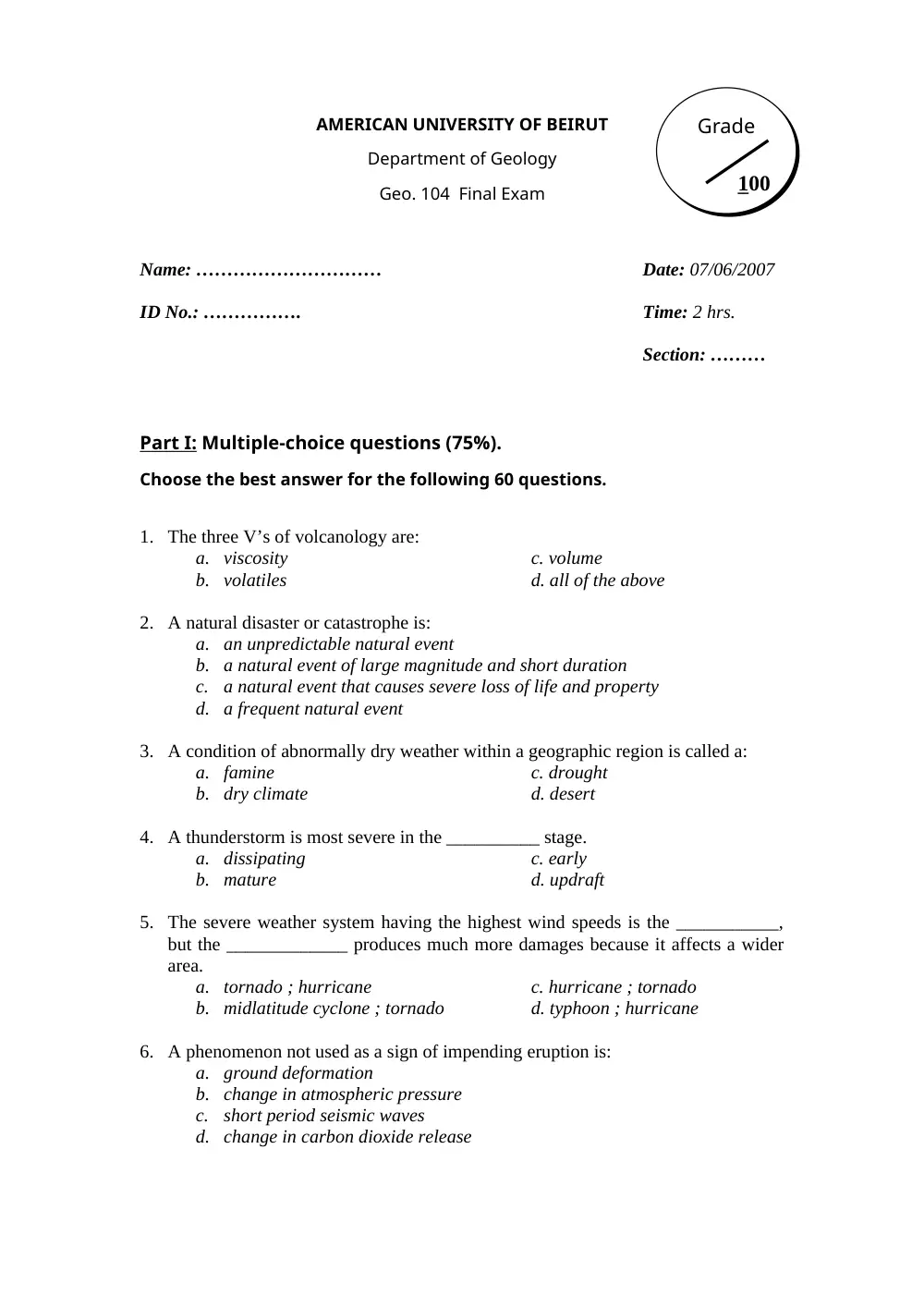
AMERICAN UNIVERSITY OF BEIRUT
Department of Geology
Geo. 104 Final Exam
Name: …………………………
Date: 07/06/2007
ID No.: …………….
Time: 2 hrs.
Section: ………
Part I: Multiple-choice questions (75%).
Choose the best answer for the following 60 questions.
1. The three V’s of volcanology are:
a. viscosity
c. volume
b. volatiles
d. all of the above
2. A natural disaster or catastrophe is:
a. an unpredictable natural event
b. a natural event of large magnitude and short duration
c.
a natural event that causes severe loss of life and property
d. a frequent natural event
3. A condition of abnormally dry weather within a geographic region is called a:
a. famine
c. drought
b. dry climate
d. desert
4. A thunderstorm is most severe in the __________ stage.
a. dissipating
c. early
b. mature
d. updraft
5. The severe weather system having the highest wind speeds is the ___________,
but the _____________ produces much more damages because it affects a wider
area.
a. tornado ; hurricane
c. hurricane ; tornado
b. midlatitude cyclone ; tornado
d. typhoon ; hurricane
6. A phenomenon not used as a sign of impending eruption is:
a. ground deformation
b. change in atmospheric pressure
c.
short period seismic waves
d. change in carbon dioxide release
Grade
Grade
100
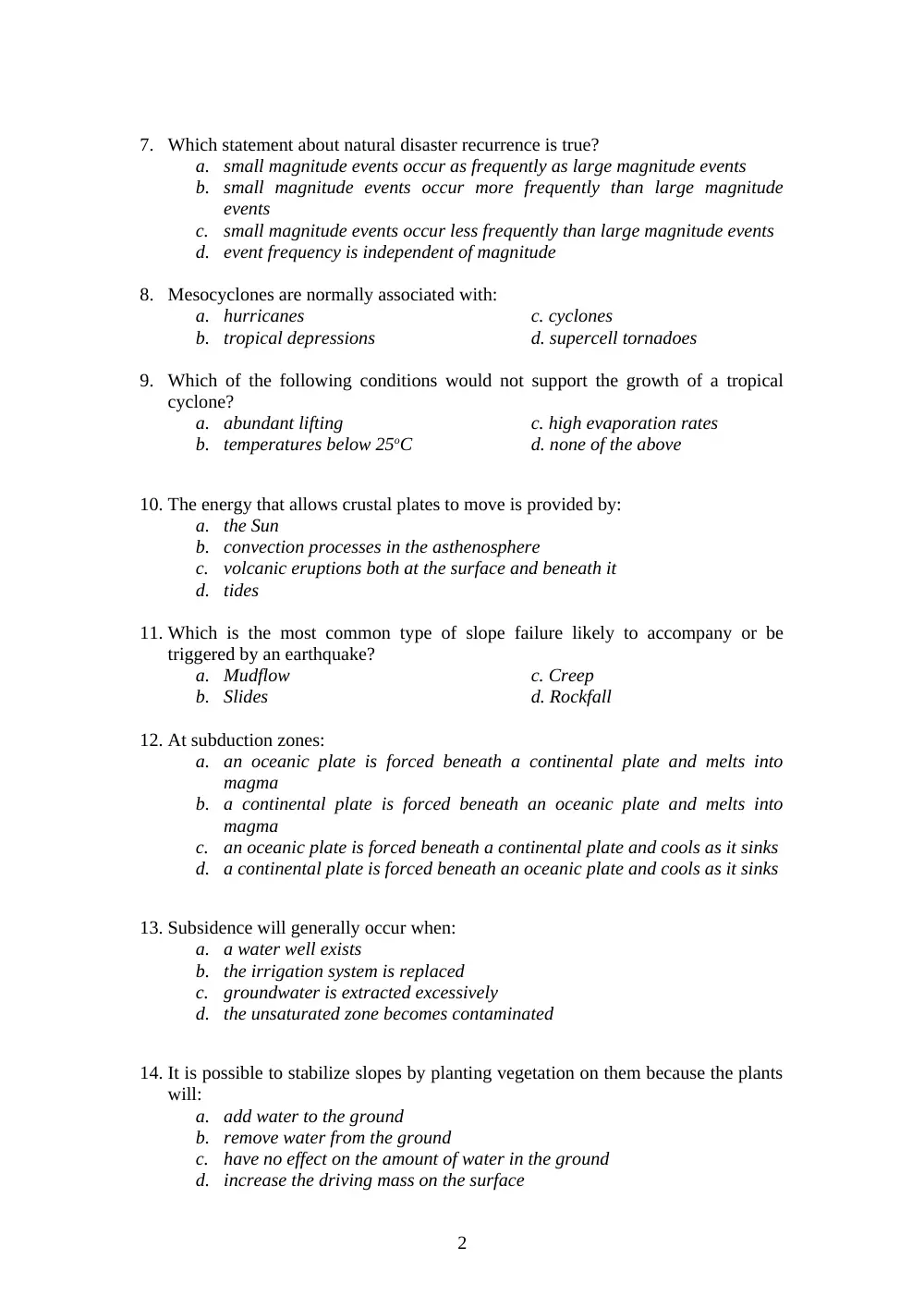
7. Which statement about natural disaster recurrence is true?
a. small magnitude events occur as frequently as large magnitude events
b. small magnitude events occur more frequently than large magnitude
events
c.
small magnitude events occur less frequently than large magnitude events
d. event frequency is independent of magnitude
8. Mesocyclones are normally associated with:
a. hurricanes
c. cyclones
b. tropical depressions
d. supercell tornadoes
9. Which of the following conditions would not support the growth of a tropical
cyclone?
a. abundant lifting
c. high evaporation rates
b. temperatures below 25oC
d. none of the above
10. The energy that allows crustal plates to move is provided by:
a. the Sun
b. convection processes in the asthenosphere
c.
volcanic eruptions both at the surface and beneath it
d. tides
11. Which is the most common type of slope failure likely to accompany or be
triggered by an earthquake?
a. Mudflow
c. Creep
b. Slides
d. Rockfall
12. At subduction zones:
a. an oceanic plate is forced beneath a continental plate and melts into
magma
b. a continental plate is forced beneath an oceanic plate and melts into
magma
c.
an oceanic plate is forced beneath a continental plate and cools as it sinks
d. a continental plate is forced beneath an oceanic plate and cools as it sinks
13. Subsidence will generally occur when:
a. a water well exists
b. the irrigation system is replaced
c.
groundwater is extracted excessively
d. the unsaturated zone becomes contaminated
14. It is possible to stabilize slopes by planting vegetation on them because the plants
will:
a. add water to the ground
b. remove water from the ground
c.
have no effect on the amount of water in the ground
d. increase the driving mass on the surface
2
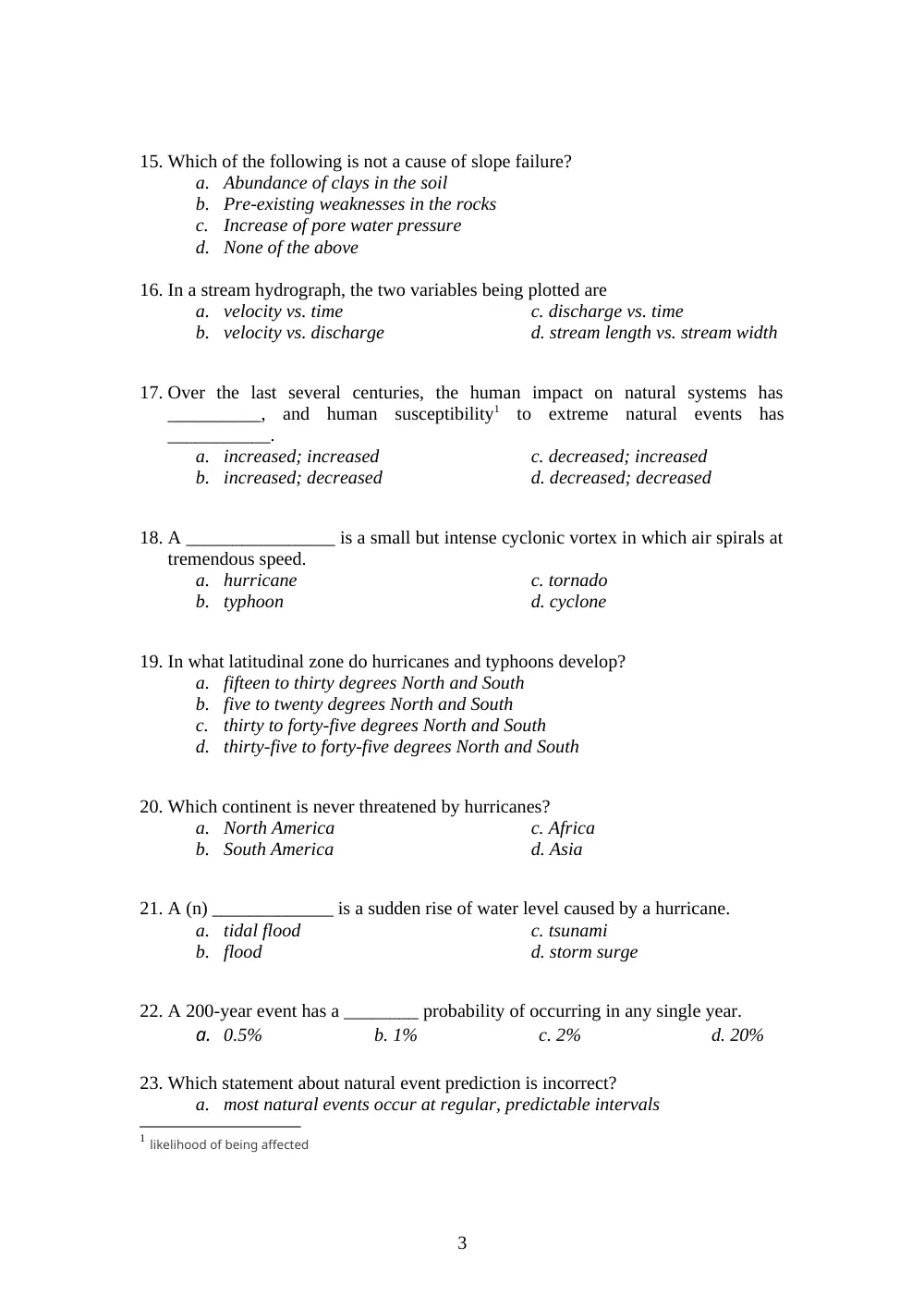
15. Which of the following is not a cause of slope failure?
a. Abundance of clays in the soil
b. Pre-existing weaknesses in the rocks
c.
Increase of pore water pressure
d. None of the above
16. In a stream hydrograph, the two variables being plotted are
a. velocity vs. time
c. discharge vs. time
b. velocity vs. discharge
d. stream length vs. stream width
17. Over the last several centuries, the human impact on natural systems has
__________, and human susceptibility1 to extreme natural events has
___________.
a. increased; increased
c. decreased; increased
b. increased; decreased
d. decreased; decreased
18. A ________________ is a small but intense cyclonic vortex in which air spirals at
tremendous speed.
a. hurricane
c. tornado
b. typhoon
d. cyclone
19. In what latitudinal zone do hurricanes and typhoons develop?
a. fifteen to thirty degrees North and South
b. five to twenty degrees North and South
c.
thirty to forty-five degrees North and South
d. thirty-five to forty-five degrees North and South
20. Which continent is never threatened by hurricanes?
a. North America
c. Africa
b. South America
d. Asia
21. A (n) _____________ is a sudden rise of water level caused by a hurricane.
a. tidal flood
c. tsunami
b. flood
d. storm surge
22. A 200-year event has a ________ probability of occurring in any single year.
a. 0.5% b. 1% c. 2% d. 20%
23. Which statement about natural event prediction is incorrect?
a. most natural events occur at regular, predictable intervals
1 likelihood of being affected
3
b. it is impossible to predict most natural events
c.
we understand in a general way what causes natural events
d. one natural event can trigger another
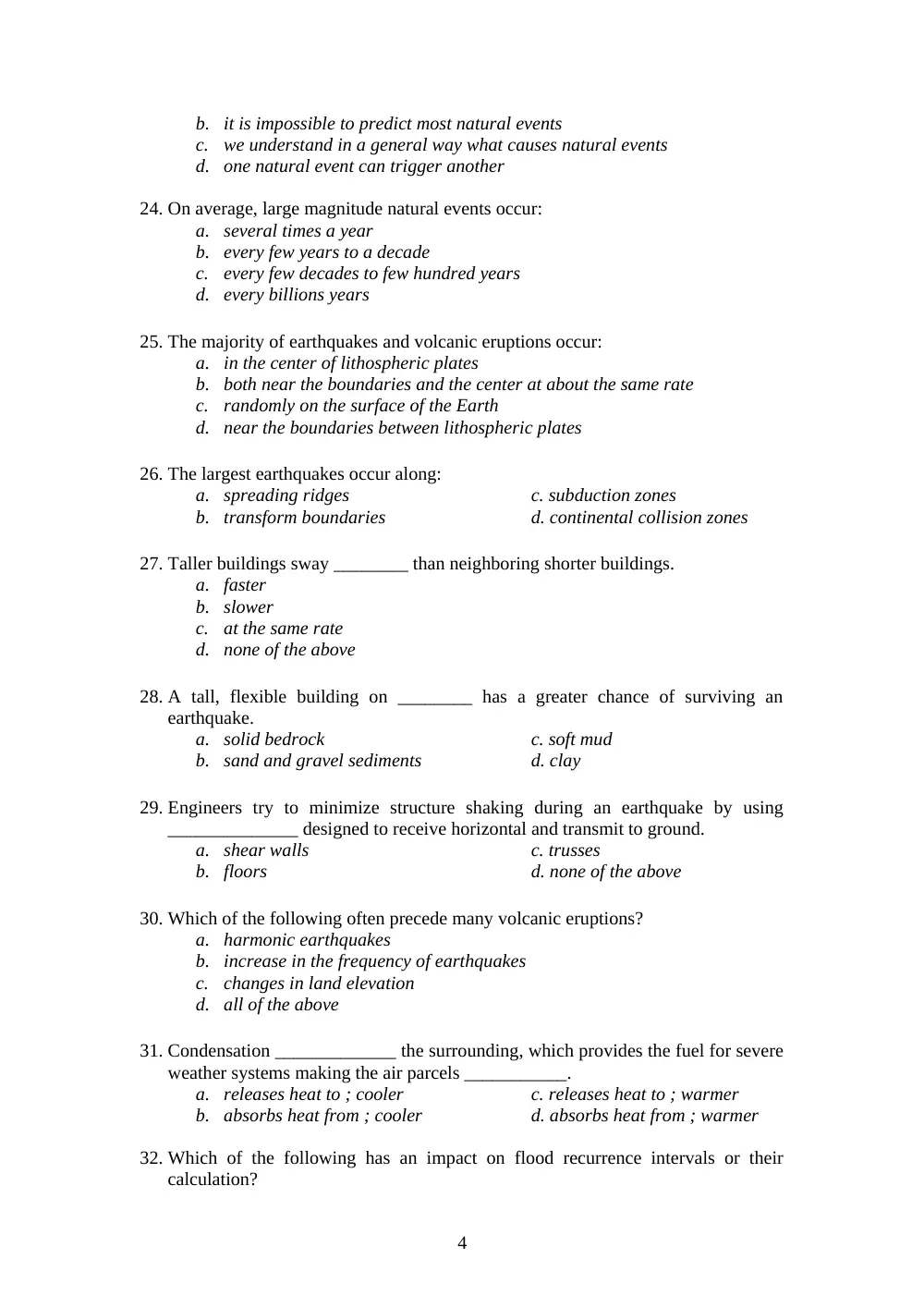
24. On average, large magnitude natural events occur:
a. several times a year
b. every few years to a decade
c.
every few decades to few hundred years
d. every billions years
25. The majority of earthquakes and volcanic eruptions occur:
a. in the center of lithospheric plates
b. both near the boundaries and the center at about the same rate
c.
randomly on the surface of the Earth
d. near the boundaries between lithospheric plates
26. The largest earthquakes occur along:
a. spreading ridges
c. subduction zones
b. transform boundaries
d. continental collision zones
27. Taller buildings sway ________ than neighboring shorter buildings.
a. faster
b. slower
c.
at the same rate
d. none of the above
28. A tall, flexible building on ________ has a greater chance of surviving an
earthquake.
a. solid bedrock
c. soft mud
b. sand and gravel sediments
d. clay
29. Engineers try to minimize structure shaking during an earthquake by using
______________ designed to receive horizontal and transmit to ground.
a. shear walls
c. trusses
b. floors
d. none of the above
30. Which of the following often precede many volcanic eruptions?
a. harmonic earthquakes
b. increase in the frequency of earthquakes
c.
changes in land elevation
d. all of the above
31. Condensation _____________ the surrounding, which provides the fuel for severe
weather systems making the air parcels ___________.
a. releases heat to ; cooler
c. releases heat to ; warmer
b. absorbs heat from ; cooler
d. absorbs heat from ; warmer
32. Which of the following has an impact on flood recurrence intervals or their
calculation?
4
a. length of the record used
c. climate change
b. urbanization or channelization
d. all of the above
33. Hurricane develop in tropical or subtropical water with temperatures of at least:
a. 20°C
c. 30°C
b. 26°C
d. 34°C
34. The diameter of a tornado averages about ____________ whereas that of a
hurricane is about ______________.
a. 0.5 – 2 m ; 400 – 800 m
c. 0.5 – 2 km ; 400 – 800 km
b. 400 – 800 km ; 0.5 – 2 km
d. 400 – 800 m ; 0.5 – 2 m
35. Lightning travels from:
a. cloud to ground
c. cloud to cloud
b. ground to cloud
d. all of the above
36. Which of the following types of damages cannot be a result of a downburst?
a. plane crash
c. failure of small buildings
b. blowing trees and rooftops
d. all of the above
37. The asteroid belt lies between ________ and ________.
a. Mars ; Jupiter
c. Jupiter ; Saturn
b. Earth ; Mars
d. Mars ; Saturn
38. Meteor trails are visible in the night sky because:
a. the friction of the fast moving meteorite against the air causes the
meteorite to heat into a glowing mass
b. the friction of the fast moving meteorite against the air causes the
atmospheric gases and vaporized material from the meteorite to become
glowing
c.
the moonlight is strongly reflected against the heated shiny surface of the
meteorite
d. only meteorites made of ice are visible in the night sky as they reflect the
light from earth
39. Which of the following is a reason why people are often willing to go along with
the construction of expensive alternatives and projects that eventually will fail?
a. They don't understand how natural hazardous processes work and the
futility of such measures
b. They are ignorant about the possible impact on their downstream or
downcurrent property of such measure (e.g. loss of sand on the beach,
increased flooding potential)
c.
They have a poor understanding of the hidden cost of such projects
d. All of these are examples of lack of education or ignorance that make
people go along with the adoption of costly alternatives
40. Stony meteorites are less commonly collected than iron meteorites because:
5
a. they break up more readily while passing through the Earth's atmospheric
filter
b. those reaching the ground are weathered and destroyed more rapidly
c.
they are not as easily recognized
d. all of the above
41. Why are there so many more impact craters visible on the Moon than on the
Earth?
a. The moon has been hit by many more meteorites than the Earth
b. The moon formed long before the earth formed, so it had more time to be
hit by meteorites
c.
Because of gravitational effects, the moon deflects many of the meteorites
that would otherwise hit the Earth
d. Craters on the Earth can be destroyed by erosion and mountain-building
processes, or obscured by vegetation or sedimentation
42. When a meteorite large enough to cause a crater hits the Earth, the size of the
impact crater is:
a. smaller than the meteorite
b. perhaps 10-20 times the diameter of the meteorite
c.
about the same as the meteorite
d. determined by the angle of impact
43. Comets are composed of:
a. gas, mostly hydrogen and helium
c. solid rock
b. ice and rocky debris
d. unknown material
44. The number of incoming space objects is related to their size:
a. the smaller the meteoroids, the greater their abundance
b. the larger the meteoroids, the greater their abundance
c.
the number is the same for each size range
d. none of the above
45. Space debris that collides with the Earth comes primarily from ___________ and
secondarily from __________.
a. asteroids ; comets
c. asteroids ; meteorites
b. comets ; asteroids
d. comets ; meteorites
46. On a given stream, small floods happen:
a. with the same frequency as large floods
b. more often than large floods
c.
less often than large floods
d. sometimes more often, sometimes less often than large floods
47. Efforts to control rivers include:
a. dams
c. channelization
b. levees
d. all of the above
6
48. The two curves on the hydrograph in the attached
picture are for the same area prior to development and
after development. Which of the curves is for the area
prior to development?
a. Curve a
b. Curve b
49. Why are flash floods so dangerous and result in many
deaths?
a. They are long lasting covering very large regions
b. They carry large amounts of sediment
c.
They occur very fast with little or no warning signs of an approaching
flood
d. They are no different than other floods
50. Which of the following factors does not contribute to storm surge?
a. Colder temperatures during the storms
b. Strong winds blowing on the water
c.
Low pressure in the center of a storm
d. All of the above
51. Tropical cyclones in the Indian Ocean are known as
a. hurricanes
c. cyclones
b. typhoons
d. depressions
52. The Saffir-Simpson Hurricane Scale is base strictly on:
a. average wind speed and atmospheric pressure
b. size of the hurricane eye and atmospheric pressure
c.
average wind direction and atmospheric pressure
d. average temperature in the hurricane and average wind speed
53. In the Saffir-Simpson scale, the hurricane that produces catastrophic damage is:
a. Category 2
c. Category 5
b. Category 4
d. Category 6
54. The atmospheric pressure in the eye of a hurricane is:
a. the same as in the outside of the hurricane
b. higher than that of surrounding air
c.
lower than that of surrounding air
d. variable, it is sometime higher than surrounding air and sometimes lower
55. A tropical storm evolves into a hurricane when sustained wind speeds exceed:
a. 62 kilometers per hour
c. 154 kilometers per hour
b. 119 kilometers per hour
d. 210 kilometers per hour
56. Which of the following has not played a role in the observed decrease in loss of
life during hurricane strikes in the US mainland?
a. Improved transportation network to and from coastal islands
7
b. Improved forecasting of hurricane path and strike zone
c.
Improved communication network and evacuation procedures
d. Decrease in the number of category 4 and 5 hurricanes
57. During a hurricane impact, the greatest amount of damage to buildings is caused
by:
a. storm surge flooding
c. landslides and debris flows
b. rainfall and associated flooding
d. wind force and blowing debris
58. The sound of thunder is produced by:
a. the connection of positive and negative charges
b. the impact of the lighting strike on the surface
c.
the rapid expansion of air produced by the extreme and sudden heating
during a lightning strike
d. none of the above
59. You and a friend are walking through the middle of a field with nice trees when
you are caught by a thunderstorm that is fast approaching, and lightning is striking
close by. Your safest course of action would be:
a. run to one of the trees to seek shelter from rain and lightning
b. lie flat on the ground
c.
sit on the ground under your umbrella
d. none of the above
60. During El Niño, dry conditions dominate in _____________while more flood-like
conditions exist in_____________.
a. Indonesia and Australia ; Peru and Ecuador
b. Peru and Ecuador ; Indonesia and Australia
c.
Indonesia and Peru ; Australia and Ecuador
d. Peru and Indonesia ; Ecuador and Australia
Part II: (25%).
Answer two of the three following questions (Answering the three
automatically means that the third question is cancelled).
1. List the energy sources of disasters, and the phenomena related to each one (i.e. the
source and the corresponding phenomena).
2. Fill in the blanks with the proper expression.
An estimated 100,000 million or more ___________ enter the Earth’s
atmosphere every day. Earth is largely protected from this
8
bombardment by its __________________. At about _________ km above the
ground, the atmosphere is dense enough to cause many meteoroids to
glow. However, large impacts can produce extremely large damages.
The first step in a defense plan to protect ourselves from such impacts is
to ___________ those objects. Then identify which one is presenting a
___________. Finally, different ways can be used to alter its collision like
________________________________.
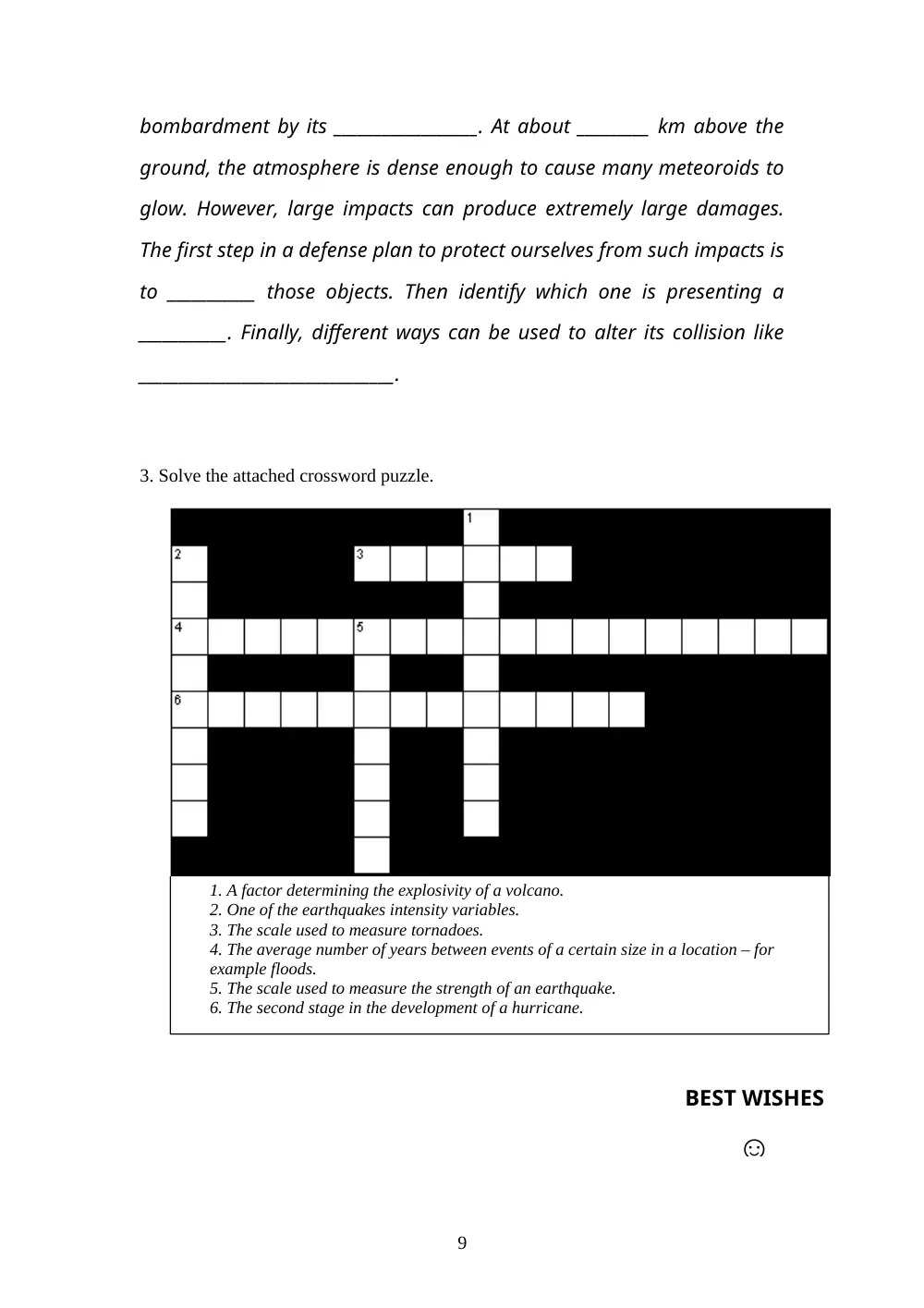
3. Solve the attached crossword puzzle.
1. A factor determining the explosivity of a volcano.
2. One of the earthquakes intensity variables.
3. The scale used to measure tornadoes.
4. The average number of years between events of a certain size in a location – for
example floods.
5. The scale used to measure the strength of an earthquake.
6. The second stage in the development of a hurricane.
9
BEST WISHES
☺