
GEOL 200 Final, Spring 1997
American University of Beirut · Earth and Human Affairs · 6 pages

More GEOL 200 files
Show the text of this final exam
AYN
Op
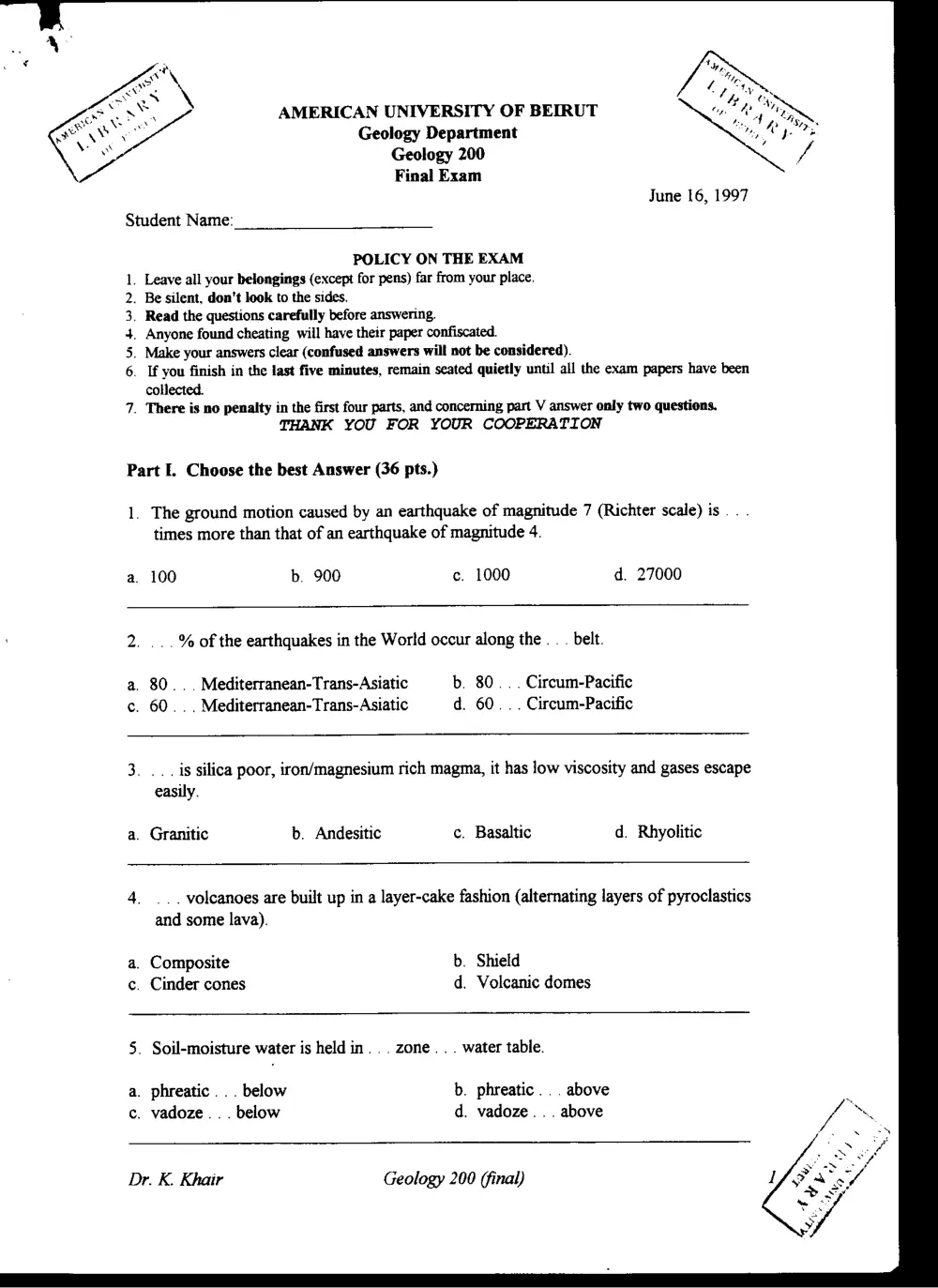
AMERICAN UNIVERSITY OF BEIRUT
Geology Department
Geology 200
Final Exam
June 16, 1997
Student Name:
POLICY ON THE EXAM
Leave all your belongings (except for pens) far from your place.
Be silent, don't look to the sides.
Read the questions carefully before answering.
Anyone found cheating will have their paper confiscated.
Make your answers clear (confused answers will not be considered).
If you finish in the last five minutes, remain seated quietly until all the exam papers have been
collected.
7. There is no penalty in the first four parts, and concerning part V answer only two questions.
THANK YOU FOR YOUR COOPERATION
aAwWewWN
Part I. Choose the best Answer (36 pts.)
1. The ground motion caused by an earthquake of magnitude 7 (Richter scale) is . . -
times more than that of an earthquake of magnitude 4.
a. 100 b. 900 c. 1000 d. 27000
2. ...% of the earthquakes in the World occur along the. . . belt.
a. 80... Mediterranean-Trans-Asiatic b. 80... Circum-Pacific
c. 60... Mediterranean-Trans-Asiatic d. 60... Circum-Pacific
3. .. . is silica poor, iron/magnesium rich magma, it has low viscosity and gases escape
easily.
a. Granitic b. Andesitic c. Basaltic d. Rhyolitic
4. ... volcanoes are built up in a layer-cake fashion (alternating layers of pyroclastics
and some lava).
a. Composite b. Shield
c. Cinder cones d. Volcanic domes
5. Soil-moisture water is held in... zone. . . water table.
a. phreatic.. . below b. phreatic .. . above
c. vadoze... below d. vadoze.. . above
Dr. K. Khair Geology 200 (final)
¥
YY,
LO»
4; TN,
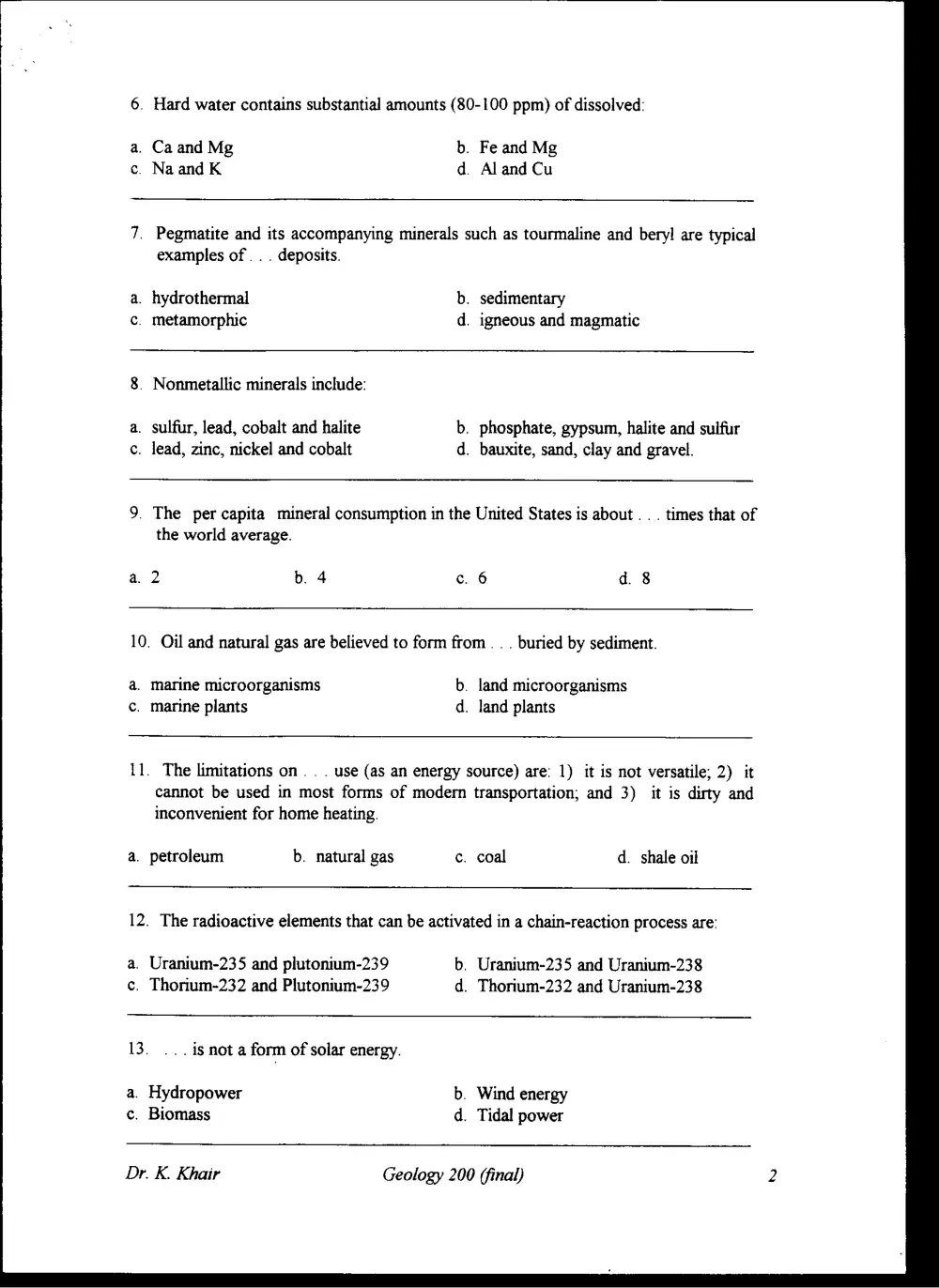
6. Hard water contains substantial amounts (80-100 ppm) of dissolved:
a. Ca and Mg b. Fe and Mg
c. NaandK d. Aland Cu
7. Pegmatite and its accompanying minerals such as tourmaline and beryl are typical
examples of . . . deposits.
a. hydrothermal b. sedimentary
c. metamorphic d. igneous and magmatic
8. Nonmetallic minerals include:
a. sulfur, lead, cobalt and halite b. phosphate, gypsum, halite and sulfur
c. lead, zinc, nickel and cobalt d. bauxite, sand, clay and gravel.
9. The per capita mineral consumption in the United States is about . . . times that of
the world average.
a. 2 b. 4 c. 6 d. 8
10. Oil and natural gas are believed to form from . . . buried by sediment.
a. marine microorganisms b. land microorganisms
c. marine plants d. land plants
11. The limitations on . . . use (as an energy source) are: 1) it is not versatile, 2) it
cannot be used in most forms of modern transportation, and 3) it is dirty and
inconvenient for home heating.
a. petroleum b. natural gas c. coal d. shale oil
12. The radioactive elements that can be activated in a chain-reaction process are:
a. Uranium-235 and plutonium-239 b. Uranium-235 and Uranium-238
c. Thorium-232 and Plutonium-239 d. Thorium-232 and Uranium-238
13. ...isnota form of solar energy.
a. Hydropower b. Wind energy
c. Biomass d. Tidal power
Dr. K. Khair Geology 200 (final)
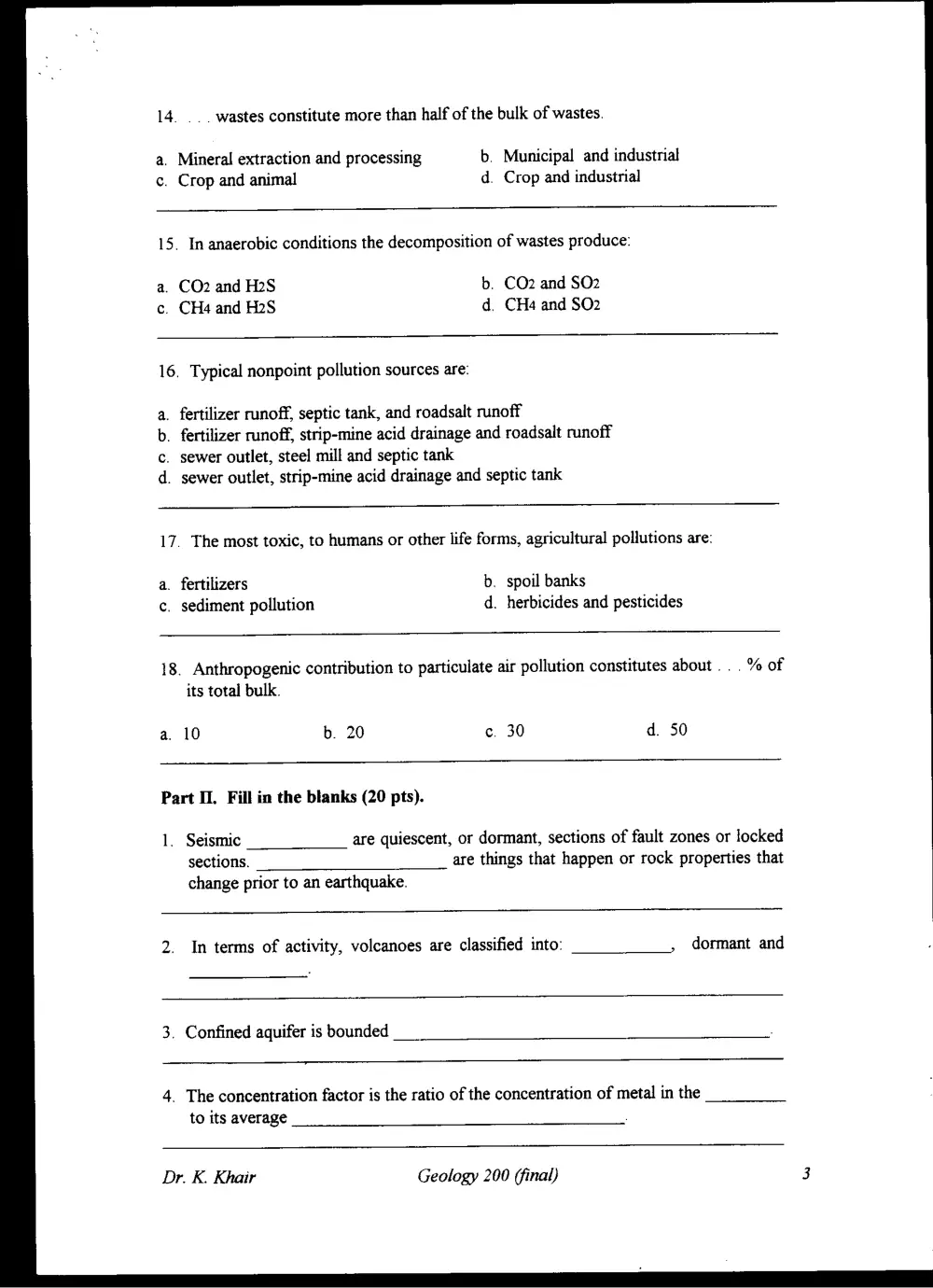
14. __. wastes constitute more than half of the bulk of wastes.
a. Mineral extraction and processing b. Municipal and industrial
c. Crop and animal d. Crop and industrial
15. In anaerobic conditions the decomposition of wastes produce:
a. CO2 and H2S b. CQ2 and SO2
c. CHa and H2S d. CHa and SO2
16. Typical nonpoint pollution sources are:
a. fertilizer runoff, septic tank, and roadsalt runoff
b. fertilizer runoff, strip-mine acid drainage and roadsalt runoff
c. sewer outlet, steel mill and septic tank
d. sewer outlet, strip-mine acid drainage and septic tank
17. The most toxic, to humans or other life forms, agricultural pollutions are:
a. fertilizers b. spoil banks
c. sediment pollution d. herbicides and pesticides
18. Anthropogenic contribution to particulate air pollution constitutes about... % of
its total bulk.
a. 10 b. 20 c. 30 d. 50
Part I. Fill in the blanks (20 pts).
1. Seismic are quiescent, or dormant, sections of fault zones or locked
sections. are things that happen or rock properties that
change prior to an earthquake.
2. In terms of activity, volcanoes are classified into: , dormant and
3. Confined aquifer is bounded
4. The concentration factor is the ratio of the concentration of metal in the
to its average
Dr. K. Khair Geology 200 (final) 3
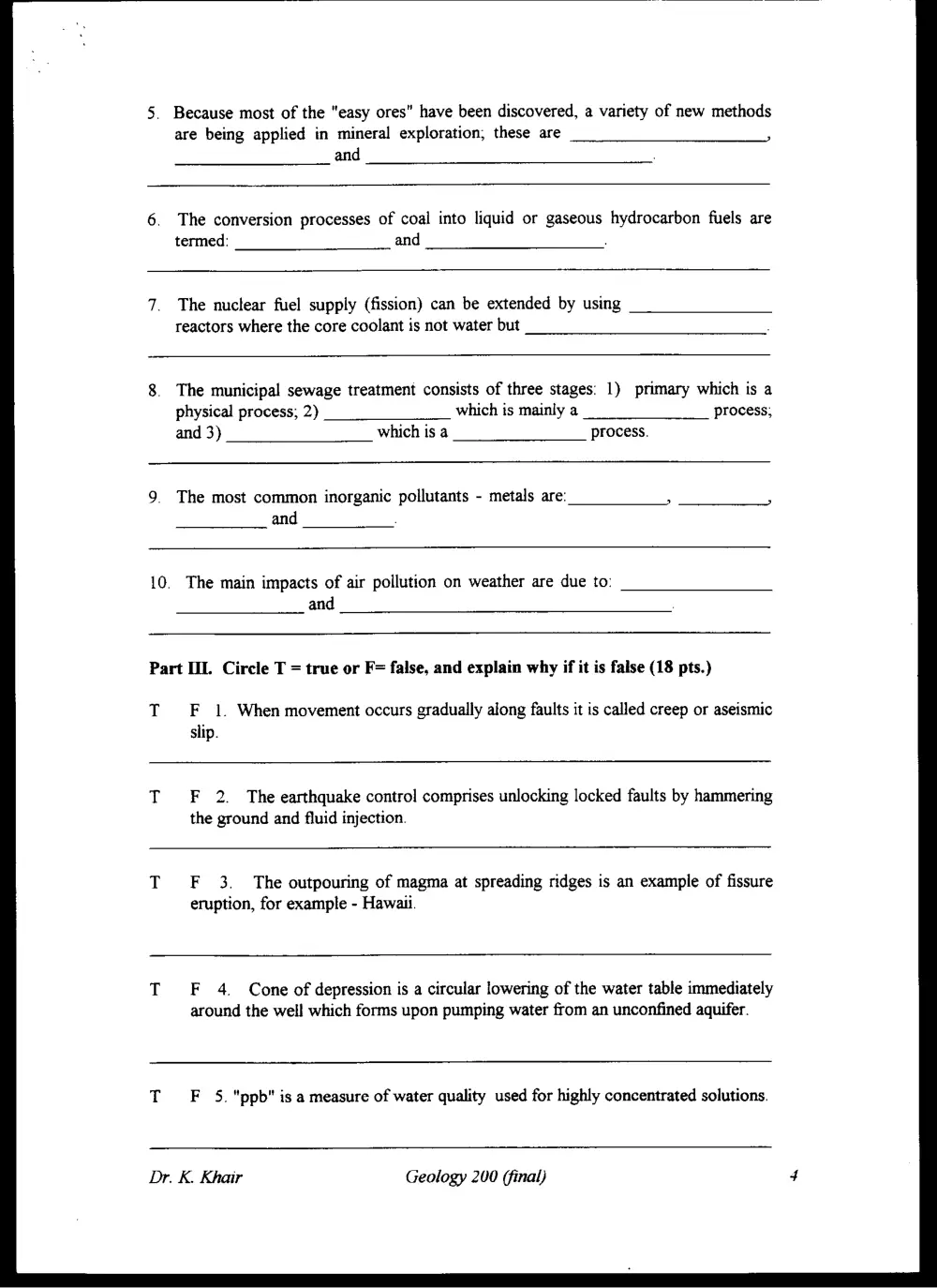
5. Because most of the "easy ores” have been discovered, a variety of new methods
are being applied in mineral exploration; these are >
and
6. The conversion processes of coal into liquid or gaseous hydrocarbon fuels are
termed: and
7. The nuclear fuel supply (fission) can be extended by using
reactors where the core coolant is not water but
8. The municipal sewage treatment consists of three stages: 1) primary which is a
physical process; 2) which is mainly a process;
and 3) which is a process.
9. The most common inorganic pollutants - metals are: > ;
and
10. The main impacts of air pollution on weather are due to:
and
Part DI. Circle T = true or F= false, and explain why if it is false (18 pts.)
TF 1. When movement occurs gradually along faults it is called creep or aseismic
slip.
TF 2. The earthquake control comprises unlocking locked faults by hammering
the ground and fluid injection.
T F 3. The outpouring of magma at spreading ridges is an example of fissure
eruption, for example - Hawaii.
TF 4. Cone of depression is a circular lowering of the water table immediately
around the well which forms upon pumping water from an unconfined aquifer.
TF 5. "ppb" is a measure of water quality used for highly concentrated solutions.
Dr. K. Khair Geology 200 (final)
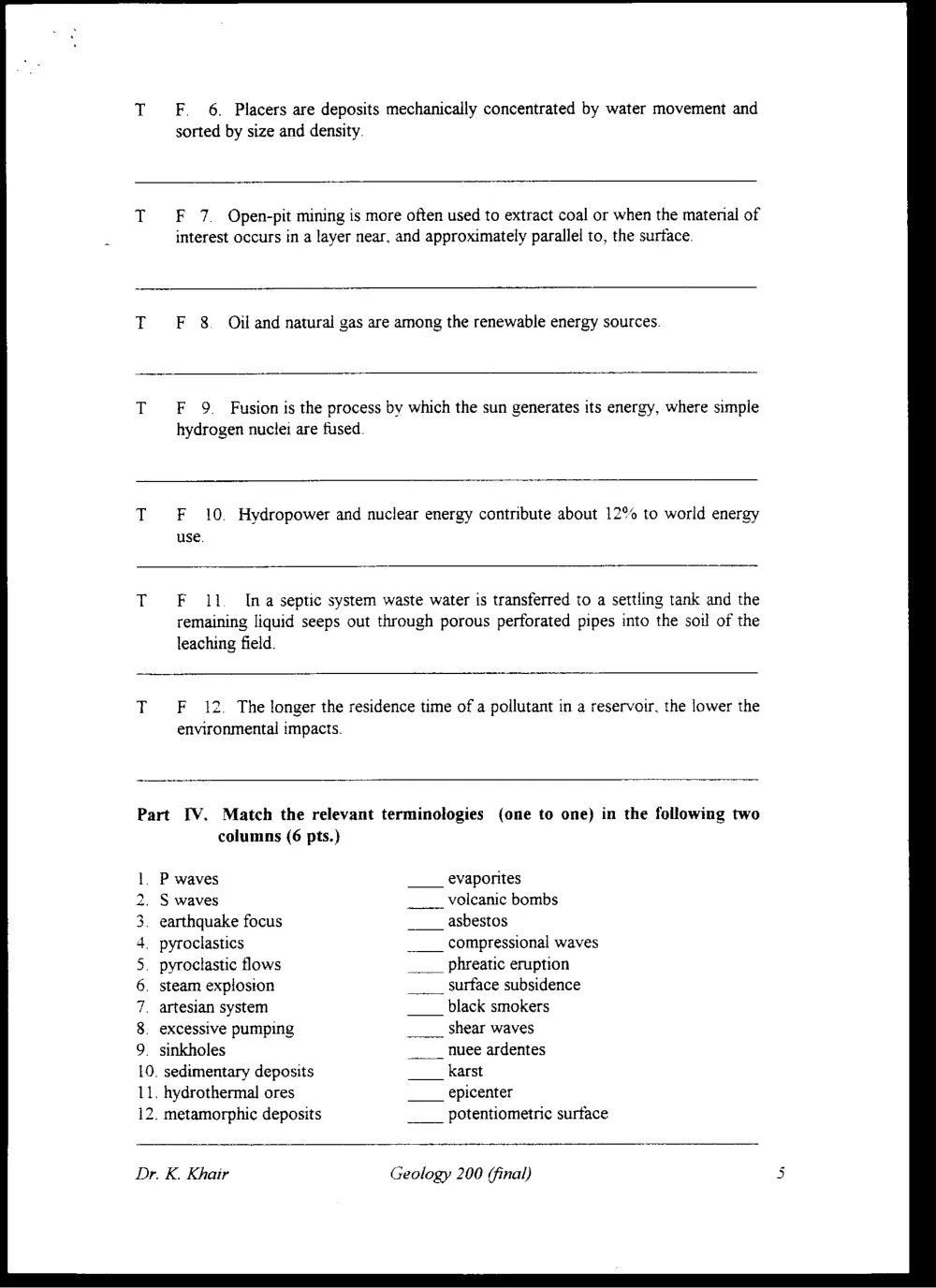
F. 6. Placers are deposits mechanically concentrated by water movement and
sorted by size and density
F 7. Open-pit mining is more often used to extract coal or when the maternal of
interest occurs in a layer near, and approximately parallel to, the surface.
F 8. Oil and natural gas are among the renewable energy sources.
F 9. Fusion is the process by which the sun generates its energy, where simple
hydrogen nuclei are fused.
F 10. Hydropower and nuclear energy contribute about 12% to world energy
use.
F 11. Ina septic system waste water is transferred to a settling tank and the
remaining liquid seeps out through porous perforated pipes into the soil of the
leaching field.
F 12. The longer the residence time of a pollutant in a reservoir, the lower the
environmental impacts.
Part IV. Match the relevant terminologies (one to one) in the following two
columns (6 pts.)
P waves evaporites
S waves volcanic bombs
earthquake focus ___ asbestos
pyroclastics ____ compressional waves
pyroclastic flows ___ phreatic eruption
steam explosion surface subsidence
artesian system black smokers
excessive pumping shear waves
9. sinkholes nuee ardentes
10. sedimentary deposits karst
11. hydrothermal ores epicenter
12. metamorphic deposits potentiometric surface
POD MN HW bd re
Dr. K. Khair Geology 200 (final)
Part V. Answer only two of the following three questions (20 pts).
1. Discuss locating the epicenter, including calculating the distance to the earthquake
station (draw a scheme),
2. Discuss the enhanced oil recovery and the geopressurized natural gas.
3. Describe the secure landfills and deep-well disposal and draw schemes.
GOOD LUCK
Dr. K. Khair Geology 200 (final)