
GEOL 202 Final, Spring 1997
American University of Beirut · Historical Geology · 6 pages


More GEOL 202 files
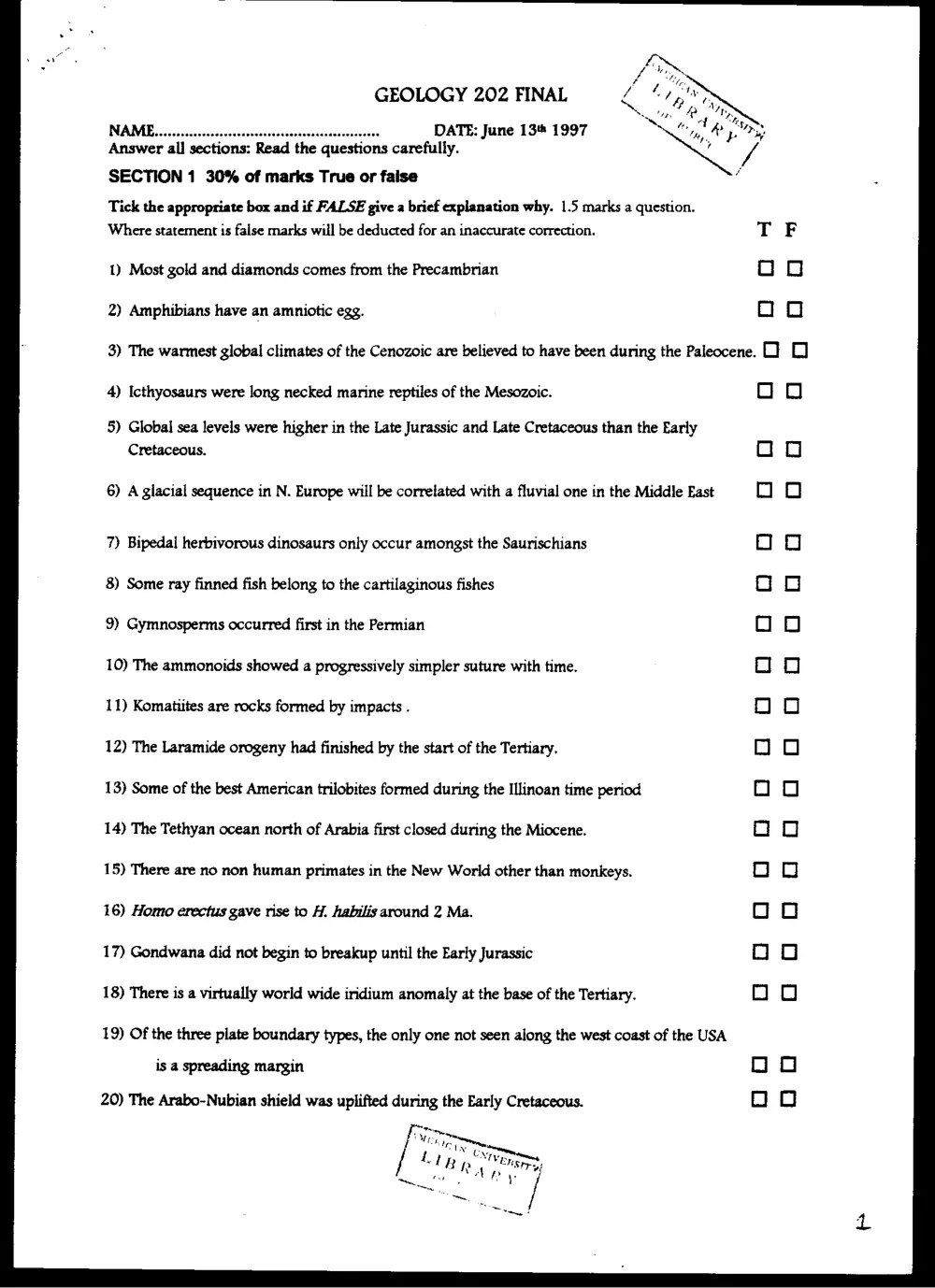
Show the text of this final exam
GEOLOGY 202 FINAL
DATE: June 13% 1997
Answer all sections: Read the questions carefully.
SECTION 1 30% of marks True or false
Tick the appropriate box and if FALSE give a brief explanation why. 1.5 marks a question.
Where statement is false marks will be deducted for an inaccurate correction. T F
1) Most gold and diamonds comes from the Precambrian oo
2) Amphibians have an amniotic egg. og
3) The warmest global climates of the Cenozoic are believed to have been during the Paleocene. O (]
4) Icthyosaurs were long necked marine reptiles of the Mesozoic. od
5) Global sea levels were higher in the Late Jurassic and Late Cretaceous than the Early
Cretaceous.
6) A glacial sequence in N. Europe will be correlated with a fluvial one in the Middle East
7) Bipedal herbivorous dinosaurs only occur amongst the Saurischians
8) Some ray finned fish belong to the cartilaginous fishes
9) Gymnosperms occurred first in the Permian
10) The ammonoids showed a progressively simpler suture with time.
11) Komattites are rocks formed by impacts .
12) The Laramide orogeny had finished by the start of the Tertiary.
13) Some of the best American trilobites formed during the Illinoan time period
14) The Tethyan ocean north of Arabia first closed during the Miocene.
15) There are no non human primates in the New World other than monkeys.
16) Homo erectus gave rise to H. habilis around 2 Ma.
17) Gondwana did not begin to breakup until the Early Jurassic
ood
oa
oo
oo
oOo
oo
oo
OO
oo
oo
oo
od
oo
od
18) There is a virtually world wide iridium anomaly at the base of the Tertiary.
19) Of the three plate boundary types, the only one not seen along the west coast of the USA
oO
O
is a spreading margin
Oo
0
20) The Arabo-Nubian shield was uplifted during the Early Cretaceous.
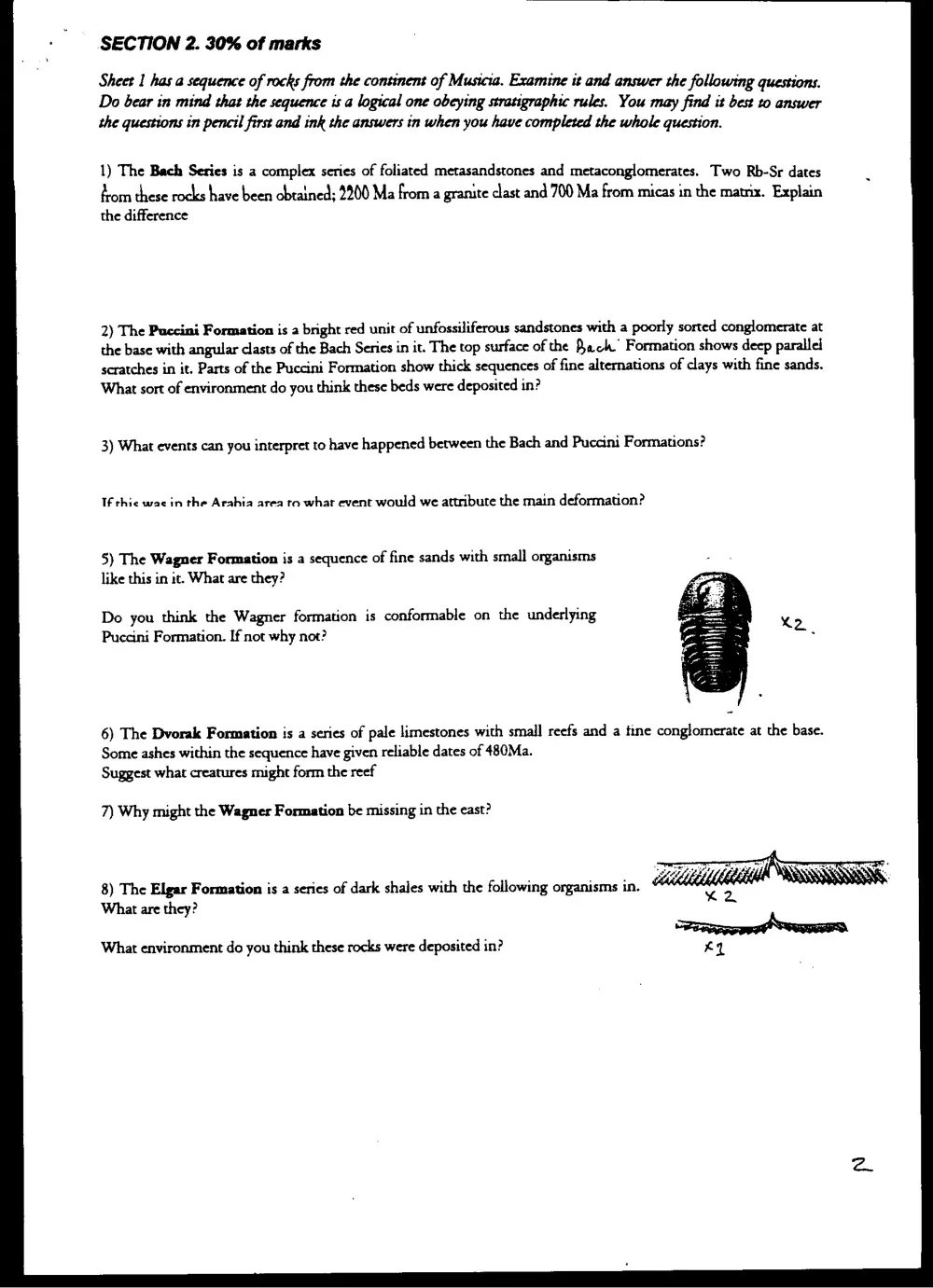
SECTION 2. 30% of marks
Sheet 1 has a sequence of rocks from the continent of Musicia. Examine it and answer the following questions.
Do bear in mind that the sequence is a logical one obeying stratigraphic rules. You may find it best to answer
the questions in pencil first and ink the answers in when you have completed the whole question.
1) The Bach Series is a complex series of foliated metasandstones and metaconglomerates. Two Rb-Sr dates
trom these rocks have been obtained; 2200 Ma from a granite clast and 700 Ma from micas in the matrix. Explain
the difference
2) The Puccini Formation is a bright red unit of unfossiliferous sandstones with a poorly sorted conglomerate at
the base with angular clasts of the Bach Series in it. The top surface of the Pach.” Formation shows deep parallel
scratches in it. Parts of the Puccini Formation show thick sequences of fine alternations of clays with fine sands.
What sort of environment do you think these beds were deposited in?
3) What events can you interpret to have happened between the Bach and Puccini Formations?
Tf thie wae in the Arabia area ro what event would we attribute the main deformation?
5) The Wagner Formation is a sequence of fine sands with small organisms
like this in it. What are they?
Do you think the Wagner formation is conformable on the underlying
Puccini Formation. If not why not?
6) The Dvorak Formation is a series of pale limestones with small reefs and a tine conglomerate at the base.
Some ashes within the sequence have given reliable dates of 480Ma.
Suggest what creatures might form the reef
7) Why might the Wagner Formation be missing in the east?
8) The Elgar Formation is a series of dark shales with the following organisms in.
What are they?
What environment do you think these rocks were deposited in?
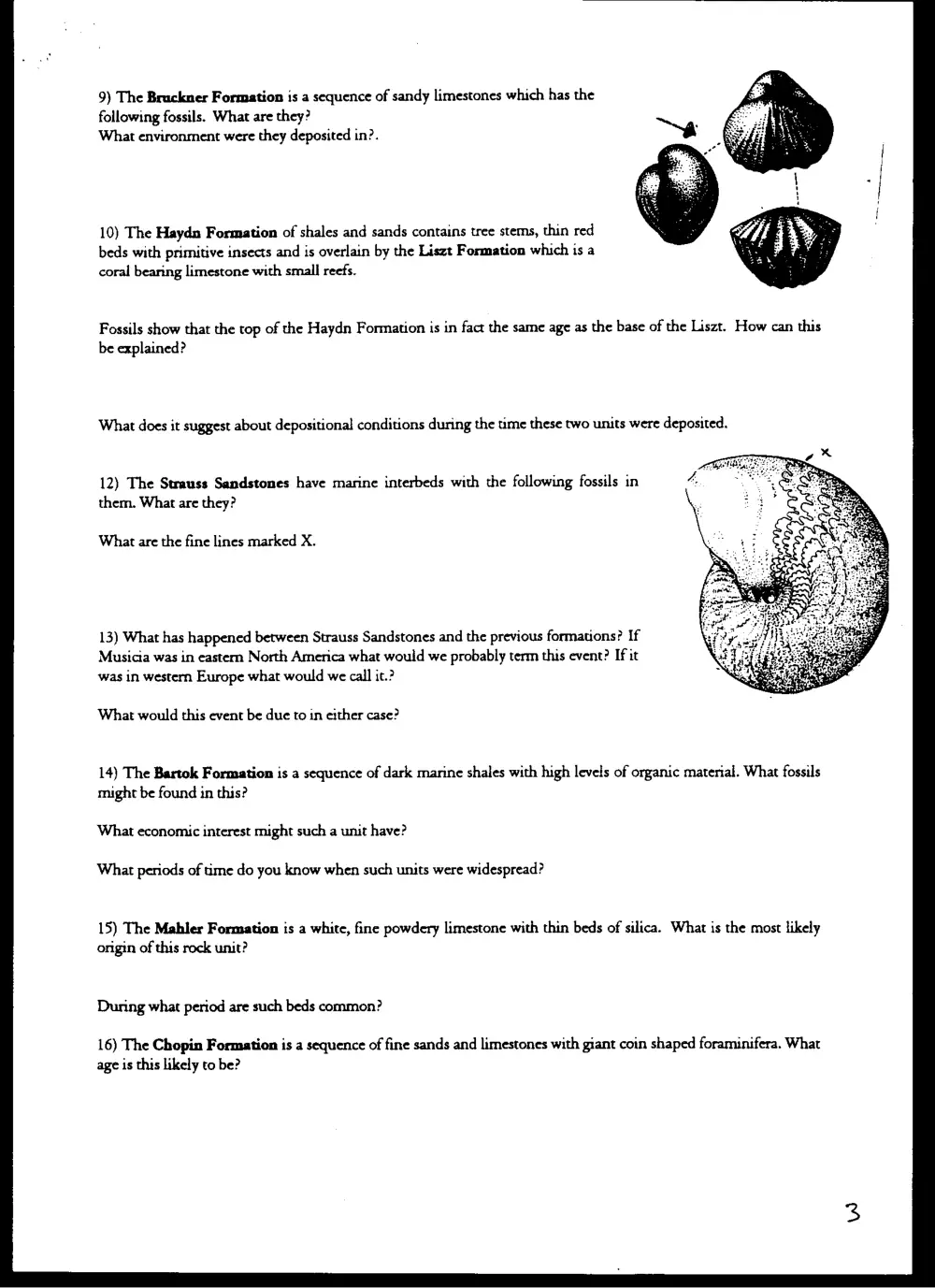
9) The Bruckner Formation is a sequence of sandy limestones which has the
following fossils. What are they?
What environment were they deposited in?.
10) The Haydn Formation of shales and sands contains tree stems, thin red
beds with primitive insects and is overlain by the Liszt Formation which is a
coral bearing limestone with small reefs.
Fossils show that the top of the Haydn Formation is in fact the same age as the base of the Liszt. How can this
be explained?
What does it suggest about depositional conditions during the time these two units were deposited.
12) The Strauss Sandstones have marine interbeds with the following fossils in
them. What are they?
What are the fine lines marked X.
13) What has happened between Strauss Sandstones and the previous formations? If
Musicia was in eastem North America what would we probably term this event? If it
was in western Europe what would we call it.?
What would this event be due to in either case?
14) The Bartok Formation is a sequence of dark marine shales with high levels of organic material. What fossils
might be found in this?
What economic interest might such a unit have?
What periods of time do you know when such units were widespread?
15) The Mahler Formation is a white, fine powdery limestone with thin beds of silica. What is the most likely
origin of this rock unit?
During what period are such beds common?
16) The Chopin Formation is a sequence of fine sands and limestones with giant coin shaped foraminifera. What
age is this likely to be?
17) The Mozart Formation is pale grey hard finely crystalline rock. What would this rock type be most probably
be termed? What do we calf the way it occurs?
18) The Verdi Formation are a series of fine dark rocks made up of crystals with columnar jointing. These rocks
give a K-Ar date of 35 Ma. What can we deduce about the origin of these rocks?
What seerns to have happened prior to the deposition of this bed?.
19) The following fossils are found within the Brahms Formation. What are they and what do they tell you about
the environment of deposition?
20) The base of the Beethoven Formation of mudstones is marked by an abrupt sheared surface. The Beethoven
Formation contains the following fossils.
What are they a)
What age is it?
Explain its position in the sequence.
SECTION 3 20% Geology of Lebanon.
1) What distinguishing features would you look for to identify the Jurassic-Cretaceous boundary in the field in
Lebanon.
2) What age are the oldest rocks in Lebanon?
3) What conditions are necessary to get the preservation of the soft bodied faunas of units like those in the
Lebanese Fish Beds?
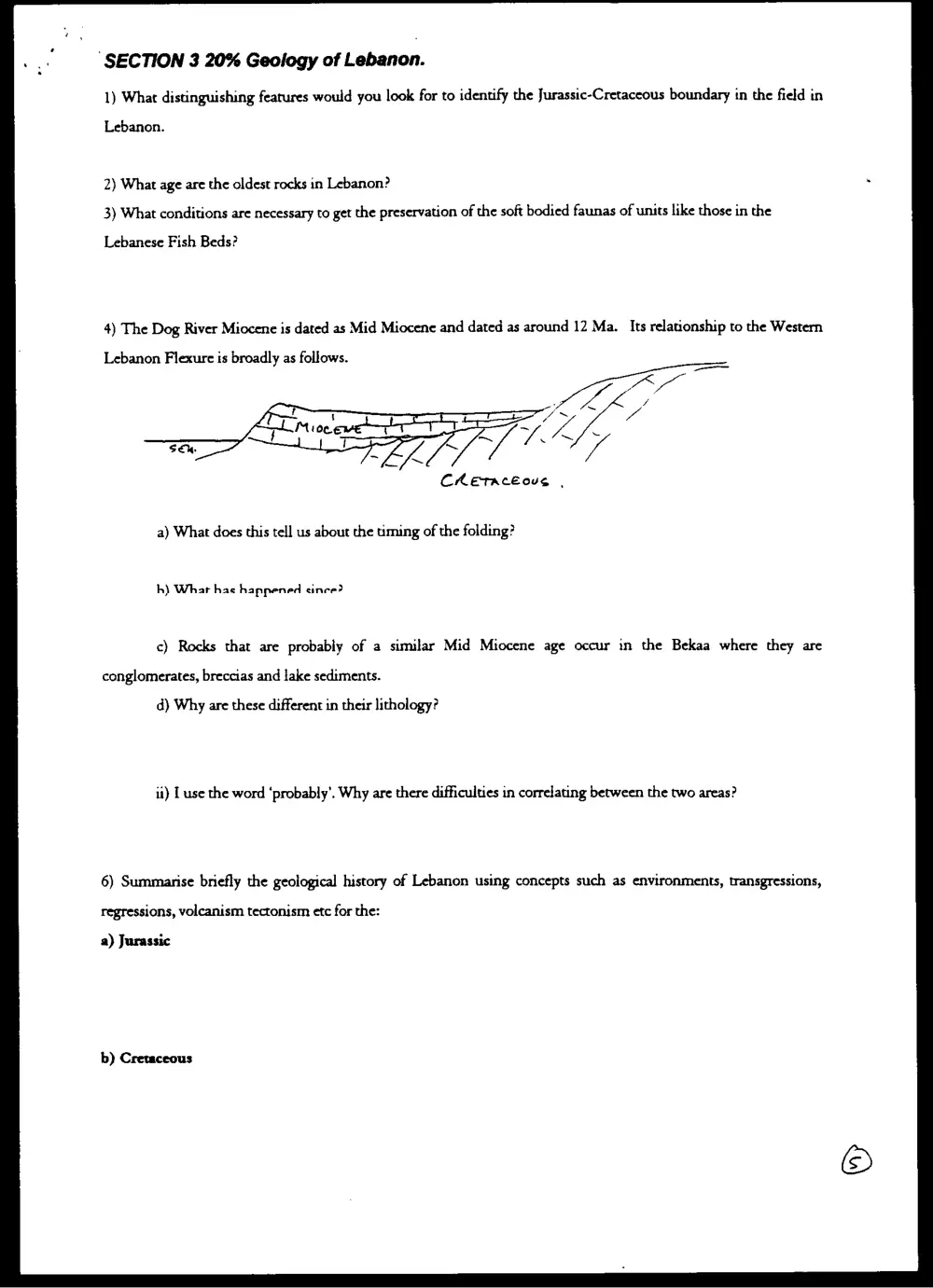
4) The Dog River Miocene is dated as Mid Miocene and dated as around 12 Ma. Its relationship to the Western
Lebanon Flexure is broadly as follows.
ChEtaAcEous ,
a) What does this tell us about the timing of the folding?
h) Whar hac happened cince?
c) Rocks that are probably of a similar Mid Miocene age occur in the Bekaa where they are
conglomerates, breccias and lake sediments.
d) Why are these different in their lithology?
it) I use the word ‘probably’. Why are there difficulties in correlating between the two areas?
6) Summarise briefly the geological history of Lebanon using concepts such as environments, transgressions,
regressions, volcanism tectonism etc for the:
a) Jurassic
b) Cretaceous
c) Cenozoic
SECTION 4: 20% ESSAY QUESTIONS
Answer Two
1) Why has research on Precambnian strata really only developed in the last 50 years? The Precambrian of the
Arabian plate north of about the latitude of the Dead Sea is totally unknown even from boreholes as it is so deep.
In what ways may it have been significant to regional Phanerozoic history?
2) Discuss the possible and probable effects on Life on Earth if the following changes to history had taken place.
a) Outgassing had produced twice the CO, that it did.
b) The continents had stayed together after the Triassic.
c) The K/T bolide had missed.
d) Sealevels had risen substantially during the Late Cenozoic
3) Consider the following features. Choose four and in each case list the evolutionary advantages and, where
relevant, the disadvantages.
a) jaws
b) sexual reproduction
c) brains
d) placental reproduction
e) large size
4) Explain briefly the significance to earth history of four of the following
Archaeopteryx
The coelacanth Latimeria.
Marrella, Sidneyia, Wiwaxia and their friends .
Nestralopithoceus afarensis
Quetzacoatlus
Montypythonoides
Best wishes