
GEOL 221 Final, Fall 1995
American University of Beirut · Petrology · 4 pages


More GEOL 221 files
Show the text of this final exam
J.
: oN.
as
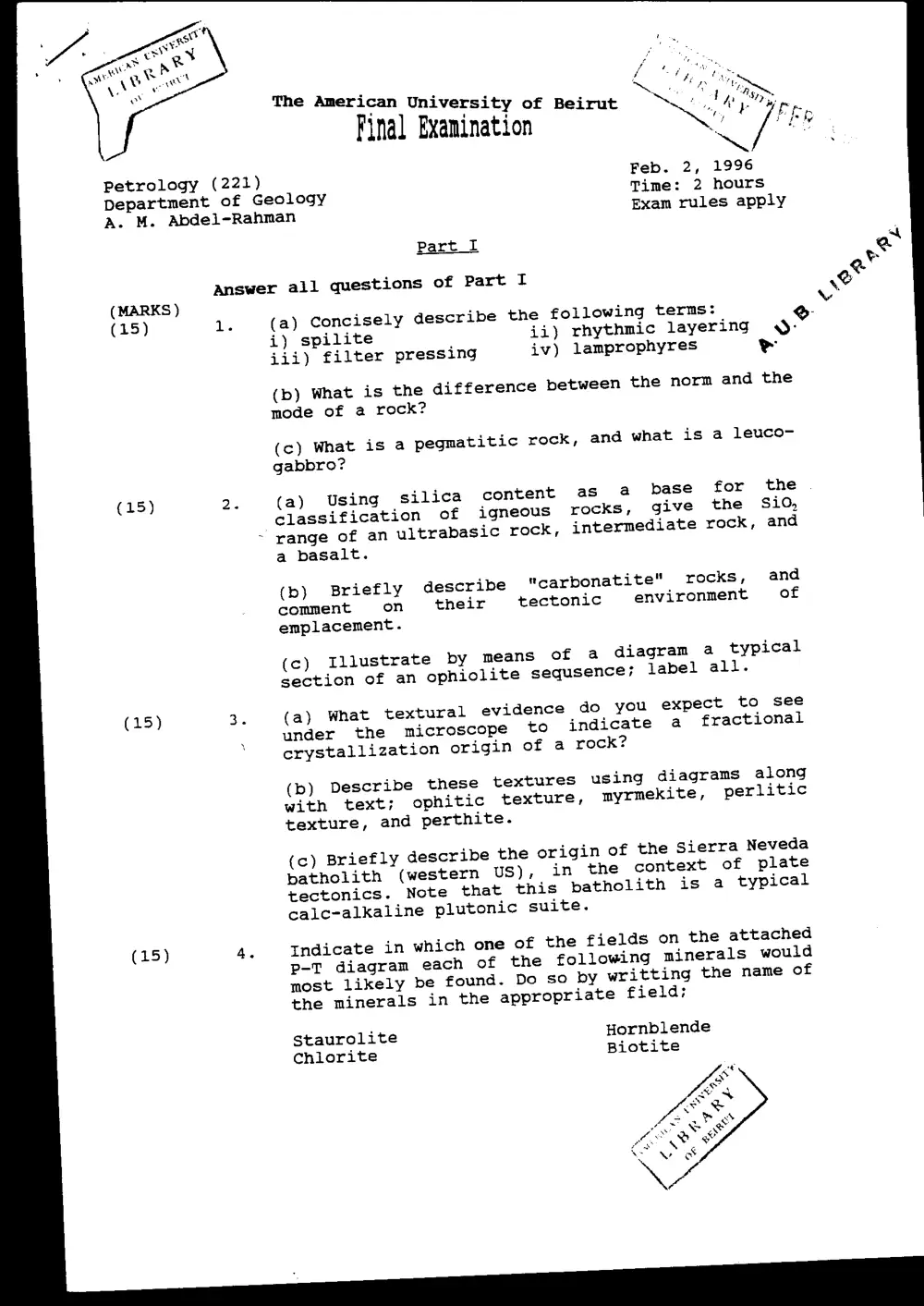
The Ameri i F ms :
erican University of Beirut ae a
ia PRp
Final Examination "
NN
Petrology (221) Feb. 2, 1996
Department of Geology Time: 2 hours
A. M. Abdel-Rahman Exam rules apply
Part I
@Q@
Answer ail questions of Part I @
x
(MARKS )
(15) 1. (a) Concisely describe the following terms: 2
i) spilite ii) rhythmic layering :-
iii) filter pressing iv) lamprophyres e
(b) What is the difference between the norm and the
mode of a rock?
(c) What is a pegmatitic rock, and what is a leuco-
gabbro?
Using silica content as a _ base for the
igneous rocks, give the SiO,
intermediate rock, and
(15) 2. (a)
classification of
~ range of an ultrabasic rock,
a basalt.
"carbonatite" rocks, and
(b) Briefly describe
environment of
comment on their tectonic
emplacement.
gram a typical
(c) Illustrate by means of a dia
label all.
section of an ophiolite sequsence;
(15) 3. (a) What textural evidence do you expect to see
under the microscope to indicate a fractional
crystallization origin of a rock?
ing diagrams along
(b) Describe these textures us
perlitic
with text; ophitic texture, myrmekite,
texture, and perthite.
rigin of the Sierra Neveda
batholith (western us), in the context of plate
tectonics. Note that this batholith is a typical
calc-alkaline plutonic suite.
(c) Briefly describe the o
ne of the fields on the attached
(15) 4. Indicate in which o
P-T diagram each of the following minerals would
most likely be found. Do so py writting the name of
the minerals in the appropriate field;
Hornblende
Staurolite
Biotite
chlorite
Actinolite Hypersthene
Glaucophane Plagioclase (An 25)
Epidote Andalusite
Wollastonite Almandine
Albite Prehnite
Diopside Tale
(a) Define the so-called "metamorphic facies".
(b) The muscovite breakdown reaction is an
important reaction occurring at the boundary
between the amphibolite~, and the granulite facies:
write this reaction.
(c) What is meant by the term "skarn", and by the
term "migmatite".
(d) How does the An content of plagioclase vary with
increasing grade of metamorphism.
(a) Write a metamorphic reaction that occurs at the
boundary between greenschist-, and amphibolite
facies.
(b) Name two minerals that are most characteristic
of the low pressure part of the amphibolite facies,
and another two most characteristic of the high
pressure part of the same facies.
(c) Do you expect to find a special type of slate
produced as a result of metamorphism within
the granulite facies conditions? Why?
Part II
Answer only two out of three questions in Part II
7. Use the phase diagram given below to; i) Describe
the crystallization path of a melt of composition
"a", and ii) Describe the melting path of a rock of
composition "y", and name such a rock.
2100
(7)
Two liquids
qa
|
!
!
[
|
|
{
i
|
I
i \
i \
H \
i a
i \
t \
! \
\ W713 + $°
Enstatite
| Liquid + i\ + liquid 1695 + Se
forsterite | \
| | Cristobalite + liquid
d
Temperature, °C
L |
; jb 1543 + 2°
1557 + 2°) © - "i
| Enstatite + cristobalite
je { o
Forsterite | 1470 + 10
+ enstatite!
1400 i +
Mg:SiO, mgsio, © Y¥) SiO2
{Forsterite) (Enstatite) {Cristobalite,
tridymite)
4
Enstatite + tridymite
(10)
(10)
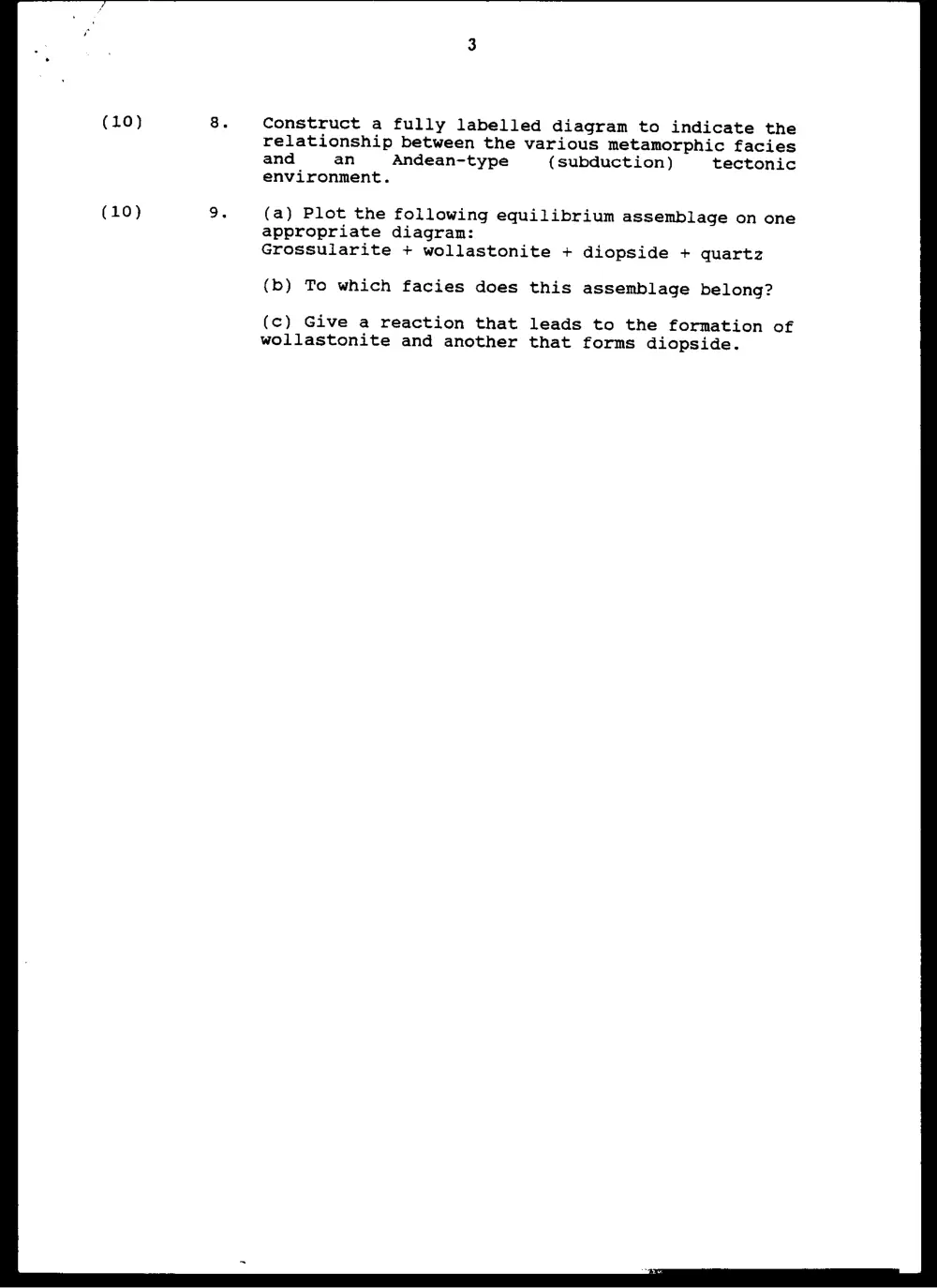
Construct a fully labelled diagram to indicate the
relationship between the various metamorphic facies
and an Andean-type (subduction) tectonic
environment.
(a) Plot the following equilibrium assemblage on one
appropriate diagran:
Grossularite + wollastonite + diopside + quartz
(b) To which facies does this assemblage belong?
(c) Give a reaction that leads to the formation of
wollastonite and another that forms diopside.