
GEOL 305 Final, Fall 1997
American University of Beirut · Geophysics II · 6 pages


More GEOL 305 files
Show the text of this final exam
’ ny .
i AN TUN Rsey
j LIBRARY AMERICAN UNIVERSITY OF BEIRUT
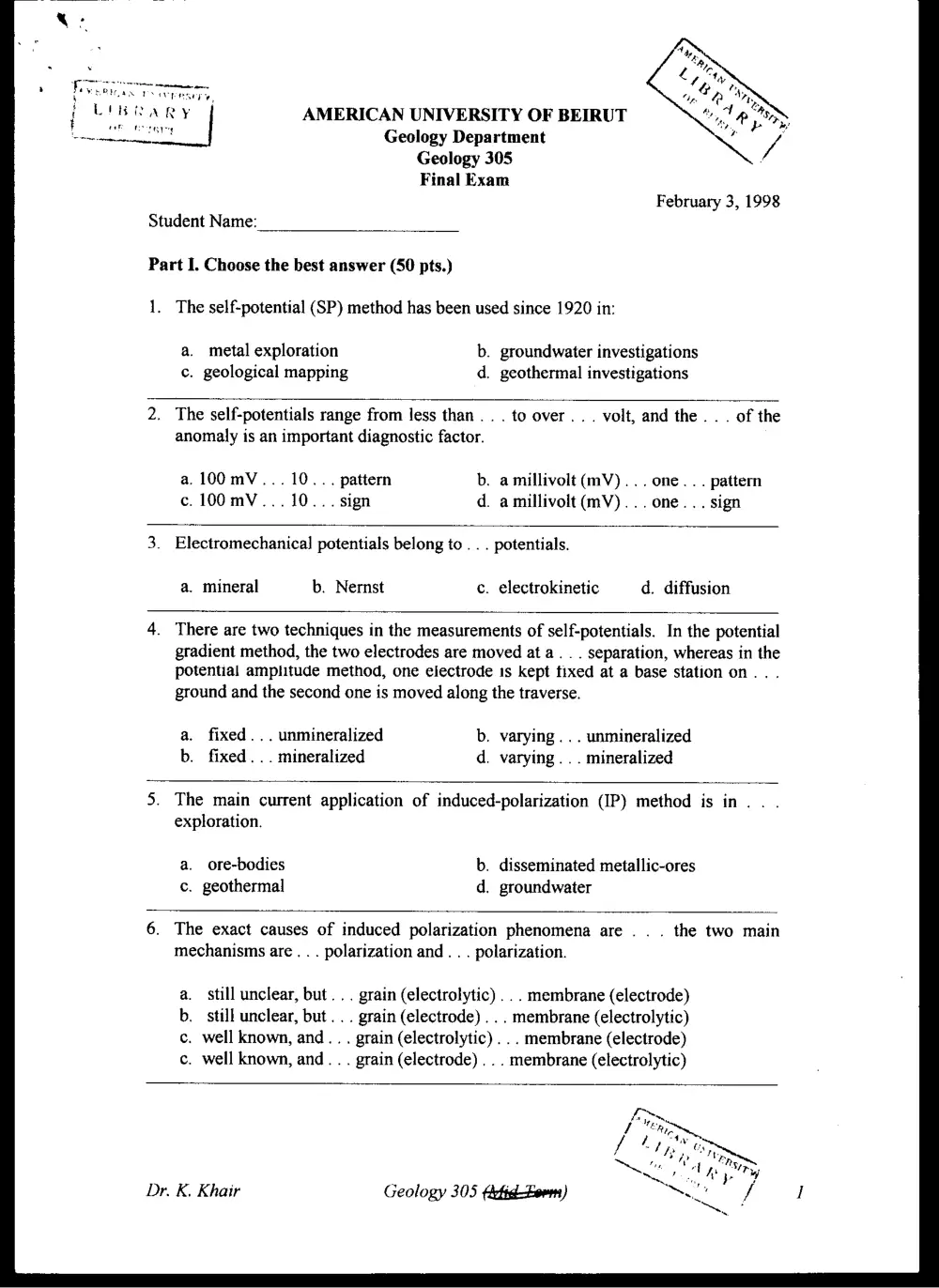
Ineo! Geology Department
Geology 305
Final Exam
February 3, 1998
Student Name:
Part I. Choose the best answer (50 pts.)
1. The self-potential (SP) method has been used since 1920 in:
a. metal exploration b. groundwater investigations
c. geological mapping d. geothermal investigations
2. The self-potentials range from less than... to over... volt, and the . . . of the
anomaly is an important diagnostic factor.
a. 100mV...10... pattern b. amillivolt (mV)... one... pattern
c.100mV... 10... sign d. a millivolt (mV)... one... sign
3. Electromechanical potentials belong to . . . potentials.
a. mineral b. Nernst c. electrokinetic d. diffusion
4. There are two techniques in the measurements of self-potentials. In the potential
gradient method, the two electrodes are moved at a. . . separation, whereas in the
potential amplitude method, one electrode 1s kept tixed at a base station on...
ground and the second one is moved along the traverse.
a. fixed... unmineralized b. varying... unmineralized
b. fixed... mineralized d. varying... mineralized
5. The main current application of induced-polarization (IP) method is in. . .
exploration.
a. ore-bodies b. disseminated metallic-ores
c. geothermal d. groundwater
6. The exact causes of induced polarization phenomena are .. . the two main
mechanisms are . . . polarization and . . . polarization.
a. still unclear, but . . . grain (electrolytic) . .. membrane (electrode)
b. still unclear, but... grain (electrode) . .. membrane (electrolytic)
c. well known, and... grain (electrolytic)... membrane (electrode)
c. well known, and... grain (electrode) . .. membrane (electrolytic)
Dr. K. Khair Geology 305 tkefid—Eown)
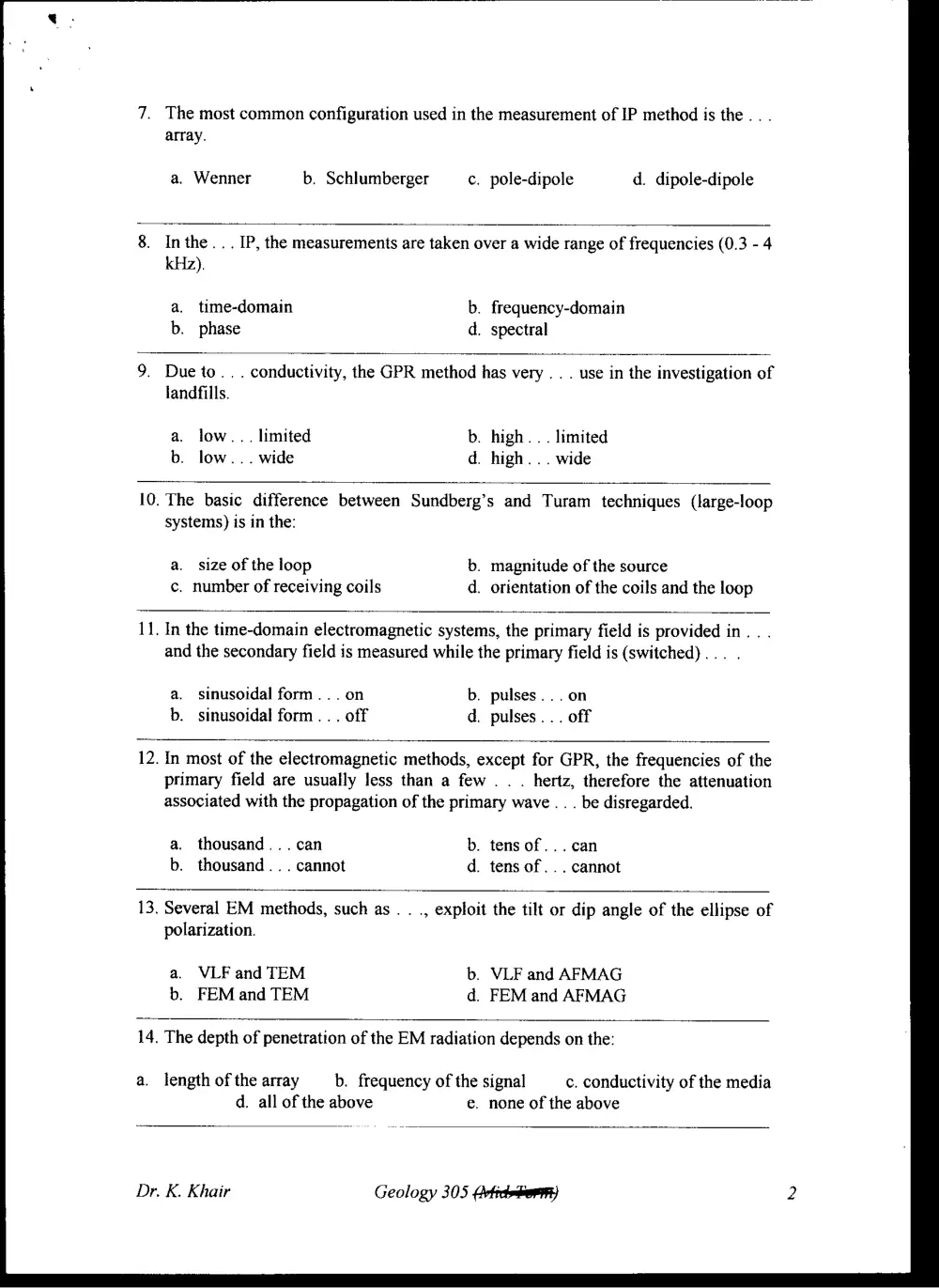
7. The most common configuration used in the measurement of IP method is the . . .
array.
a. Wenner b. Schlumberger c. pole-dipole d. dipole-dipole
8. Inthe... IP, the measurements are taken over a wide range of frequencies (0.3 - 4
kHz).
a. time-domain b. frequency-domain
b. phase d. spectral
9. Due to... conductivity, the GPR method has very . . . use in the investigation of
landfills.
a. low... limited b. high... limited
b. low... wide d. high... wide
10. The basic difference between Sundberg’s and Turam techniques (large-loop
systems) is in the:
a. size of the loop b. magnitude of the source
c. number of receiving coils d. orientation of the coils and the loop
11. In the time-domain electromagnetic systems, the primary field is provided in. . .
and the secondary field is measured while the primary field is (switched)... .
a. sinusoidal form... on b. pulses... on
b. sinusoidal form . . . off d. pulses... off
12. In most of the electromagnetic methods, except for GPR, the frequencies of the
primary field are usually less than a few . . . hertz, therefore the attenuation
associated with the propagation of the primary wave .. . be disregarded.
a. thousand... can b. tens of... can
b. thousand... cannot d. tens of... cannot
13. Several EM methods, such as . . ., exploit the tilt or dip angle of the ellipse of
polarization.
a. VLF and TEM b. VLF and AFMAG
b. FEM and TEM d. FEM and AFMAG
14. The depth of penetration of the EM radiation depends on the:
a. length of the array b. frequency of the signal c. conductivity of the media
d. all of the above e. none of the above
Dr. K. Khair Geology 305 (vtrdsderr) 2
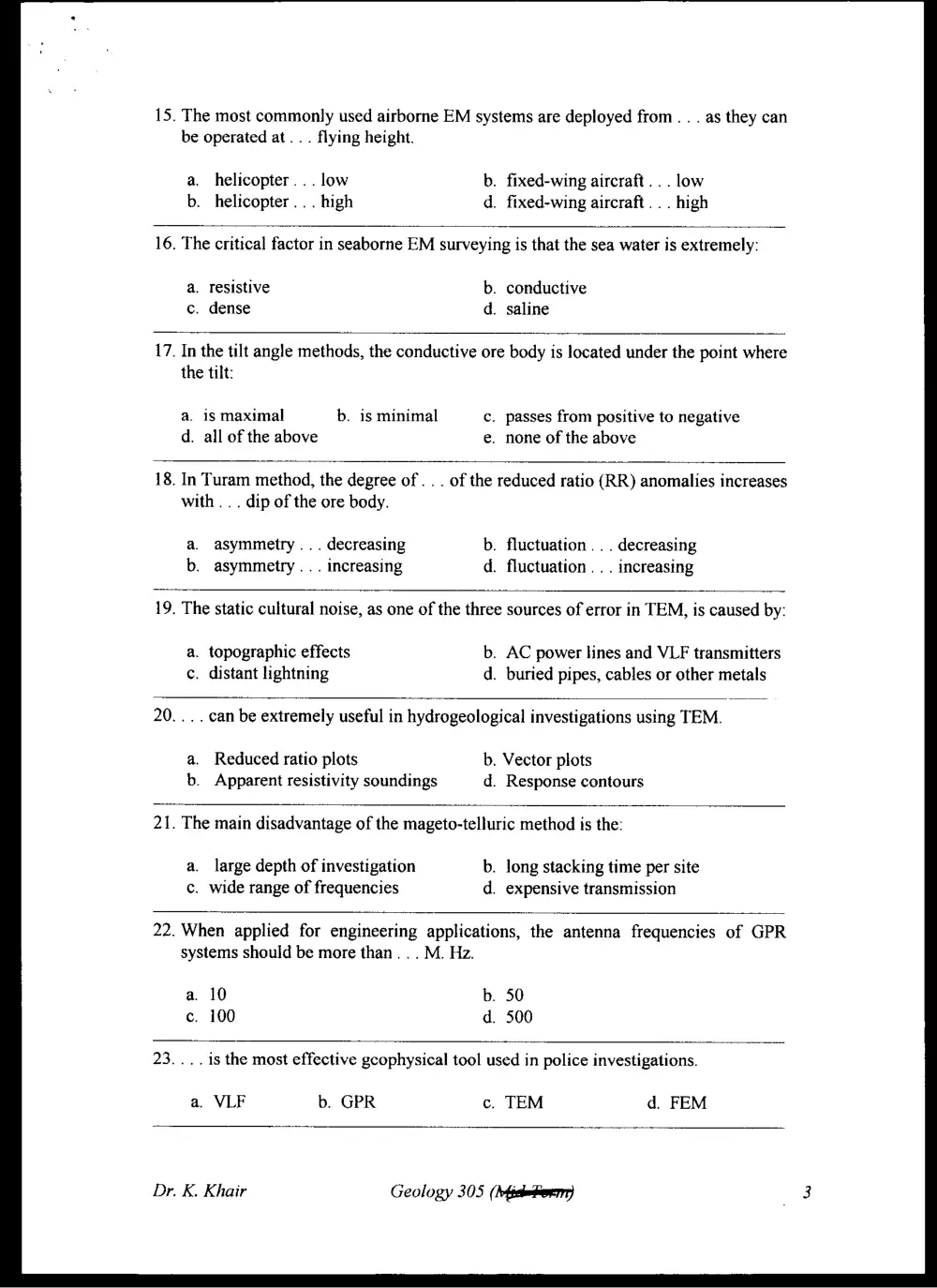
15. The most commonly used airborne EM systems are deployed from . . . as they can
be operated at. . . flying height.
a. helicopter... low b. fixed-wing aircraft... low
b. helicopter... high d. fixed-wing aircraft... high
16. The critical factor in seaborne EM surveying is that the sea water is extremely:
a. resistive b. conductive
c. dense d. saline
17. In the tilt angle methods, the conductive ore body is located under the point where
the tilt:
a. is maximal b. is minimal c. passes from positive to negative
d. all of the above e. none of the above
18. In Turam method, the degree of . . . of the reduced ratio (RR) anomalies increases
with . . . dip of the ore body.
a. asymmetry... decreasing b. fluctuation... decreasing
b. asymmetry ... increasing d. fluctuation . . . increasing
19. The static cultural noise, as one of the three sources of error in TEM, is caused by:
a. topographic effects b. AC power lines and VLF transmitters
c, distant lightning d. buried pipes, cables or other metals
20. .. . can be extremely useful in hydrogeological investigations using TEM.
a. Reduced ratio plots b. Vector plots
b. Apparent resistivity soundings d. Response contours
21. The main disadvantage of the mageto-telluric method is the:
a. large depth of investigation b. long stacking time per site
c. wide range of frequencies d. expensive transmission
22. When applied for engineering applications, the antenna frequencies of GPR
systems should be more than. . . M. Hz.
a. 10 b. 50
c. 100 d. 500
23... . is the most effective geophysical tool used in police investigations.
a. VLF b. GPR c. TEM d, FEM
Dr. K. Khair Geology 305 (hfebetieerr
24, The downgoing signal of radiowave propagating in a cone of radiation influences .
. . resolution.
a. vertical b. horizontal
c. vertical and horizontal d. none of them
25. In... deployement of GPR, the transmitter and receiver are on opposite sides of
the medium under investigation.
a. transillumination b. wide-angle reflection and refraction
c. common mid-point sounding d. radar reflection profiling
Part II. Answer only five of the following seven questions (50 pts.)
1. Discuss the basis for the usage of SP method in two of the following applications:
geothermal, location of massive sulphide ore bodies, hydrogeology, landfills, leak
detection within embankments; draw diagrams if necessary.
2. Discuss the forms of display of IP data (time-domain and frequency-domain),
draw diagrams.
Describe the large-loop systems and draw their layouts, draw diagrams.
Discuss the principles of operation of the very-low-frequency (VLF) method.
5. Using the shown figure (Fig. 1), explain the relationship between induced voltages
and associated phase lags of different magnetic fields.
ewe
(A)
(B)
()
(D)
Figure 1
Dr. K. Khair Geology 305 @udka=Pere:)
6. The phasor diagram (Fig. 2) is the plot of an EM sounding method. Name and
explain this method, and how the diagram is interpreted.
In-phase (%)
T T T
-20 +10
28 160
\
Frequency (Hz)
Quadrature (%)}
Figure 2
Dr. K. Khair Geology 305-Arigeisiiionmn)
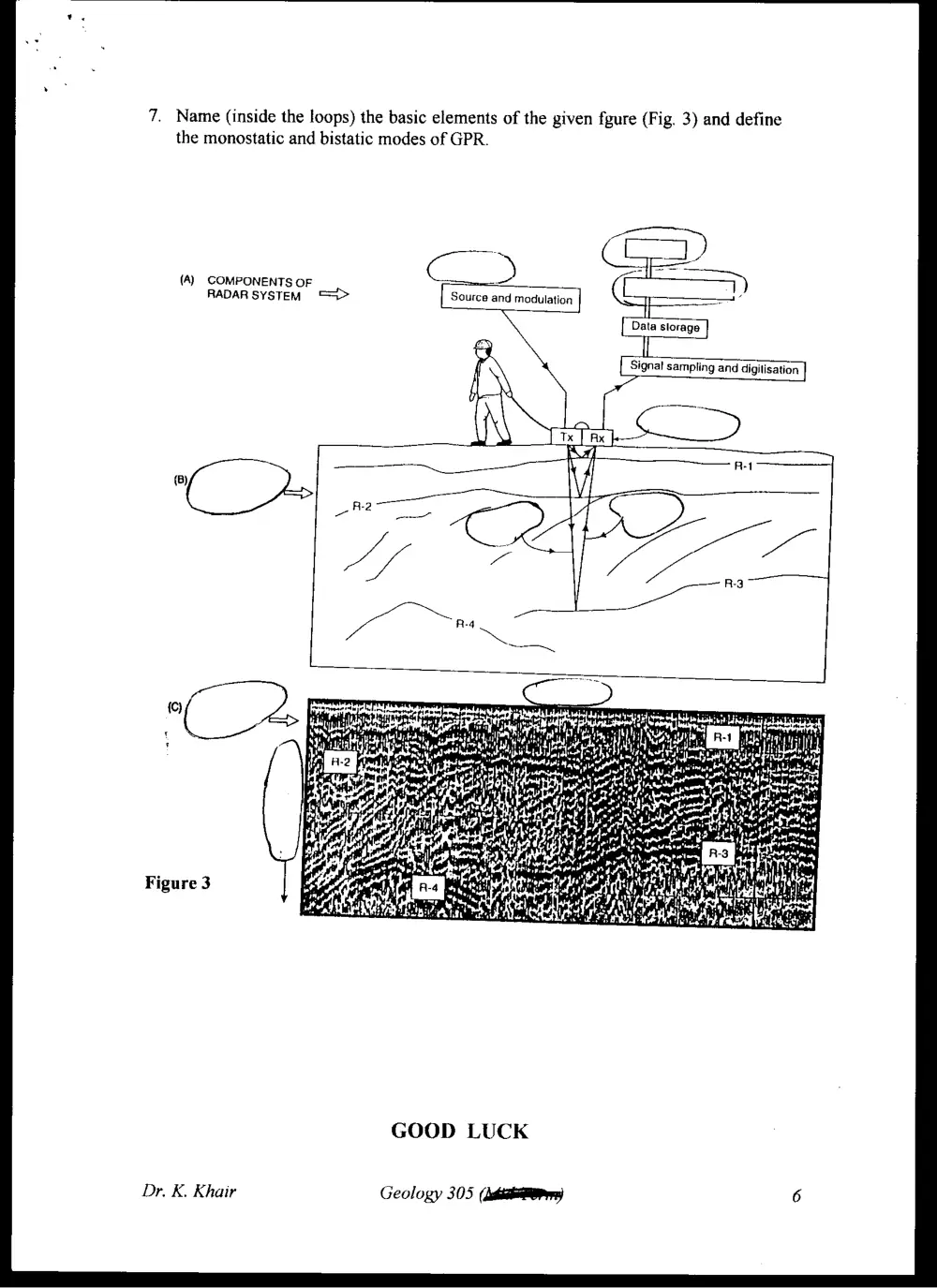
7. Name (inside the loops) the basic elements of the given fgure (Fig. 3) and define
the monostatic and bistatic modes of GPR.
(A) COMPONENTS OF C » ( - —)
RADAR SYSTEM “> Source and modulation
Data storage
Signal sampling and digilisation
es
Re1
bce EH
1 eat sp eietts
San a Naihe
GOOD LUCK
Dr. K. Khair Geology 305 (hiebaaPrrs)