
GEOL 310 Final, Fall 2005
American University of Beirut · Global Tectonics · 3 pages


Show the text of this final exam
1
The American University of Beirut
Department of Geology
Global Tectonics (Geol 310)
Fall 2005-2006: Final Examination
Dr. Maya El-Kibbi
Time: 3 hours
Pledge
Exam rules apply.
I. - Based on the diagrams below, compare proposed driving mechanisms of plate tectonics. (12 pts)
- Which mechanism appears to be more significant today? Defend your answer. (8 pts)
2
II.
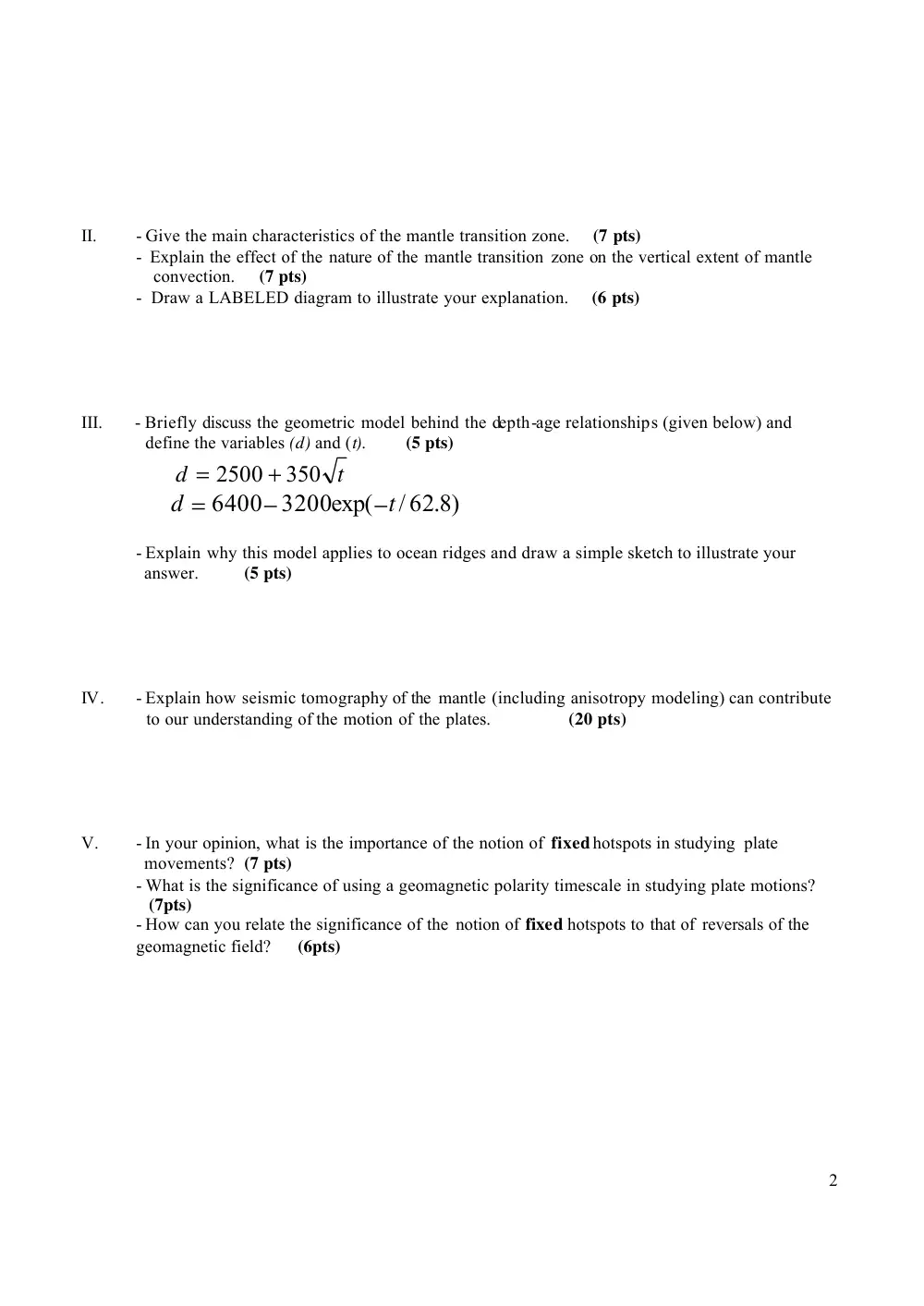
- Give the main characteristics of the mantle transition zone. (7 pts)
- Explain the effect of the nature of the mantle transition zone on the vertical extent of mantle
convection. (7 pts)
- Draw a LABELED diagram to illustrate your explanation. (6 pts)
III. - Briefly discuss the geometric model behind the depth-age relationships (given below) and
define the variables (d) and (t).
(5 pts)
t
d
= 2500 + 350
/ 62 8. )
6400 3200exp(
t
d
−
−
=
- Explain why this model applies to ocean ridges and draw a simple sketch to illustrate your
answer.
(5 pts)
IV.
- Explain how seismic tomography of the mantle (including anisotropy modeling) can contribute
to our understanding of the motion of the plates.
(20 pts)
V.
- In your opinion, what is the importance of the notion of fixed hotspots in studying plate
movements? (7 pts)
- What is the significance of using a geomagnetic polarity timescale in studying plate motions?
(7pts)
- How can you relate the significance of the notion of fixed hotspots to that of reversals of the
geomagnetic field?
(6pts)
3
VI.
Consider the figure below:
(10 pts)
- Using graph paper, draw a velocity vector diagram showing the configuration of the plates.
-
Calculate the relative motion between plates A and B.
-
Draw arrows at each plate boundary to show motion of each plate relative to the other.
-
Analyze the stability of the triple junction. Label the velocity lines.