
HIST 201 Final, Fall 1995
American University of Beirut · Introduction to the Study of History · 1 page
Stuck on a question? A tutor can walk you through it.
Show the text of this final exam
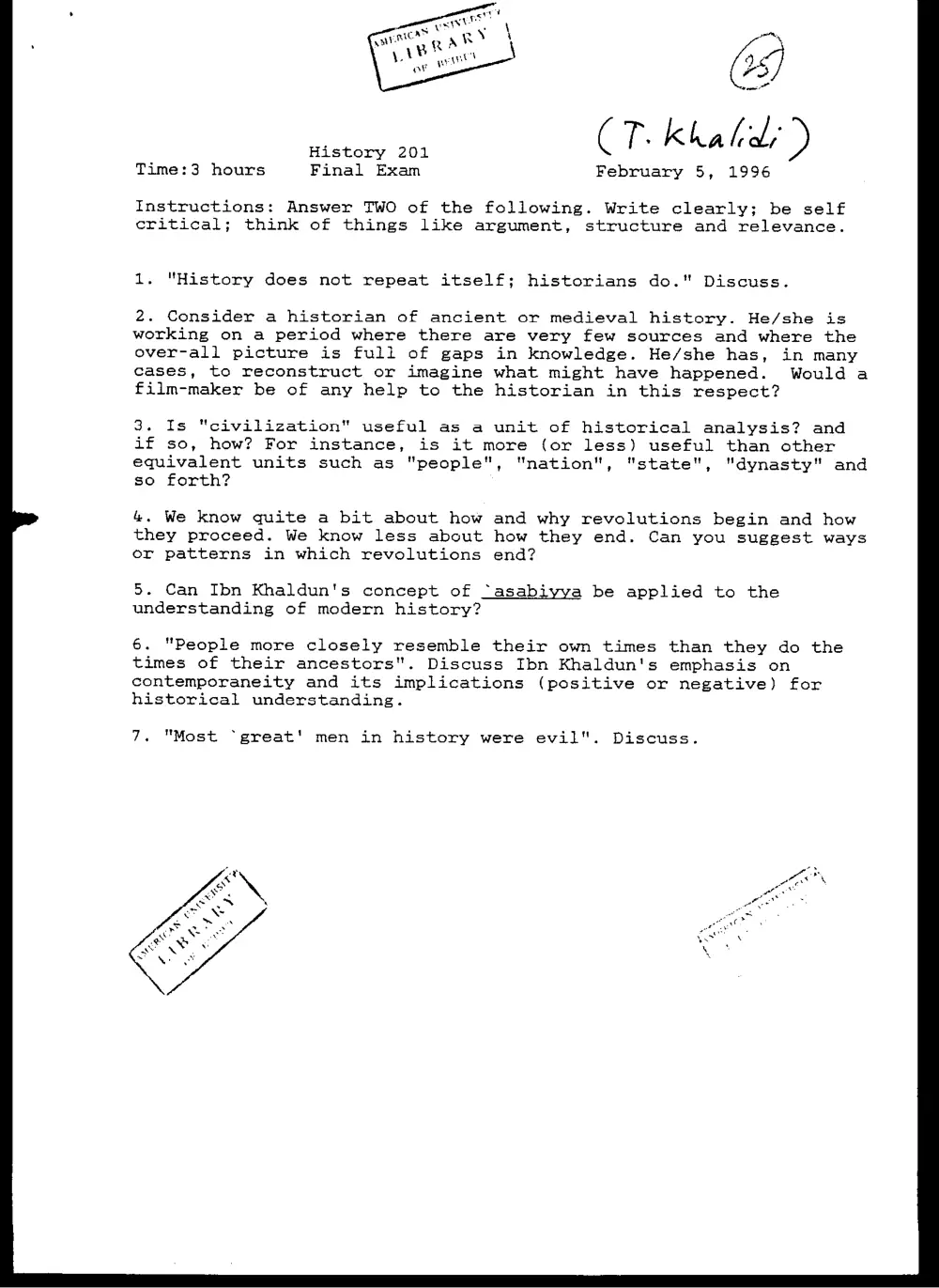
History 201 C r. khalaly )
Time:3 hours Final Exam February 5, 1996
Instructions: Answer TWO of the following. Write clearly; be self
critical; think of things like argument, structure and relevance.
1. "History does not repeat itself; historians do." Discuss.
2. Consider a historian of ancient or medieval history. He/she is
working on a period where there are very few sources and where the
over-all picture is full of gaps in knowledge. He/she has, in many
cases, to reconstruct or imagine what might have happened. Would a
film-maker be of any help to the historian in this respect?
3. Is "civilization" useful as a unit of historical analysis? and
if so, how? For instance, is it more (or less) useful than other
equivalent units such as "people", "nation", "state", "dynasty" and
so forth?
&. We know quite a bit about how and why revolutions begin and how
they proceed. We know less about how they end. Can you suggest ways
or patterns in which revolutions end?
5. Can Ibn Khaldun's concept of “asabiyya be applied to the
understanding of modern history?
6. "People more closely resemble their own times than they do the
times of their ancestors". Discuss Ibn Khaldun's emphasis on
contemporaneity and its implications (positive or negative) for
historical understanding.
7. "Most ‘great' men in history were evil". Discuss.