
HIST 242 Final, Fall 2007
American University of Beirut · A Social History of the Modern Middle East - 1800-1980 · 2 pages
Show the text of this final exam
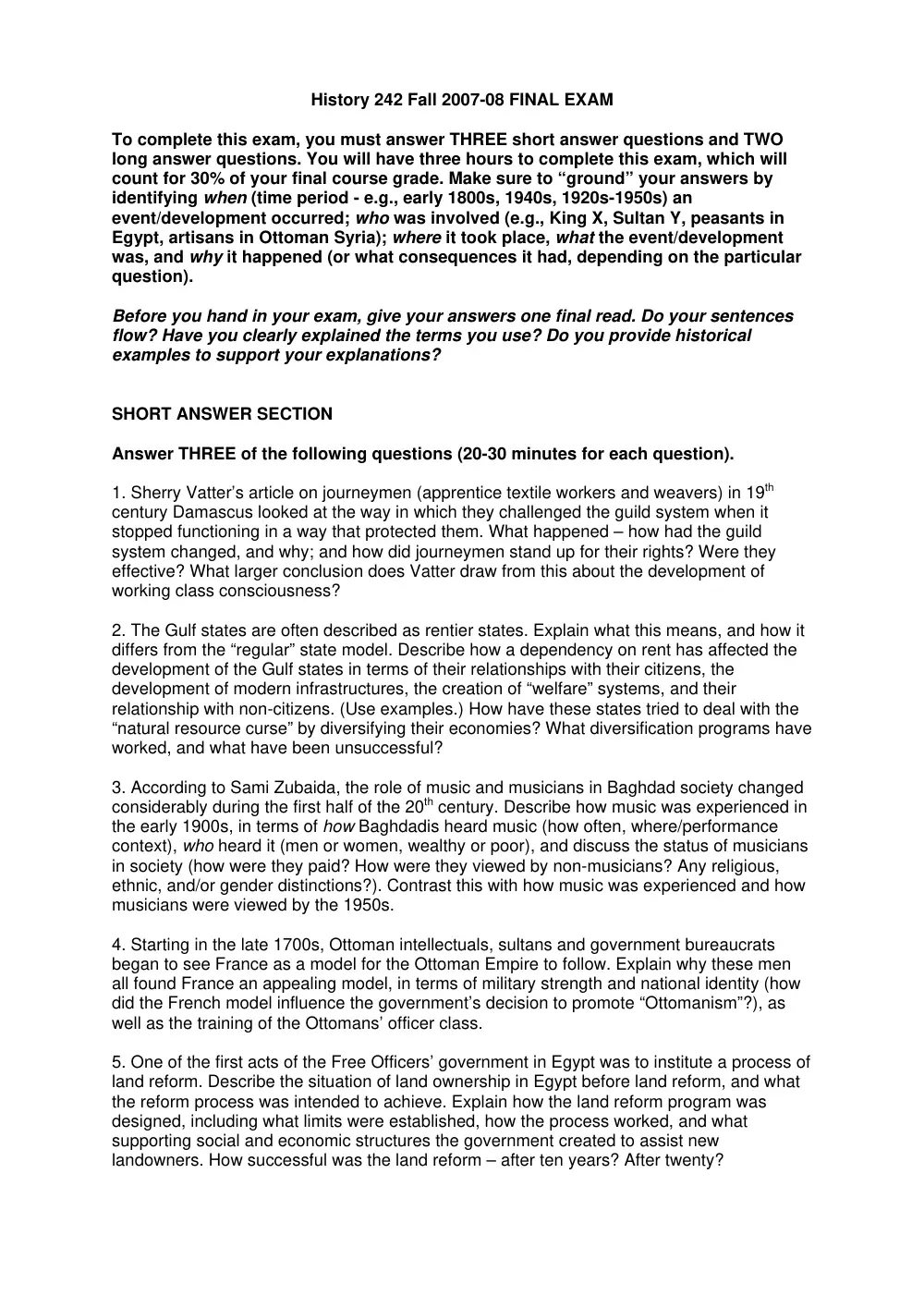
History 242 Fall 2007-08 FINAL EXAM
To complete this exam, you must answer THREE short answer questions and TWO
long answer questions. You will have three hours to complete this exam, which will
count for 30% of your final course grade. Make sure to “ground” your answers by
identifying when (time period - e.g., early 1800s, 1940s, 1920s-1950s) an
event/development occurred; who was involved (e.g., King X, Sultan Y, peasants in
Egypt, artisans in Ottoman Syria); where it took place, what the event/development
was, and why it happened (or what consequences it had, depending on the particular
question).
Before you hand in your exam, give your answers one final read. Do your sentences
flow? Have you clearly explained the terms you use? Do you provide historical
examples to support your explanations?
SHORT ANSWER SECTION
Answer THREE of the following questions (20-30 minutes for each question).
1. Sherry Vatter’s article on journeymen (apprentice textile workers and weavers) in 19th
century Damascus looked at the way in which they challenged the guild system when it
stopped functioning in a way that protected them. What happened – how had the guild
system changed, and why; and how did journeymen stand up for their rights? Were they
effective? What larger conclusion does Vatter draw from this about the development of
working class consciousness?
2. The Gulf states are often described as rentier states. Explain what this means, and how it
differs from the “regular” state model. Describe how a dependency on rent has affected the
development of the Gulf states in terms of their relationships with their citizens, the
development of modern infrastructures, the creation of “welfare” systems, and their
relationship with non-citizens. (Use examples.) How have these states tried to deal with the
“natural resource curse” by diversifying their economies? What diversification programs have
worked, and what have been unsuccessful?
3. According to Sami Zubaida, the role of music and musicians in Baghdad society changed
considerably during the first half of the 20th century. Describe how music was experienced in
the early 1900s, in terms of how Baghdadis heard music (how often, where/performance
context), who heard it (men or women, wealthy or poor), and discuss the status of musicians
in society (how were they paid? How were they viewed by non-musicians? Any religious,
ethnic, and/or gender distinctions?). Contrast this with how music was experienced and how
musicians were viewed by the 1950s.
4. Starting in the late 1700s, Ottoman intellectuals, sultans and government bureaucrats
began to see France as a model for the Ottoman Empire to follow. Explain why these men
all found France an appealing model, in terms of military strength and national identity (how
did the French model influence the government’s decision to promote “Ottomanism”?), as
well as the training of the Ottomans’ officer class.
5. One of the first acts of the Free Officers’ government in Egypt was to institute a process of
land reform. Describe the situation of land ownership in Egypt before land reform, and what
the reform process was intended to achieve. Explain how the land reform program was
designed, including what limits were established, how the process worked, and what
supporting social and economic structures the government created to assist new
landowners. How successful was the land reform – after ten years? After twenty?
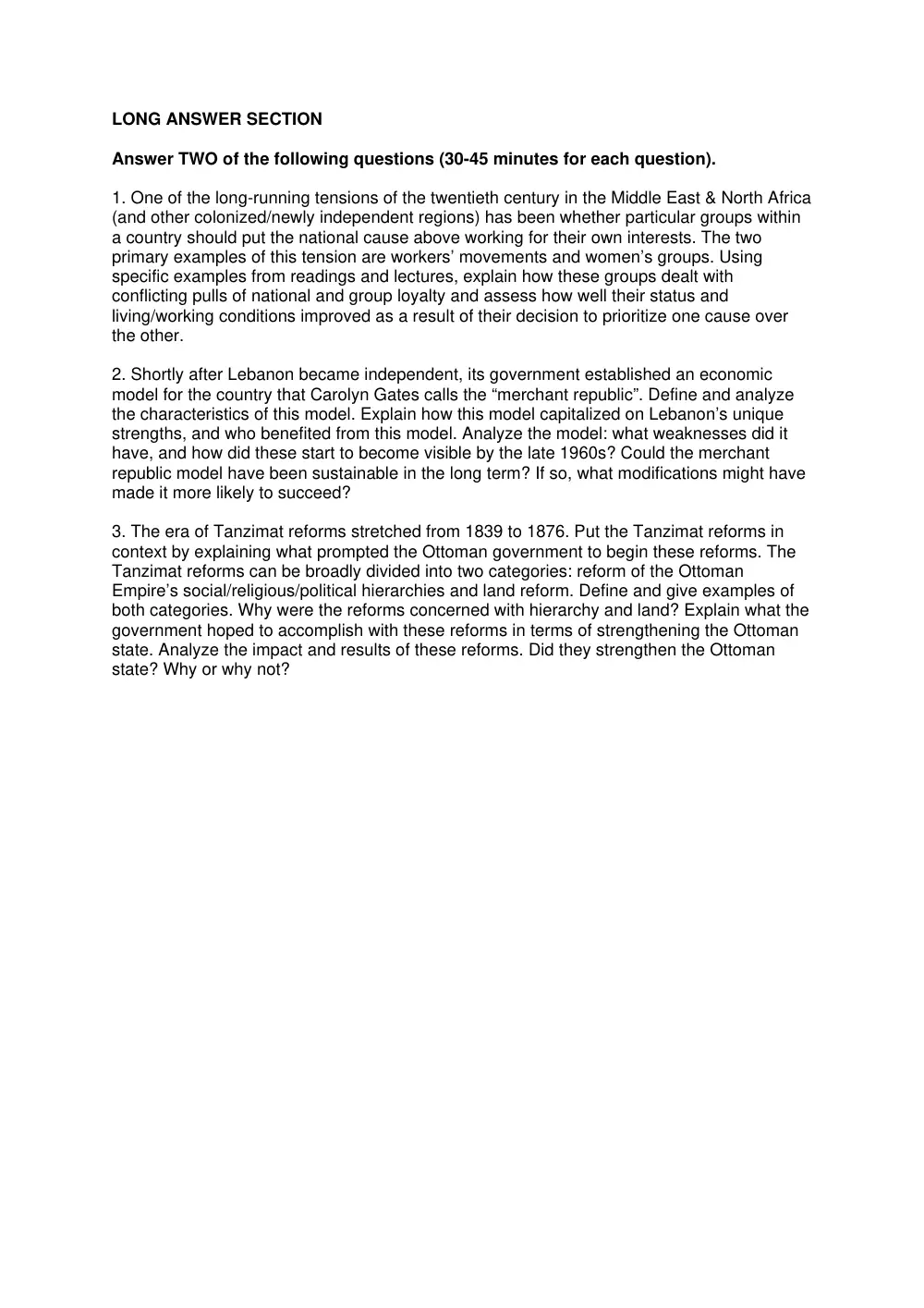
LONG ANSWER SECTION
Answer TWO of the following questions (30-45 minutes for each question).
1. One of the long-running tensions of the twentieth century in the Middle East & North Africa
(and other colonized/newly independent regions) has been whether particular groups within
a country should put the national cause above working for their own interests. The two
primary examples of this tension are workers’ movements and women’s groups. Using
specific examples from readings and lectures, explain how these groups dealt with
conflicting pulls of national and group loyalty and assess how well their status and
living/working conditions improved as a result of their decision to prioritize one cause over
the other.
2. Shortly after Lebanon became independent, its government established an economic
model for the country that Carolyn Gates calls the “merchant republic”. Define and analyze
the characteristics of this model. Explain how this model capitalized on Lebanon’s unique
strengths, and who benefited from this model. Analyze the model: what weaknesses did it
have, and how did these start to become visible by the late 1960s? Could the merchant
republic model have been sustainable in the long term? If so, what modifications might have
made it more likely to succeed?
3. The era of Tanzimat reforms stretched from 1839 to 1876. Put the Tanzimat reforms in
context by explaining what prompted the Ottoman government to begin these reforms. The
Tanzimat reforms can be broadly divided into two categories: reform of the Ottoman
Empire’s social/religious/political hierarchies and land reform. Define and give examples of
both categories. Why were the reforms concerned with hierarchy and land? Explain what the
government hoped to accomplish with these reforms in terms of strengthening the Ottoman
state. Analyze the impact and results of these reforms. Did they strengthen the Ottoman
state? Why or why not?