
HIST 251 Final, Fall 2007
American University of Beirut · History of North Africa and Spain in the Middle Ages · 11 pages
Showing the first 10 of 11 pages. Download the PDF to see all of it.
More HIST 251 files
Show the text of this final exam
AMERICAN UNIVERSITY OF BEIRUT
Faculty of Arts and Sciences
Mathematics Department
MATH 251
FINAL EXAM
FALL 2007-2008
Closed Book, 2 HOURS
WRITE YOUR ANSWERS ON THE QUESTION SHEET
STUDENT NAME
ID NUMBER
Problem
Out of
Grade
1
20
2
10
3
20
4
15
5
25
6
10
TOTAL
100
1
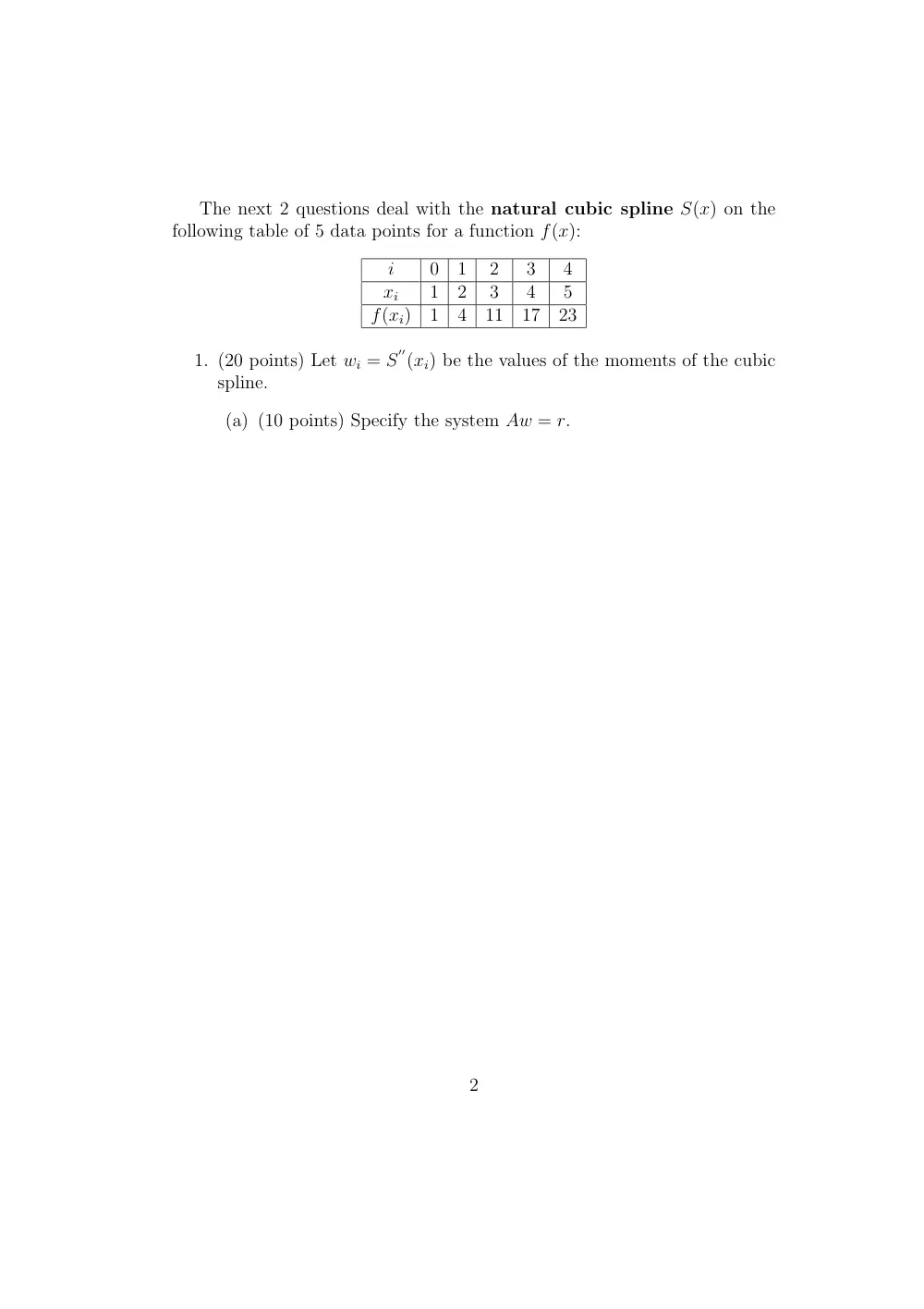
The next 2 questions deal with the natural cubic spline S(x) on the
following table of 5 data points for a function f(x):
i
0
1
2
3
4
xi
1
2
3
4
5
f(xi)
1
4
11
17
23
1. (20 points) Let wi = S
′′(xi) be the values of the moments of the cubic
spline.
(a) (10 points) Specify the system Aw = r.
2
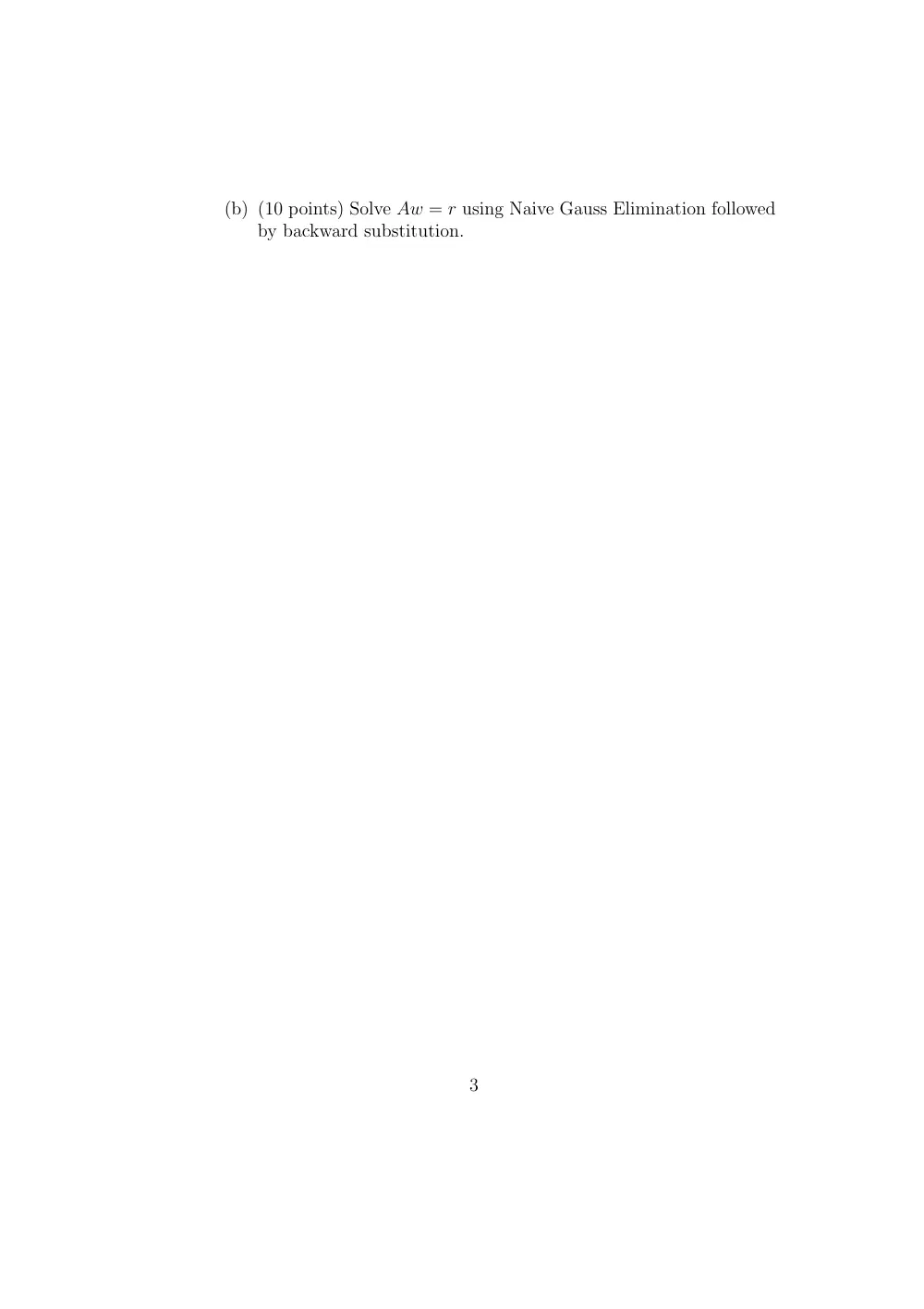
(b) (10 points) Solve Aw = r using Naive Gauss Elimination followed
by backward substitution.
3
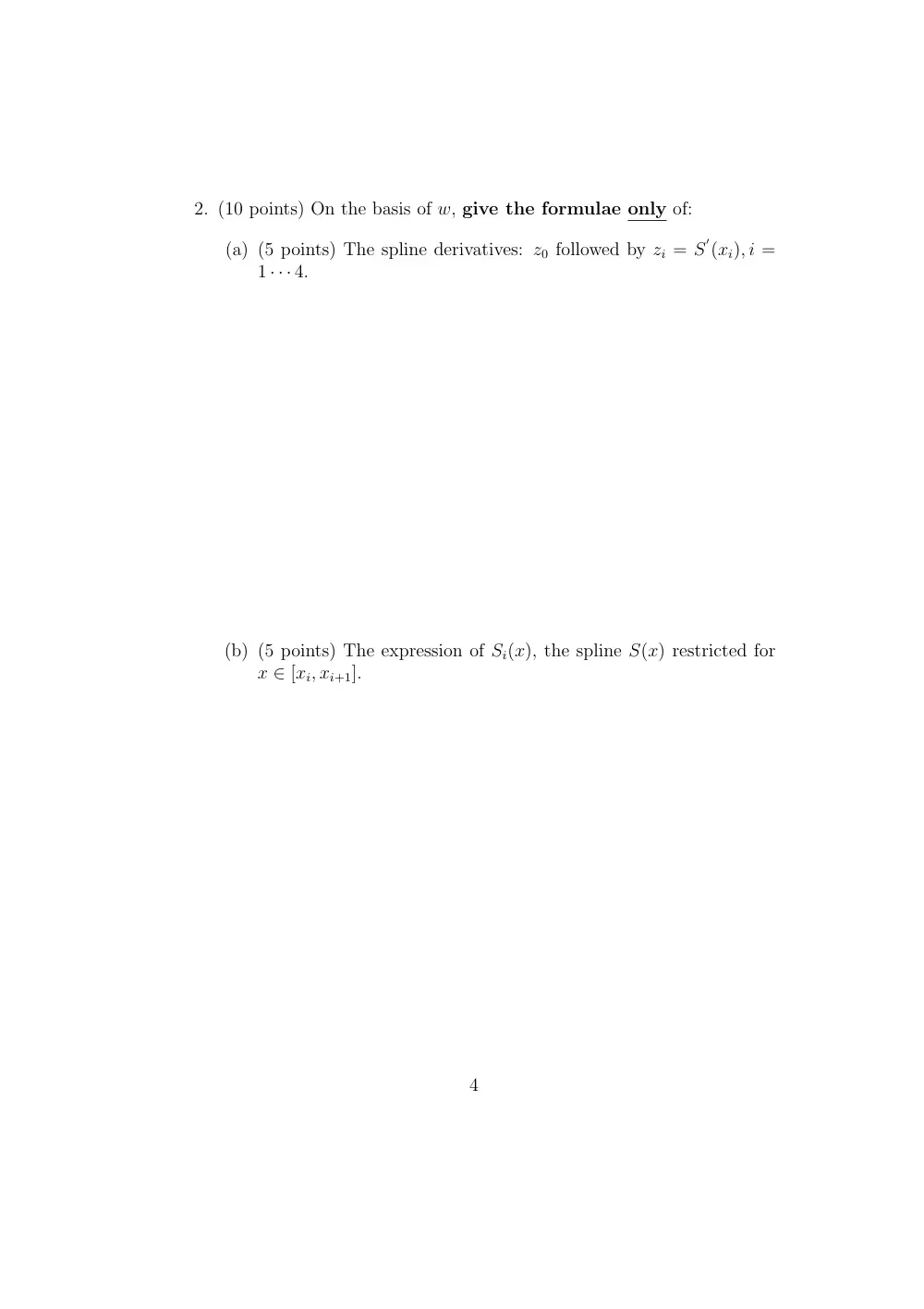
2. (10 points) On the basis of w, give the formulae only of:
(a) (5 points) The spline derivatives: z0 followed by zi = S
′(xi), i =
1 · · · 4.
(b) (5 points) The expression of Si(x), the spline S(x) restricted for
x ∈ [xi, xi+1].
4
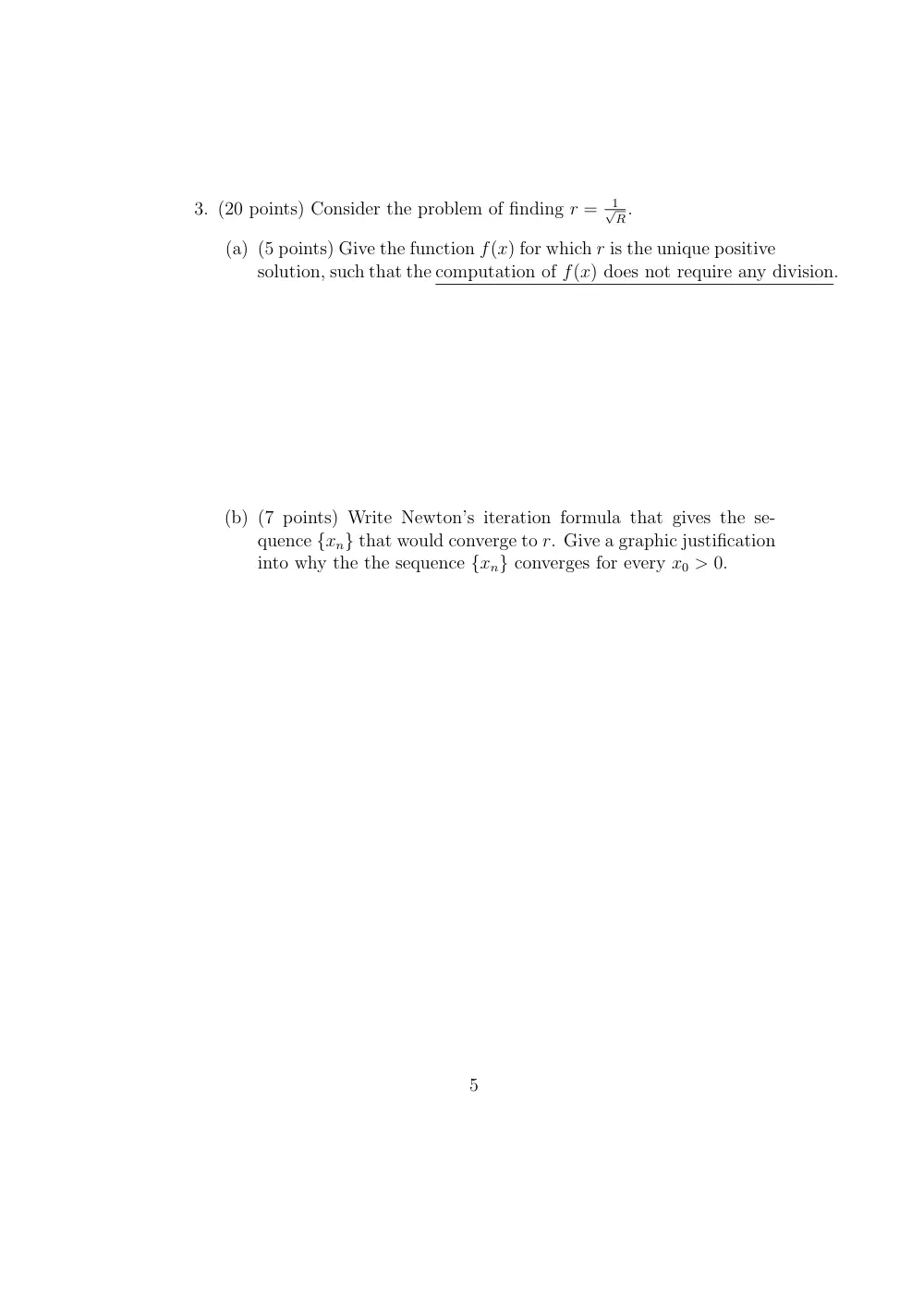
3. (20 points) Consider the problem of finding r =
1
√
R.
(a) (5 points) Give the function f(x) for which r is the unique positive
solution, such that the computation of f(x) does not require any division.
(b) (7 points) Write Newton’s iteration formula that gives the se-
quence {xn} that would converge to r. Give a graphic justification
into why the the sequence {xn} converges for every x0 > 0.
5
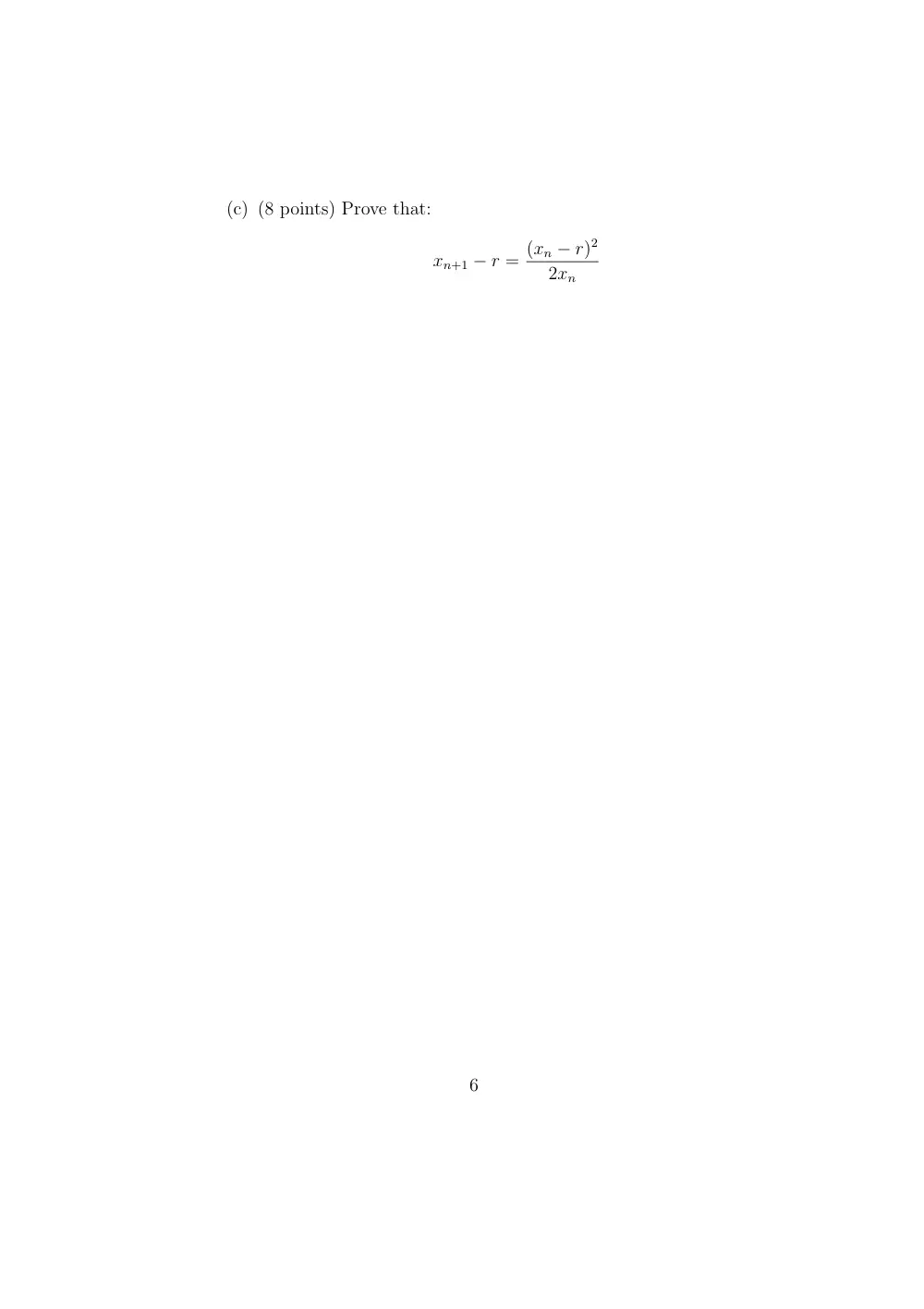
(c) (8 points) Prove that:
xn+1 − r = (xn − r)2
2xn
6
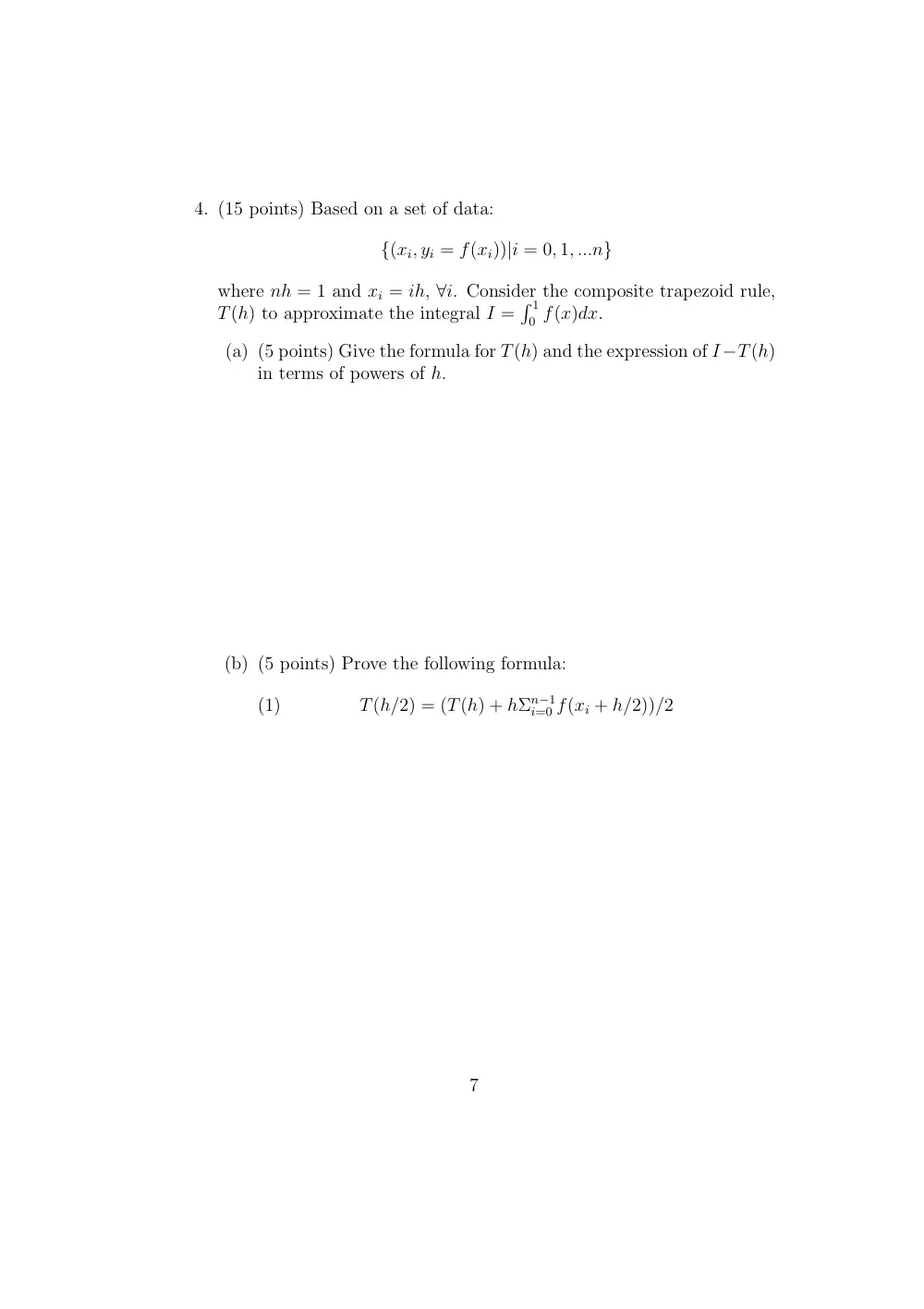
4. (15 points) Based on a set of data:
{(xi, yi = f(xi))|i = 0, 1, ...n}
where nh = 1 and xi = ih, ∀i. Consider the composite trapezoid rule,
T(h) to approximate the integral I =
� 1
0 f(x)dx.
(a) (5 points) Give the formula for T(h) and the expression of I−T(h)
in terms of powers of h.
(b) (5 points) Prove the following formula:
(1)
T(h/2) = (T(h) + hΣn−1
i=0 f(xi + h/2))/2
7
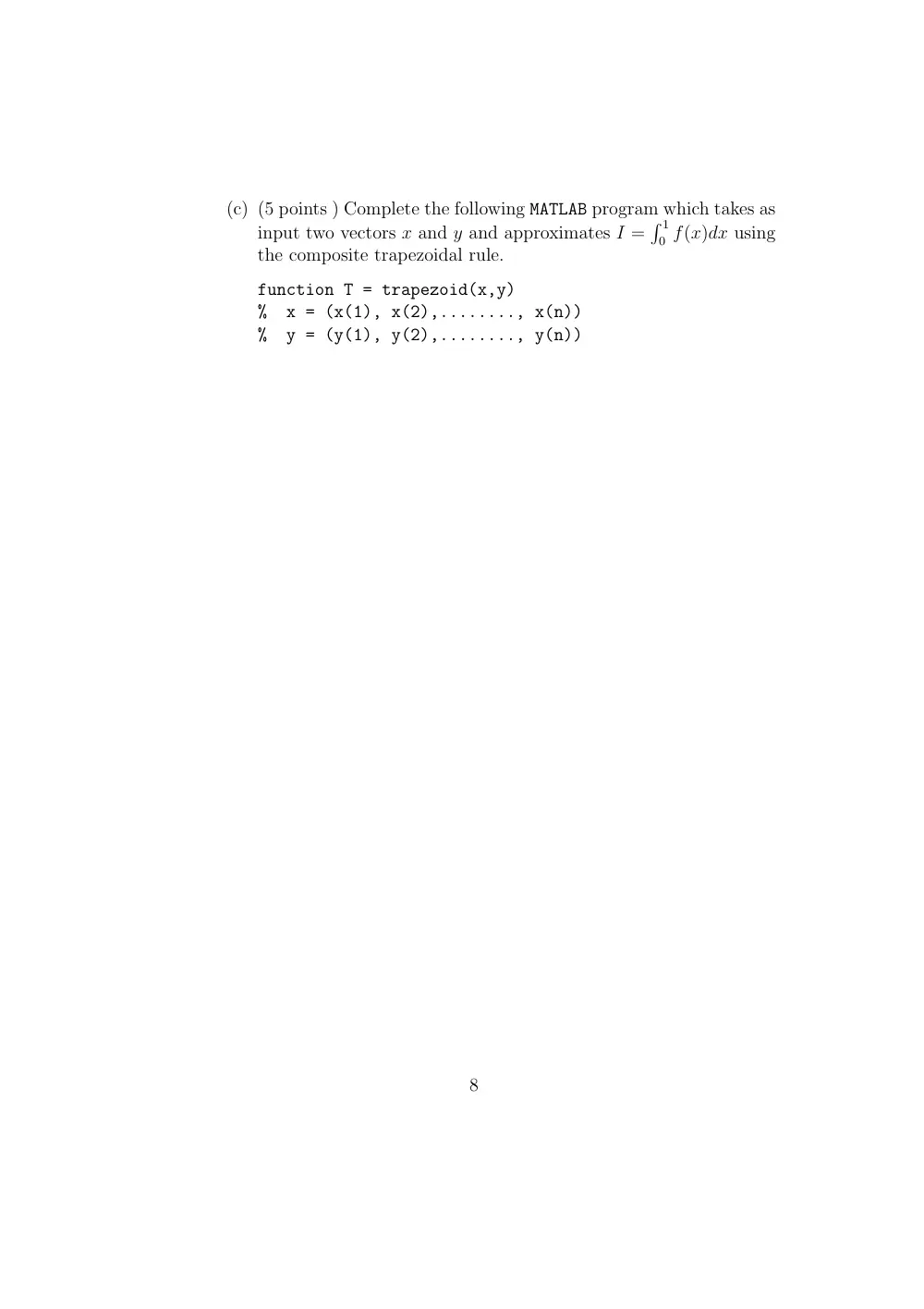
(c) (5 points ) Complete the following MATLAB program which takes as
input two vectors x and y and approximates I =
� 1
0 f(x)dx using
the composite trapezoidal rule.
function T = trapezoid(x,y)
%
x = (x(1), x(2),........, x(n))
%
y = (y(1), y(2),........, y(n))
8
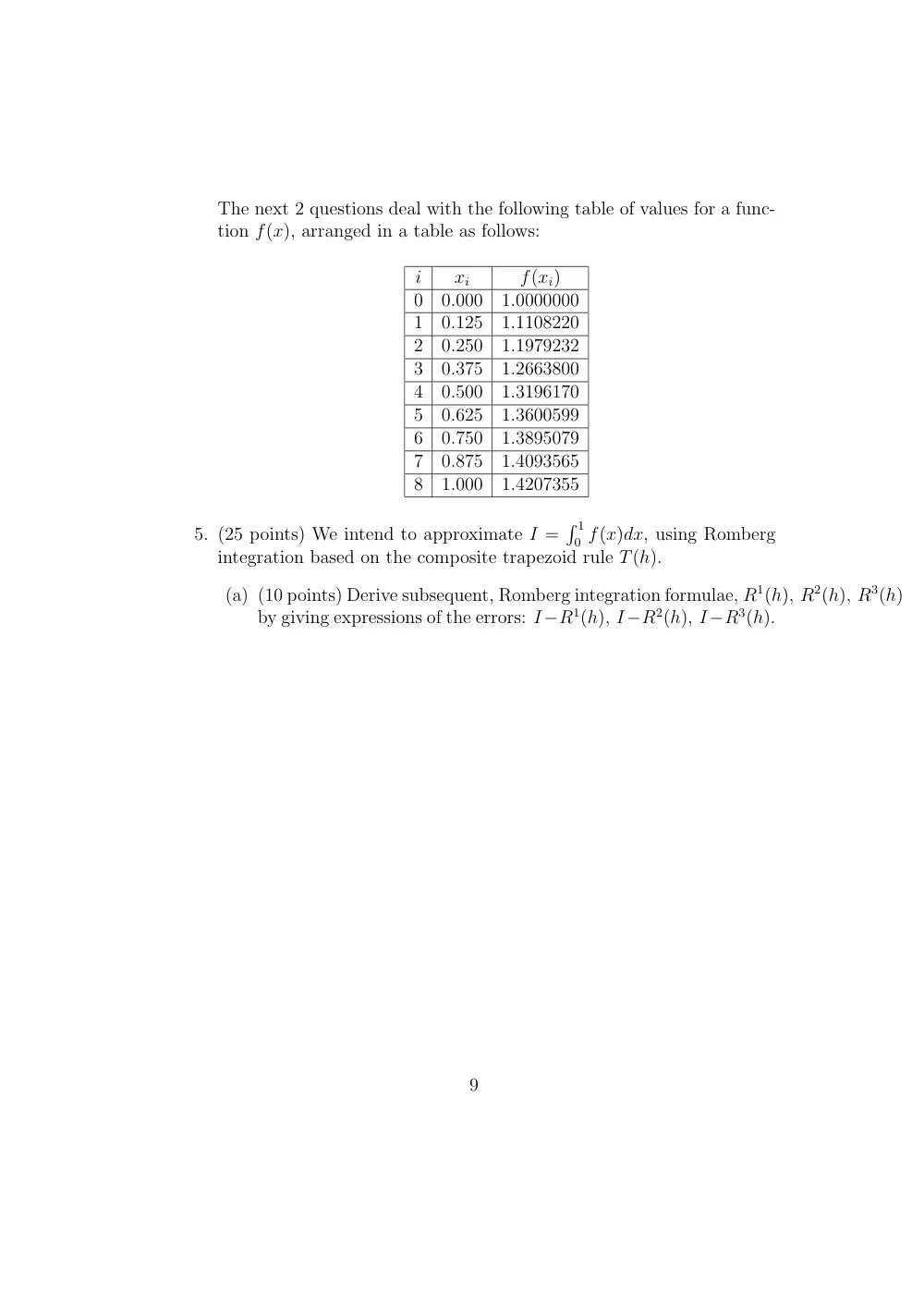
The next 2 questions deal with the following table of values for a func-
tion f(x), arranged in a table as follows:
i
xi
f(xi)
0
0.000
1.0000000
1
0.125
1.1108220
2
0.250
1.1979232
3
0.375
1.2663800
4
0.500
1.3196170
5
0.625
1.3600599
6
0.750
1.3895079
7
0.875
1.4093565
8
1.000
1.4207355
5. (25 points) We intend to approximate I =
� 1
0 f(x)dx, using Romberg
integration based on the composite trapezoid rule T(h).
(a) (10 points) Derive subsequent, Romberg integration formulae, R1(h), R2(h), R3(h)
by giving expressions of the errors: I−R1(h), I−R2(h), I−R3(h).
9
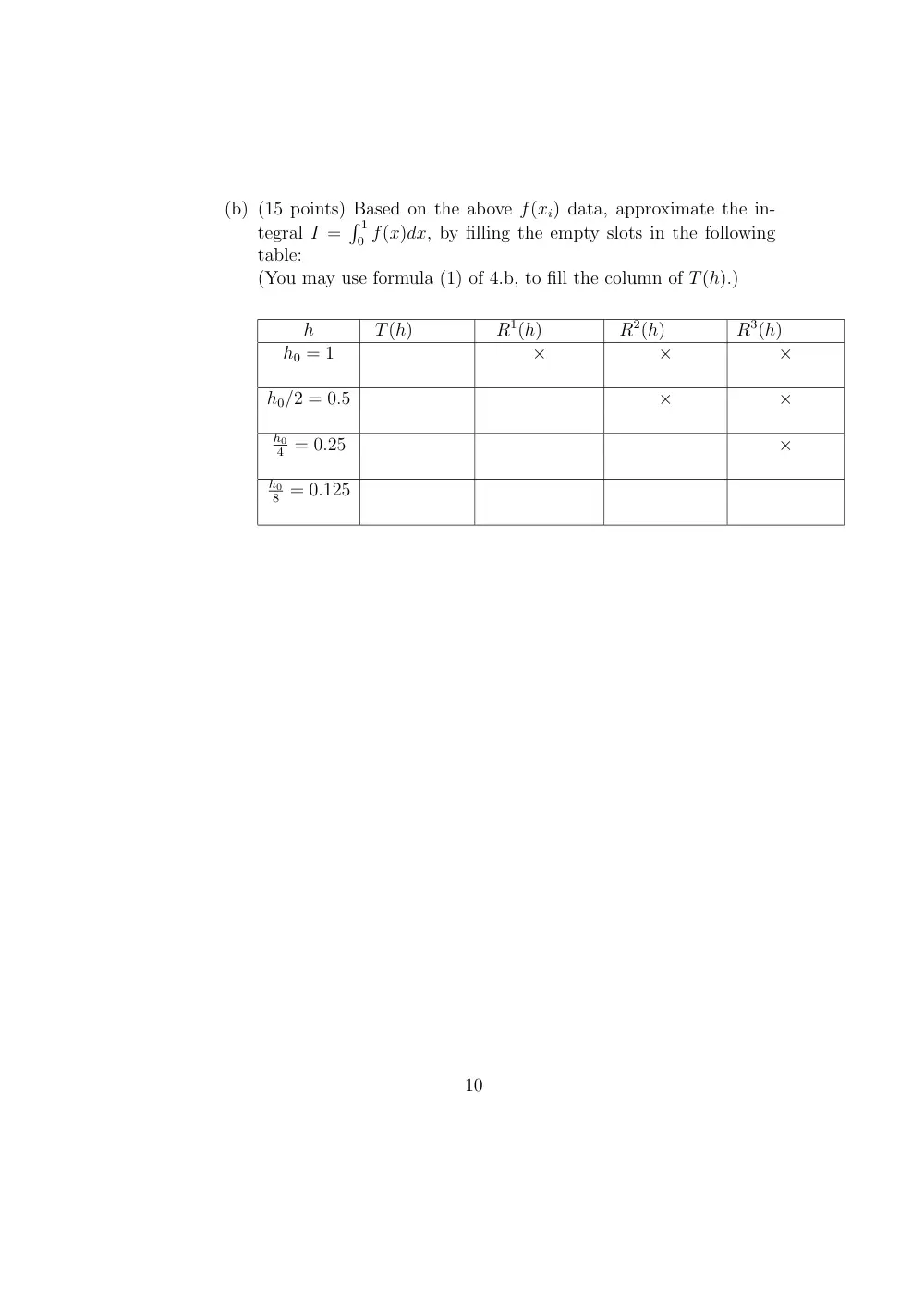
(b) (15 points) Based on the above f(xi) data, approximate the in-
tegral I =
� 1
0 f(x)dx, by filling the empty slots in the following
table:
(You may use formula (1) of 4.b, to fill the column of T(h).)
h
T(h)
R1(h)
R2(h)
R3(h)
h0 = 1
×
×
×
h0/2 = 0.5
×
×
h0
4 = 0.25
×
h0
8 = 0.125
10
6. (10 points) Using the forward Difference formula to approximate f
′(0),
followed by Richardson extrapolation, find the best approximation to
f
′(0) starting with h0 = 0.5. For that purpose, derive the formulae of
the following table and fill the empty slots in its entries:
h
φ(h)
φ(1)(h)
φ(2)(h)
h0 = 0.5
×
×
×
11