
HIST 258B Final, Fall 2007
American University of Beirut · Sp. Topics in History History of the Palestine Problem 1917-1948 · 1 page
Stuck on a question? A tutor can walk you through it.
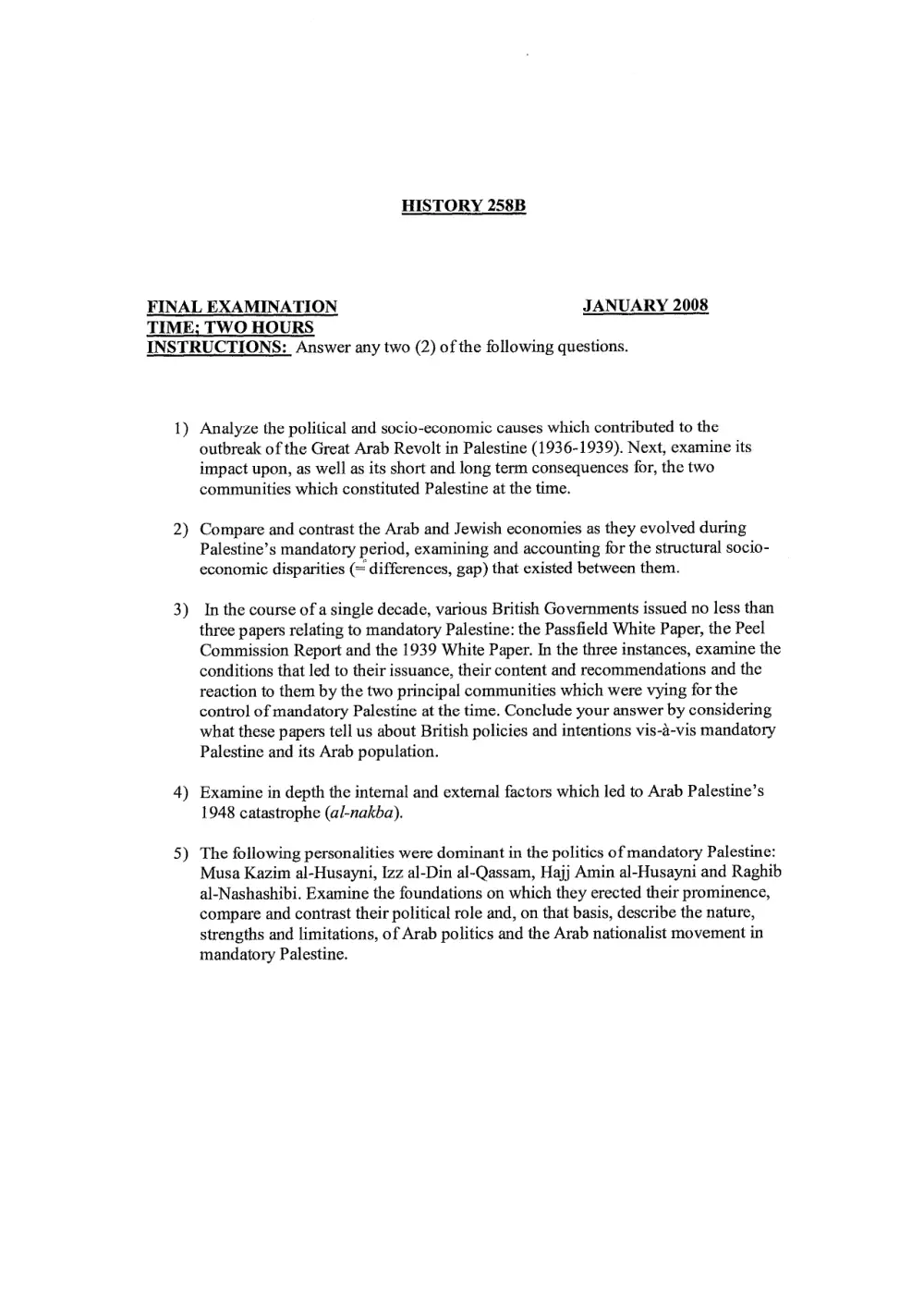
Show the text of this final exam
HISTORY 258B
FINAL EXAMINATION JANUARY 2008
TIME; TWO HOURS
INSTRUCTIONS: Answer any two (2) of the following questions.
1)
2)
3)
4)
5)
Analyze the political and socio-economic causes which contributed to the
outbreak of the Great Arab Revolt in Palestine (1936-1939). Next, examine its
impact upon, as well as its short and long term consequences for, the two
communities which constituted Palestine at the time.
Compare and contrast the Arab and Jewish economies as they evolved during
Palestine’s mandatory period, examining and accounting for the structural socio-
economic disparities (= differences, gap) that existed between them.
In the course of a single decade, various British Governments issued no less than
three papers relating to mandatory Palestine: the Passfield White Paper, the Peel
Commission Report and the 1939 White Paper. In the three instances, examine the
conditions that led to their issuance, their content and recommendations and the
reaction to them by the two principal communities which were vying for the
control of mandatory Palestine at the time. Conclude your answer by considering
what these papers tell us about British policies and intentions vis-a-vis mandatory
Palestine and its Arab population.
Examine in depth the internal and external factors which led to Arab Palestine’s
1948 catastrophe (a/-nakba).
The following personalities were dominant in the politics of mandatory Palestine:
Musa Kazim al-Husayni, Izz al-Din al-Qassam, Hajj Amin al-Husayni and Raghib
al-Nashashibi. Examine the foundations on which they erected their prominence,
compare and contrast their political role and, on that basis, describe the nature,
strengths and limitations, of Arab politics and the Arab nationalist movement in
mandatory Palestine.