
MATH 101 Final, Fall 2001
American University of Beirut · Calculus and Analytical Geometry I · 9 pages
More MATH 101 files
Show the text of this final exam
OF BEIRUY
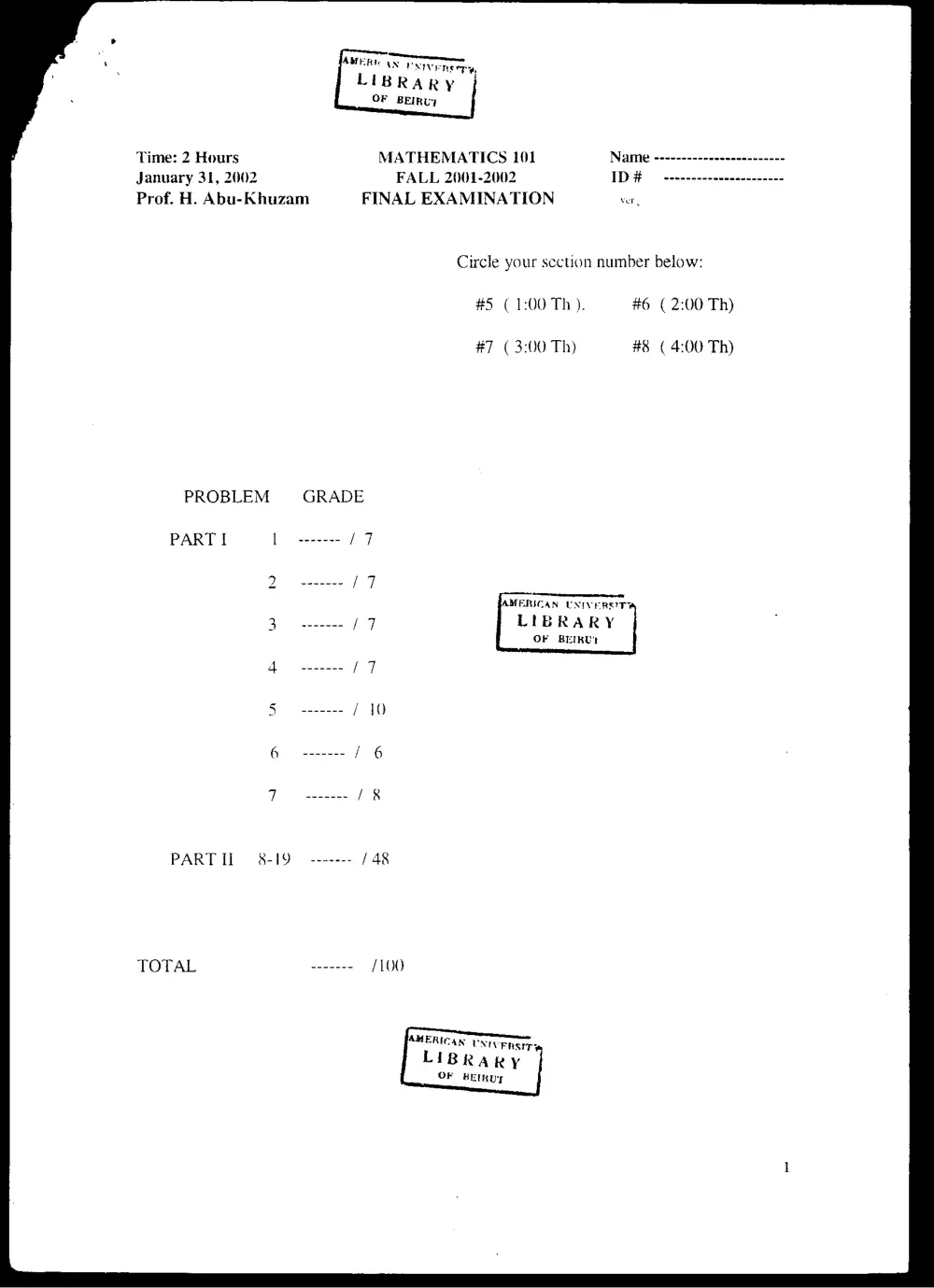
Time: 2 Hours MATHEMATICS 101
January 31, 2002 FALL 2001-2002
Prof. H. Abu-Khuzam FINAL EXAMINATION
Circle your section number below:
#5 (1:00 Th). #6 (2:00 Th)
#7 (3:00 Th) #8 (4:00 Th)
PROBLEM GRADE
OF BEIKU't
PART II 8-19
AMERICAN UNIVERSIT+
LIBRary
OF BEIRUy
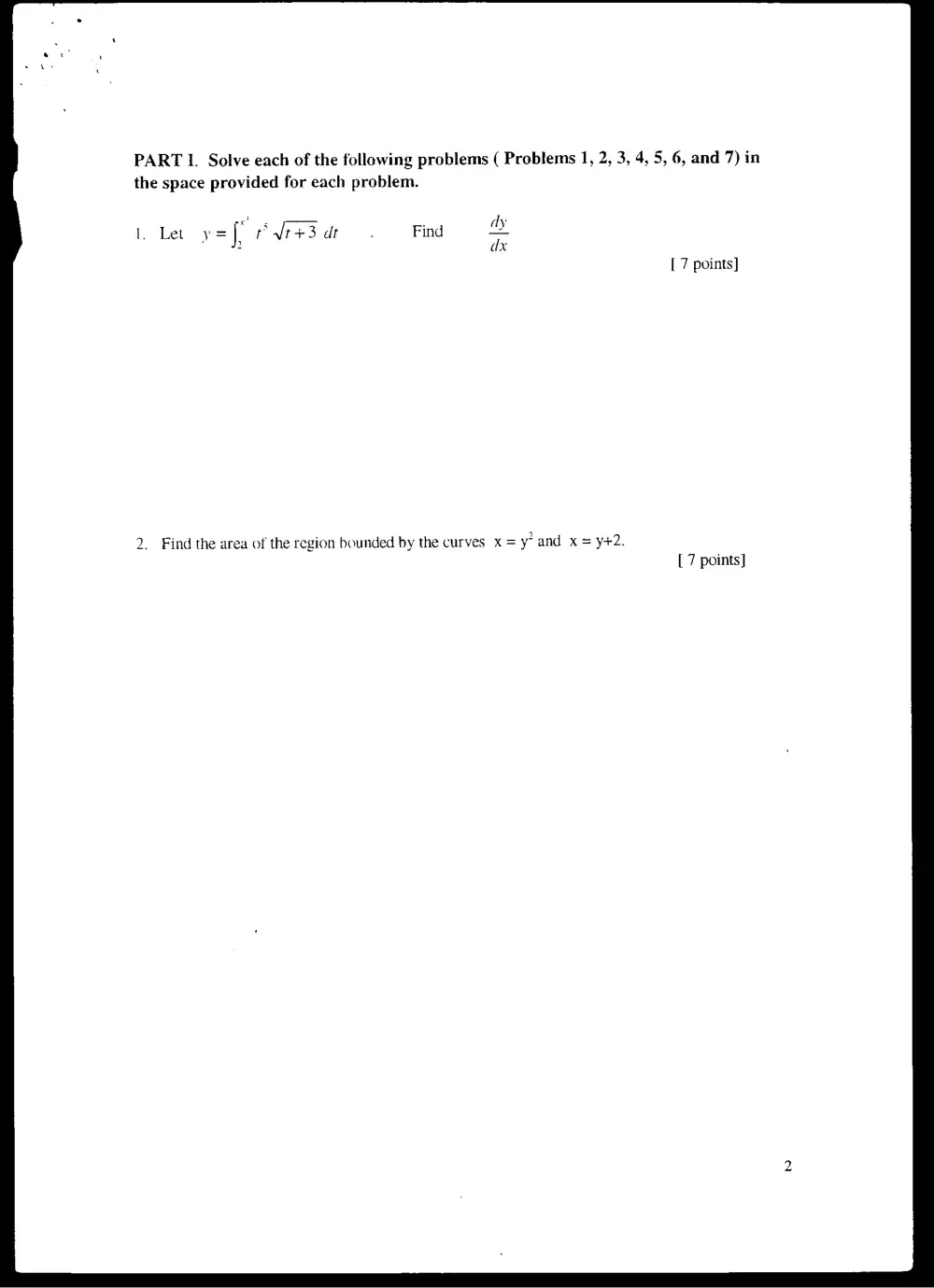
PART I. Solve each of the following problems ( Problems 1, 2, 3, 4, 5, 6, and 7) in
the space provided for each problem.
1. Let y=f tvrt3dt . Find “
- ax
[ 7 points]
2. Find the area of the region bounded by the curves x = yvand x = y+2.
[7 points]
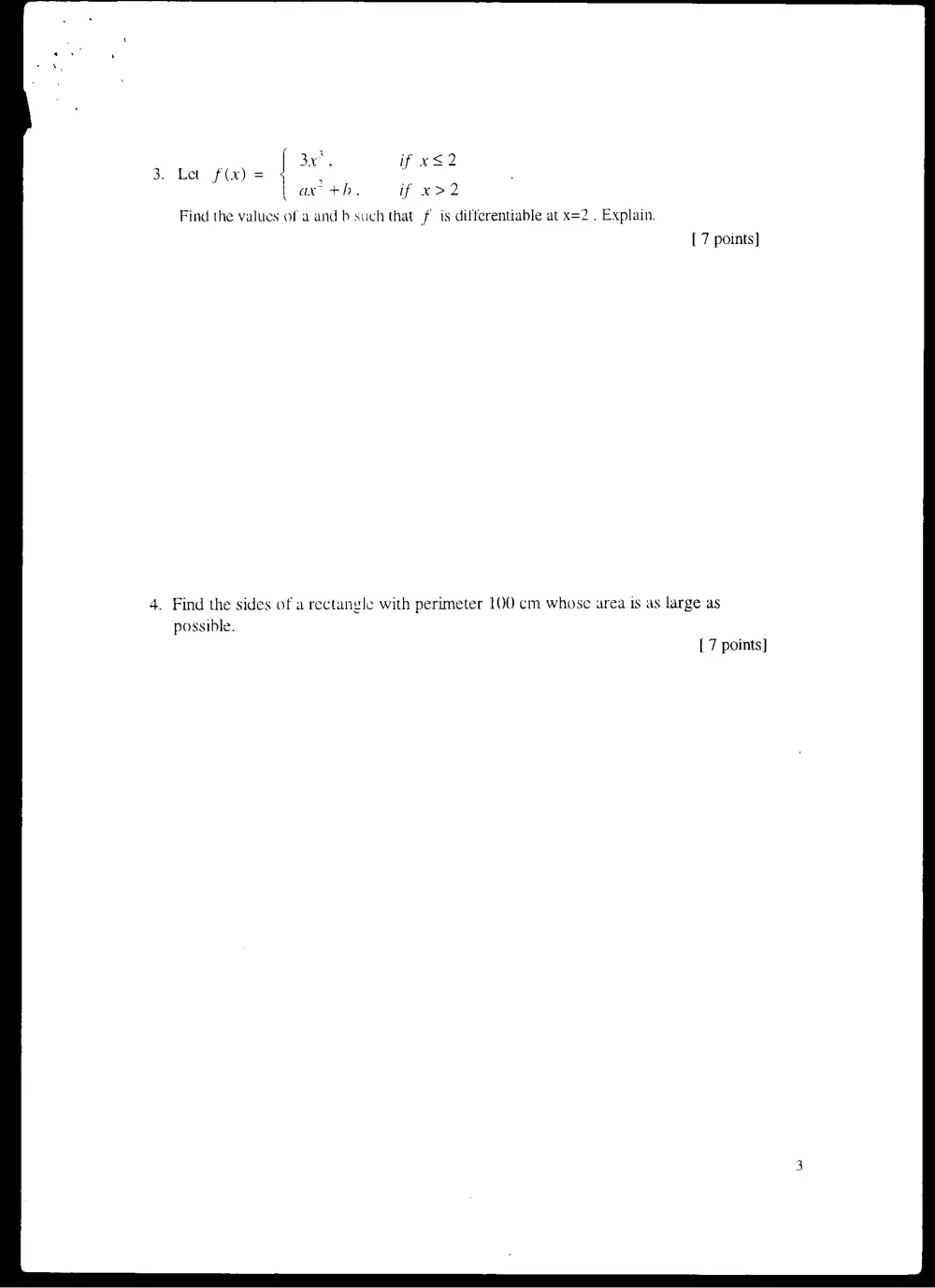
3x. if x<2
3. Let f(x) = |
ax +h. if x>2
Find the values of a and b such that f is differentiable at x=2 . Explain.
(7 points]
4. Find the sides of a rectangle with perimeter 100 cm whose urea is as large as
possible.
[ 7 points]
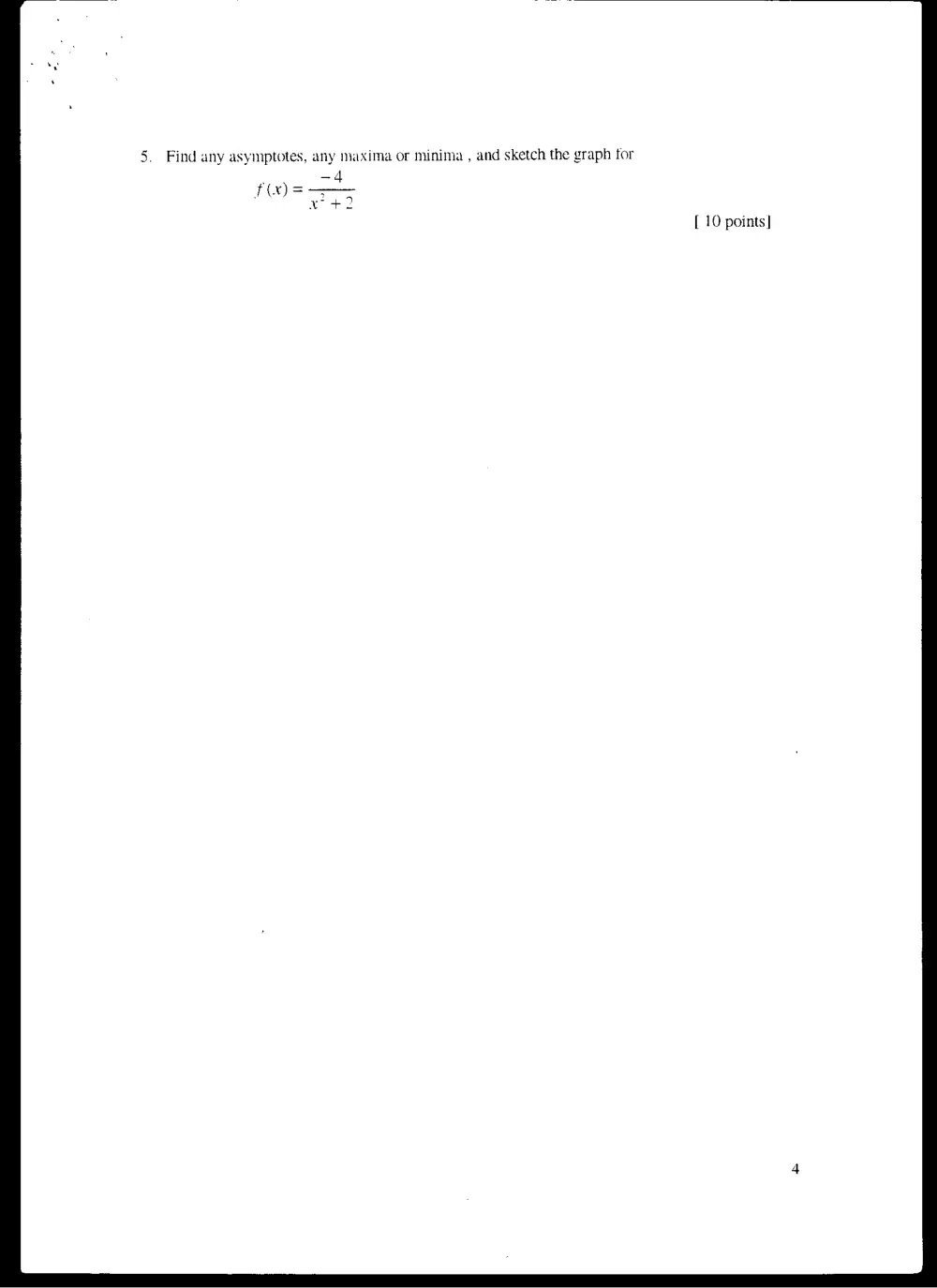
5. Find any asymptotes, any maxima or minima , and sketch the graph for
f(x)
xt?
[ 10 points]
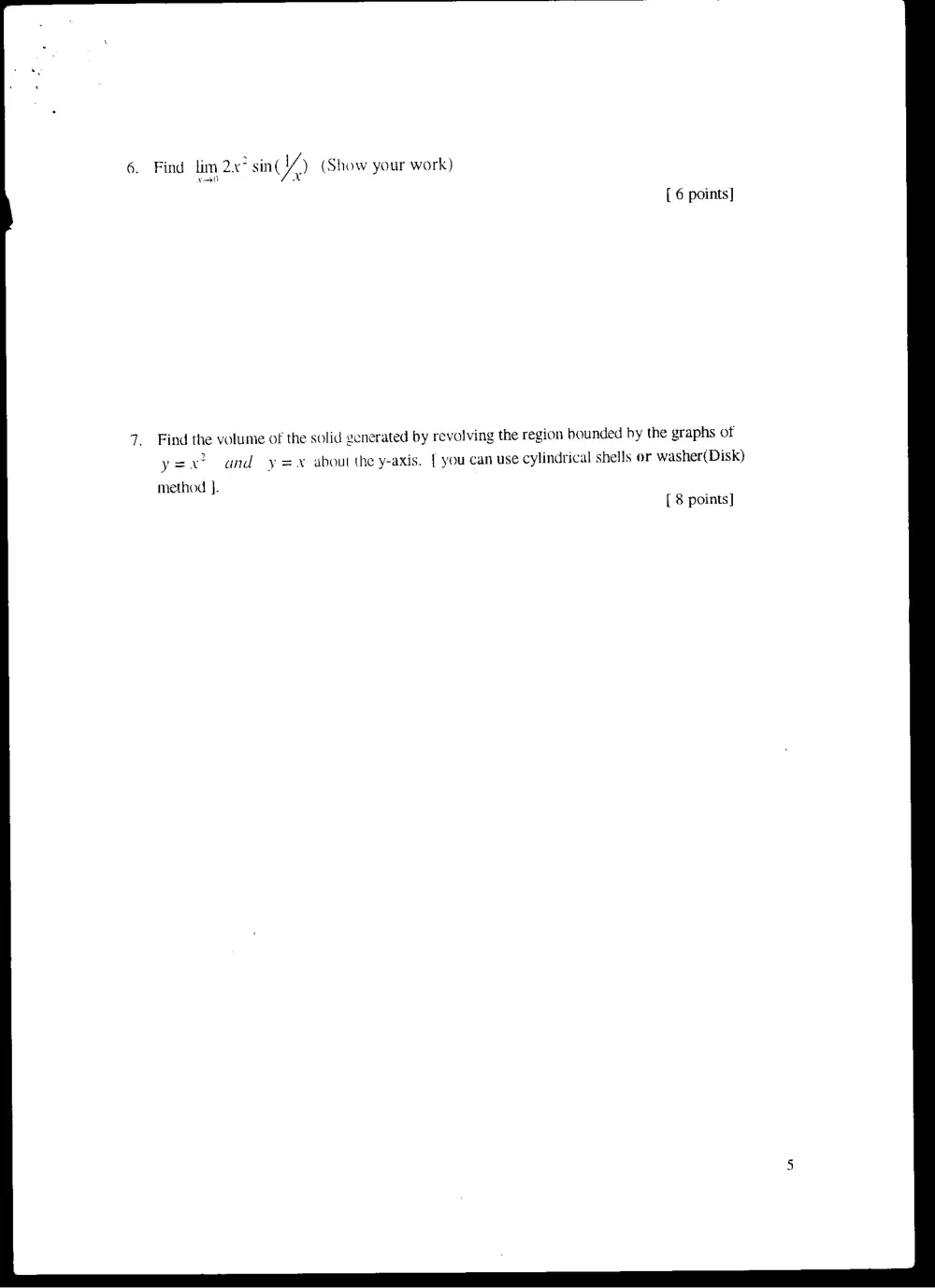
6. Find lim 2x7 sin Y) (Show your work)
yo
[ 6 points]
7. Find the volume of the solid generated by revolving the region bounded by the graphs of
and y =X about the y-axis. {| you can use cylindrical shells er washer(Disk)
yeu
method J.
[ 8 points]
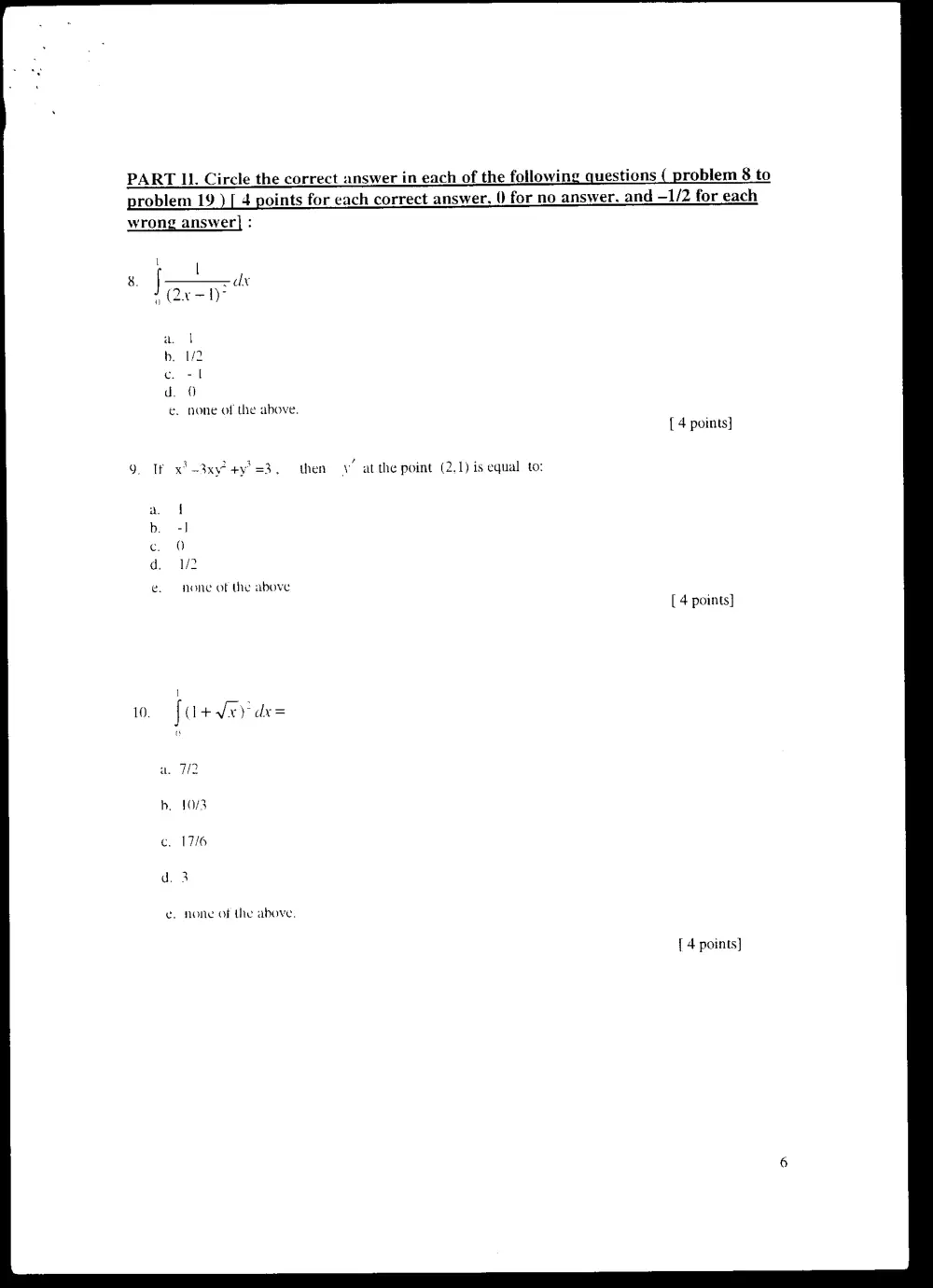
PART II. Circle the correct answer in each of the following questions (problem 8 to
problem 19 ) [ 4 points for each correct answer, 0) for no answer. and —1/2 for each
wrong answer] :
\
l
——~ dx
* ler 1°
|
. 12
- 1
0
. none of the above.
{ 4 points]
9. Ir xi-3xyty'=3. then \” at the point (2.1) is equal to:
{
-1
0
1/2
none of the above
[4 points]
1
10. futvey de
‘
a7
108
_ 1716
3
ce. none of the above.
{ 4 points]
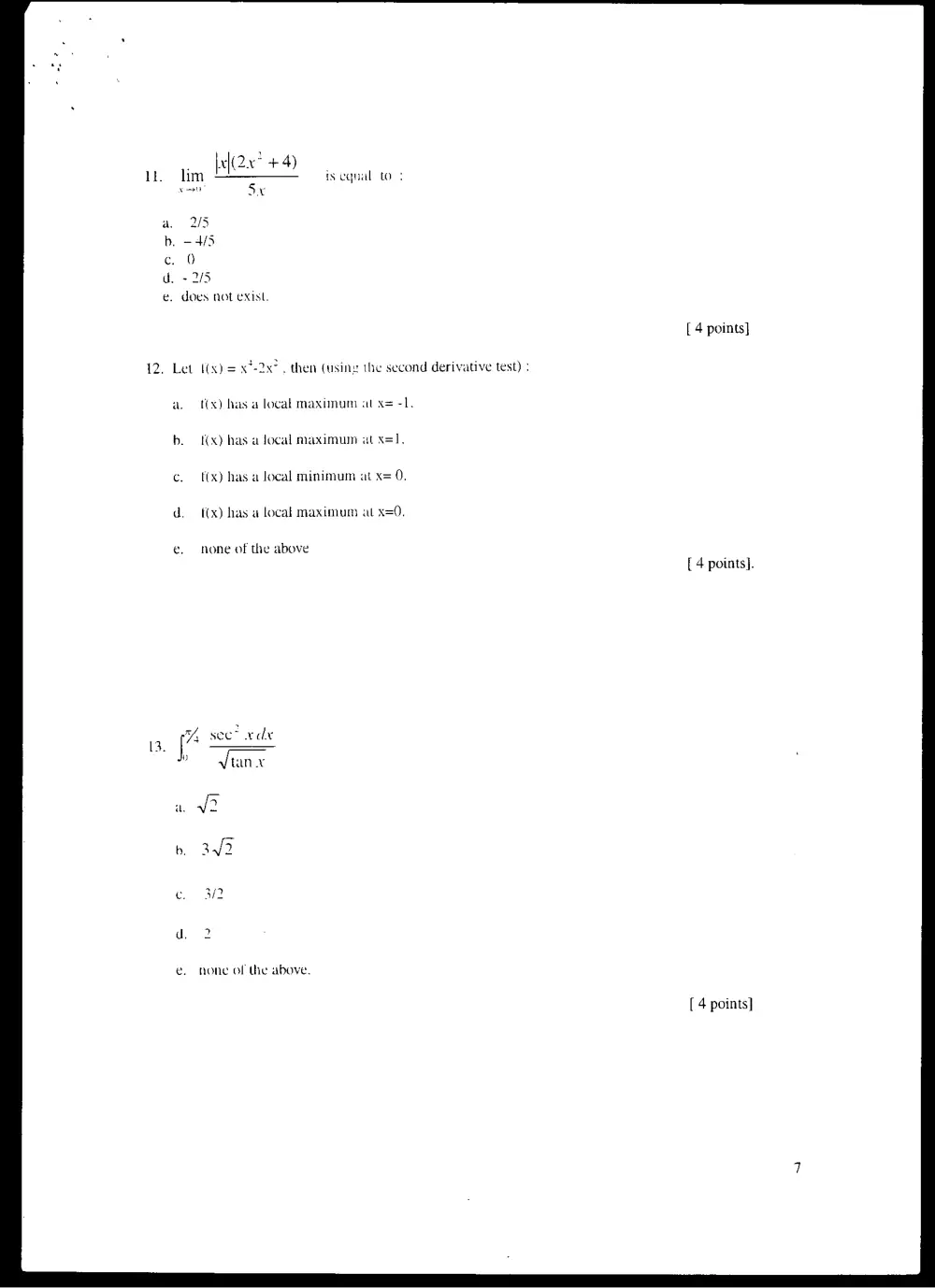
. jx[(2x° +4)
1k. lim —————— __iisequal to:
vo 5x
a, 2/5
b. -4/5
c 0
d. - 2/5
e. does not exist.
12. Let (x) = x7-2x", then (using the second derivative test) :
f(x) has a local maximum al x= -1.
f(x) has a focal maximum at x=1.
f(x) has a local minimum at x= 0.
f(x) has a local maximum at x=0.
none of the above
(4 points].
(4 sec xde
0
vlan
none of the above.
[ 4 points]
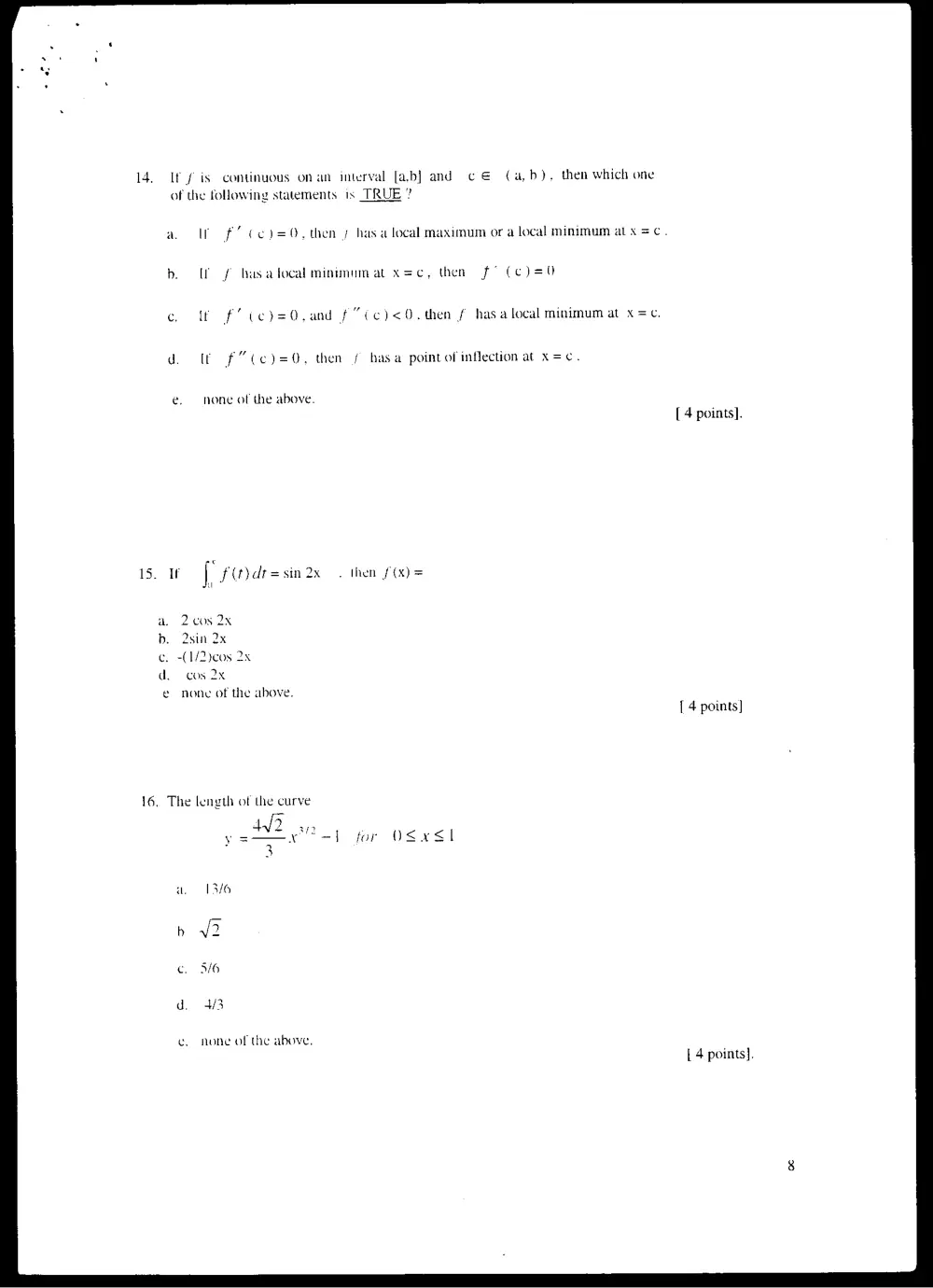
14. If fis continuous onan interval [ab] and c € (a,b), then which one
of the folowing statements is TRUE ?
f ’¢e)=0, then » has a local maximum or a local minimum al x = Cc.
f bas atocal minimumat x=c, then f° (co) =0
if (c)sO.and Ff (c) <0. then f has a local minimum at x = c.
te f’ (ce) =O, then / basa point of inflection at x=
e. none of the above.
(4 points].
15. If [ fndr=sin 2x . then f(x) =
2 cos 2x
2sin 2x
>. -(1/2)cus 2x
cos 2x
e none of the above.
[ 4 points]
16, The length of the curve
4V2 an
y= for
4/3
none of the above.
[ 4 points].
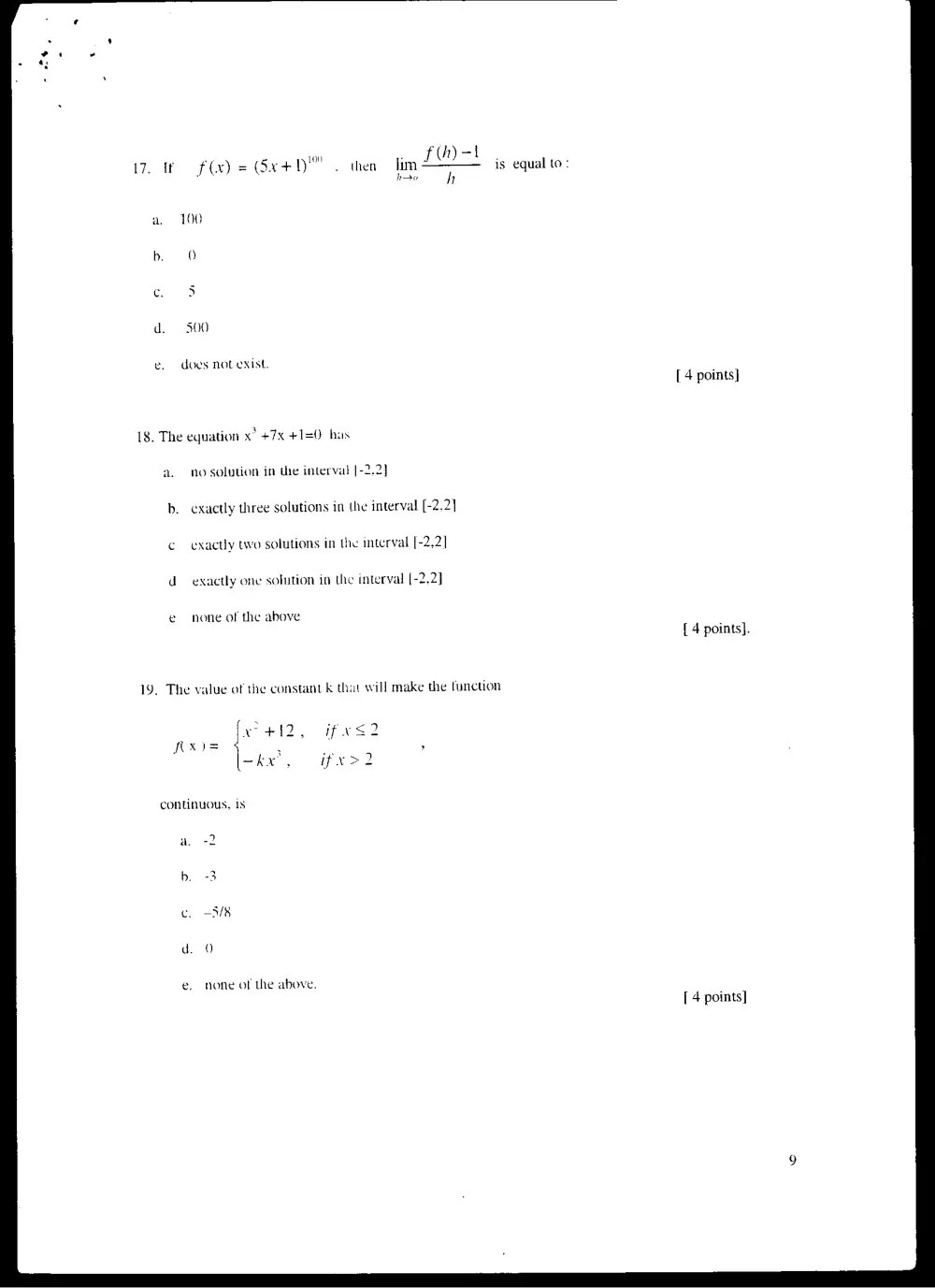
or fo) = Set". hen fim LOA
is equal to:
hoo h 4
190
500
does NOt exist.
[ 4 points]
18. The equation x* +7x +1=0 has
a. no solution in the interval |-2.2
b. exactly three solutions in the interval (-2,2]
exactly wo solutions in the interval [-2,2]
exactly one solution in the interval {-2,2]
none of the above
{ 4 points].
19, The value of the constant k that will make the function
xetl2, ifvs2
Kxos ,
—kx', ifx>2
continuous, is
none of the above,
[ 4 points]