
MATH 102 Exam 1 With Solution, Spring 2012
American University of Beirut · Calculus and Analytical Geometry II · 6 pages · Dr. Martin James Bright · with solution
More MATH 102 files
- Exam 1 Solutions · Fall 2018Exam · with solutionView
- Exam 1 · Spring 2018ExamView
- Exam 1 with Solutions · Spring 2018Exam · with solutionView
- Exam 2 with Solutions · Spring 2018Exam · with solutionView
- Exam 2 Solutions · Fall 2018Exam · with solutionView
- Midterm · Summer 2013ExamView
- Exam 2 MATH 102 Quiz 2 with Solutions · Spring 2012Exam · with solutionView
- Exam 2 Exam & Solutions · Spring 2012Exam · with solutionView
Show the text of this exam
MATH102 mid-term quiz 1
Saturday 17 March 2012
Name:
ID:
Circle your recitation section:
5 (8am)
6 (9am)
7 (11am)
8 (12am)
Question:
1
2
3
4
5
6
7
Bonus
Total
Points:
18
12
12
12
19
12
15
5
100
Score:
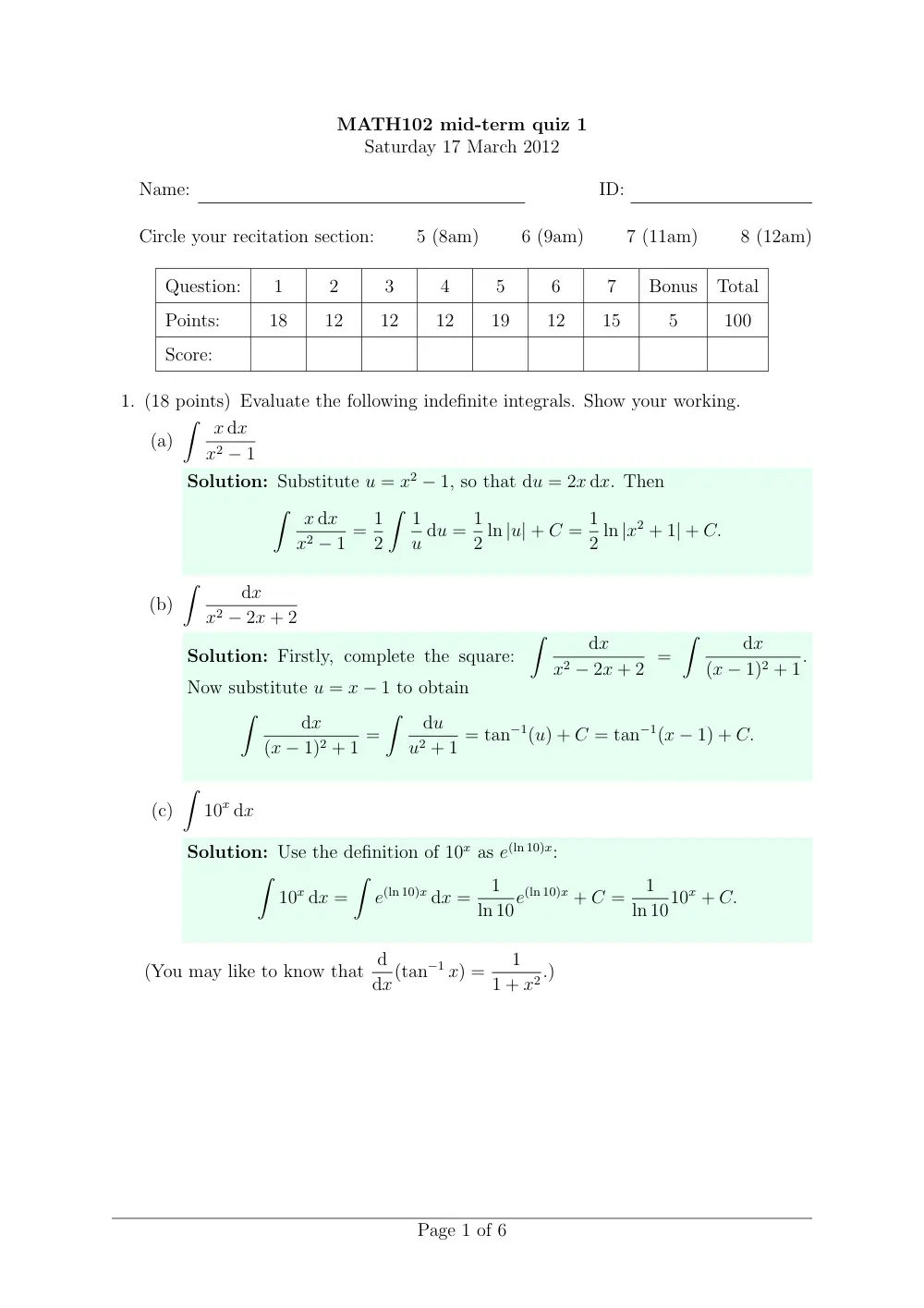
1. (18 points) Evaluate the following indefinite integrals. Show your working.
(a)
�
x dx
x2 − 1
Solution: Substitute u = x2 − 1, so that du = 2x dx. Then
�
x dx
x2 − 1 = 1
2
� 1
u du = 1
2 ln |u| + C = 1
2 ln |x2 + 1| + C.
(b)
�
dx
x2 − 2x + 2
Solution: Firstly, complete the square:
�
dx
x2 − 2x + 2 =
�
dx
(x − 1)2 + 1.
Now substitute u = x − 1 to obtain
�
dx
(x − 1)2 + 1 =
�
du
u2 + 1 = tan−1(u) + C = tan−1(x − 1) + C.
(c)
�
10x dx
Solution: Use the definition of 10x as e(ln 10)x:
�
10x dx =
�
e(ln 10)x dx =
1
ln 10e(ln 10)x + C =
1
ln 1010x + C.
(You may like to know that d
dx(tan−1 x) =
1
1 + x2.)
Page 1 of 6
MATH 102
Mid-term quiz 1
17 March, 2012
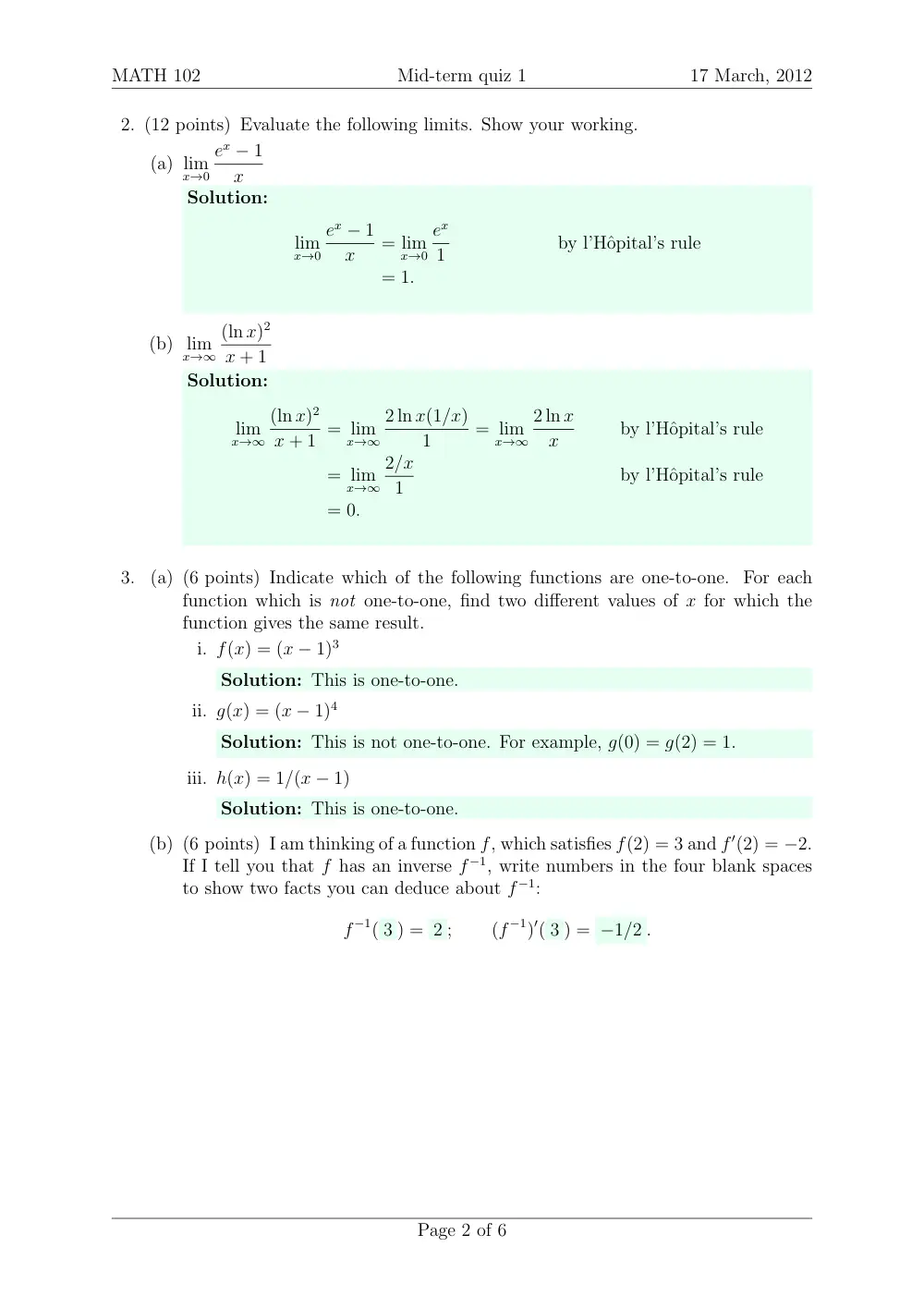
2. (12 points) Evaluate the following limits. Show your working.
(a) lim
x→0
ex − 1
x
Solution:
lim
x→0
ex − 1
x
= lim
x→0
ex
1
by l’Hˆopital’s rule
= 1.
(b) lim
x→∞
(ln x)2
x + 1
Solution:
lim
x→∞
(ln x)2
x + 1 = lim
x→∞
2 ln x(1/x)
1
= lim
x→∞
2 ln x
x
by l’Hˆopital’s rule
= lim
x→∞
2/x
1
by l’Hˆopital’s rule
= 0.
3.
(a) (6 points) Indicate which of the following functions are one-to-one. For each
function which is not one-to-one, find two different values of x for which the
function gives the same result.
i. f(x) = (x − 1)3
Solution: This is one-to-one.
ii. g(x) = (x − 1)4
Solution: This is not one-to-one. For example, g(0) = g(2) = 1.
iii. h(x) = 1/(x − 1)
Solution: This is one-to-one.
(b) (6 points) I am thinking of a function f, which satisfies f(2) = 3 and f ′(2) = −2.
If I tell you that f has an inverse f −1, write numbers in the four blank spaces
to show two facts you can deduce about f −1:
f −1( 3 ) = 2 ;
(f −1)′( 3 ) = −1/2 .
Page 2 of 6
MATH 102
Mid-term quiz 1
17 March, 2012
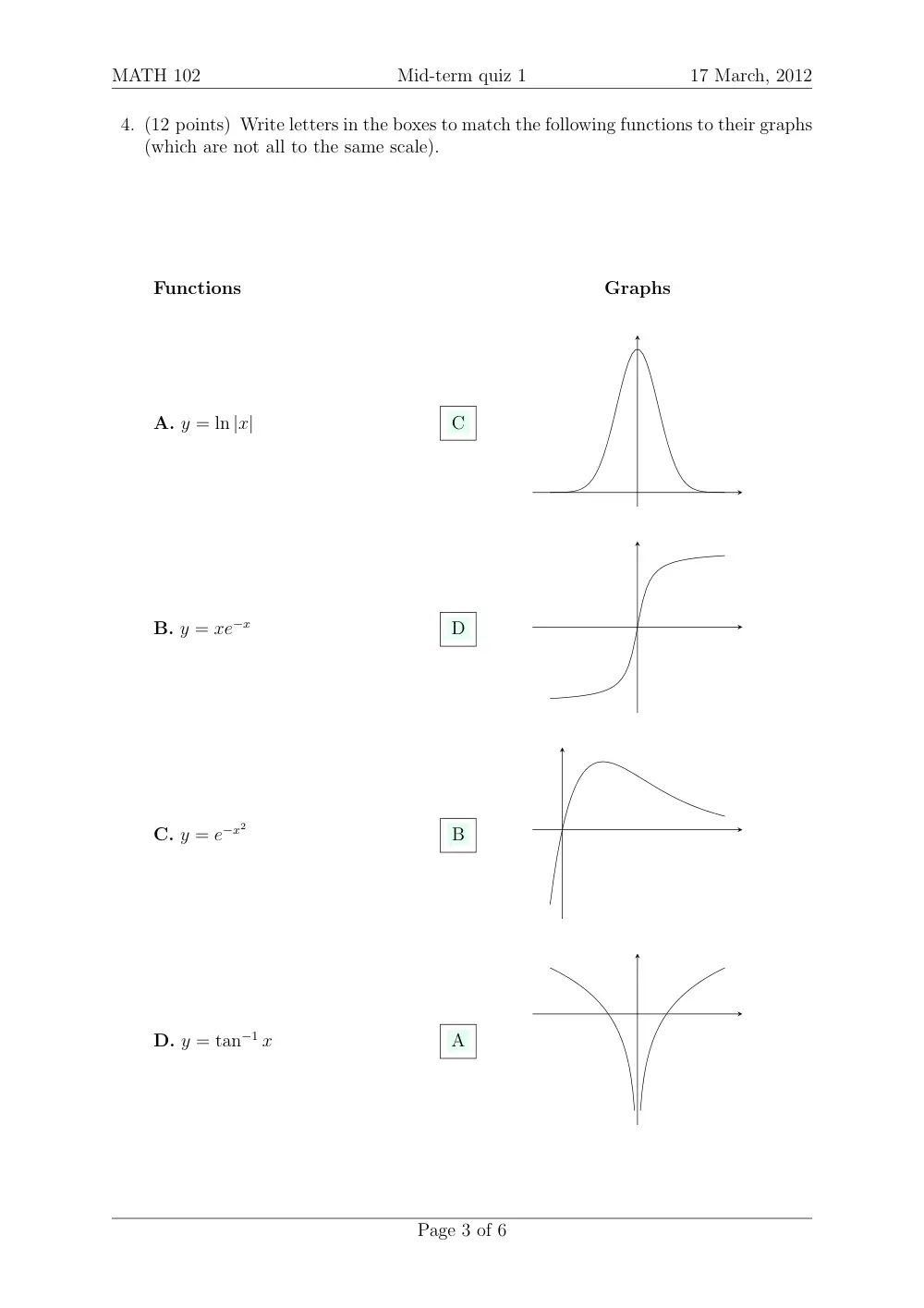
4. (12 points) Write letters in the boxes to match the following functions to their graphs
(which are not all to the same scale).
Functions
Graphs
A. y = ln |x|
C
B. y = xe−x
D
C. y = e−x2
B
D. y = tan−1 x
A
Page 3 of 6
MATH 102
Mid-term quiz 1
17 March, 2012
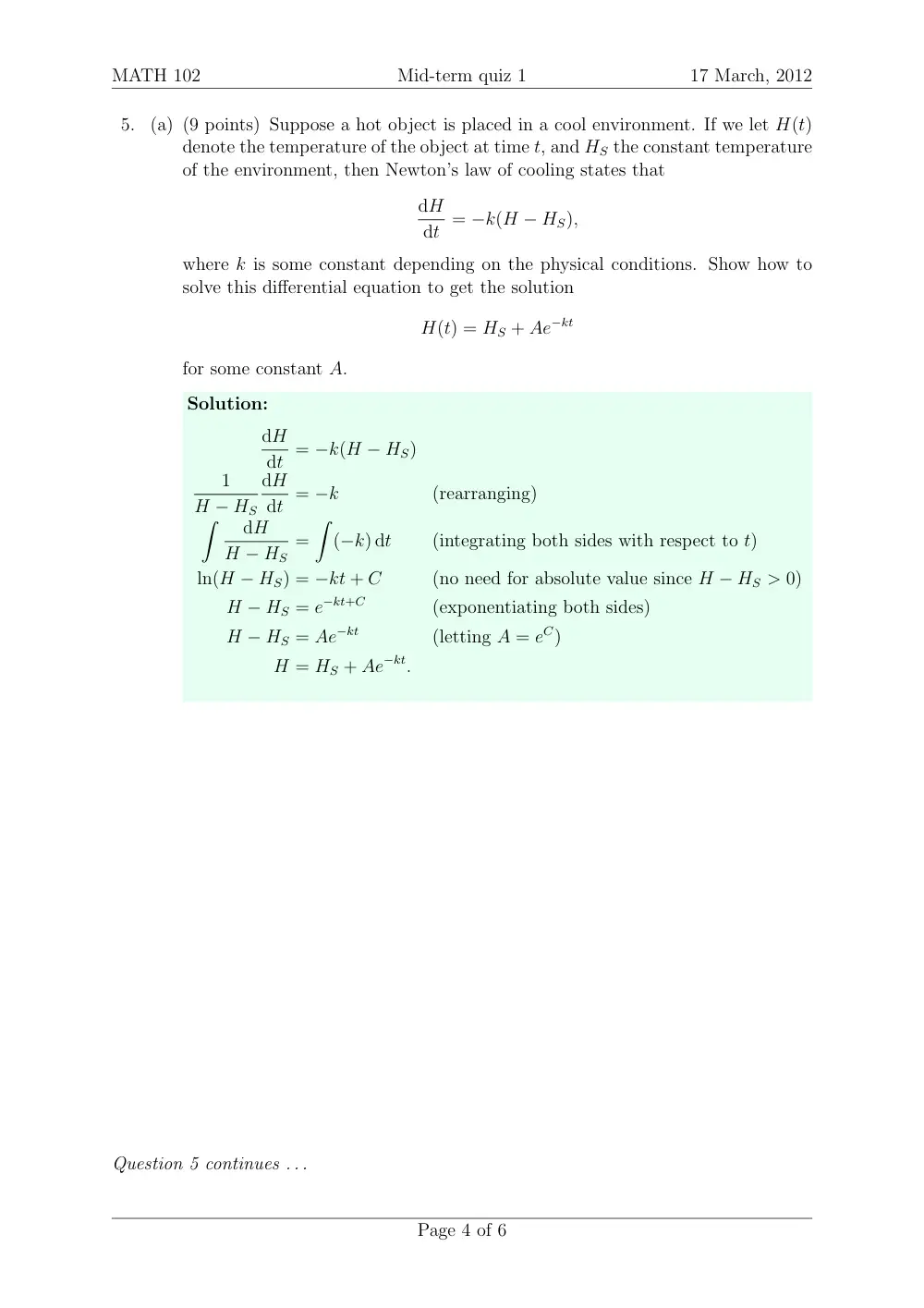
5.
(a) (9 points) Suppose a hot object is placed in a cool environment. If we let H(t)
denote the temperature of the object at time t, and HS the constant temperature
of the environment, then Newton’s law of cooling states that
dH
dt = −k(H − HS),
where k is some constant depending on the physical conditions. Show how to
solve this differential equation to get the solution
H(t) = HS + Ae−kt
for some constant A.
Solution:
dH
dt = −k(H − HS)
1
H − HS
dH
dt = −k
(rearranging)
�
dH
H − HS
=
�
(−k) dt
(integrating both sides with respect to t)
ln(H − HS) = −kt + C
(no need for absolute value since H − HS > 0)
H − HS = e−kt+C
(exponentiating both sides)
H − HS = Ae−kt
(letting A = eC)
H = HS + Ae−kt.
Question 5 continues ...
Page 4 of 6
MATH 102
Mid-term quiz 1
17 March, 2012
Question 5 (continued)
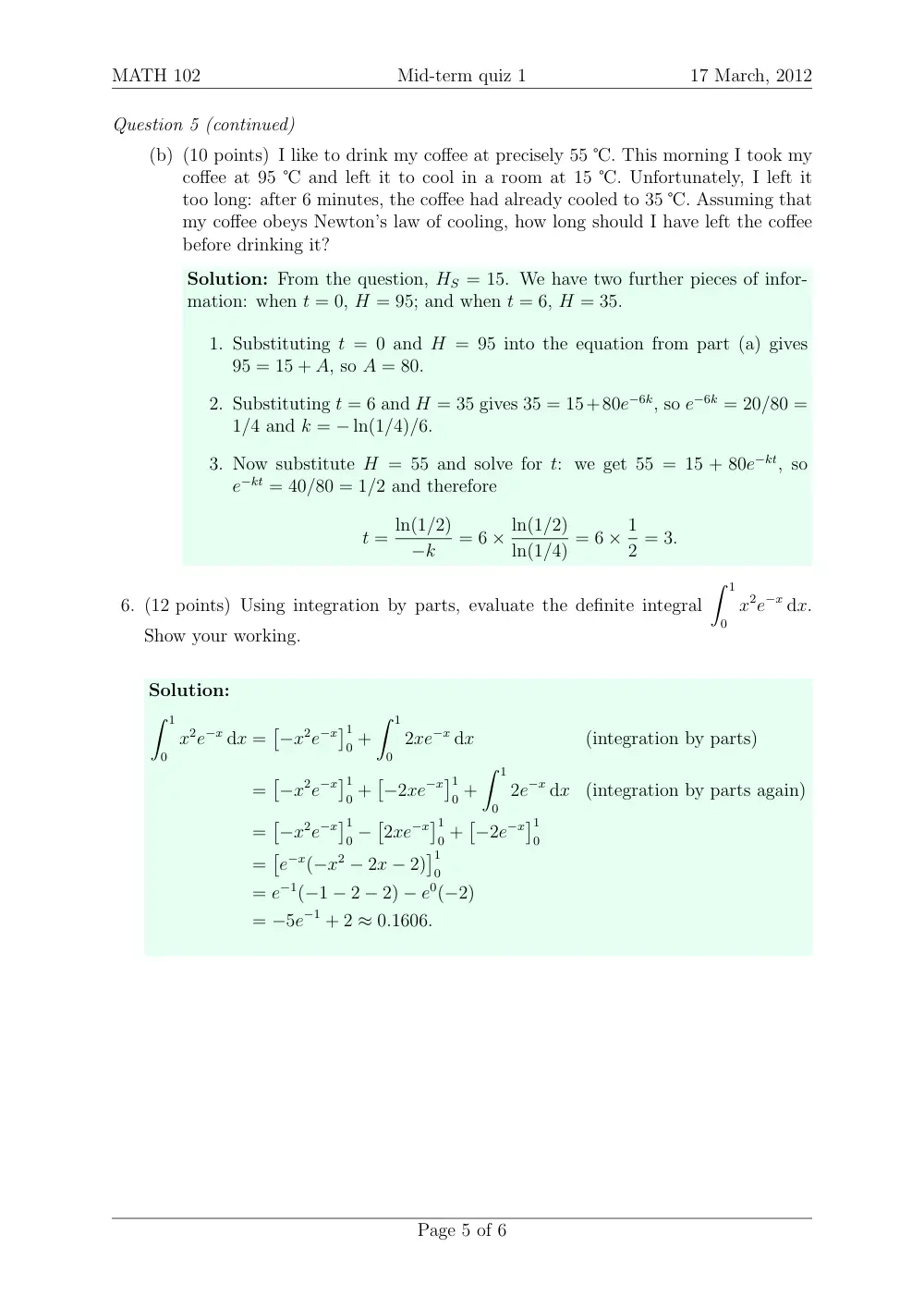
(b) (10 points) I like to drink my coffee at precisely 55 ℃. This morning I took my
coffee at 95 ℃ and left it to cool in a room at 15 ℃. Unfortunately, I left it
too long: after 6 minutes, the coffee had already cooled to 35 ℃. Assuming that
my coffee obeys Newton’s law of cooling, how long should I have left the coffee
before drinking it?
Solution: From the question, HS = 15. We have two further pieces of infor-
mation: when t = 0, H = 95; and when t = 6, H = 35.
1. Substituting t = 0 and H = 95 into the equation from part (a) gives
95 = 15 + A, so A = 80.
2. Substituting t = 6 and H = 35 gives 35 = 15+80e−6k, so e−6k = 20/80 =
1/4 and k = − ln(1/4)/6.
3. Now substitute H = 55 and solve for t: we get 55 = 15 + 80e−kt, so
e−kt = 40/80 = 1/2 and therefore
t = ln(1/2)
−k
= 6 × ln(1/2)
ln(1/4) = 6 × 1
2 = 3.
6. (12 points) Using integration by parts, evaluate the definite integral
� 1
0
x2e−x dx.
Show your working.
Solution:
� 1
0
x2e−x dx =
�
−x2e−x�1
0 +
� 1
0
2xe−x dx
(integration by parts)
=
�
−x2e−x�1
0 +
�
−2xe−x�1
0 +
� 1
0
2e−x dx
(integration by parts again)
=
�
−x2e−x�1
0 −
�
2xe−x�1
0 +
�
−2e−x�1
0
=
�
e−x(−x2 − 2x − 2)
�1
0
= e−1(−1 − 2 − 2) − e0(−2)
= −5e−1 + 2 ≈ 0.1606.
Page 5 of 6
MATH 102
Mid-term quiz 1
17 March, 2012
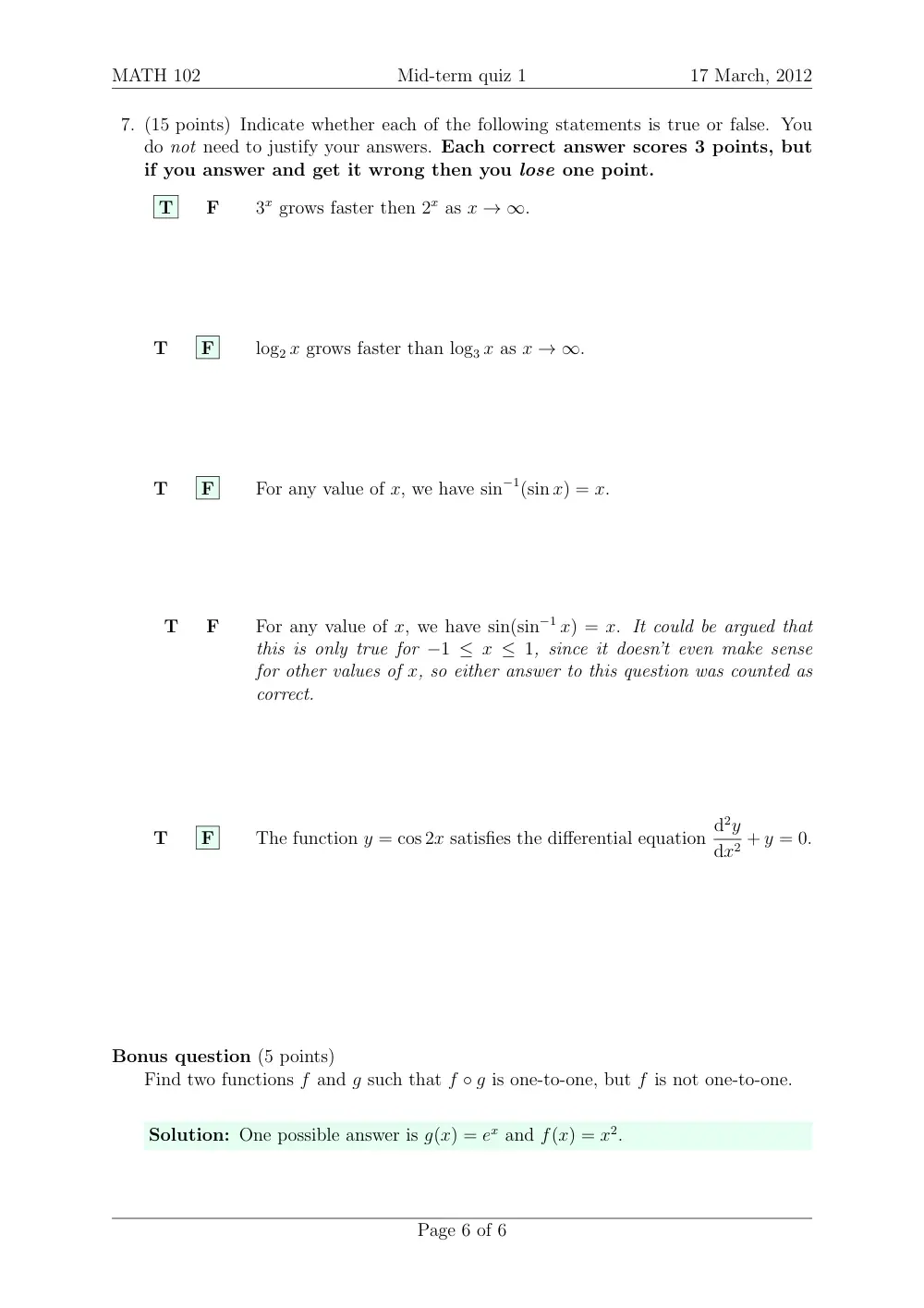
7. (15 points) Indicate whether each of the following statements is true or false. You
do not need to justify your answers. Each correct answer scores 3 points, but
if you answer and get it wrong then you lose one point.
T
F
3x grows faster then 2x as x → ∞.
T
F
log2 x grows faster than log3 x as x → ∞.
T
F
For any value of x, we have sin−1(sin x) = x.
T
F
For any value of x, we have sin(sin−1 x) = x. It could be argued that
this is only true for −1 ≤ x ≤ 1, since it doesn’t even make sense
for other values of x, so either answer to this question was counted as
correct.
T
F
The function y = cos 2x satisfies the differential equation d2y
dx2 + y = 0.
Bonus question (5 points)
Find two functions f and g such that f ◦ g is one-to-one, but f is not one-to-one.
Solution: One possible answer is g(x) = ex and f(x) = x2.
Page 6 of 6