
MATH 201 Exam 1, Fall 2001
American University of Beirut · Calculus and Analytical Geometry III · 3 pages · Prof. Abdallah Lyzzaik
More MATH 201 files
Show the text of this exam
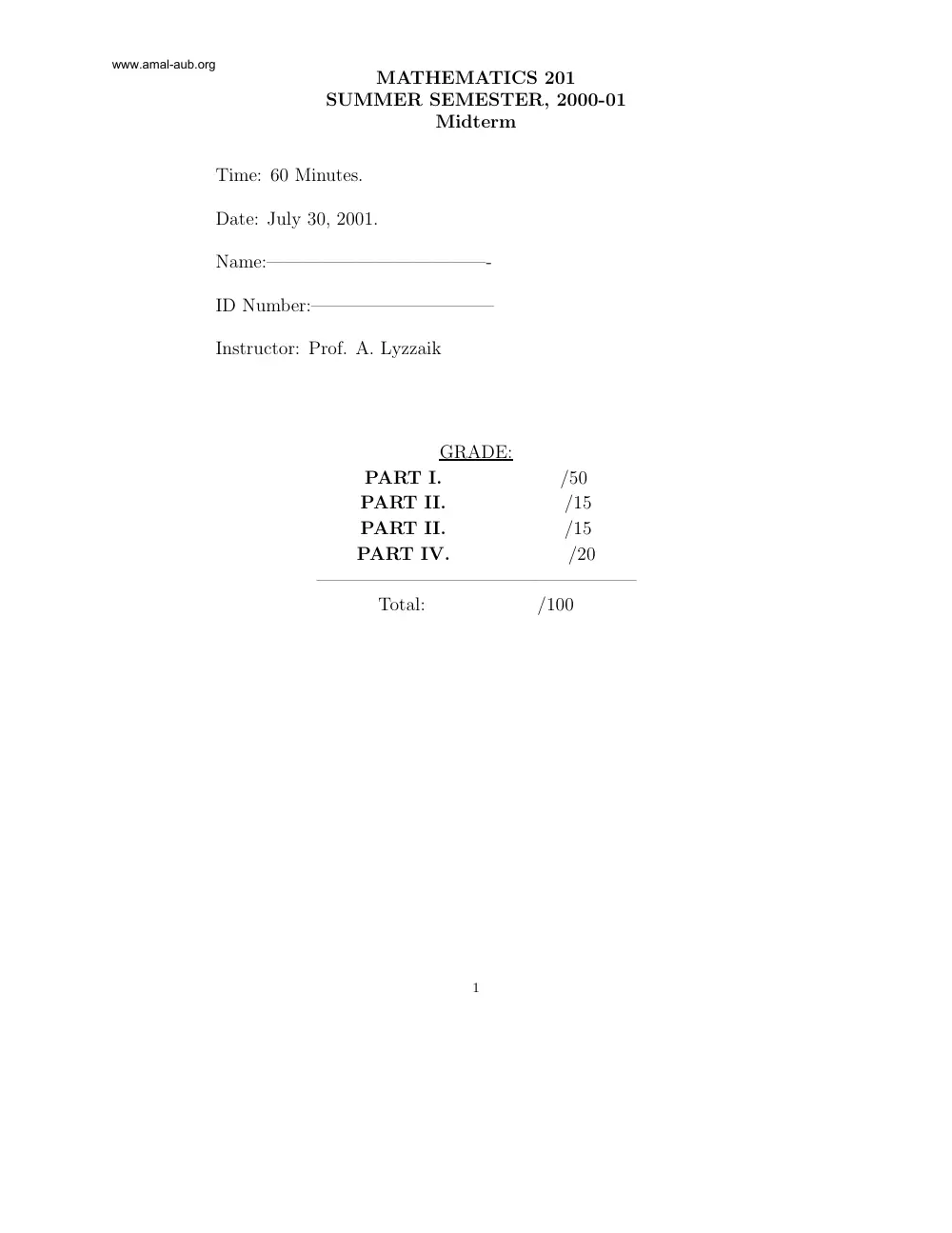
MATHEMATICS 201
SUMMER SEMESTER, 2000-01
Midterm
Time: 60 Minutes.
Date: July 30, 2001.
Name:————————————-
ID Number:——————————
Instructor: Prof. A. Lyzzaik
GRADE:
PART I.
/50
PART II.
/15
PART II.
/15
PART IV.
/20
—————————————————–
Total:
/100
1
www.amal-aub.org
2
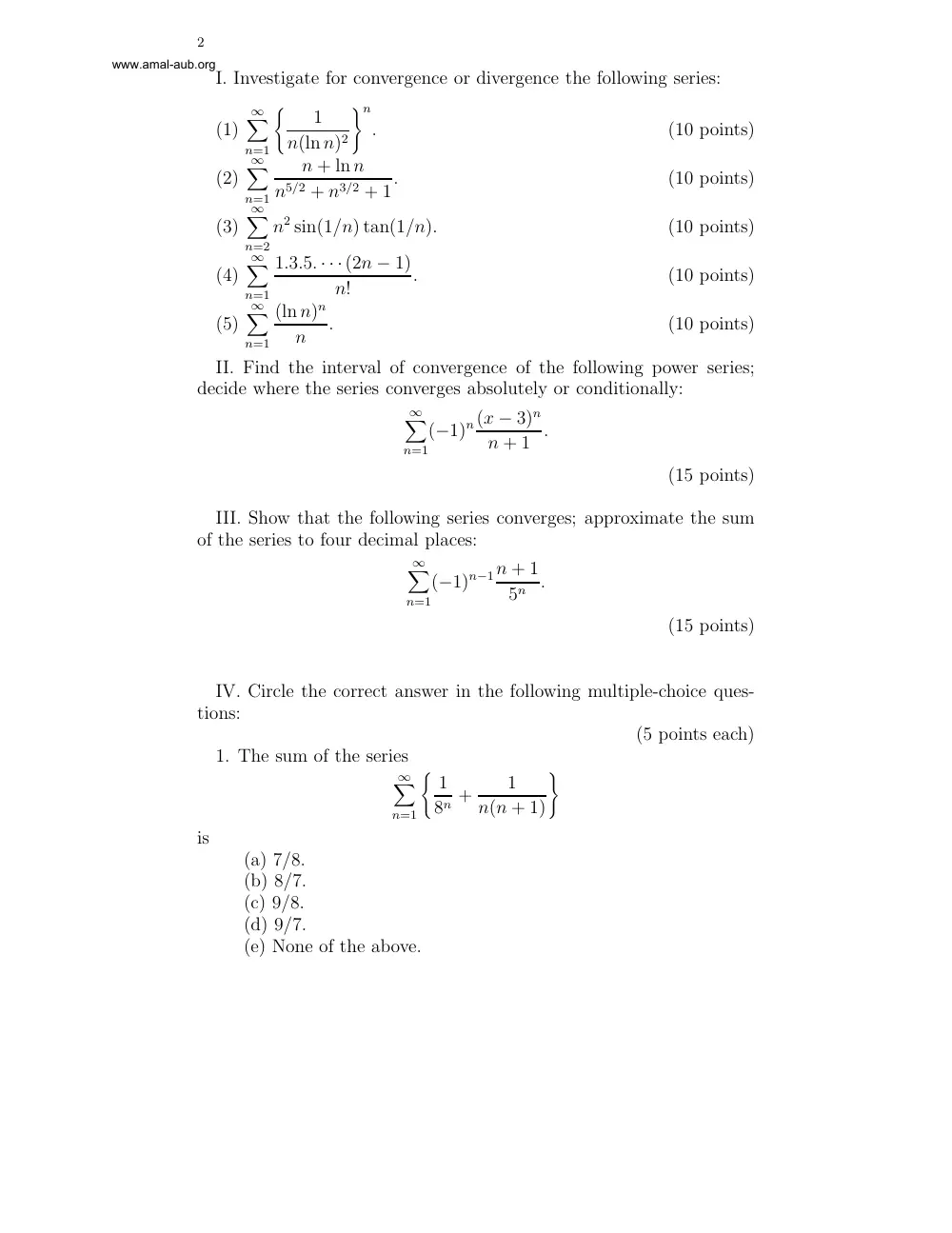
I. Investigate for convergence or divergence the following series:
(1)
∞
�
n=1
�
1
n(ln n)2
�n
.
(10 points)
(2)
∞
�
n=1
n + ln n
n5/2 + n3/2 + 1.
(10 points)
(3)
∞
�
n=2
n2 sin(1/n) tan(1/n).
(10 points)
(4)
∞
�
n=1
1.3.5. · · ·(2n − 1)
n!
.
(10 points)
(5)
∞
�
n=1
(ln n)n
n
.
(10 points)
II. Find the interval of convergence of the following power series;
decide where the series converges absolutely or conditionally:
∞
�
n=1
(−1)n(x − 3)n
n + 1 .
(15 points)
III. Show that the following series converges; approximate the sum
of the series to four decimal places:
∞
�
n=1
(−1)n−1n + 1
5n .
(15 points)
IV. Circle the correct answer in the following multiple-choice ques-
tions:
(5 points each)
1. The sum of the series
∞
�
n=1
� 1
8n +
1
n(n + 1)
�
is
(a) 7/8.
(b) 8/7.
(c) 9/8.
(d) 9/7.
(e) None of the above.
www.amal-aub.org
3
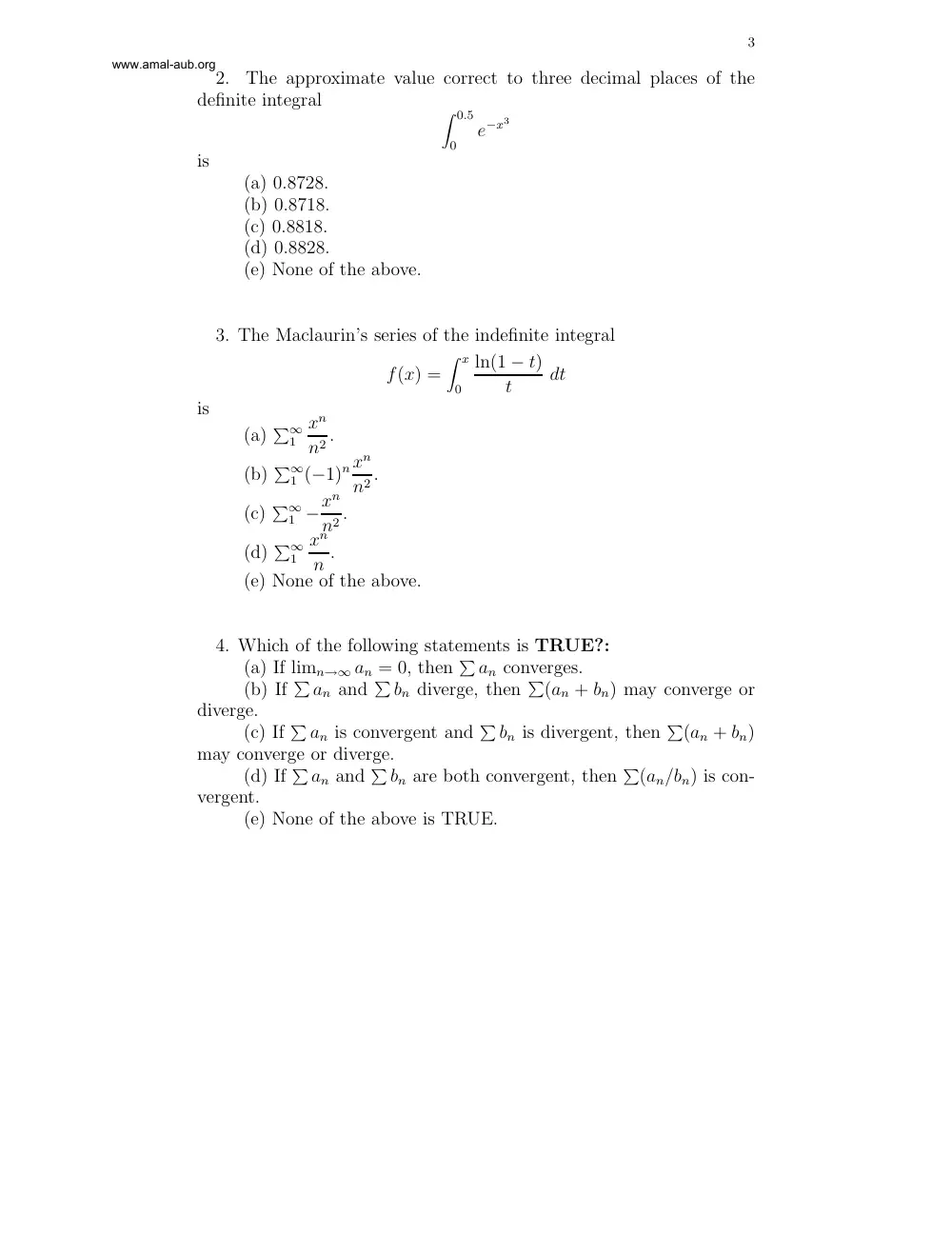
2.
The approximate value correct to three decimal places of the
definite integral
� 0.5
0
e−x3
is
(a) 0.8728.
(b) 0.8718.
(c) 0.8818.
(d) 0.8828.
(e) None of the above.
3. The Maclaurin’s series of the indefinite integral
f(x) =
� x
0
ln(1 − t)
t
dt
is
(a)
�∞
1
xn
n2 .
(b)
�∞
1 (−1)nxn
n2 .
(c) �∞
1 −xn
n2 .
(d) �∞
1
xn
n .
(e) None of the above.
4. Which of the following statements is TRUE?:
(a) If limn→∞ an = 0, then
� an converges.
(b) If
� an and
� bn diverge, then
�(an + bn) may converge or
diverge.
(c) If � an is convergent and � bn is divergent, then �(an + bn)
may converge or diverge.
(d) If
� an and
� bn are both convergent, then
�(an/bn) is con-
vergent.
(e) None of the above is TRUE.
www.amal-aub.org