
MATH 201 Exam 1, Fall 2001
American University of Beirut · Calculus and Analytical Geometry III · 5 pages
More MATH 201 files
Show the text of this exam
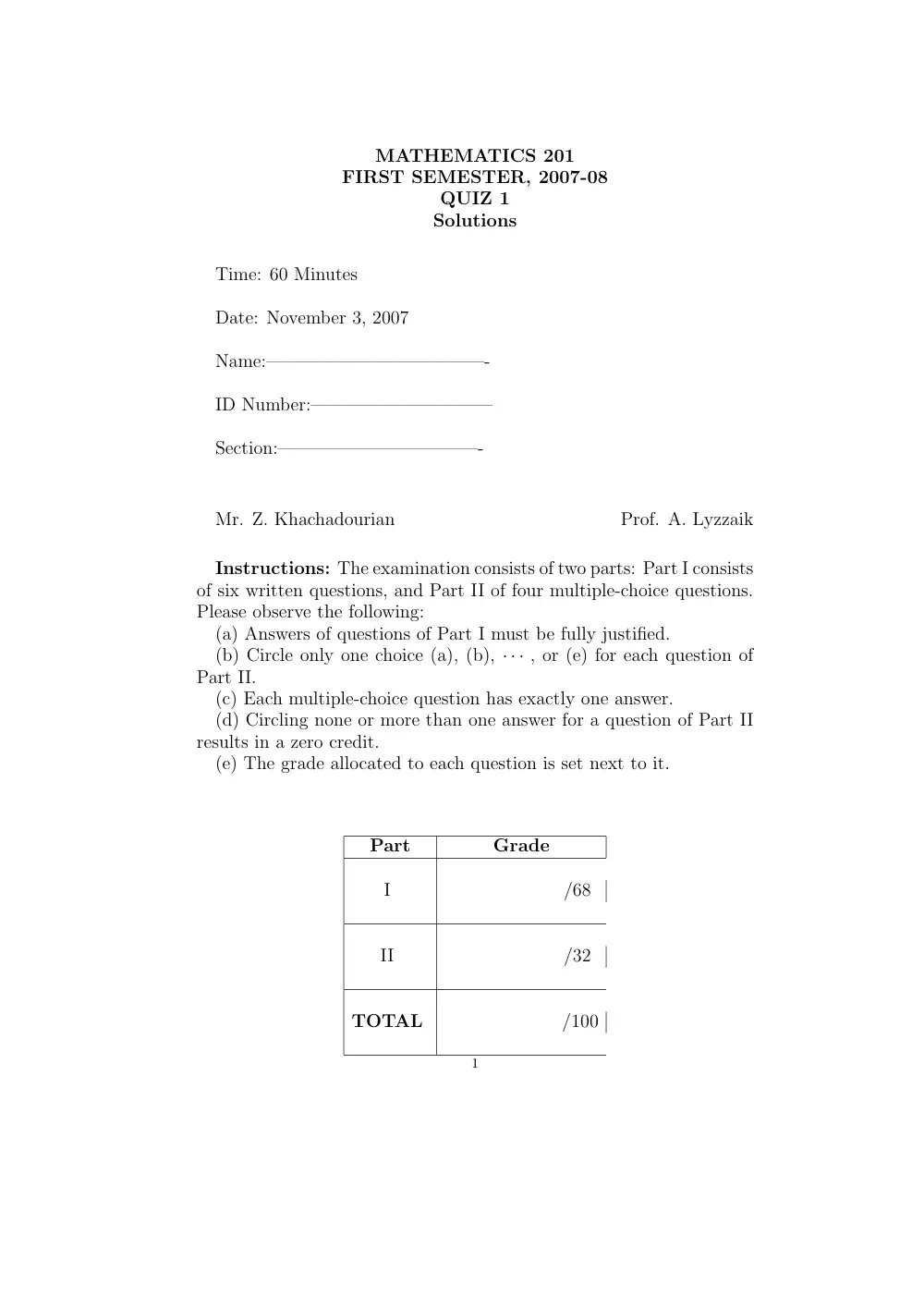
MATHEMATICS 201
FIRST SEMESTER, 2007-08
QUIZ 1
Solutions
Time: 60 Minutes
Date: November 3, 2007
Name:————————————-
ID Number:——————————
Section:———————————-
Mr. Z. Khachadourian
Prof. A. Lyzzaik
Instructions: The examination consists of two parts: Part I consists
of six written questions, and Part II of four multiple-choice questions.
Please observe the following:
(a) Answers of questions of Part I must be fully justified.
(b) Circle only one choice (a), (b), · · · , or (e) for each question of
Part II.
(c) Each multiple-choice question has exactly one answer.
(d) Circling none or more than one answer for a question of Part II
results in a zero credit.
(e) The grade allocated to each question is set next to it.
Part
Grade
I
/68
II
/32
TOTAL
/100
1
2
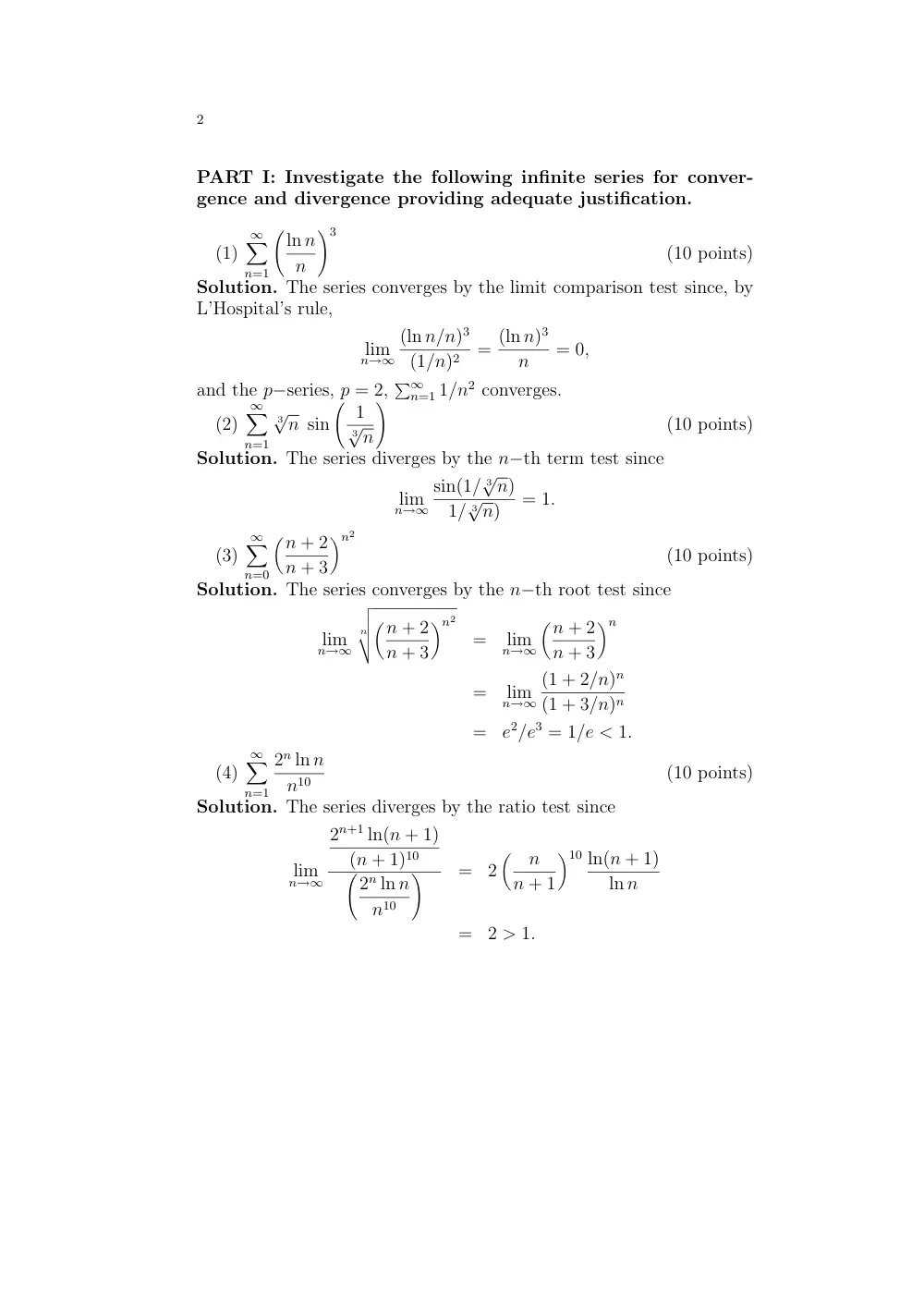
PART I: Investigate the following infinite series for conver-
gence and divergence providing adequate justification.
(1)
∞
�
n=1
�ln n
n
�3
(10 points)
Solution. The series converges by the limit comparison test since, by
L’Hospital’s rule,
lim
n→∞
(ln n/n)3
(1/n)2
= (ln n)3
n
= 0,
and the p−series, p = 2, �∞
n=1 1/n2 converges.
(2)
∞
�
n=1
3√n sin
� 1
3√n
�
(10 points)
Solution. The series diverges by the n−th term test since
lim
n→∞
sin(1/ 3√n)
1/ 3√n)
= 1.
(3)
∞
�
n=0
�n + 2
n + 3
�n2
(10 points)
Solution. The series converges by the n−th root test since
lim
n→∞
n
�
�
�
�
�n + 2
n + 3
�n2
=
lim
n→∞
�n + 2
n + 3
�n
=
lim
n→∞
(1 + 2/n)n
(1 + 3/n)n
=
e2/e3 = 1/e < 1.
(4)
∞
�
n=1
2n ln n
n10
(10 points)
Solution. The series diverges by the ratio test since
lim
n→∞
2n+1 ln(n + 1)
(n + 1)10
�2n ln n
n10
�
=
2
�
n
n + 1
�10 ln(n + 1)
ln n
=
2 > 1.
3
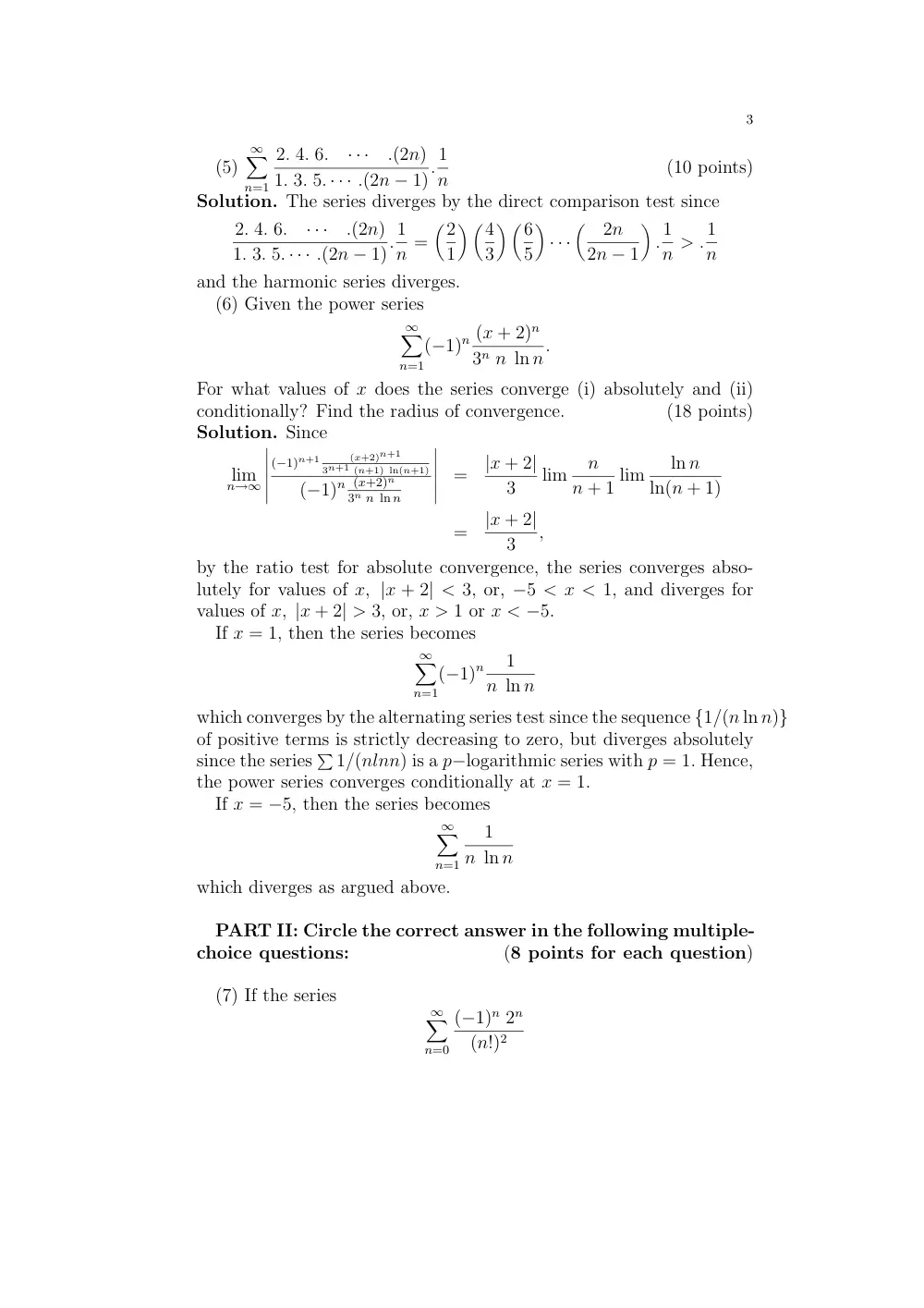
(5)
∞
�
n=1
2. 4. 6.
· · ·
.(2n)
1. 3. 5. · · · .(2n − 1).1
n
(10 points)
Solution. The series diverges by the direct comparison test since
2. 4. 6.
· · ·
.(2n)
1. 3. 5. · · · .(2n − 1).1
n =
�2
1
� �4
3
� �6
5
�
· · ·
�
2n
2n − 1
�
.1
n > .1
n
and the harmonic series diverges.
(6) Given the power series
∞
�
n=1
(−1)n (x + 2)n
3n n ln n.
For what values of x does the series converge (i) absolutely and (ii)
conditionally? Find the radius of convergence.
(18 points)
Solution. Since
lim
n→∞
������
(−1)n+1
(x+2)n+1
3n+1 (n+1) ln(n+1)
(−1)n (x+2)n
3n n ln n
������
=
|x + 2|
3
lim
n
n + 1 lim
ln n
ln(n + 1)
=
|x + 2|
3
,
by the ratio test for absolute convergence, the series converges abso-
lutely for values of x, |x + 2| < 3, or, −5 < x < 1, and diverges for
values of x, |x + 2| > 3, or, x > 1 or x < −5.
If x = 1, then the series becomes
∞
�
n=1
(−1)n
1
n ln n
which converges by the alternating series test since the sequence {1/(n ln n)}
of positive terms is strictly decreasing to zero, but diverges absolutely
since the series � 1/(nlnn) is a p−logarithmic series with p = 1. Hence,
the power series converges conditionally at x = 1.
If x = −5, then the series becomes
∞
�
n=1
1
n ln n
which diverges as argued above.
PART II: Circle the correct answer in the following multiple-
choice questions:
(8 points for each question)
(7) If the series
∞
�
n=0
(−1)n 2n
(n!)2
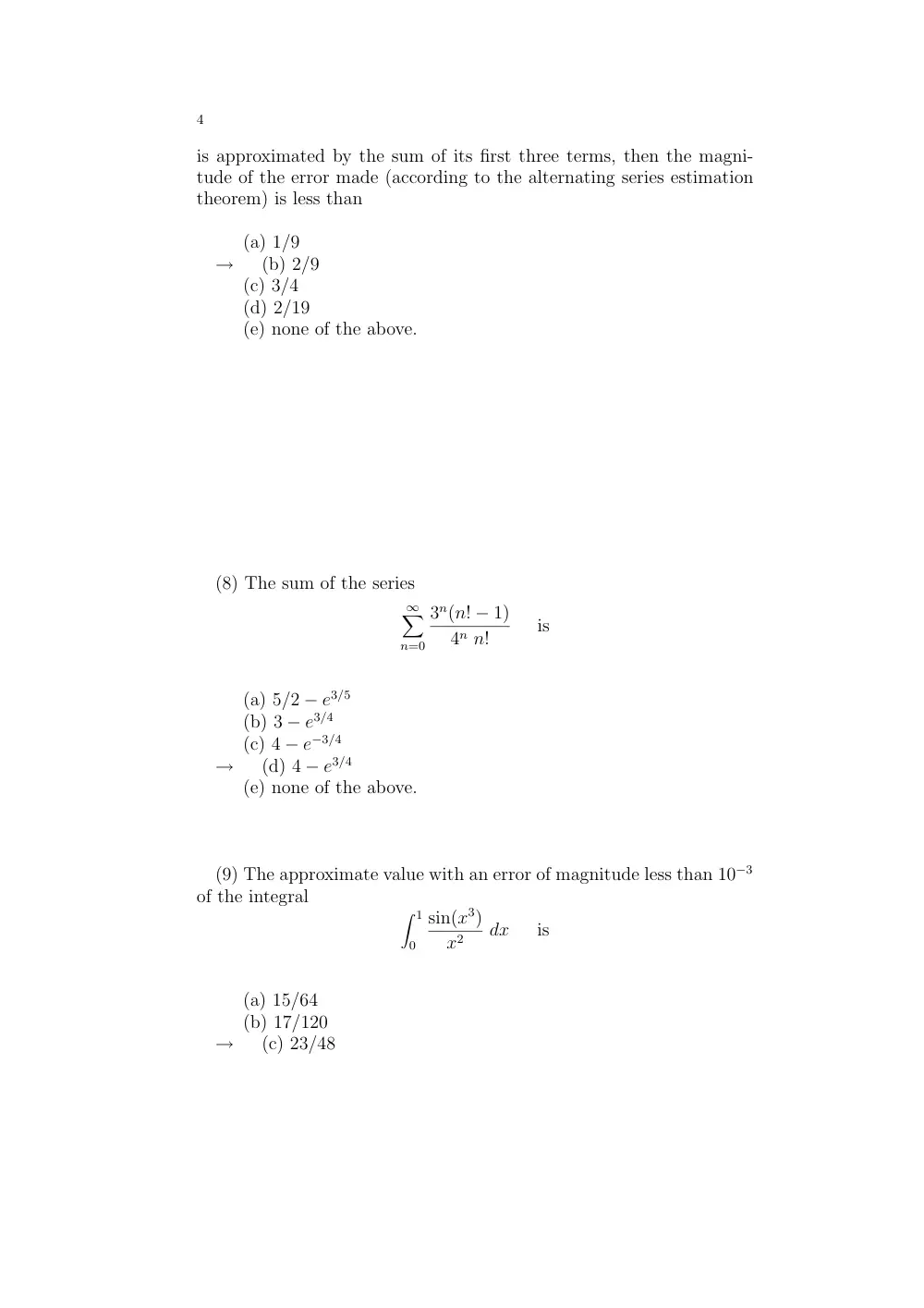
4
is approximated by the sum of its first three terms, then the magni-
tude of the error made (according to the alternating series estimation
theorem) is less than
(a) 1/9
→
(b) 2/9
(c) 3/4
(d) 2/19
(e) none of the above.
(8) The sum of the series
∞
�
n=0
3n(n! − 1)
4n n!
is
(a) 5/2 − e3/5
(b) 3 − e3/4
(c) 4 − e−3/4
→
(d) 4 − e3/4
(e) none of the above.
(9) The approximate value with an error of magnitude less than 10−3
of the integral
� 1
0
sin(x3)
x2
dx
is
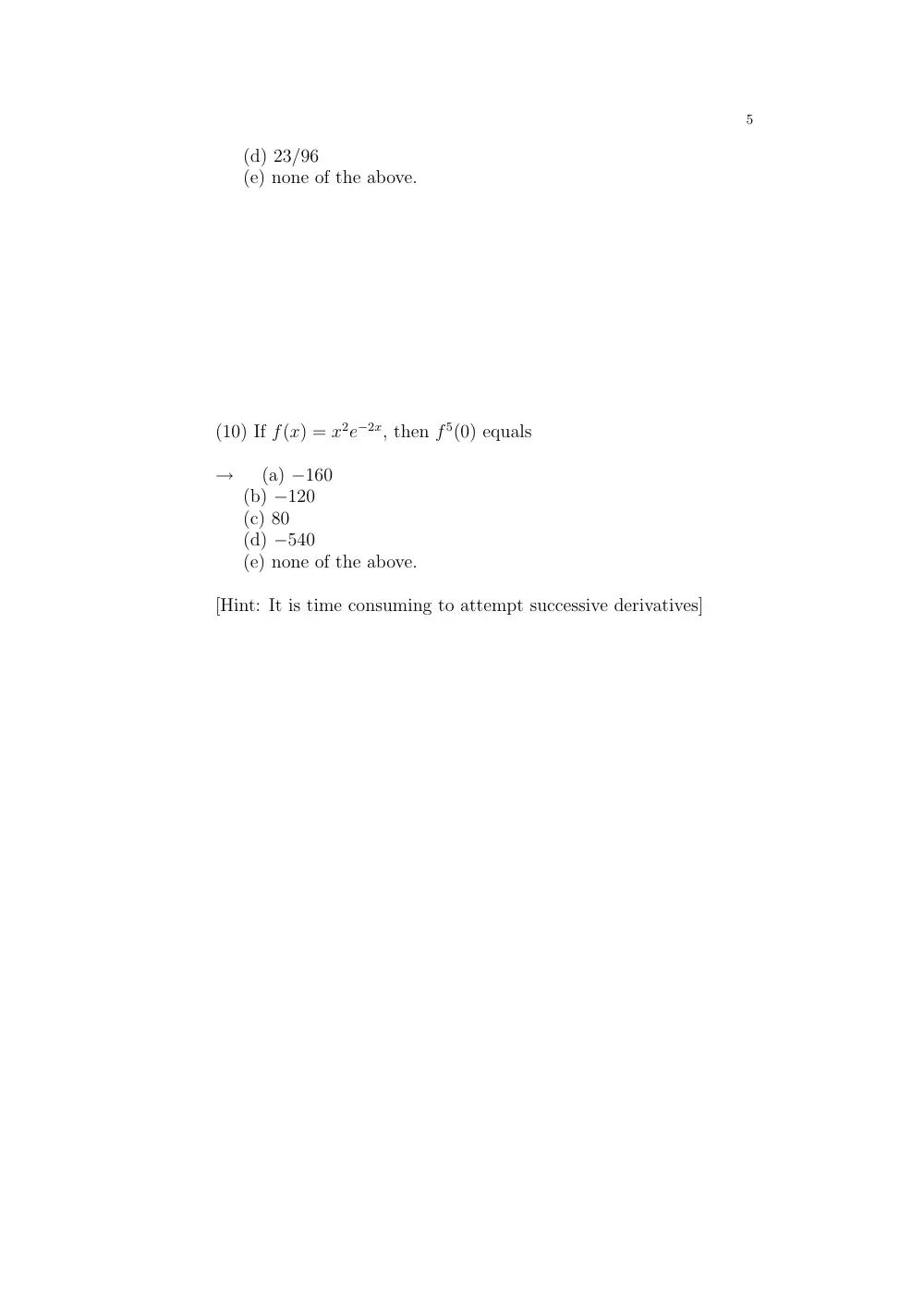
(a) 15/64
(b) 17/120
→
(c) 23/48
5
(d) 23/96
(e) none of the above.
(10) If f(x) = x2e−2x, then f 5(0) equals
→
(a) −160
(b) −120
(c) 80
(d) −540
(e) none of the above.
[Hint: It is time consuming to attempt successive derivatives]