
MATH 201 Exam 1, Fall 2005
American University of Beirut · Calculus and Analytical Geometry III · 8 pages · Prof. Kamal Makdisi
More MATH 201 files
Show the text of this exam
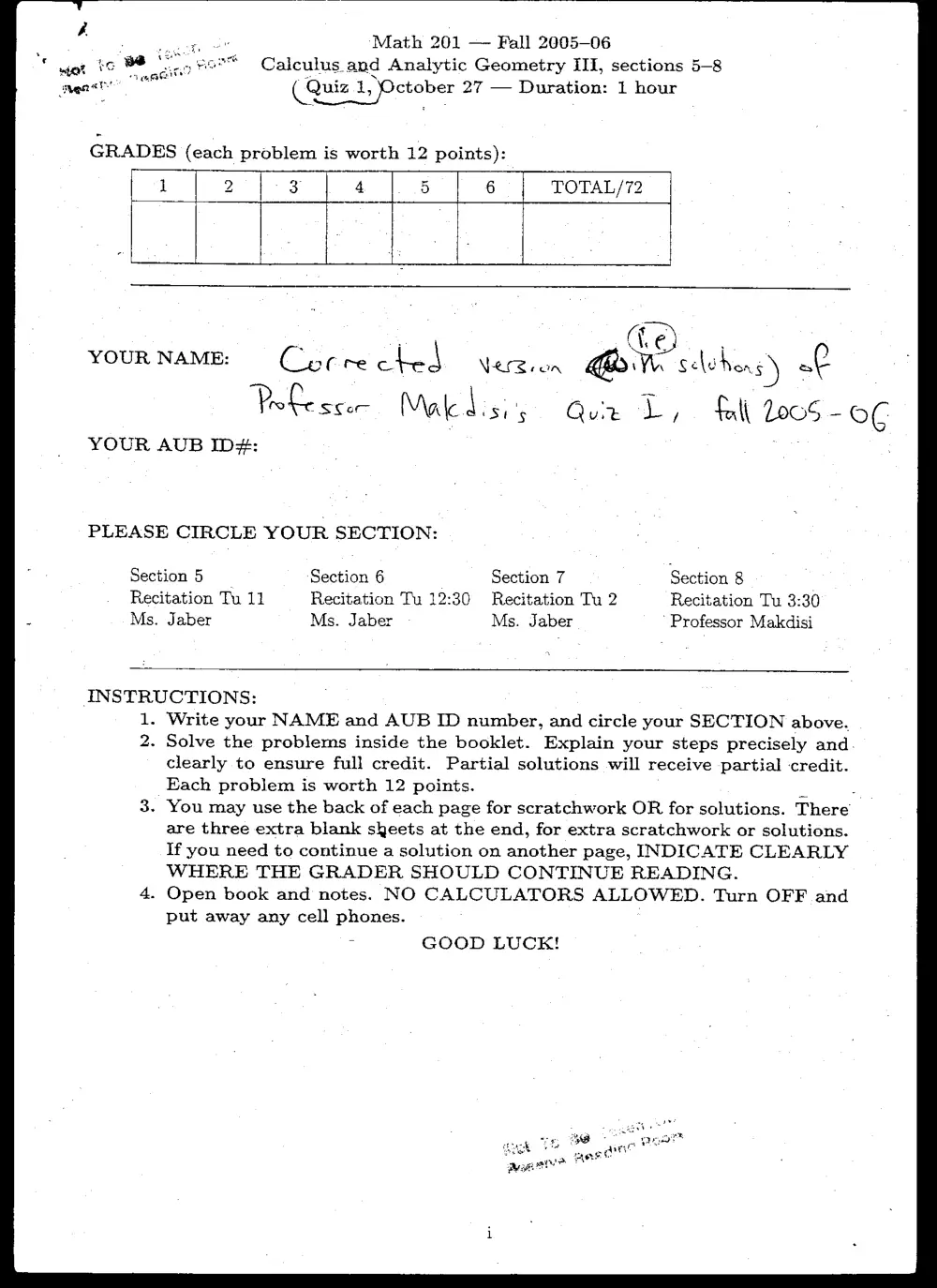
A : Math 201 — Fall 2005-06
*s war 1c Be eee gant Calculus_and Analytic Geometry III, sections 5-8
opens! eee ( Quiz 1, October 27 — Duration: 1 hour
GRADES (each problem is worth 12 points):
1 2 3 4 5 6 TOTAL/72
Qe),
YOURNAME: (Caycreched \yerron I cclchons) me
Vokescer Makdisis Qua L, fall 2005-06
YOUR AUB ID#:
PLEASE CIRCLE YOUR SECTION:
Section 5 Section 6 Section 7 Section 8
Recitation Tu 11 Recitation Tu 12:30 Recitation Tu 2 Recitation Tu 3:30
- Ms. Jaber Ms. Jaber Ms. Jaber Professor Makdisi
INSTRUCTIONS:
1. Write your NAME and AUB ID number, and circle your SECTION above.
2. Solve the problems inside the booklet. Explain your steps precisely and
clearly to ensure full credit. Partial solutions will receive partial credit.
Each problem is worth 12 points. _ .
3. You may use the back of each page for scratchwork OR for solutions. There’
are three extra blank sheets at the end, for extra scratchwork or solutions.
If you need to continue a solution on another page, INDICATE CLEARLY
WHERE THE GRADER SHOULD CONTINUE READING.
4. Open book and notes. NO CALCULATORS ALLOWED. Turn OFF and
put away any cell phones.
- GOOD LUCK!
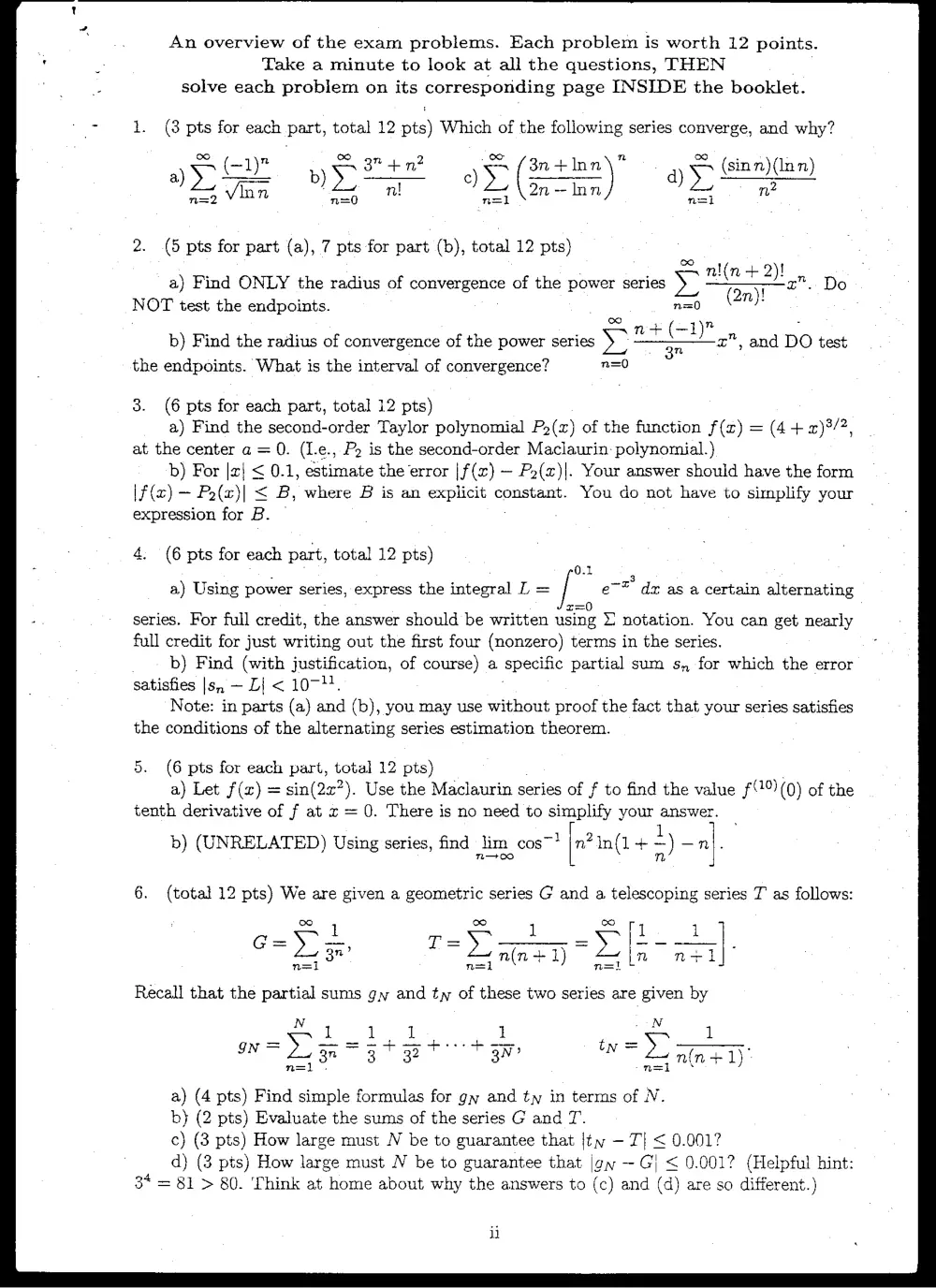
An overview of the exam problems. Each problem is worth 12 points.
Take a minute to look at all the questions, THEN
solve each problem on its corresponding page INSIDE the booklet.
1. (3 pts for each part, total 12 pts) Which of the following series converge, and why?
foo] we n oo :
3" +n? 3n + Inn (sinn)(Inn)
v) > nl 1 (Es) pe ne
n=0 n= n=
2. (5 pts for part (a), 7 pts for part (b), total 12 pts)
Wn+2
a) Find ONLY the radius of convergence of the power series 3 niin + 2)!
NOT test the endpoints. n=0 (2n)!
n+ (~1)"
37
z”. Do
b) Find the radius of convergence of the power series > az”, and DO test
the endpoints. What is the interval of convergence? n=0
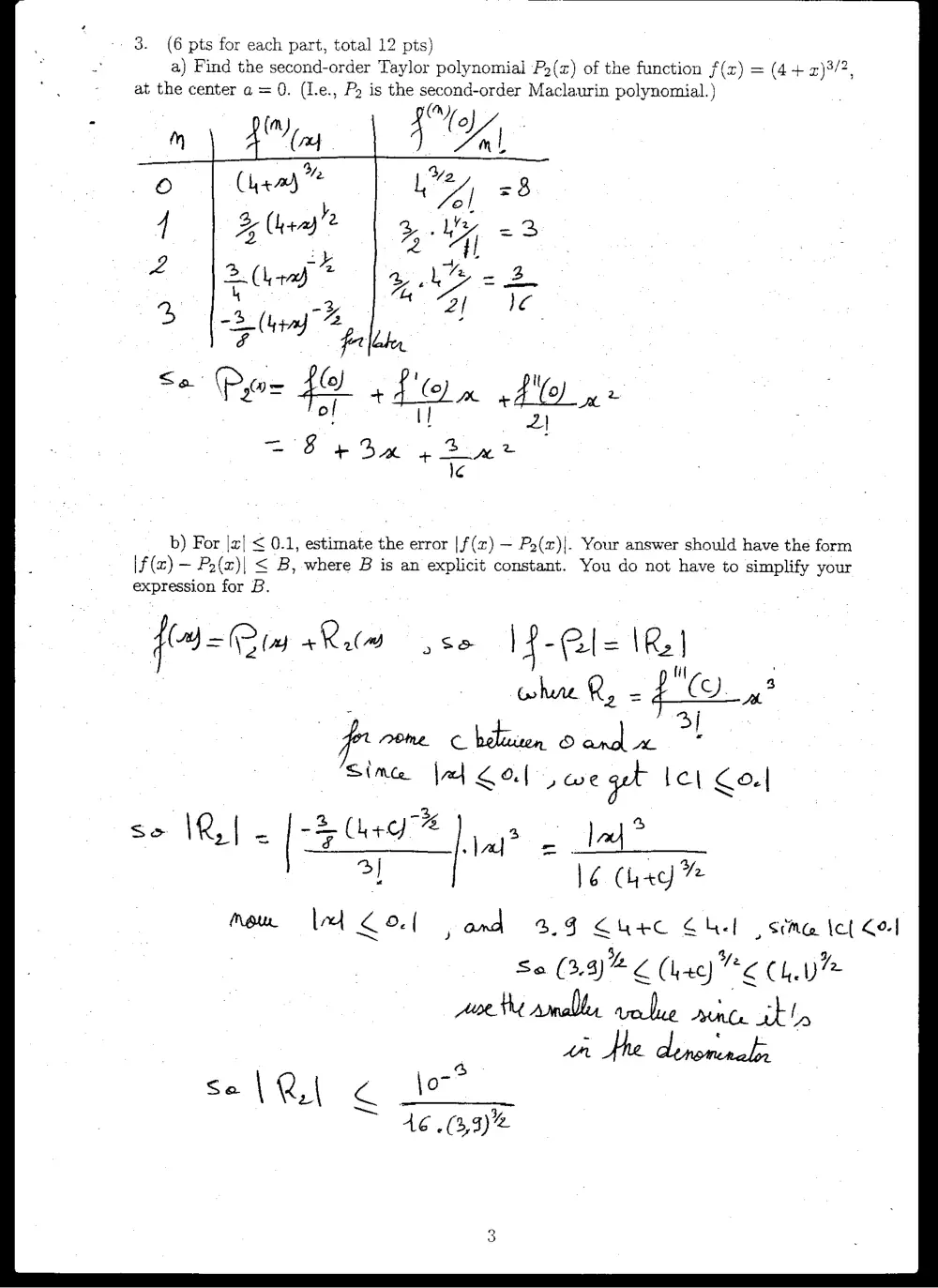
3. (6 pts for each part, total 12 pts)
a) Find the second-order Taylor polynomial P(x) of the function f(z) = (4+ 2)9/?,
at the center a = 0. (Le., P) is the second-order Maclaurin- polynomial.)
b) For |z| < 0.1, estimate the error | f(x) — P2(z)|. Your answer should have the form
|f(z) — P2(z)| < B, where B is an explicit constant. You do not have to simplify your
expression for B. © ;
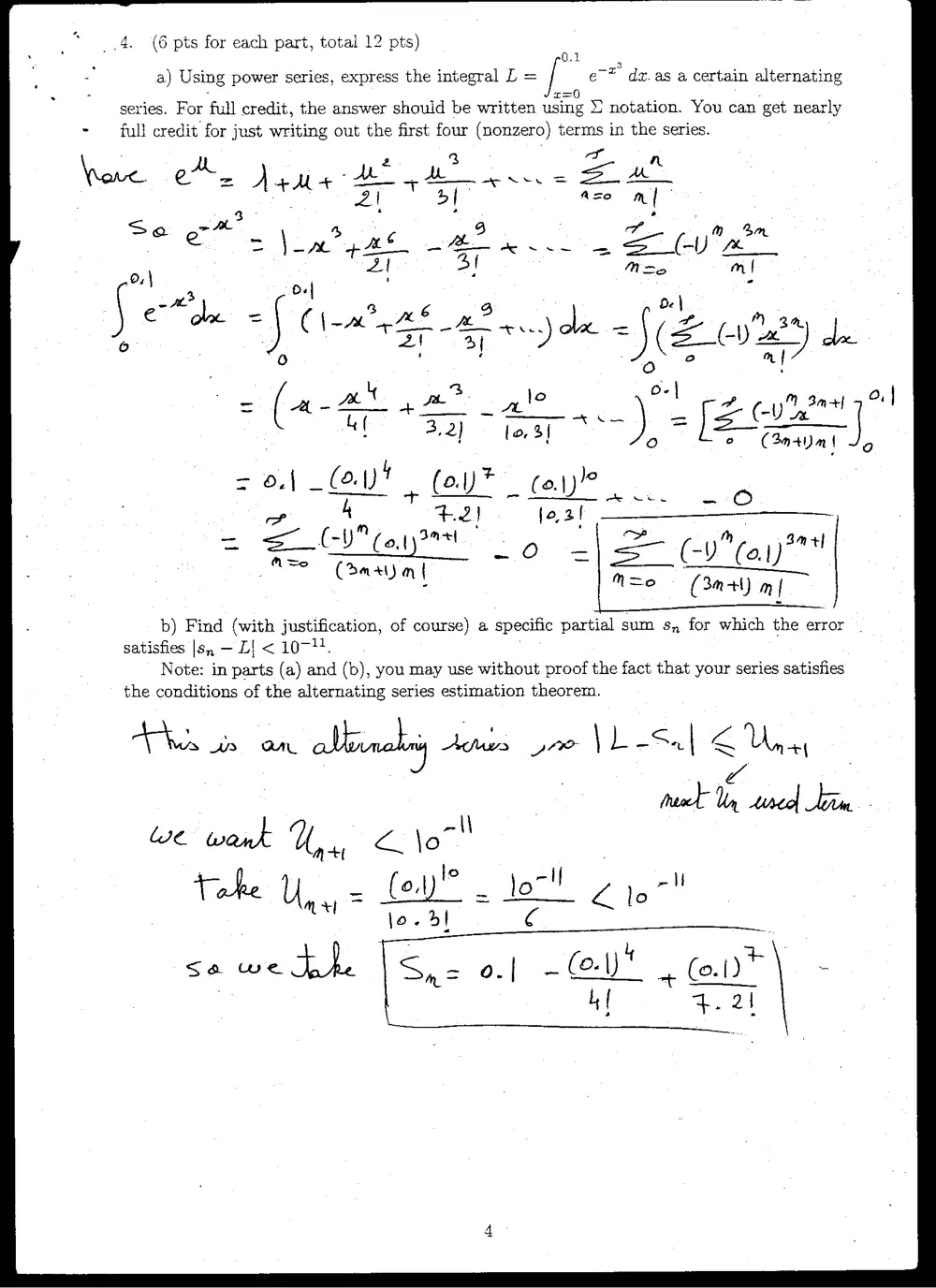
4. (6 pts for each part, total 12 pts)
0.1
a) Using power series, express the integral L = [ e~* dz as a certain alternating
x=0
series. For full credit, the answer should be written using X notation. You can get nearly
full credit for just writing out the first four (nonzero) terms in the series.
b) Find (with justification, of course) a specific partial sum s,, for which the error
satisfies |s, — Z| < 1071.
Note: in parts (a) and (b), you may use without proof the fact that your series satisfies
the conditions of the alternating series estimation theorem.
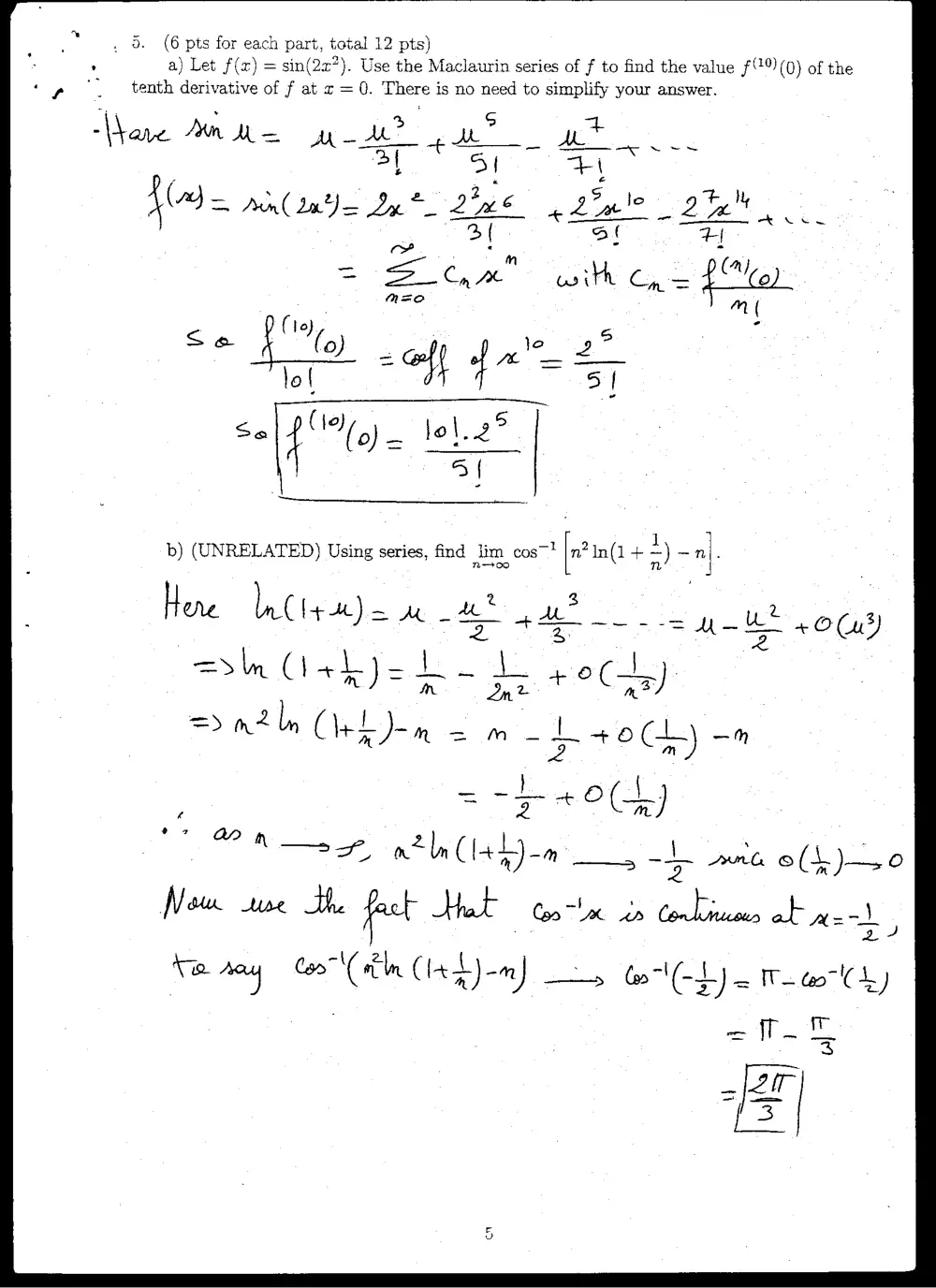
5. (6 pts for each part, total 12 pts) ;
a) Let f(z) = sin(2x). Use the Maclaurin series of f to find the value f°) (0) of the
tenth derivative of f at z = 0. There is no need to simplify your answer.
b) (UNRELATED) Using series, find lim cos™+ fe? In(l+ =) - al.
rm 0O
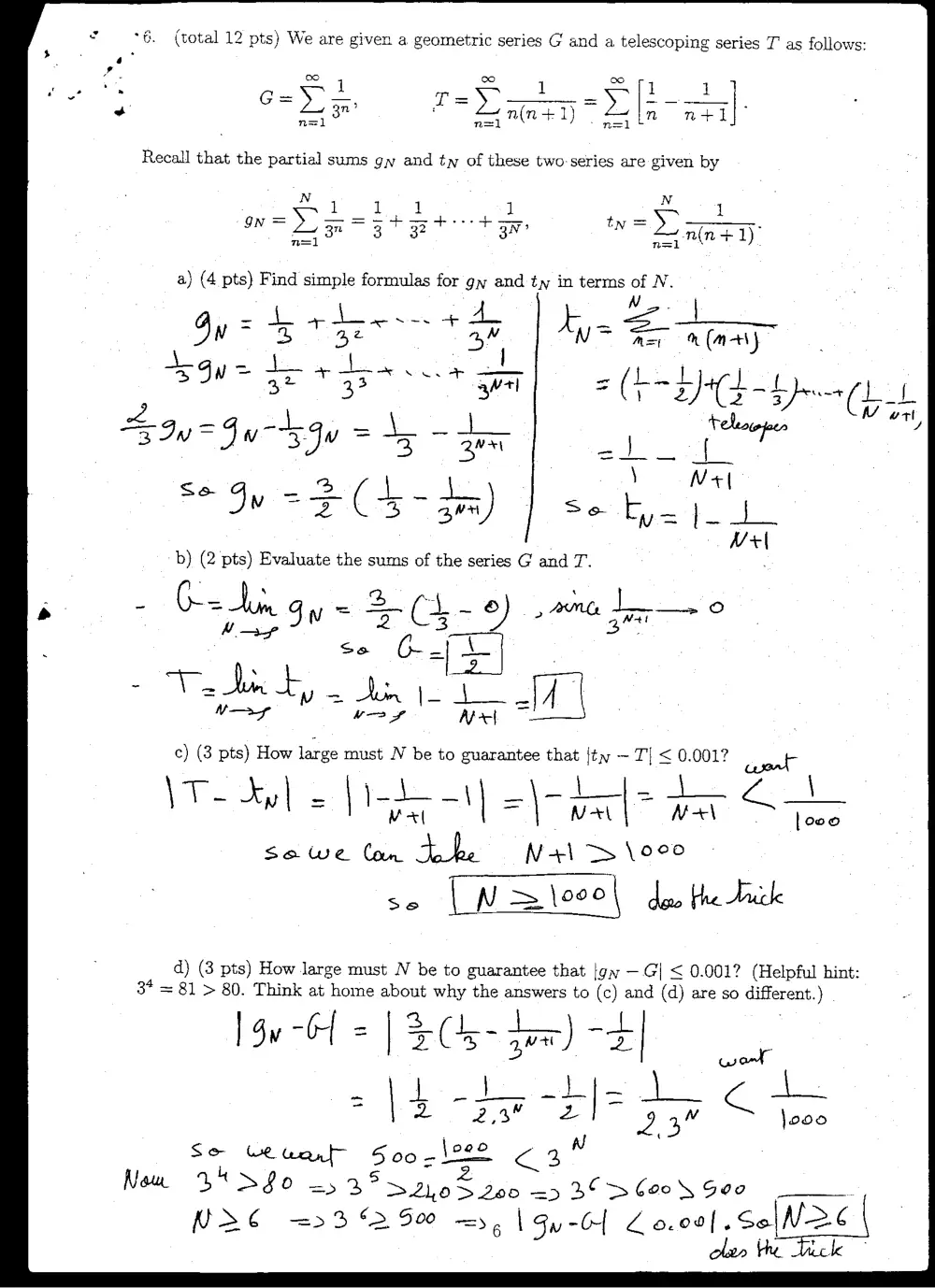
6. (total 12 pts) We are given a geometric series G and a telescoping series T as follows:
eo Co
1 1 1
; T => —_—_ -— .
n=1 n=l
Recall that the partial sums gy and ty of these two series are given by
N N
1 1 1 1 1
= —- 2 wae tvn= —__.,
2d gn 3 ge BP v= ami)
n=l
a) (4 pts) Find simple formulas for gy and ty in terms of N.
by (2 pts) Evaluate the sums of the series G and T.
c) (3 pts) How large must N be to guarantee that |ty — Z| < 0.001?
d) (3 pts) How large must N be to guarantee that |g~ - G| < 0.001? (Helpful hint:
3* = 81 > 80. Think at home about why the answers to (c) and (d) are so different.)
il
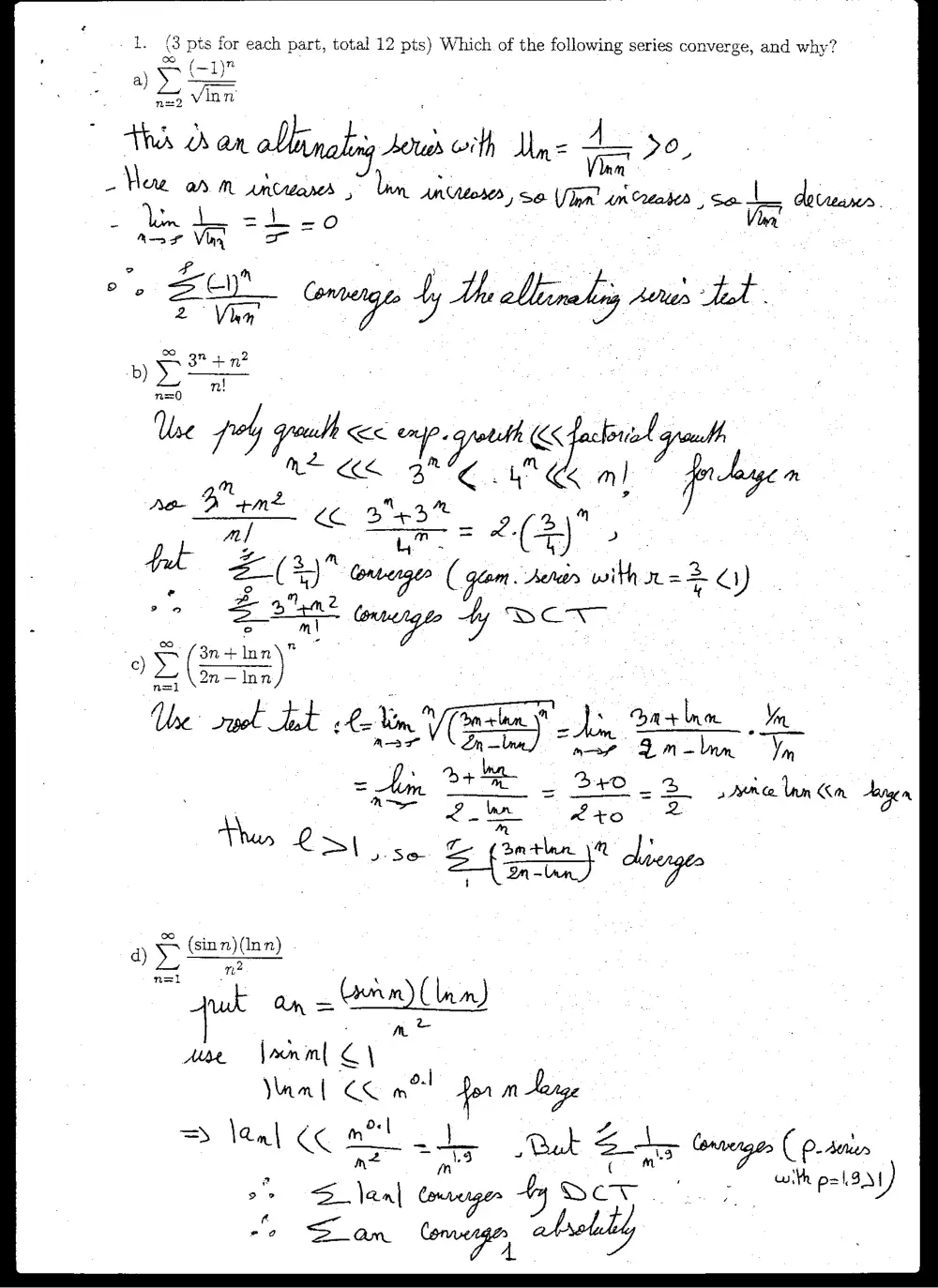
OL va ts oe each part, total 12 pts) Which of the following series converge, and why?
DO
J
- Vee a M Amitares , in Antone, 0. Ten uni coeatca . sex A decreaner
=O . Vie
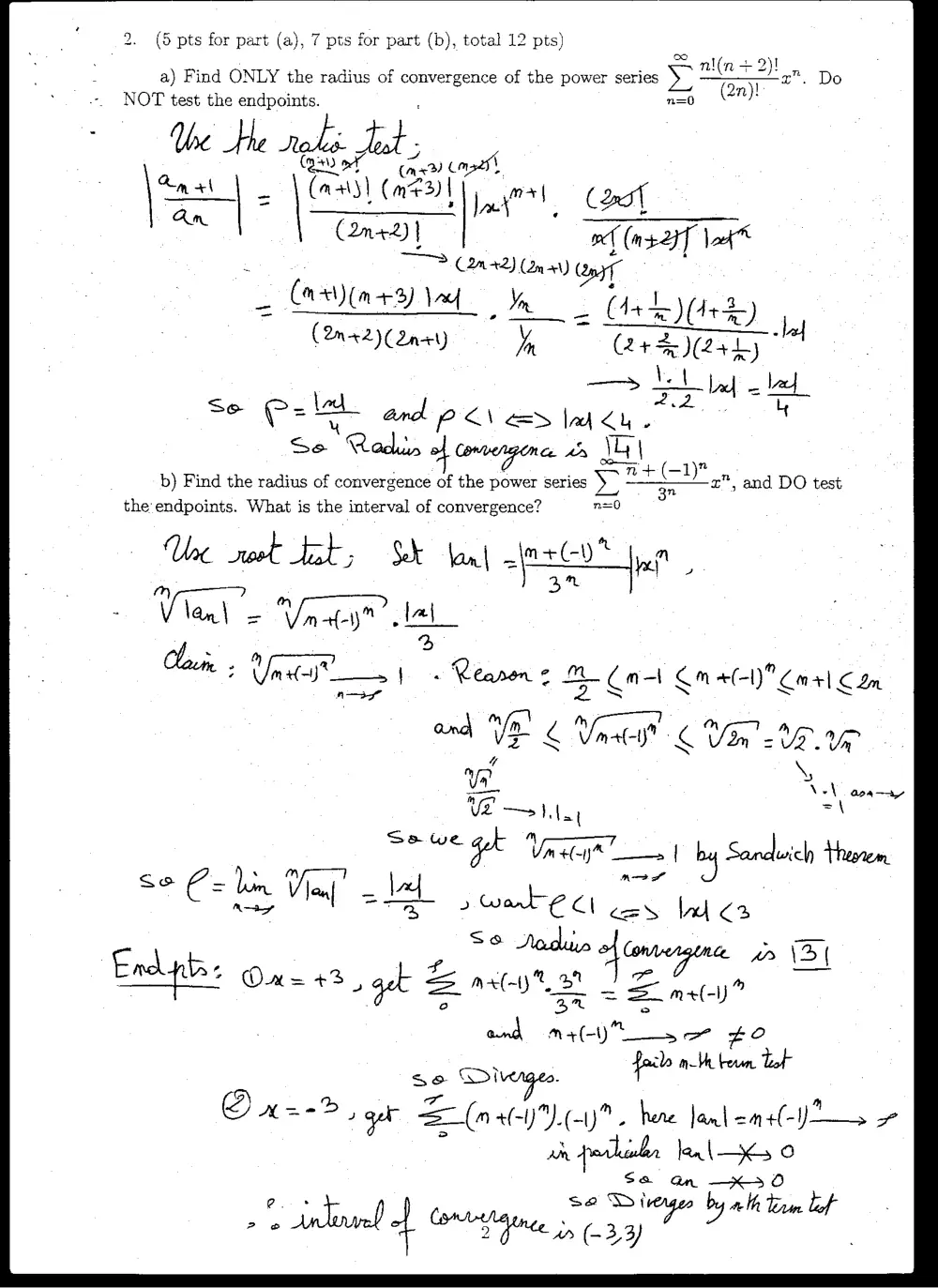
2. (5 pts for part (a), 7 pts for part (b), total 12 pts)
. a) Find ONLY the radius of convergence of the power series 3 ni( n+ 3) z”. Do
-. NOT test the endpoints. n=0 (2n)!
a or aN) eat (a a
\
se ee,
Gnd] wel (ms-24f Vat
> (20-42) (On -at) (p47 De
(arin TY me ah Ore)
(2m+2)( n+l) yy (2+ Z)(@aky lef
|
> ld ed
2.2 ra
Se eat sede 6) ee Ind Cu _ rm
Se * Qaden Conenzen
b) Find the radius of conver oh the —_ aie 4 (= vie
‘in verg power Series = Bn ™ and DO test
the endpoints. What is the interval of convergence? n=0
Une soot Set, vk \an| “pee wel
mt" | Reanen ¢ aA Oma) mal Can
§
a”
m mh
od WE CU (Ui Rg
y \
Va \ “\ aoa
VE hay =\ ~
Se we gk Vaugr_—» | by Sarah Hoven
Sed acs soled ces Wh O23
so Solvenges.
Ox=-%, wal Za (met. here fanlene(--_s +
1k poh lan ls 0
Se eye by ah
dh ope 5h
ww» (-3
3. (6 pts for each part, total 12 pts)
a) Find the second-order Taylor polynomial P(x) of the function f(z) = (4+ 2)3/2,
at the center a = 0. (I.e., P2 is the second-order Maclaurin polynomial.)
; (Yop
om | Aa L j ZK
oO | (ie Le,
y ae
Z, 2
4 en 2 4% =
2 = 2 (hand eh - 3.
2 -3 4 2/ Me
3 So (4eg “7 °
fer labor
ca Pye acs + te mh x YW ut
Uf 2)
= 8 + ame +a
b) For |z| < 0.1, estimate the error |f(z) — Po(xr)|. Your answer should have the form
|f(z) ~ Po(x)| < B, where B is an explicit constant. You do not have to simplify your
expression for B.
fy = (Qu Ral 9 Se i @l= IR, |
; ao) we
25
cp.
eld fa" a -
1g (hag
ROU. 4 K | J and 3g fu+ee GC kel 5 SiMe tel Co-|
Se (39) * ¢ (hag) 6 Ch.0%
an Hhe deromralr
2
oO
_.4. (6 pts for each part, total 12 pts)
0.1
a) Using power series, express the integral ED = e-™ dz.as a certain alternating
x=0
series. For ‘full credit, the answer should be written using © notation. You can ‘get nearly
full credit for just writing out the first four (nonzero) terms in the series.
lo. 3{
, (o* coy?
7 73) joa!
= = a 6)
Cdm4\)m |
ee Soe
ho
N=o Fae m
b) Find (with justification, of course) a specific partial sum s, for which the error .
satisfies |s, — L! < 10711.
Note: in parts (a) and (b), you may use without proof the fact that your series satisfies
the conditions of the alternating series estimation theorem.
. 5. (6 pts for each part, total 12 pts)
a) Let f(x) = sin(2x*). Use the Maclaurin series of f to find the value f(9)(0) of the
tenth derivative of f at x = 0. There is no need to simplify your answer.
b) (UNRELATED) Using series, find lim cos~?
n—-00
Here Ie Cl4s) = Ae a
2
* 7 ar th
“Nou sue The fet dat Coo “hae
Ve ray too" (4) | sy
(total 12 pts) We are given a geometric series G and a telescoping series T as follows:
°°
a <° 1 1 1
C= Dm ee ese ME eresi
n=l - n=l
Recall that the partial sums gy and ty of these two-series are given by
1
3N”
eee ft
c) (3 pts) How large must N be to guarantee that {ty ~ T| < 0.001?
\T- Al = |t-1| =\-te|= der SF
V+ M~t Jooe
sewe Con dhe N+ \oee
so LN 1000 | des He Paul
d) (3 pts) How large must N be to guarantee that Ign —G] < 0.001? (Helpful hint:
3* = 81 > 80. Think at home about why the answers to (c) and (d) are so different.)
NSC =>3 42500 -<y, | Gu -O Z 0.00/.Se\N>6 |
olan the Tuck