
MATH 201 Exam 1, Spring 2017
American University of Beirut · Calculus and Analytical Geometry III · 6 pages · Prof. Tamer Tlas


More MATH 201 files
Show the text of this exam
Math 201 - Quiz 1 (Spring 17)
T. Tlas
================================================
• Write the answers to questions 2, 3 and 4 on their sheets. The first question has an extra
sheet for you to write your answers on it. Any part of your answers written on the wrong
sheet will not be graded. Note that a sheet of paper has two sides.
• There are 4 problems in total. Some questions have several parts to them. Make sure that
you attempt them all.
• This is a closed book exam and no calculators are allowed.
================================================
Name :
ID # :
Section :
================================================
Q1
Q2
Q3
Q4
TOTAL
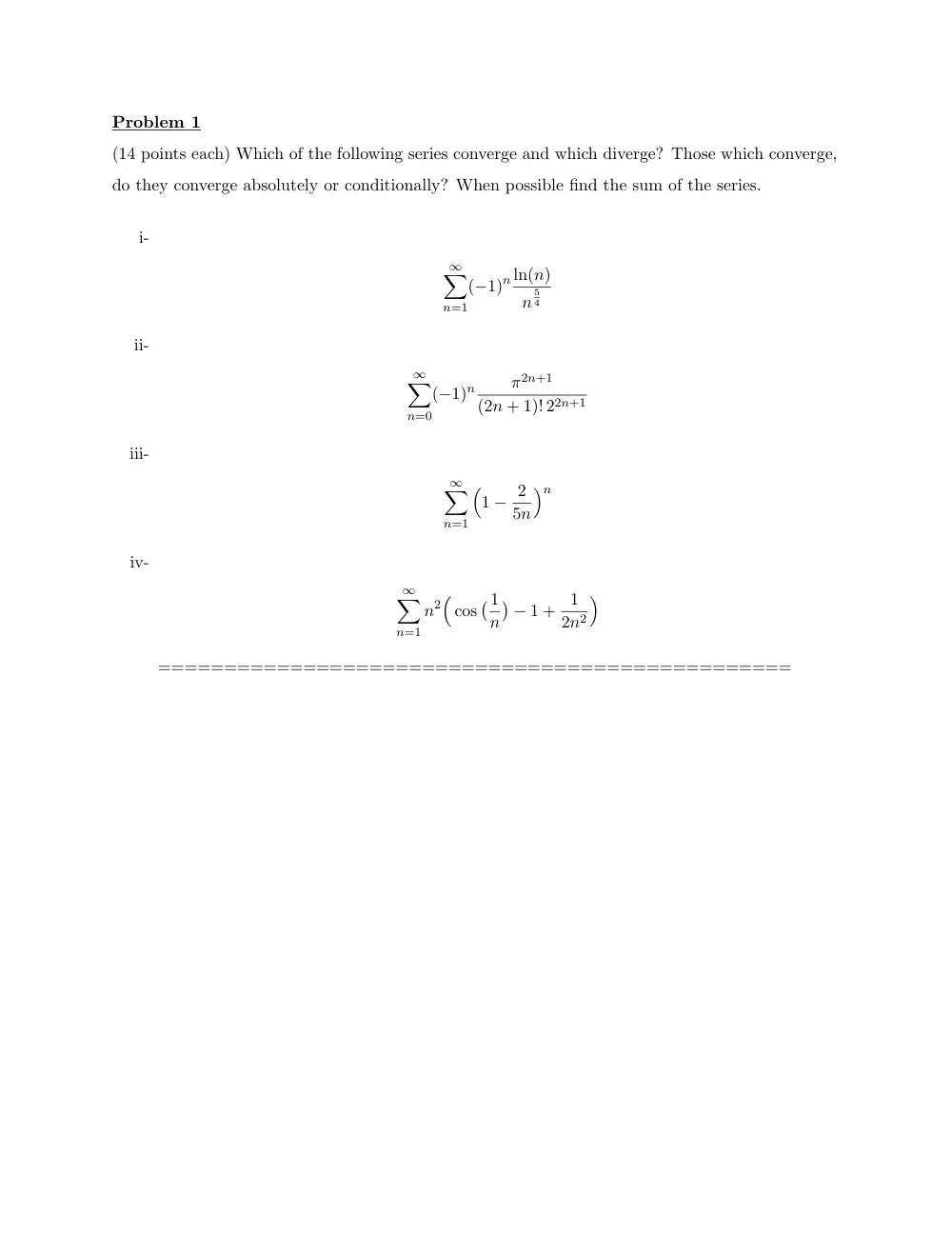
Problem 1
(14 points each) Which of the following series converge and which diverge? Those which converge,
do they converge absolutely or conditionally? When possible find the sum of the series.
i-
∞
�
n=1
(−1)n ln(n)
n
5
4
ii-
∞
�
n=0
(−1)n
π2n+1
(2n + 1)! 22n+1
iii-
∞
�
n=1
�
1 − 2
5n
�n
iv-
∞
�
n=1
n2�
cos
� 1
n
�
− 1 +
1
2n2
�
================================================
ADDITIONAL SHEET FOR PROBLEM 1 ANSWER
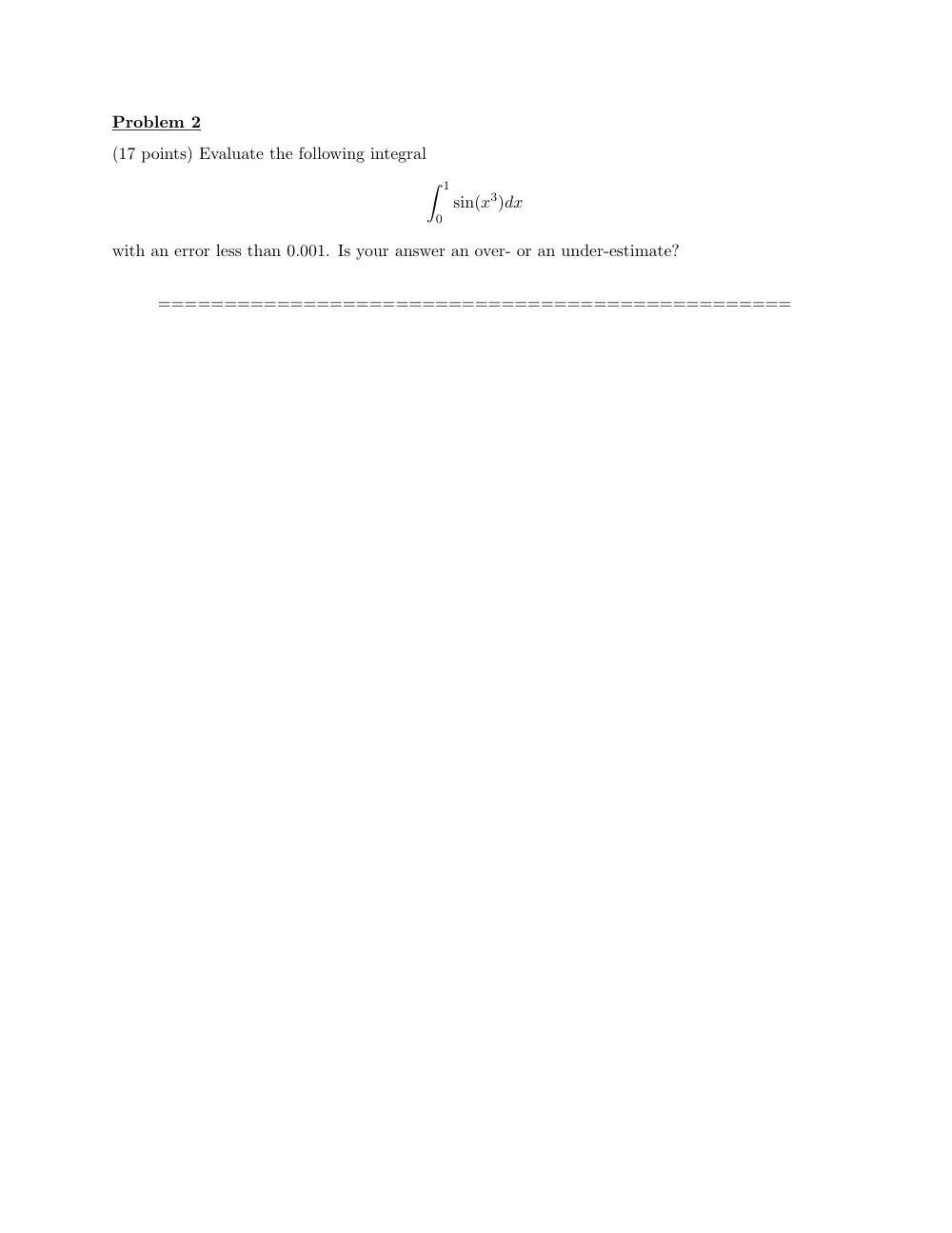
Problem 2
(17 points) Evaluate the following integral
� 1
0
sin(x3)dx
with an error less than 0.001. Is your answer an over- or an under-estimate?
================================================
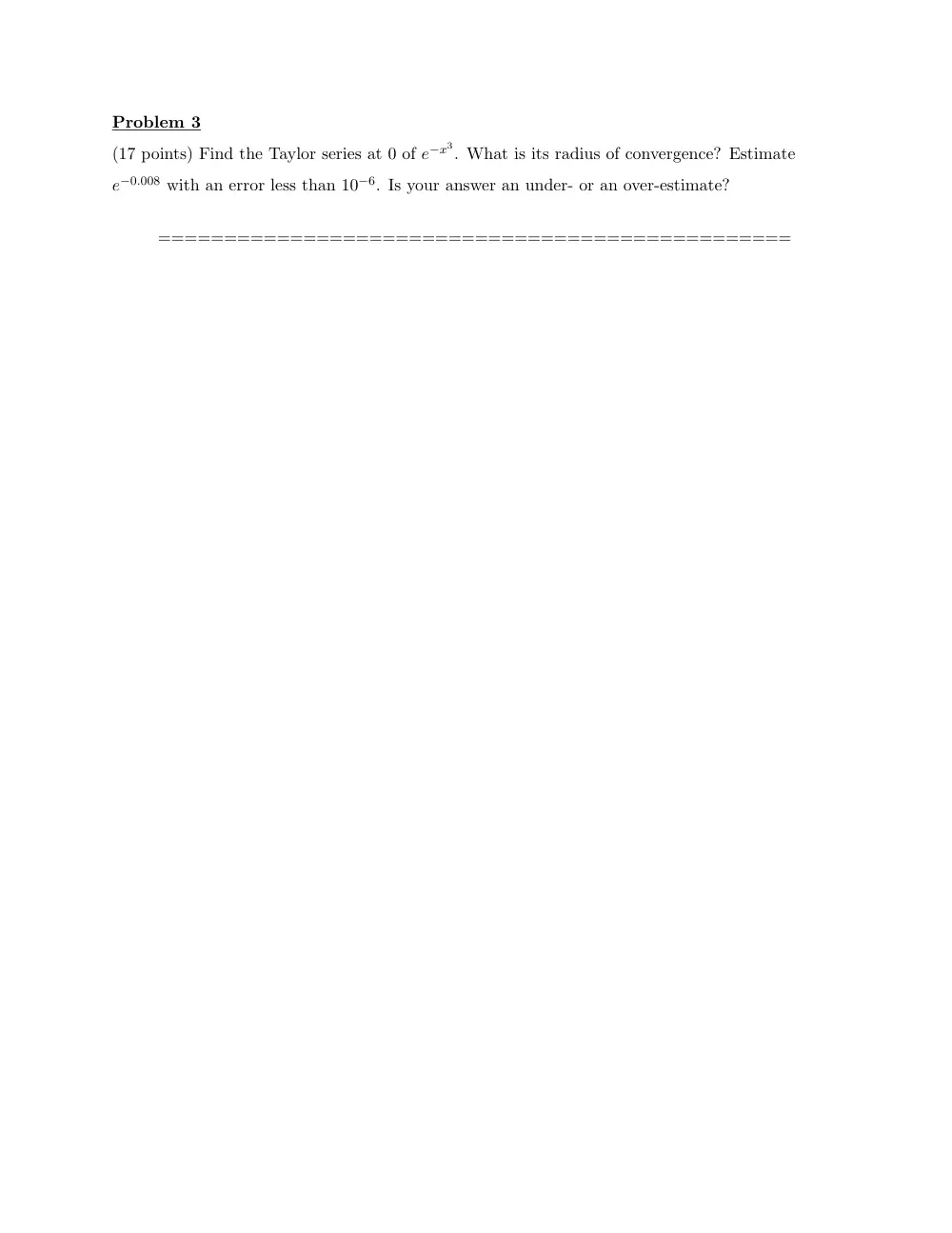
Problem 3
(17 points) Find the Taylor series at 0 of e−x3. What is its radius of convergence? Estimate
e−0.008 with an error less than 10−6. Is your answer an under- or an over-estimate?
================================================
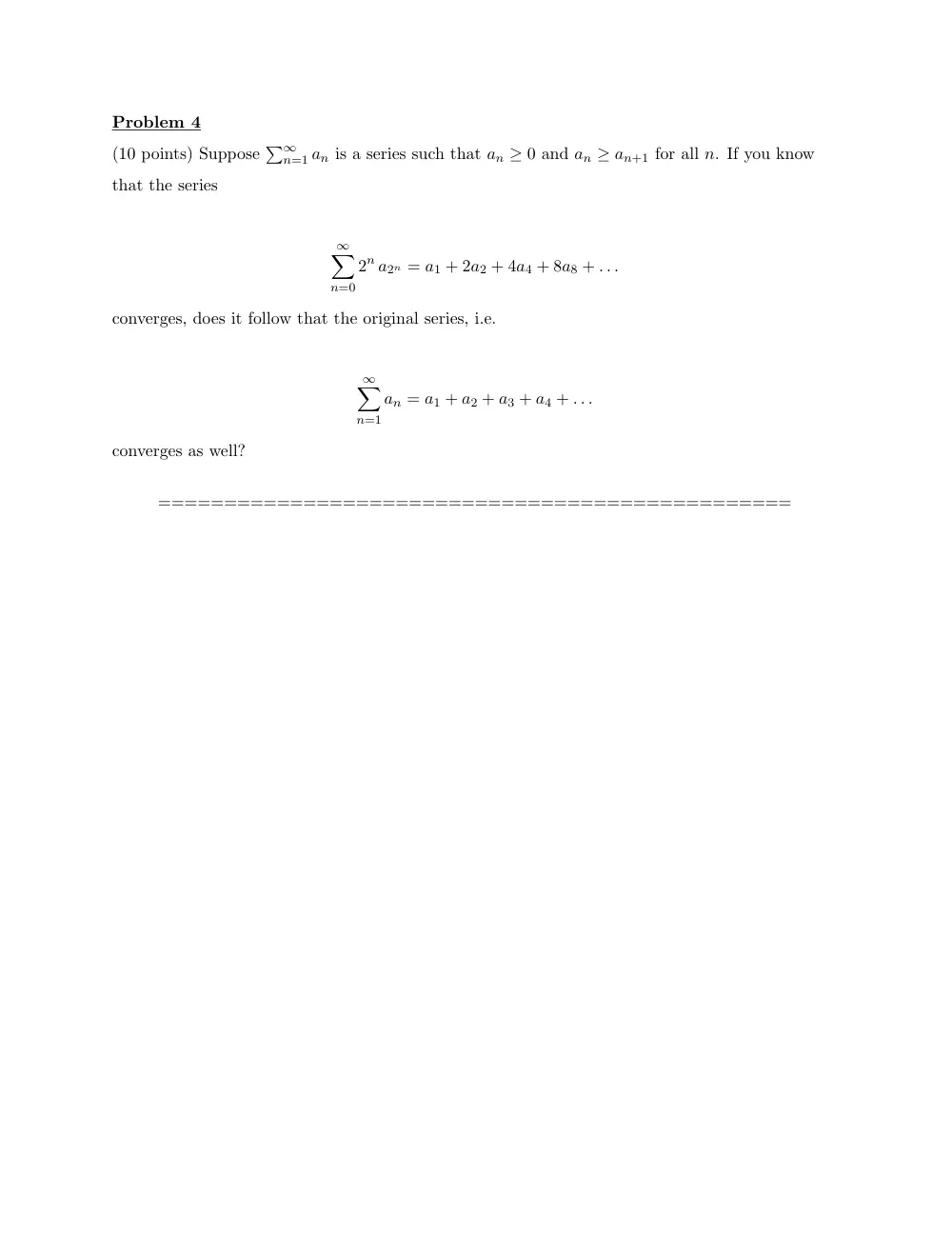
Problem 4
(10 points) Suppose �∞
n=1 an is a series such that an ≥ 0 and an ≥ an+1 for all n. If you know
that the series
∞
�
n=0
2n a2n = a1 + 2a2 + 4a4 + 8a8 + . . .
converges, does it follow that the original series, i.e.
∞
�
n=1
an = a1 + a2 + a3 + a4 + . . .
converges as well?
================================================