
MATH 201 Exam 2, Fall 2004
American University of Beirut · Calculus and Analytical Geometry III · 8 pages · Prof. Kamal Makdisi
More MATH 201 files
Show the text of this exam
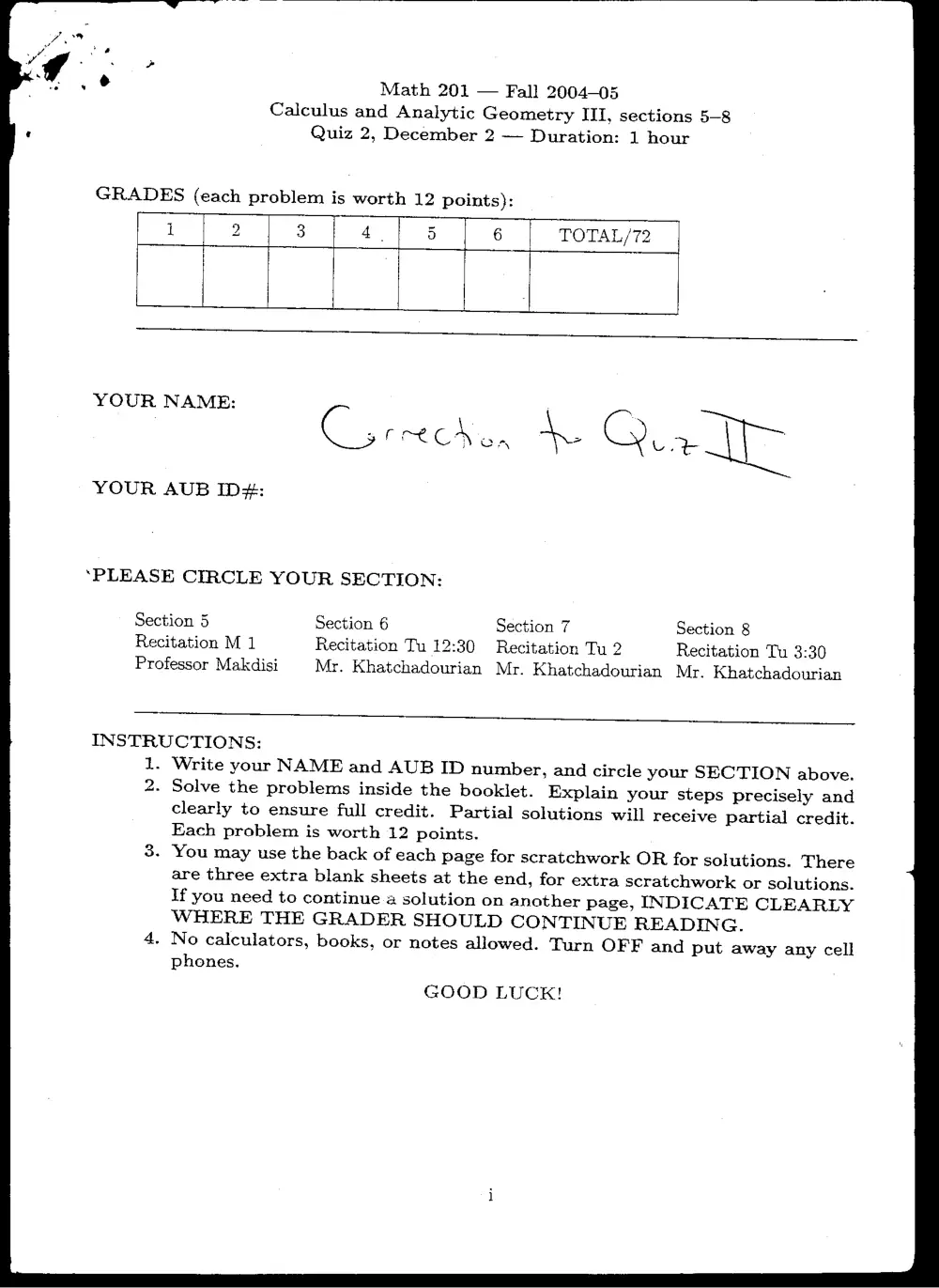
Math 201 — Fall 2004-05
Calculus and Analytic Geometry III, sections 5-8
Quiz 2, December 2 — Duration: 1 hour
GRADES (each problem is worth 12 points):
3 | 4a] 5 6 TOTAL/72
YOUR NAME:
Grete 4 Qadir
YOUR AUB ID#:
“PLEASE CIRCLE YOUR SECTION:
Section 5 Section 6 Section 7 Section 8
Recitation M 1 Recitation Tu 12:30 Recitation Tu 2 Recitation Tu 3:30
Professor Makdisi Mr. Khatchadourian Mr. Khatchadourian Mr. Khatchadourian
INSTRUCTIONS:
1. Write your NAME and AUB ID number, and circle your SECTION above.
2. Solve the problems inside the booklet. Explain your steps precisely and
clearly to ensure full credit. Partial solutions will receive partial credit.
Each problem is worth 12 points.
- You may use the back of each page for scratchwork OR for solutions. There
are three extra blank sheets at the end, for extra scratchwork or solutions.
If you need to continue a solution on another page, INDICATE CLEARLY
WHERE THE GRADER SHOULD CONTINUE READIN G.
- No calculators, books, or notes allowed. Turn OFF and put away any cell
phones.
GOOD LUCK!
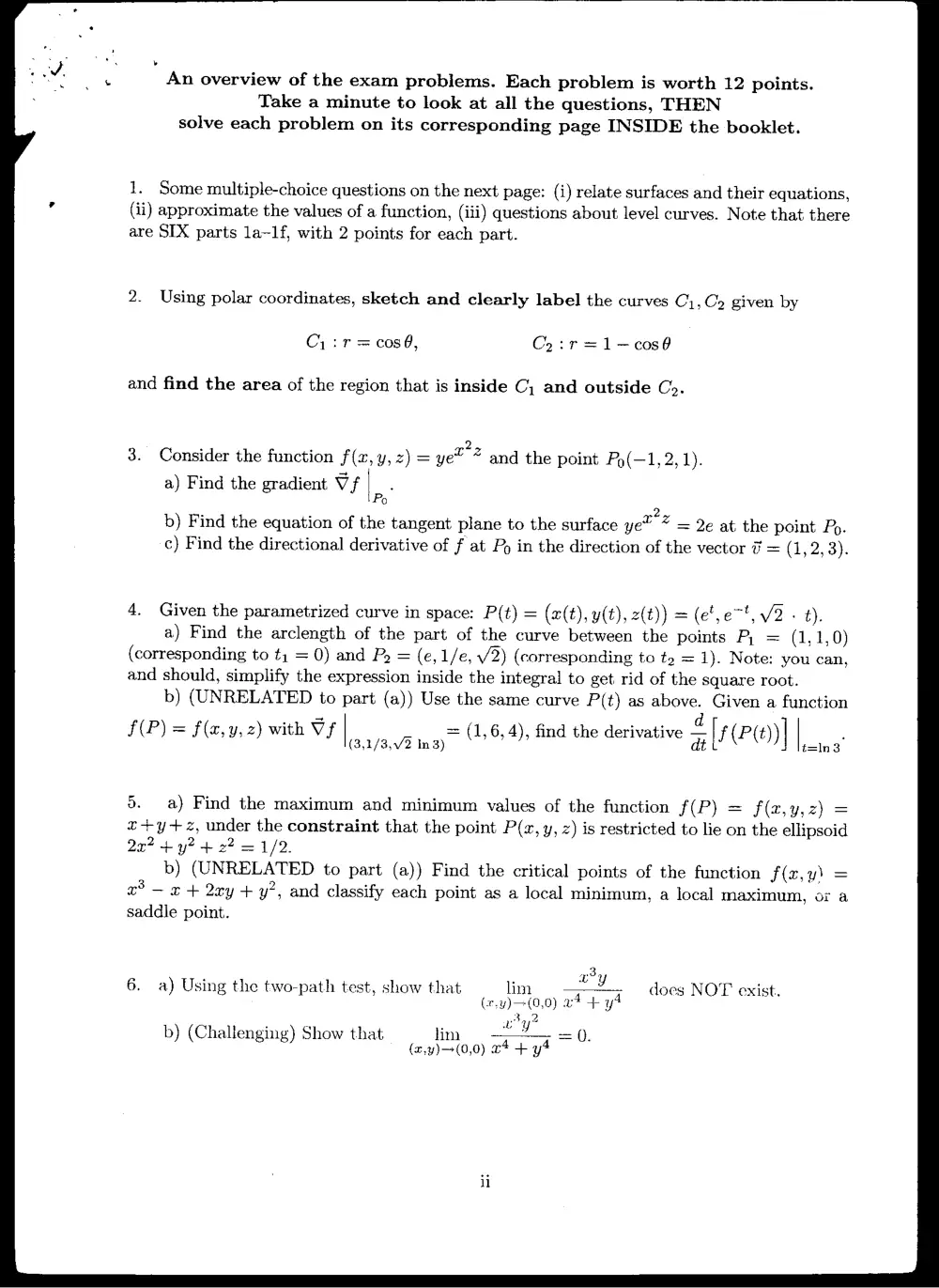
An overview of the exam problems. Each problem is worth 12 points.
Take a minute to look at all the questions, THEN
solve each problem on its corresponding page INSIDE the booklet.
1. Some multiple-choice questions on the next page: (i) relate surfaces and their equations,
(ii) approximate the values of a function, (iii) questions about level curves. Note that there
are SIX parts la~1f, with 2 points for each part.
2. Using polar coordinates, sketch and clearly label the curves C1, C> given by
Ci :r=cosé, Cz:r=1—cosé
and find the area of the region that is inside C, and outside Co.
2
3. Consider the function f(z, y,z) = ye” * and the point Pp(—1,2, 1).
a) Find the gradient Vf Pp.
0
2
b) Find the equation of the tangent plane to the surface ye” * = 2e at the point Po.
c) Find the directional derivative of f at Py in the direction of the vector 7 = (1, 2,3)
4. Given the parametrized curve in space: P(t) = (x(t), y(t), 2(t)) = (e',e7', V2 - t).
a) Find the arclength of the part of the curve between the points P; = (1,1,0)
(corresponding to t; = 0) and P2 = (e, 1/e, V2) (corresponding to tg = 1). Note: you can,
and should, simplify the expression inside the integral to get rid of the square root.
b) (UNRELATED to part (a)) Use the same curve P(t) as above. Given a function
f(P) = f(x,y, z) with Vi = (1,6, 4), find the derivative <r(Po)| |
(3,1/3,V2 In3) t=In3.
5. a) Find the maximum and minimum values of the function f(P) = f(z,y,z) =
z+y+z, under the constraint that the point P(x, y, z) is restricted to lie on the ellipsoid
2x? + y? + 2? = 1/2.
b) (UNRELATED to part (a)) Find the critical points of the function f (z,y) =
—2£+ 2ry+ y’, and classify each point as a local minimum, a local maximum, or a
saddle point.
2
43
6. a) Using the two-path test, show that lim oy
(x.y) (0,0) a4 + y4
3,2
. : . ay
b) (Challenging) Show that lina = 0.
¢ sing) (x.y) (0,0) a4 + y4
does NOT exist.
ye an
Lima wry
—3xy+5
. Then its critical point is OF SEIRUT
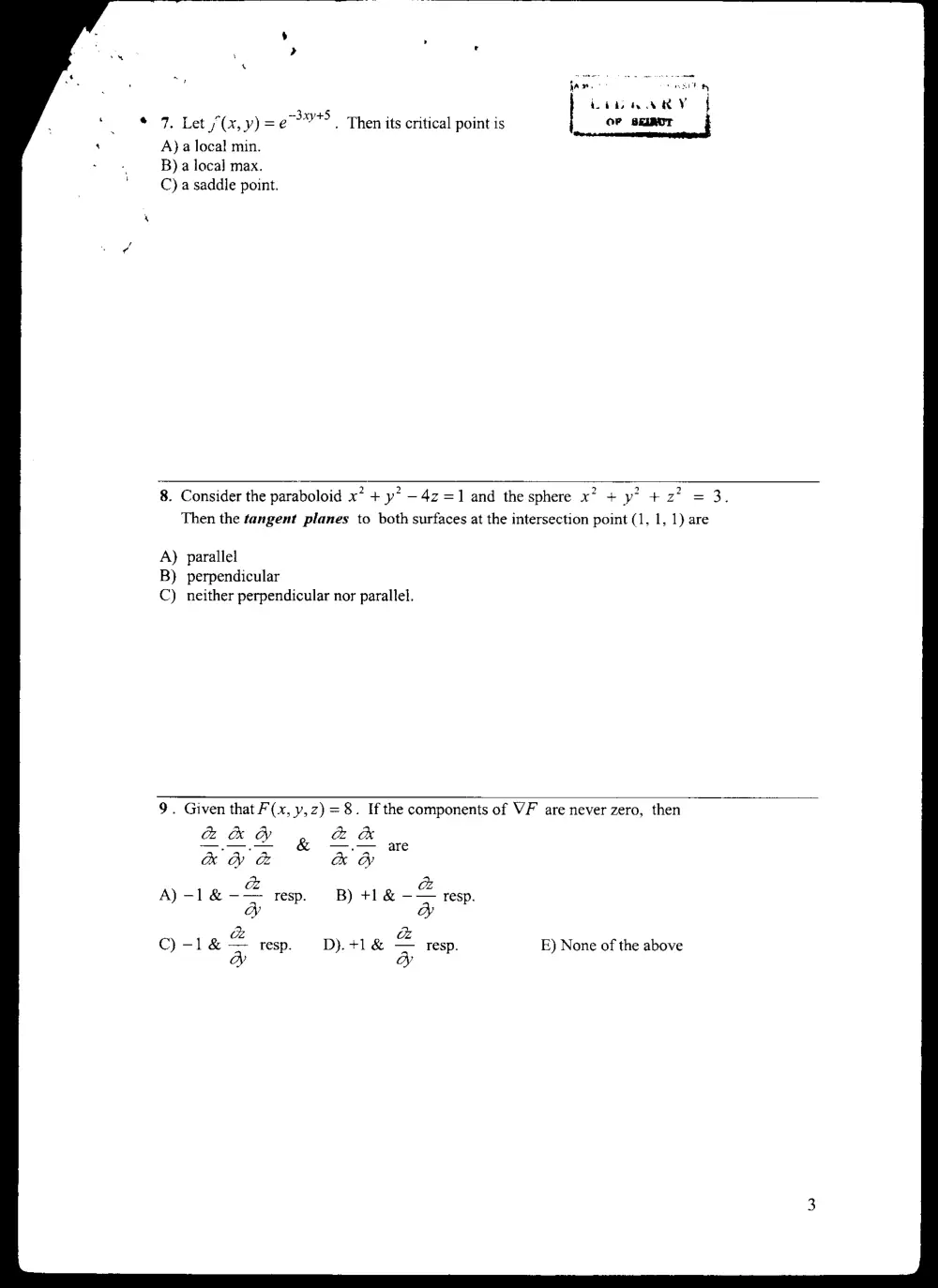
* 7 Let (x,y) =e
A) a local min.
B) a loca] max.
C) a saddle point.
8. Consider the paraboloid x? + y? —4z =1 and the sphere x? + y? +z? = 3.
Then the tangent planes to both surfaces at the intersection point (1, 1, 1) are
A) parallel
B) perpendicular
C) neither perpendicular nor parallel.
9. Given that F(x, y,z) =8. If the components of VF’ are never zero, then
axe & a KX
an a aa
A)-1& _@ resp. B) +1 & _& resp.
a a
are
j a
Cc)-1& & resp. D). +1 & a resp. E) None of the above
2 1
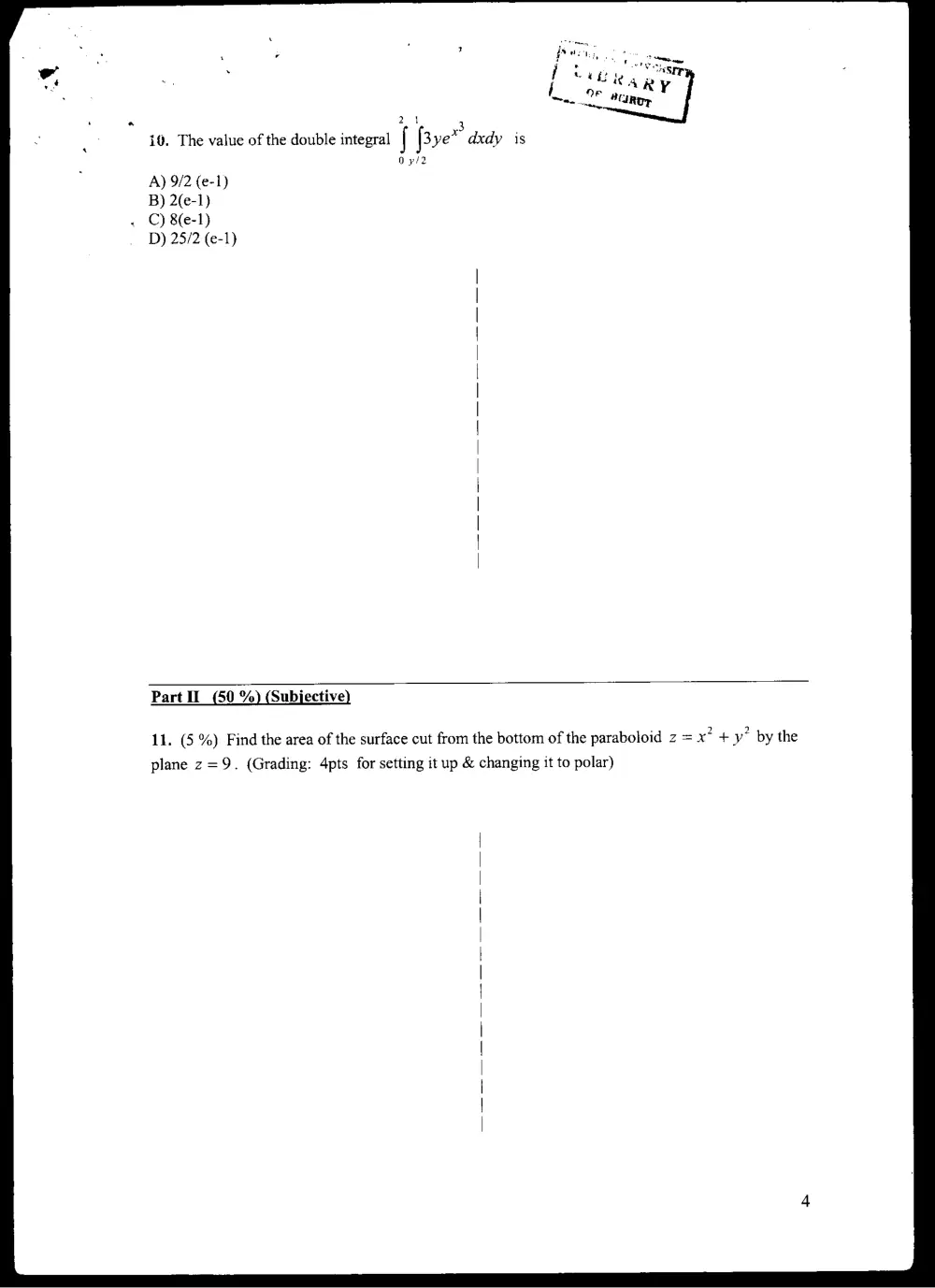
10, The value of the double integral f fave" dxdy is
0 y/2
A) 9/2 (e-l)
B) 2(e-1)
C) 8(e-1)
D) 25/2 (e-1)
Part I (50 %) (Subjective)
11. (5%) Find the area of the surface cut from the bottom of the paraboloid z = ee y by the
plane z=9. (Grading: 4pts for setting it up & changing it to polar)
ERICAN Ov VERSIT
LIBRaRy |
en OF SERED
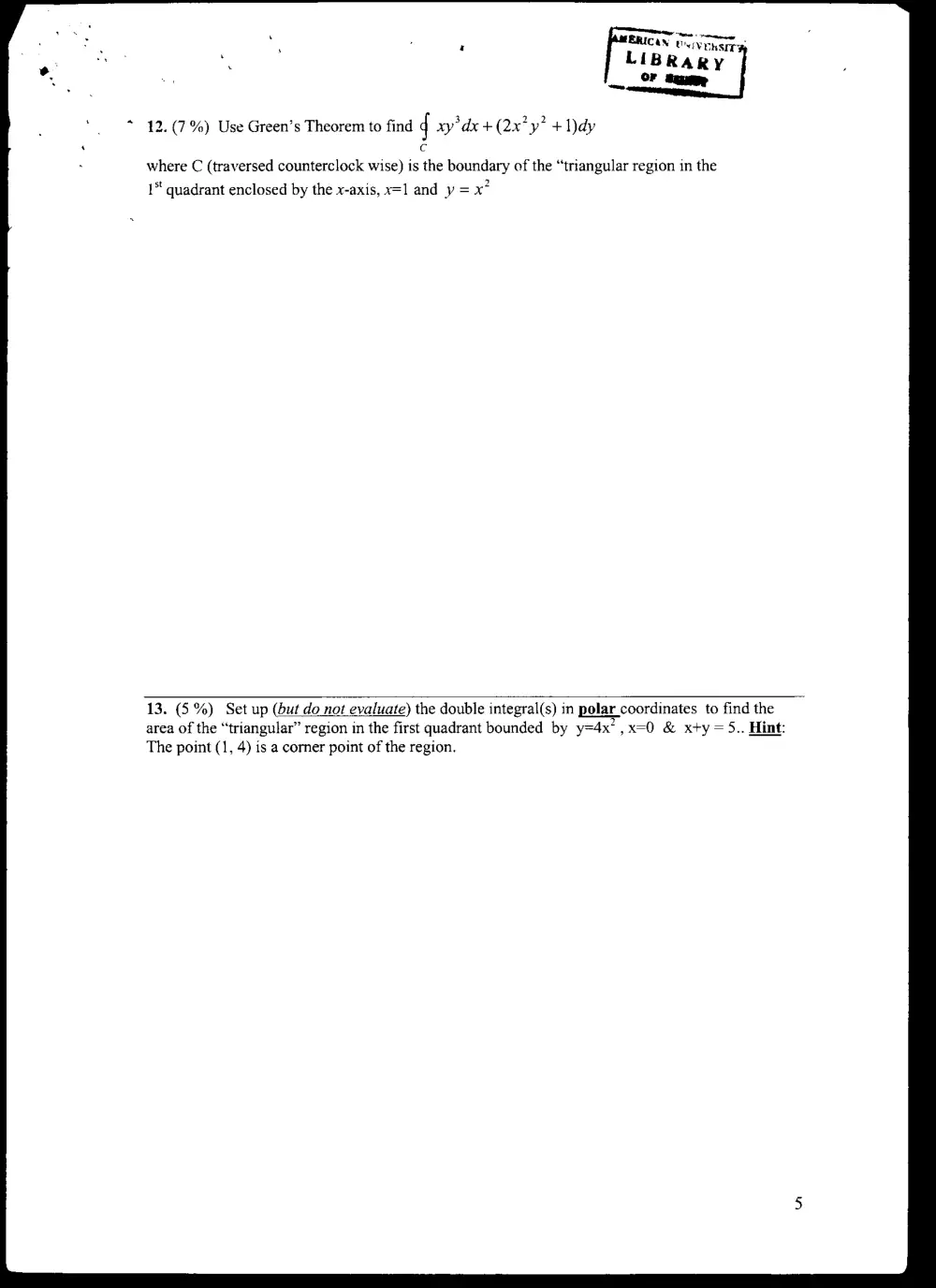
where C (traversed counterclock wise) is the boundary of the “triangular region in the
* 12.(7%) Use Green’s Theorem to find q xy dx +(2x’y? + ldy
Cc
1* quadrant enclosed by the x-axis, x=1 and y = x?
13. (6%) Set up (but do not evaluate) the double integral(s) in polar coordinates to find the
area of the “triangular” region in the first quadrant bounded by y=4x" ,x=0 & xty=5.. Hint:
The point (1, 4) is a corner point of the region.
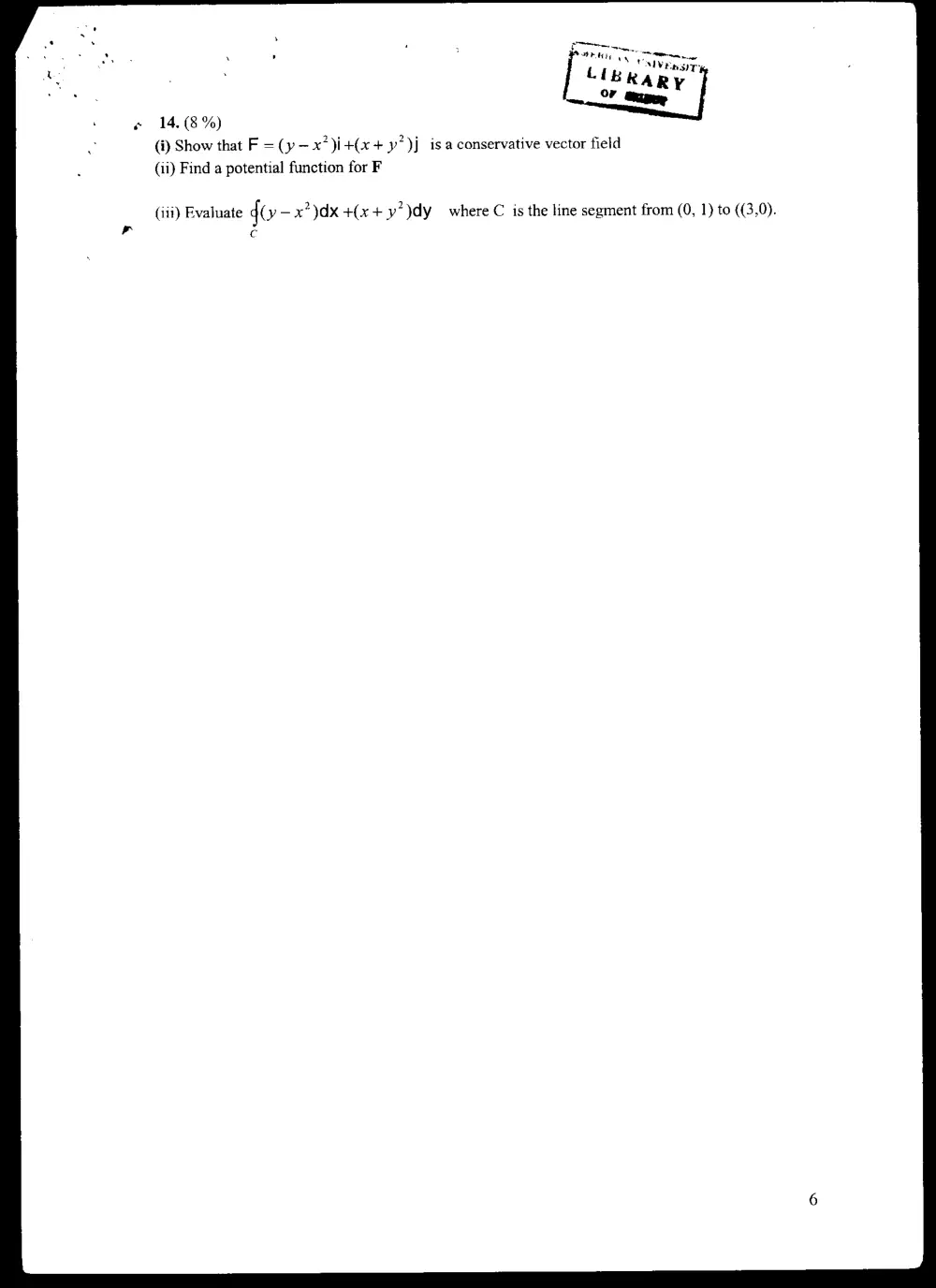
« 14.(8%)
(i) Show that F = (y —x?)i+(x+”)j isa conservative vector field
(ii) Find a potential function for F
(iii) Evaluate {iv —x’)dx+(x+y’)dy where C is the line segment from (0, 1) to ((3,0).
c
r
i.
{ ek cS a
LILKARY 4
oF Bekor 1
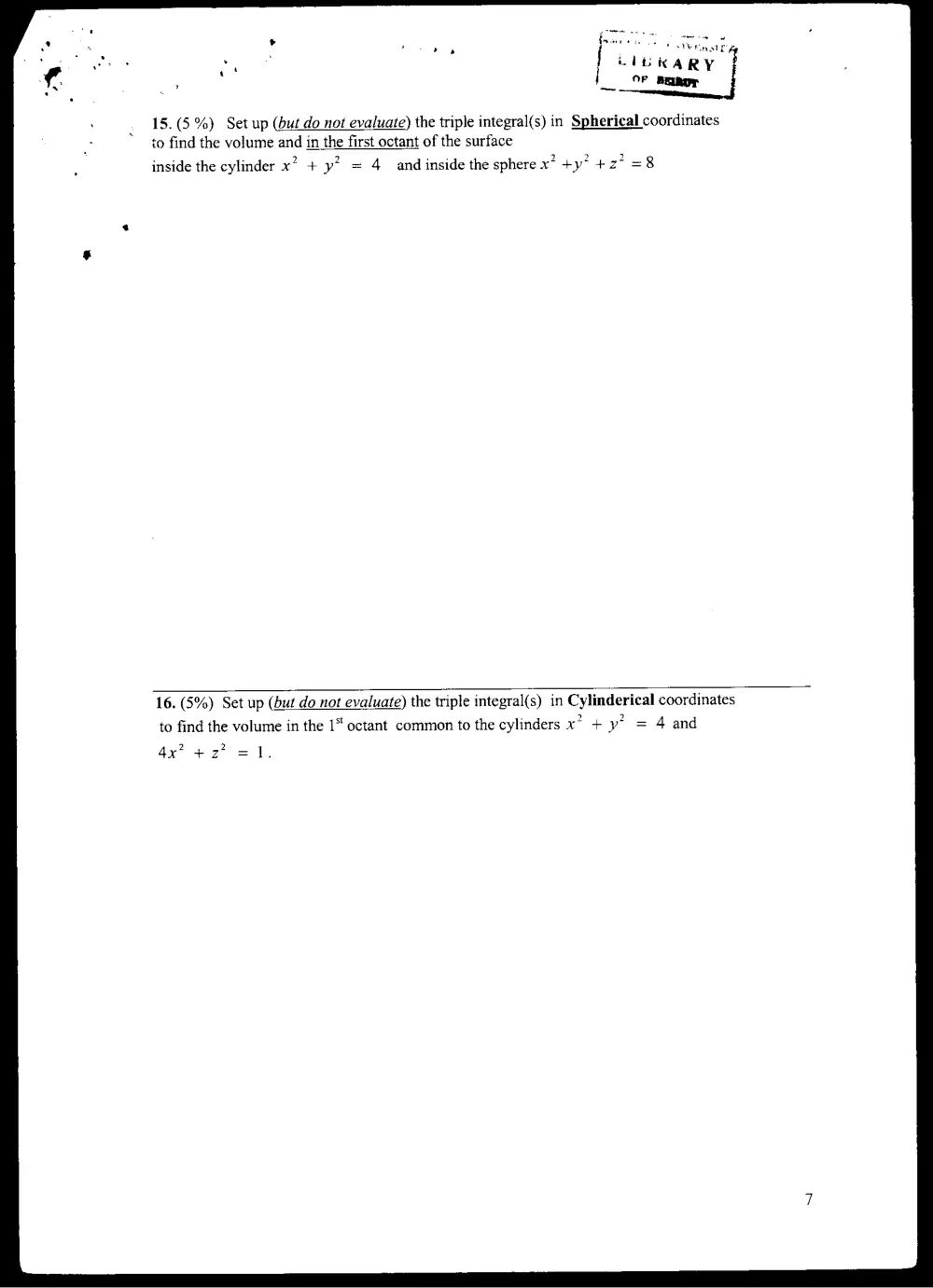
15. (5%) Set up (but do not evaluate) the triple integral(s) in Spherical coordinates
to find the volume and in the first octant of the surface
inside the cylinder x? + y? = 4 and inside the sphere x+y? +2? =8
16. (5%) Set up (but do not evaluate) the triple integral(s) in Cylinderical coordinates
to find the volume in the 1* octant common to the cylinders x7 + y? = 4 and
4x? +27 =1.
eda. AR Q
we BERD
%
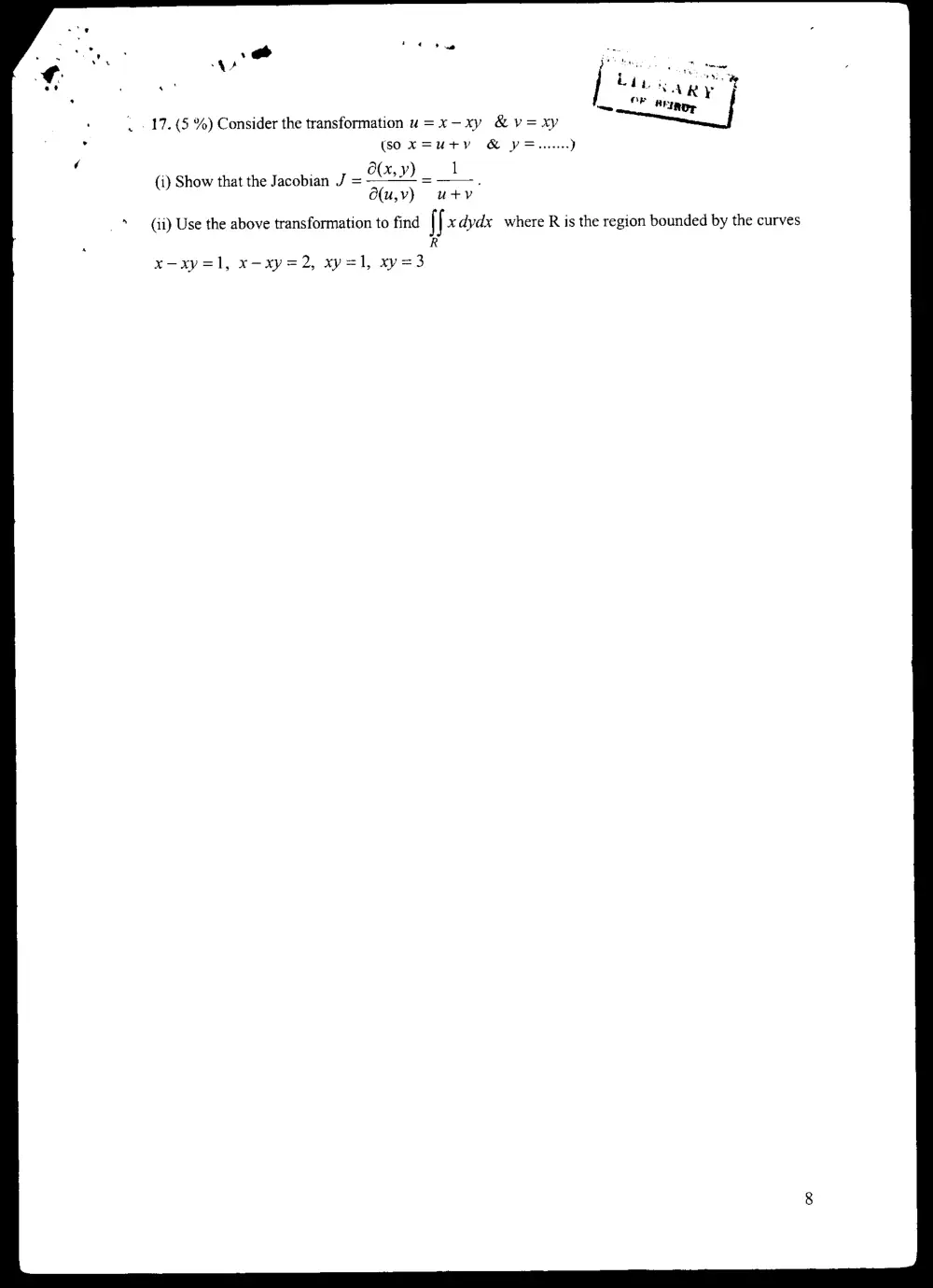
17. (5 %) Consider the transformation u=x-xy & v=xy
(sox =uty
Oxy) _ 1
a(uyv) uty:
‘
(i) Show that the Jacobian J =
» Gi) Use the above transformation to find ff dydx where R is the region bounded by the curves
R
x-xy=l, x-xy=2, xy =1, xy =3