
MATH 201 Exam 2, Fall 2005
American University of Beirut · Calculus and Analytical Geometry III · 8 pages · Prof. Kamal Makdisi
More MATH 201 files
Show the text of this exam
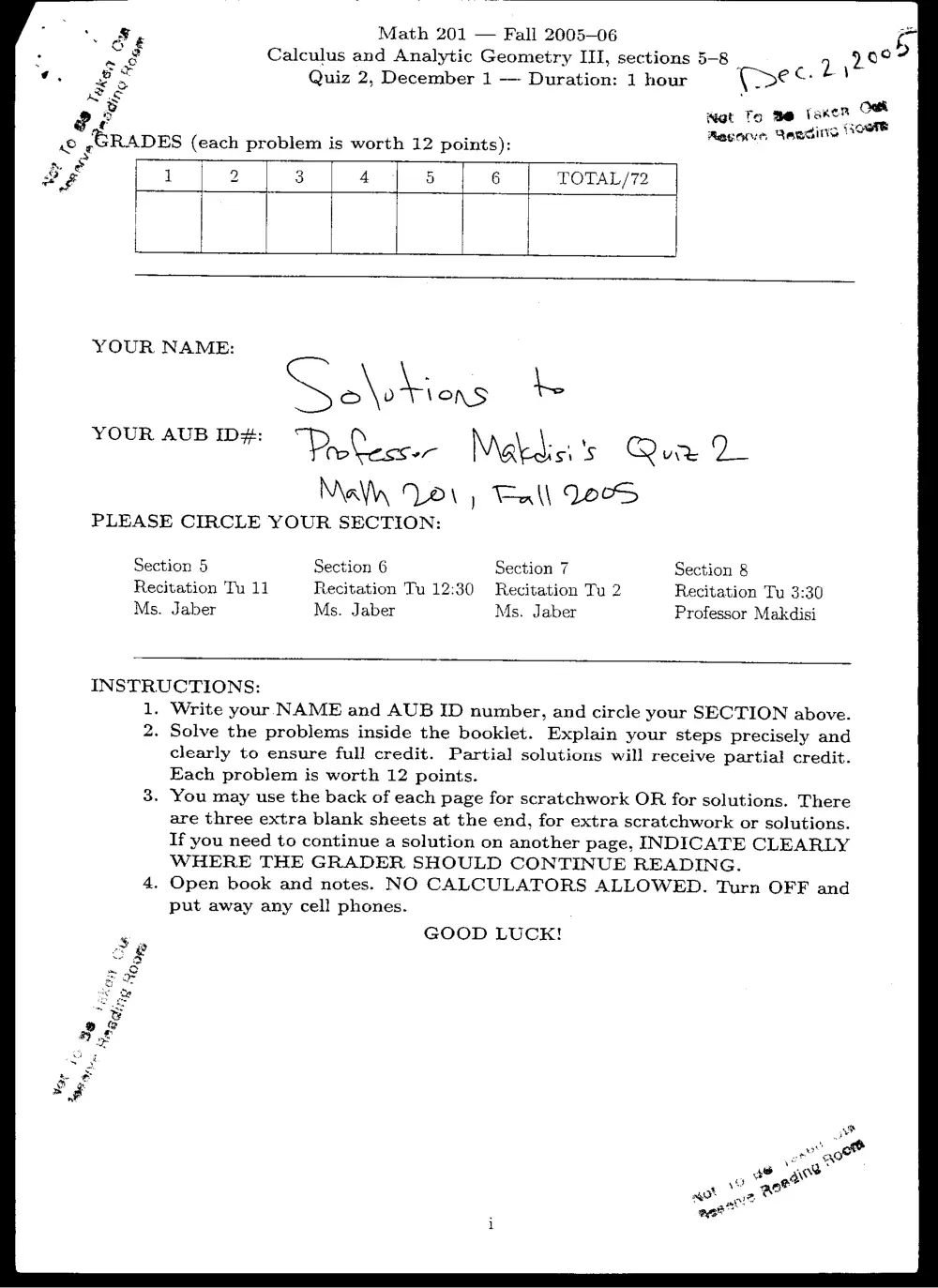
Math 201 — Fall 2005-06
Calculus and Analytic Geometry III, sections 5-8 .
Quiz 2, December 1 -— Duration: 1 hour
wot To Be facce
Ragenve Vewains |
RADES (each problem is worth 12 points):
1 2 3 4 5 6 TOTAL/72
YOUR NAME:
Saline
YOUR AUB ID#: Proece.r Makdie 's Que 2
Maly 121) Fall 200S
PLEASE CIRCLE YOUR SECTION:
Section 5 Section 6 Section 7 Section 8
Recitation Tu 11 Recitation Tu 12:30 Recitation Tu 2 Recitation Tu 3:30
Ms. Jaber Ms. Jaber Ms. Jaber Professor Makdisi
INSTRUCTIONS:
1. Write your. NAME and AUB ID number, and circle your SECTION above.
2. Solve the problems inside the booklet. Explain your steps precisely and
clearly to ensure full credit. Partial solutions will receive partial credit.
Each problem is worth 12 points.
. You may use the back of each page for scratchwork OR for solutions. There
are three extra blank sheets at the end, for extra scratchwork or solutions.
If you need to continue a solution on another page, INDICATE CLEARLY
WHERE THE GRADER SHOULD CONTINUE READING.
. Open book and notes. NO CALCULATORS ALLOWED. Turn OFF and
put away any cell phones.
GOOD LUCK!
An overview of the exam problems. Each problem is worth 12 -points.
Take a minute to look at all the questions, THEN
solve each problem on its corresponding page INSIDE the booklet.
2
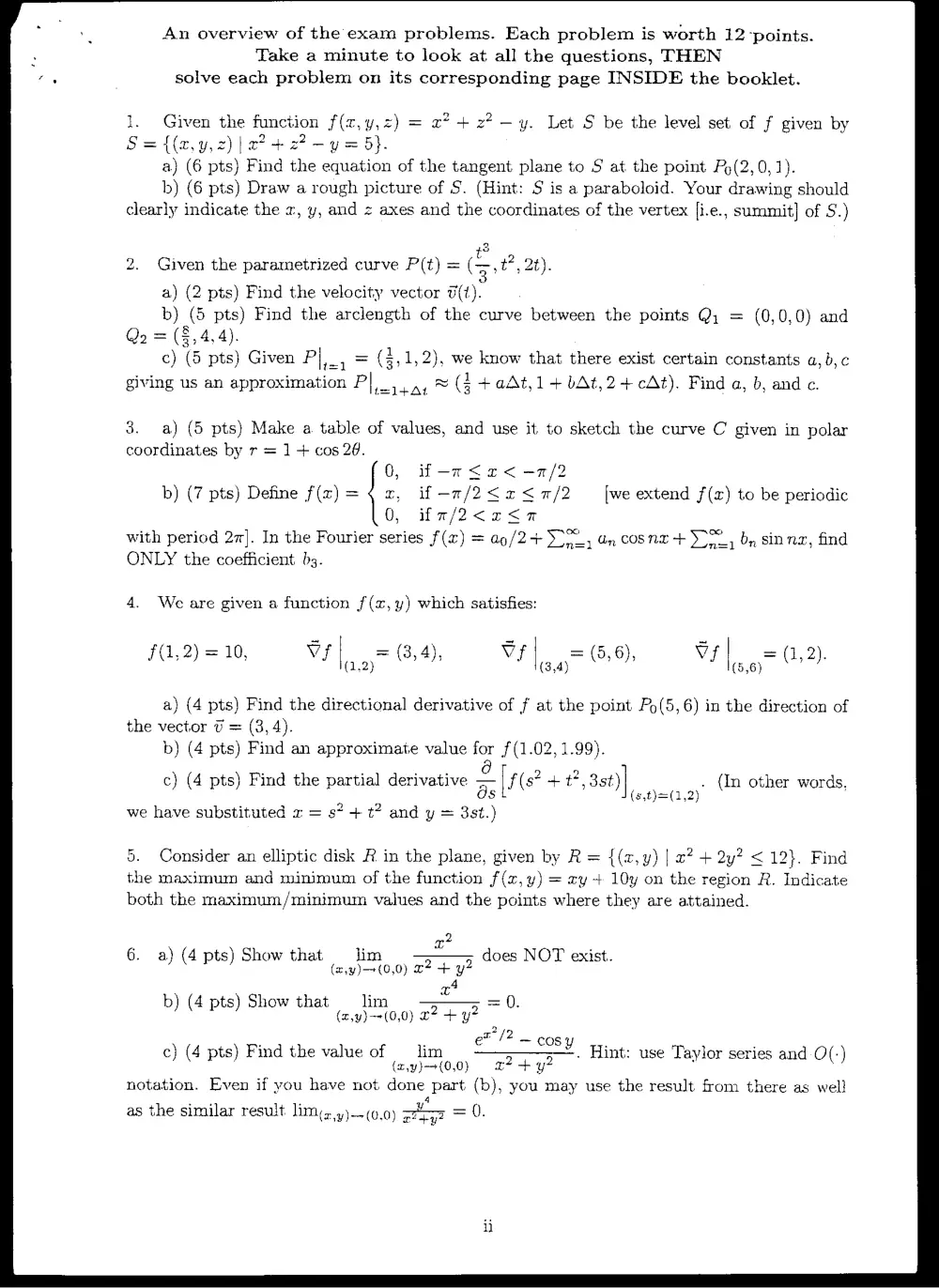
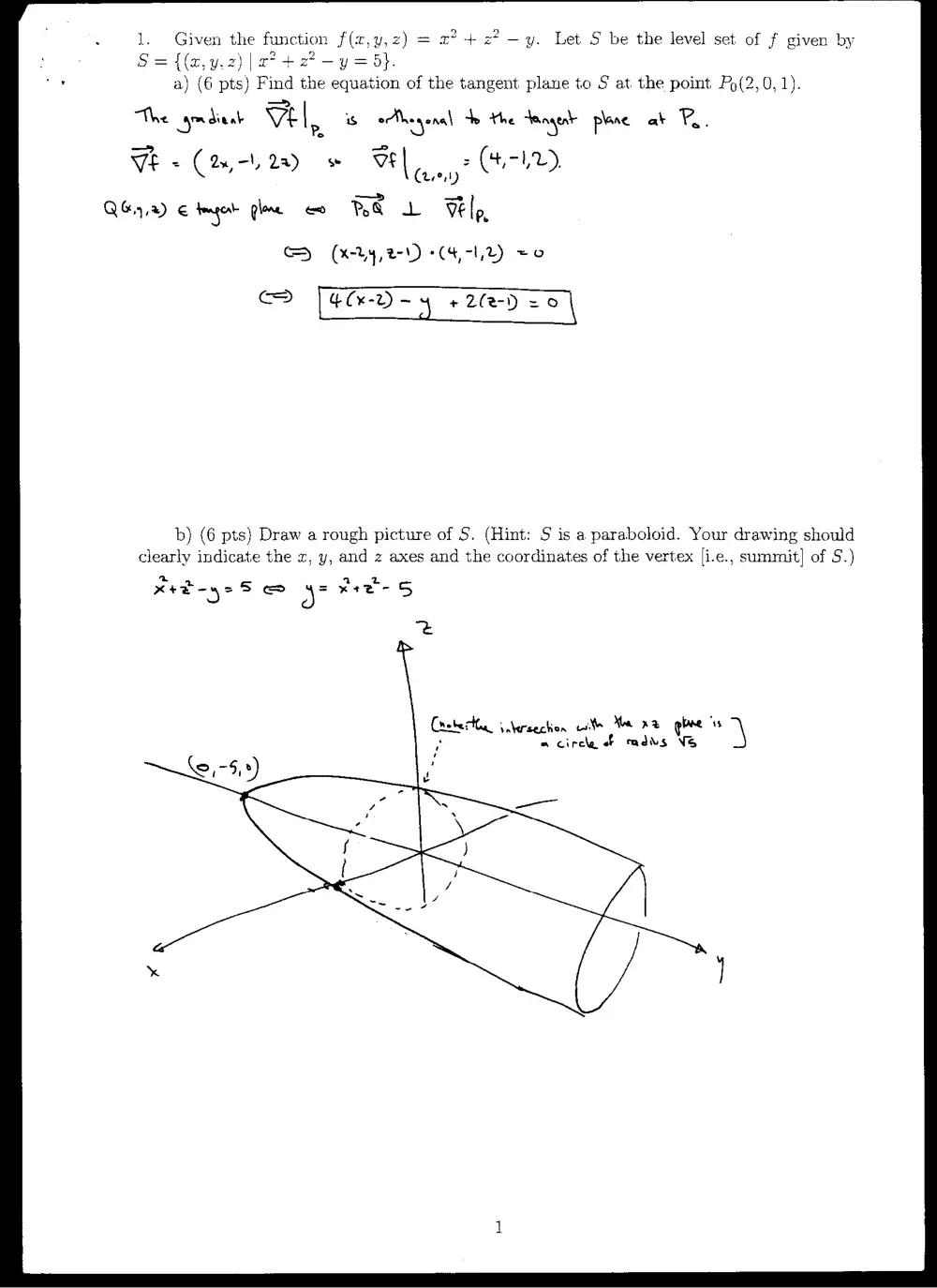
1. Given the function f(z,y,z) = 2° +27 -—y. Let S be the level set of f given by
S={(x,y,2z)|2°4+22-y= 5}.
a) (6 pts) Find the equation of the tangent plane to S at the point P9(2, 0,1).
b) (6 pts) Draw a rough picture of S. (Hint: S is a paraboloid. Your drawing should
clearly indicate the x, y, and z axes and the coordinates of the vertex |i-e., summit] of S.)
Gane
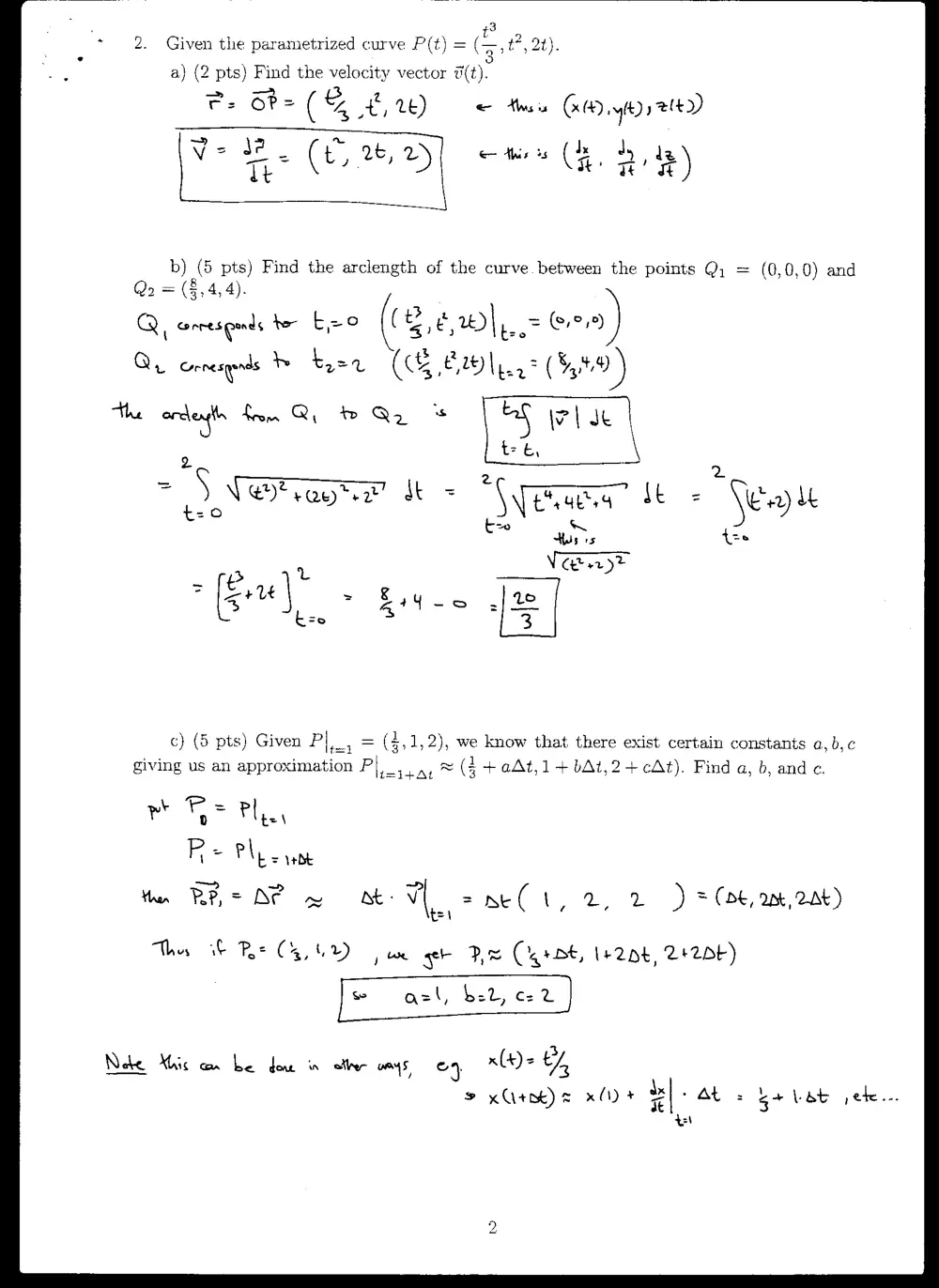
2. Given the parametrized curve P(t) = (gt? 2t).
a) (2 pts) Find the velocity vector v(t).
b) (5 pts) Find the arclength of the curve between the points Qi = (0,0,0) and
Qo = (§,4,4).
c) (5 pts) Given Pliey = (4,1,2), we know that there exist certain constants a,b,c
giving us an approximation Plroysat w (4 + aAt,1+ LAt,2+cAt). Find a, b, and c.
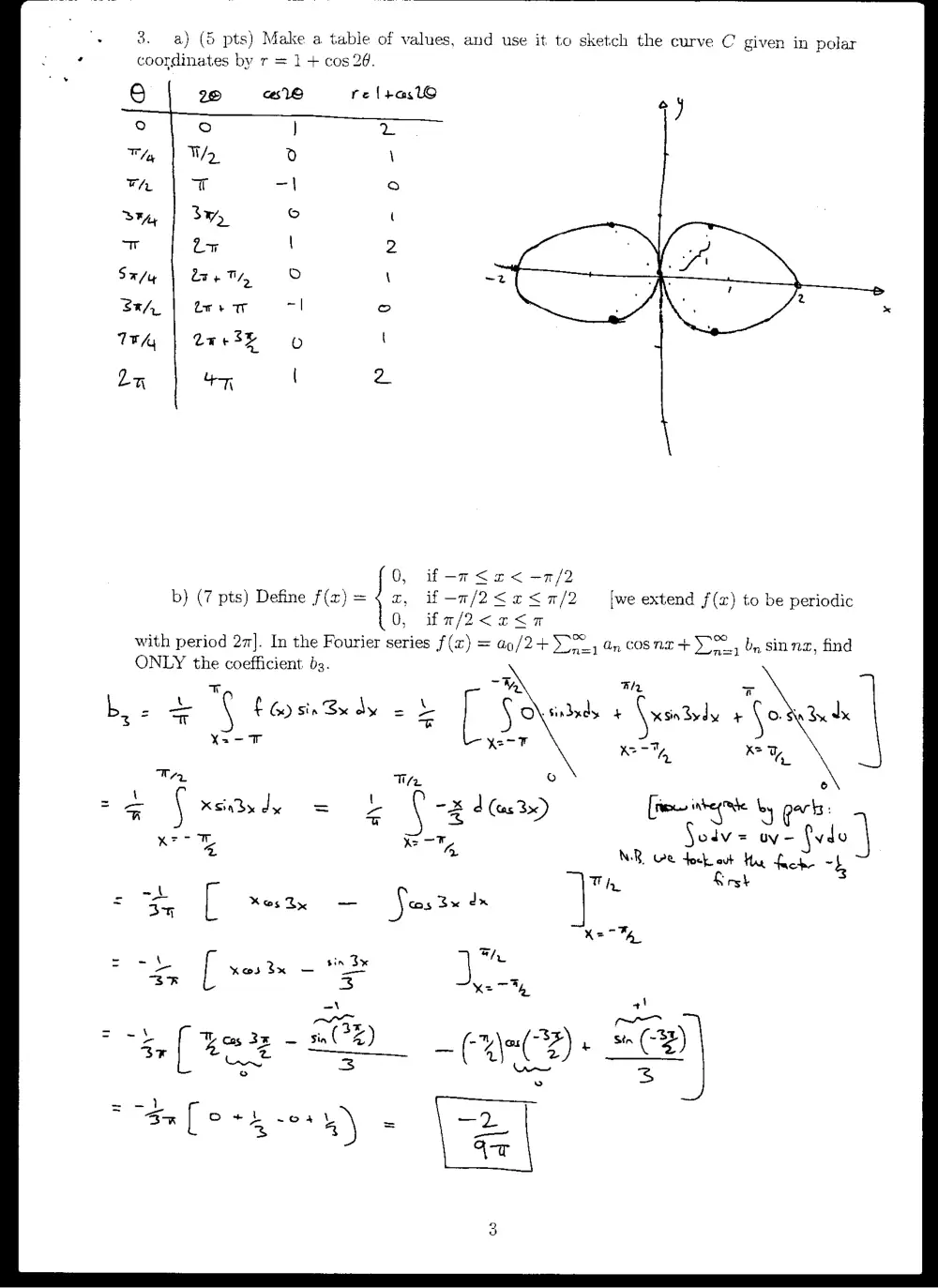
3. a) (5 pts) Make a table of values, and use it to sketch the curve C given in polar
coordinates by r = 1+ cos 26.
0, if-7<a<—-n/2
b) (7 pts) Define f(x) = ( 2, if-7/2<2< 7/2 [we extend f(z) to be periodic
0, ifa/2<a2<7
with period 27]. In the Fourier series f(x) = ao/2+ 3.724 Gn cosna + 0°, bp sin na, find
ONLY the coefficient bs.
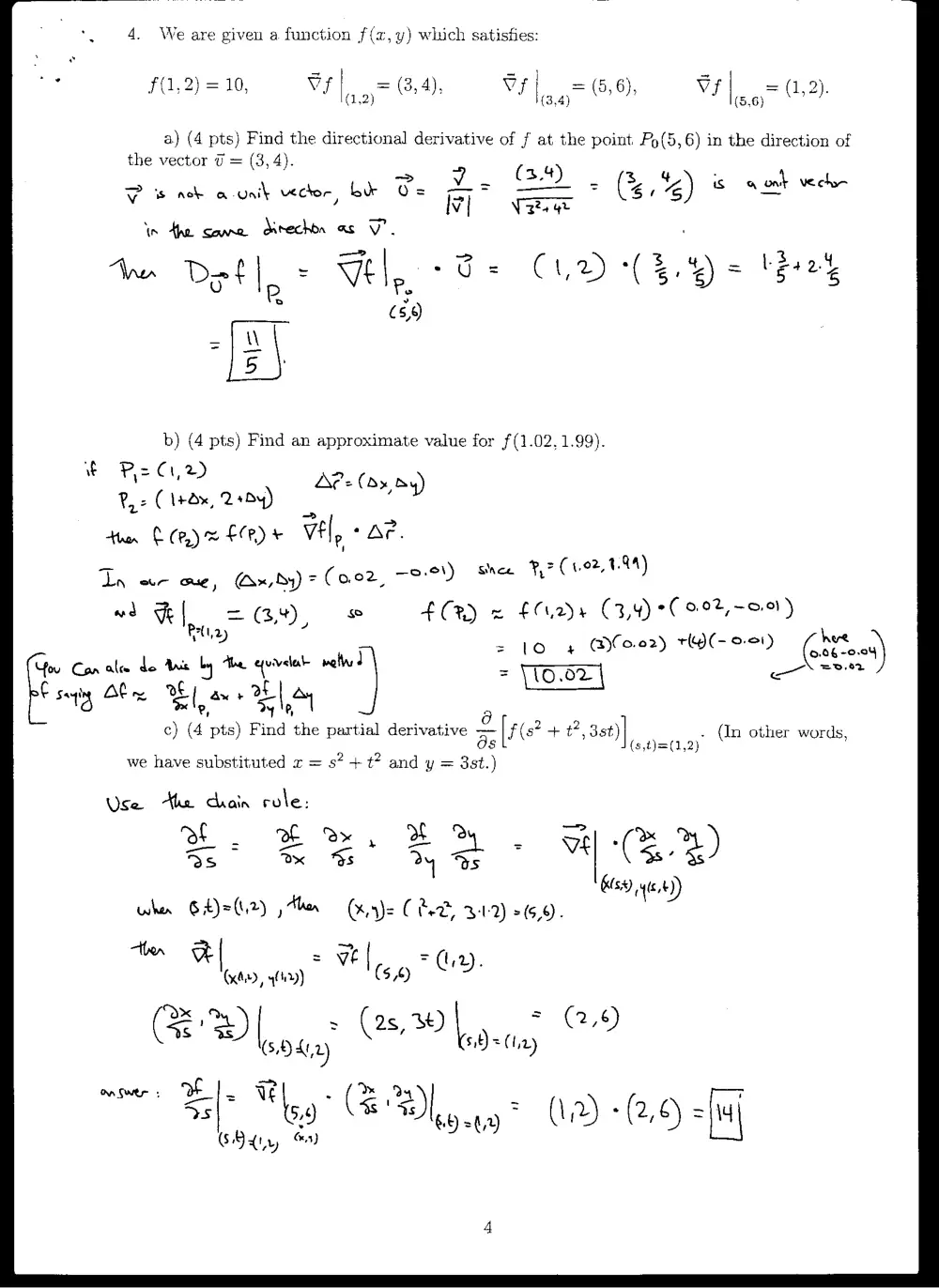
4. We are given a function f(x,y) which satisfies:
f.2)=10 VF) = G4, VF = 68, WF | = G2)
a) (4 pts) Find the directional derivative of f at the point Po(5,6) in the direction of
the vector 0 = (3,4).
b) (4 pts) Find an approximate value for f (1.02, 1.99).
a] 2
c) (4 pts) Find the partial derivative — iG +t, 3st)| . (In other words,
Os
we have substituted x = s? +t? and y = 3st.)
(s,t)=(1,2)
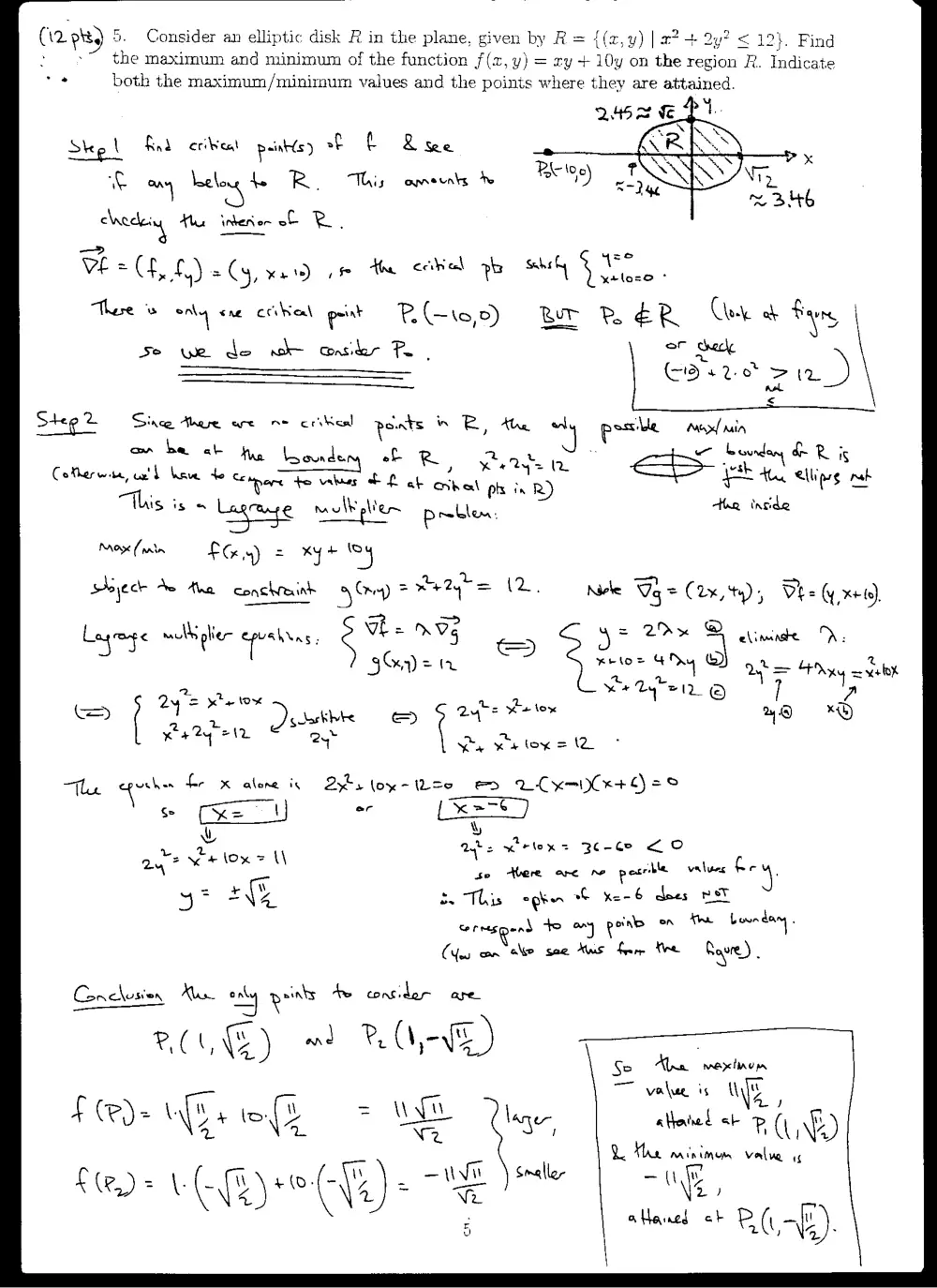
5. Consider an elliptic disk R in the plane, given by R = {(2,y) | 2? + 2y? < 12}. Find
the maximum and minimum of the function f(x,y) = zy + 10y on the region R. Indicate
both the maximum/minimum values and the points where they are attained.
2
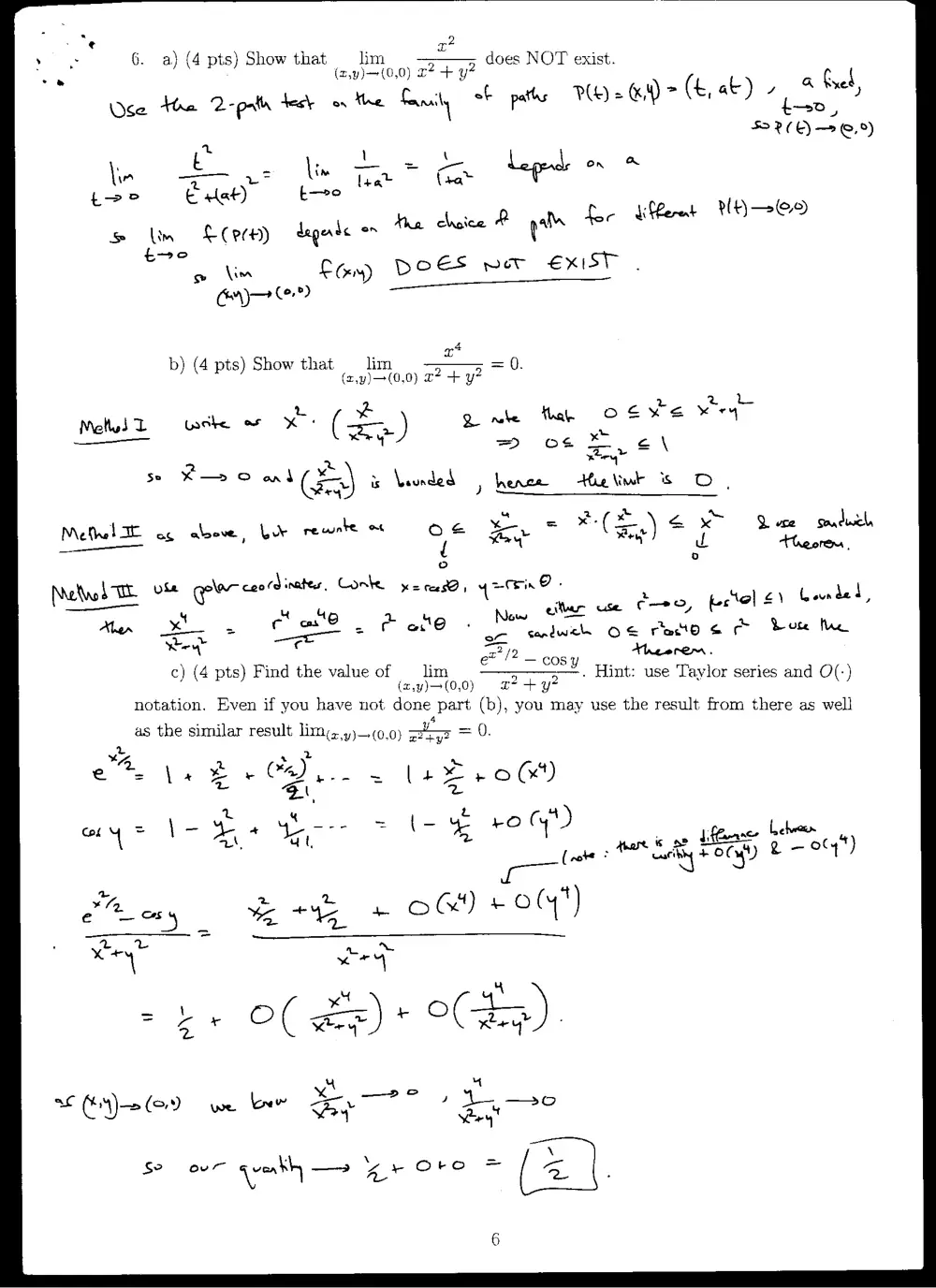
6. a) (4 pts) Show that lim Ze does NOT exist.
(x,y)—+(0,0) Z° + Y
a4
b) (4 pts) Show that lim = 0.
) (4 pts) (x,y)—=(0,0) 2? + y?
er /2 cos y
c) (4 pts) Find the value of =~ lim) = =——,——3—=
(x,y)7(0,0) 2° +y
notation. Even if you have not done part (b), you may use the result from there as well
4
as the similar result. lim(z, y)— (0.0) ao =0.
. Hint: use Taylor series and O(-)
1. Given the function f(z,y,z) = 3 y. Let S be the level set of f given by
Ss {(z,y. 2) | x +2? — y= 5}.
a) (6 pts) Find the equation of the tangent plane to $ at the point Fo(2,0, 1).
The mn dunk Vil, s& eMheyenal + he Aangent pare at v..
a < uc ~ > > 4-1
VE + (may so FLO (4,712).
Qbaay emyor gee co BE 1 Velo,
Si (x24, EV (4, -LD) ~e
c= [EOD ~ 4 + 2(e-) =o]
b) (6 pts) Draw a rough picture of S. (Hint: S is a paraboloid. Your drawing should
clearly indicate the z, y, and z axes and the coordinates of the vertex [i.e., summit] of S.)
XtF-yeS i) 3 R+e- S
%
Cestertin sabraecton with Me 23 ghee >)
. aw circle mdis VS
. aa 5
* 2. Given the parametrized curve P(t) = (—,t*, 2t).
3
a) (2 pts) Find the velocity vector O(t).
= p< z :
T= OP= ( & it, Ub) = Wiis efor
Ve ae (ty 2b, 2) eee (B, ade)
ae
b) (5 Fs) Find the arclength of the curve between the points Q; = (0,0,0) and
14).
Q, aga the b>0° ( ee, ¢ |, = “0 )
Ge cones Bema (CGE lL (HY)
t= &,
> 2
S Ve) aye dk = \ eas $k = Vey te
Ere uns =*
c) (5 pts) Given Ply = (4,1,2), we know that there exist certain constants a,b,c
giving us an approximation P| me G + aAt,1+bAt,2+cAt). Find a, b, and c.
t=1+AtL
pr T= Play
F = Plas vane
ten PP, = DP at V| s>ne(t, 2, 2 +) = (oe, at, 206)
t=
he at Re Cs, 2) ye er Rx Carat, \+2pt, 2tZDE)
[= az, ber, ce 2 |
Nete Mais con be done in Mer wns o7. x(4)= th,
lg
= xQ+m)s xf + ic
2
3. a} (6 pts) Make a table of values, and use it to sketch the curve C given in polar
coordinates by r = 1+ cos 26.
re{+astO in y
° UL
Th
‘ey \
Th
Dy
_
Sx /uy
Bah
Th,
2a
0, if-7<a2<-—7/2
b) (7 pts) Define f(z) = 4 x, if-7/2<a2<7/2 [we extend f(x) to be periodic
0, iff/2<a<a7
with period 27]. In the Fourier series f(x) = ap/2+ 0°; an cosnz+ °°, b, sin nz, find
ONLY the coefficient b3.
wv
s = S £ Ge) sin Bx dy
xy-7
4. We are given a function f(x,y) which satisfies:
F(1,2) = 10, Vii. = (3,4), y = (5,6), Vi
|
(1,2) f ia.4)
le
a) (4 pts) Find the directional derivative of f at the point Po(5,6) in the direction of
the vector 7 = (3, 4).
~> Y (3.4) _(& 4 : ‘ Jon
VY is ack a Unik vector | bur Os iv] a rT - (%, %) < a ook “se
Bo
\n Ane sama ddtechbs as 7.
Aner Defl, : Tle. -O-= (1,2) *( 3.)
. (89
~|W
b) (4 pts) Find an approximate value for f (1.02, 1.99).
ft Pe 1,2) Aee (ox dy)
Re ( 1+d~, Q+Dy)
Haar C (?,) = £0p) + vele . AP.
\ = Ga
In or cue, Gx, dy) = Co.02, —o.e\) Shee 7 (1.02, 194)
“Rl = Gy, © FO) = fOadx (34) -C 002-01)
vt,2) lo + (3900.02) +4) (- 9-21) hee )
0.06 -0.0
i Can le de tar by “He neler ae : an
a mw OE ~ at
F sty Ohm Bele EL a
c) (4 pts) Find the partial derivative — [Ze +8, 3st)| . (In other words,
Os
we have substituted 2 = s? +1? and y = 3st.)
Use Aha chain cule:
at. Oh em, BW Mm _ Shy ir
5s = Ox 5s . at - VE =e )
G(s) 41,4)
(s,t)=(,2)
when GA)=U2) ther (x y)e CRS 31-2) 26,0).
ter % | = ve |
(xan, fy) (s »)
=).
| > (28,29) | )
(a py 8 . Consider an elliptic disk R in the plane, given by R = {(z,y) | 22+ 2y? < 12). Find
the maximum and minimum of the function f(z, y) = ry + 10y on the region R. Indicate
‘4 both the maximum/minimum values and the points where they are attained.
Ske | Rad erivent prints) f QR ee
ne oy Feelong te R. This amernts te
see Ma amen er of Rr.
VE = Ct, La Ged ie the chal go seh Se:
Tees ety ne enka pit BGs) Br BER Coed fy
se ye do wk asker P.. er deck
Steg 2 — Since here are ne criKeal ports & BR, the +) poste mod min
oe beck he Land CR . — beurdany & R ig
Khe e ae) =e .
Cotherw-te, al kaw 4o ye ee tbe eat S <b tb AL. eltiers nab
“This ison @ lh pen Pooblen, athe tneide
Move (rain LG) = Ky iy
shoyeck Ae Ana conchrmith syCrny = 42 = 1D. icke The (2x, 4), Dee Gy xe'9)
=>
Laymge mlb plier epeshses: Mee Vs — 4 = 2Zr%x a elimina OD;
Soa) = wrote & 44 © ota L0 hs
we wy OK 2 Me Lg =IL © ; 5
= ; u ) satsrkbvte S 24s w+ lex 24 cal
* +2y FAD 24 m, a a
Thee ante fe x alone ix 2x. lox -(L=0e > UlCymi xt ae
Se = 4 er [x>7% )
\
2h: xielox = Re-ce LO
so there are ne pecrible valuns Few,
4* 2 5. This ogke xc 6 ees mst
wrrespend +o ony pane on TW bowndan .
Cfu or aie see WS fae Tre Rove) .
Conclusion Xn oy points Ke consider ape.
BOLE) wt (-VE)
Se Ales weenie
volver is Wt
£ (e)= Wy \o- Cs = Wo lager athaied ab > (\, ‘9
Qe Mae mainimem valve “
eRe PRE RB)
2
6. a) (4 pts) Show that = lim Tapp does NOT exist.
(z,y)—(0,0) Z° + y a Qeb
ca tha D-prth deck or the Gowily oF paths Pe) = Gi) > (E, ak) )
{so ,
— a Loped: on &
1 (aa>
S?2(E)—©,°)
. c (GLerert MH e4)
degerde en tha choice & gs for 4
£ G15) Dees peor €xisST
gt
b) (4 pts) Show that eal o. Zaye 0.
au
Q ne Mal ote Kory
=> of ca <\
xt my
x
ss X¥—5» 0 at (Fo) x \aunded ) hence thelr &§ © |
4
Meld L Lacte or as ‘ ( Fs)
wate ov Qvce sandwich,
Metal IE og leew, bat rewle t Few
[vets EE. bu (par ceo/d inate, Conte x2 ces, 4urrin ® . .
_— etar Se. C-39,
om conduc OF rato < rome Roce fae
eee — cosy Theorem.
c) (4 pts) Find the value of “ Hs, 0) aye Hint: use Taylor series and O(-)
notation. Even if you have not done part (b), you may use the result from there as well
4
as the similar result im.) (0,0) @4y7 = 0.
fectol “) (onde d,
4 4 46 1 u Now
M, a . Cc coe - Oo.
ca oe
a 2
\« e r Ca) =
Lv Zl 7
%
\- wa
au, 4
2 diffene Leehwaur
: tor Lay OGM) 2 — Cy")