
MATH 201 Exam 2, Fall 2008
American University of Beirut · Calculus and Analytical Geometry III · 2 pages · Dr. Mohammad Kobeissi
More MATH 201 files
Show the text of this exam
American University of Beirut
MATH 201
Calculus and Analytic Geometry III
Fall 2008-2009
quiz # 2 solution
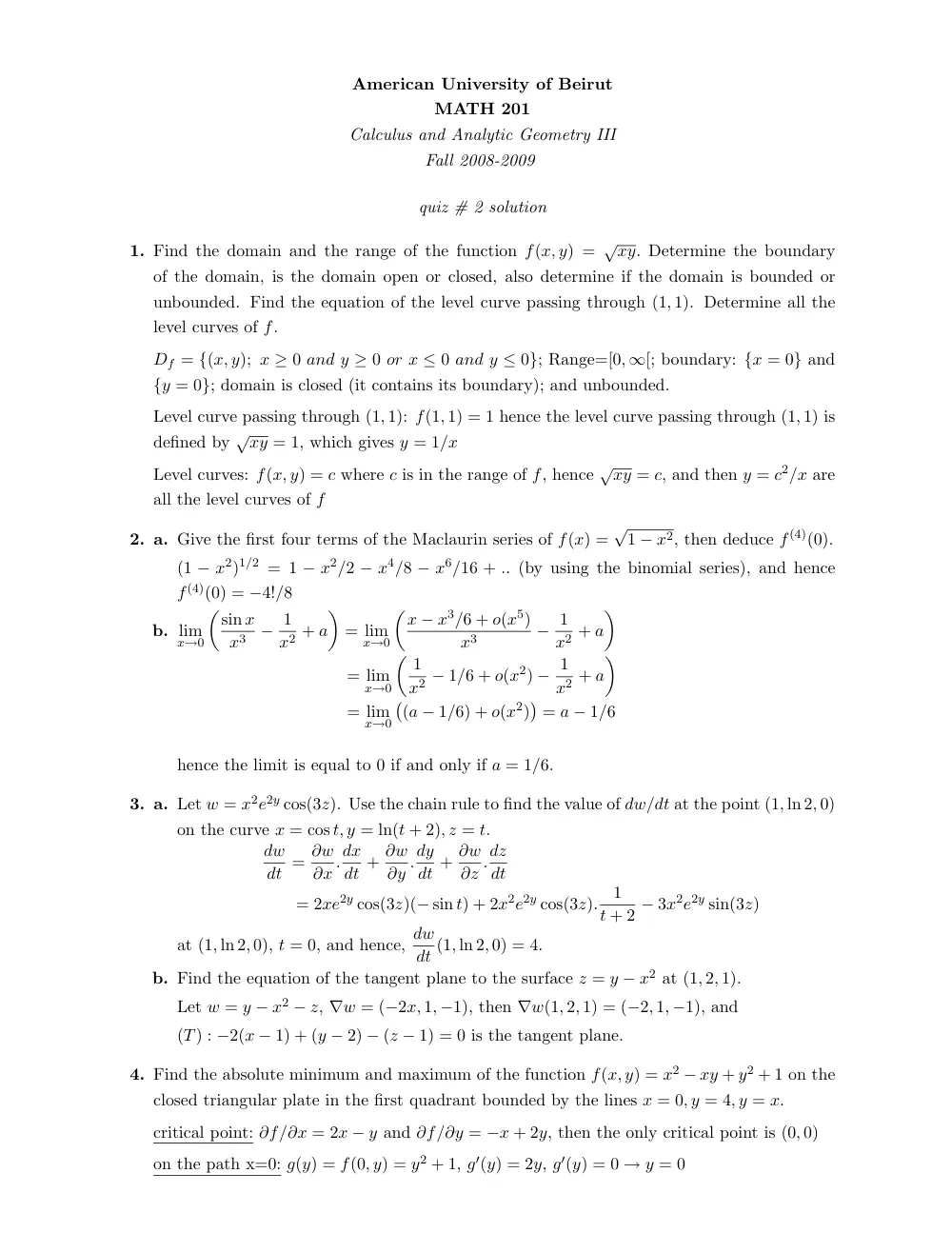
1. Find the domain and the range of the function f(x, y) = √xy. Determine the boundary
of the domain, is the domain open or closed, also determine if the domain is bounded or
unbounded. Find the equation of the level curve passing through (1, 1). Determine all the
level curves of f.
Df = {(x, y); x ≥ 0 and y ≥ 0 or x ≤ 0 and y ≤ 0}; Range=[0, ∞[; boundary: {x = 0} and
{y = 0}; domain is closed (it contains its boundary); and unbounded.
Level curve passing through (1, 1): f(1, 1) = 1 hence the level curve passing through (1, 1) is
defined by √xy = 1, which gives y = 1/x
Level curves: f(x, y) = c where c is in the range of f, hence √xy = c, and then y = c2/x are
all the level curves of f
2. a. Give the first four terms of the Maclaurin series of f(x) =
√
1 − x2, then deduce f(4)(0).
(1 − x2)1/2 = 1 − x2/2 − x4/8 − x6/16 + .. (by using the binomial series), and hence
f(4)(0) = −4!/8
b. lim
x→0
�sin x
x3
− 1
x2 + a
�
= lim
x→0
�x − x3/6 + o(x5)
x3
− 1
x2 + a
�
= lim
x→0
� 1
x2 − 1/6 + o(x2) − 1
x2 + a
�
= lim
x→0
�
(a − 1/6) + o(x2)
�
= a − 1/6
hence the limit is equal to 0 if and only if a = 1/6.
3. a. Let w = x2e2y cos(3z). Use the chain rule to find the value of dw/dt at the point (1, ln 2, 0)
on the curve x = cos t, y = ln(t + 2), z = t.
dw
dt = ∂w
∂x .dx
dt + ∂w
∂y .dy
dt + ∂w
∂z .dz
dt
= 2xe2y cos(3z)(− sin t) + 2x2e2y cos(3z).
1
t + 2 − 3x2e2y sin(3z)
at (1, ln 2, 0), t = 0, and hence, dw
dt (1, ln 2, 0) = 4.
b. Find the equation of the tangent plane to the surface z = y − x2 at (1, 2, 1).
Let w = y − x2 − z, ∇w = (−2x, 1, −1), then ∇w(1, 2, 1) = (−2, 1, −1), and
(T) : −2(x − 1) + (y − 2) − (z − 1) = 0 is the tangent plane.
4. Find the absolute minimum and maximum of the function f(x, y) = x2 − xy + y2 + 1 on the
closed triangular plate in the first quadrant bounded by the lines x = 0, y = 4, y = x.
critical point: ∂f/∂x = 2x − y and ∂f/∂y = −x + 2y, then the only critical point is (0, 0)
on the path x=0: g(y) = f(0, y) = y2 + 1, g′(y) = 2y, g′(y) = 0 → y = 0
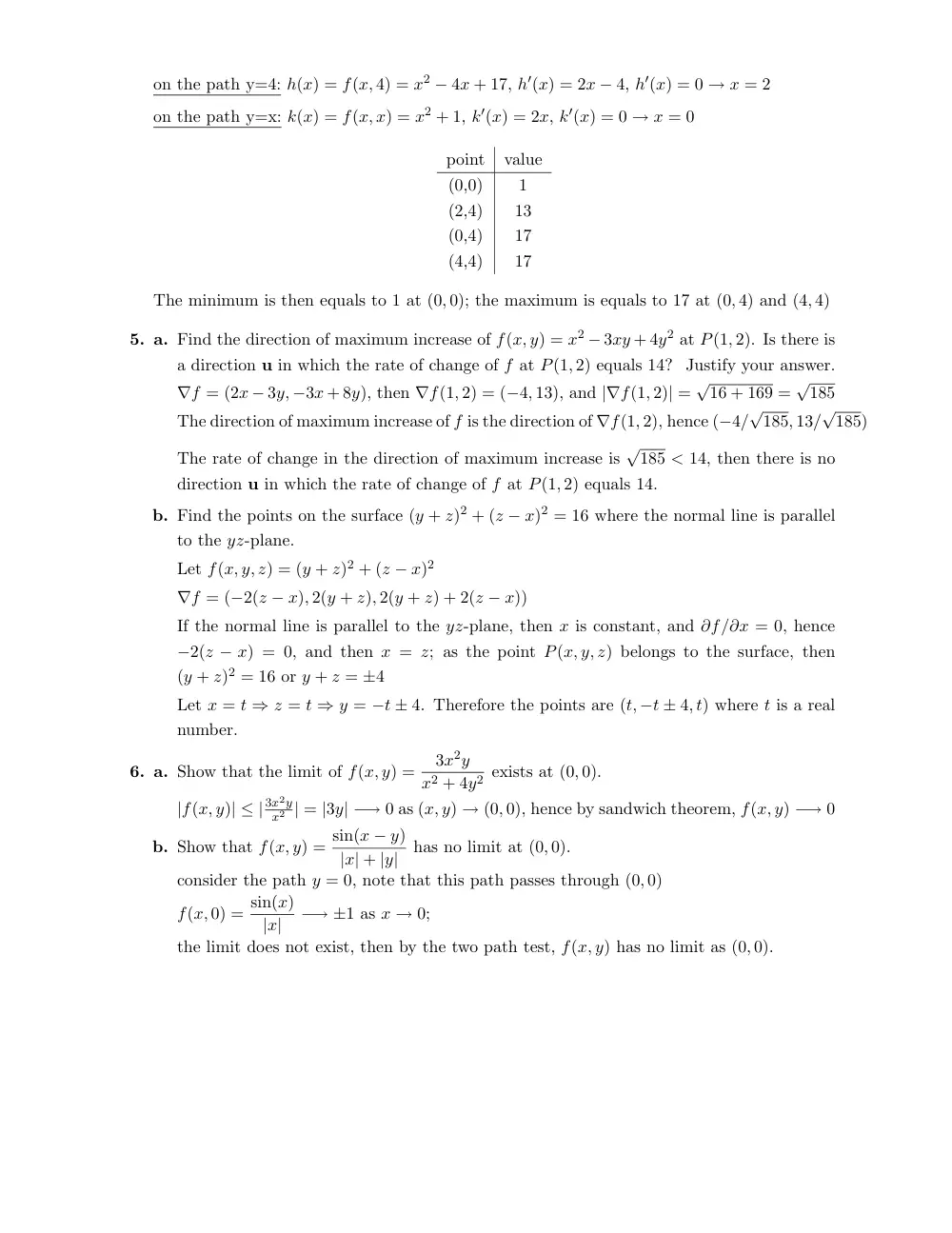
on the path y=4: h(x) = f(x, 4) = x2 − 4x + 17, h′(x) = 2x − 4, h′(x) = 0 → x = 2
on the path y=x: k(x) = f(x, x) = x2 + 1, k′(x) = 2x, k′(x) = 0 → x = 0
point
value
(0,0)
1
(2,4)
13
(0,4)
17
(4,4)
17
The minimum is then equals to 1 at (0, 0); the maximum is equals to 17 at (0, 4) and (4, 4)
5. a. Find the direction of maximum increase of f(x, y) = x2 − 3xy + 4y2 at P(1, 2). Is there is
a direction u in which the rate of change of f at P(1, 2) equals 14? Justify your answer.
∇f = (2x − 3y, −3x + 8y), then ∇f(1, 2) = (−4, 13), and |∇f(1, 2)| = √16 + 169 =
√
185
The direction of maximum increase of f is the direction of ∇f(1, 2), hence (−4/
√
185, 13/
√
185)
The rate of change in the direction of maximum increase is
√
185 < 14, then there is no
direction u in which the rate of change of f at P(1, 2) equals 14.
b. Find the points on the surface (y + z)2 + (z − x)2 = 16 where the normal line is parallel
to the yz-plane.
Let f(x, y, z) = (y + z)2 + (z − x)2
∇f = (−2(z − x), 2(y + z), 2(y + z) + 2(z − x))
If the normal line is parallel to the yz-plane, then x is constant, and ∂f/∂x = 0, hence
−2(z − x) = 0, and then x = z; as the point P(x, y, z) belongs to the surface, then
(y + z)2 = 16 or y + z = ±4
Let x = t ⇒ z = t ⇒ y = −t ± 4. Therefore the points are (t, −t ± 4, t) where t is a real
number.
6. a. Show that the limit of f(x, y) =
3x2y
x2 + 4y2 exists at (0, 0).
|f(x, y)| ≤ |3x2y
x2 | = |3y| −→ 0 as (x, y) → (0, 0), hence by sandwich theorem, f(x, y) −→ 0
b. Show that f(x, y) = sin(x − y)
|x| + |y|
has no limit at (0, 0).
consider the path y = 0, note that this path passes through (0, 0)
f(x, 0) = sin(x)
|x|
−→ ±1 as x → 0;
the limit does not exist, then by the two path test, f(x, y) has no limit as (0, 0).