
MATH 201 Exam 2, Fall 2012
American University of Beirut · Calculus and Analytical Geometry III · 7 pages · Prof. Nazih Nahlus



More MATH 201 files
Show the text of this exam
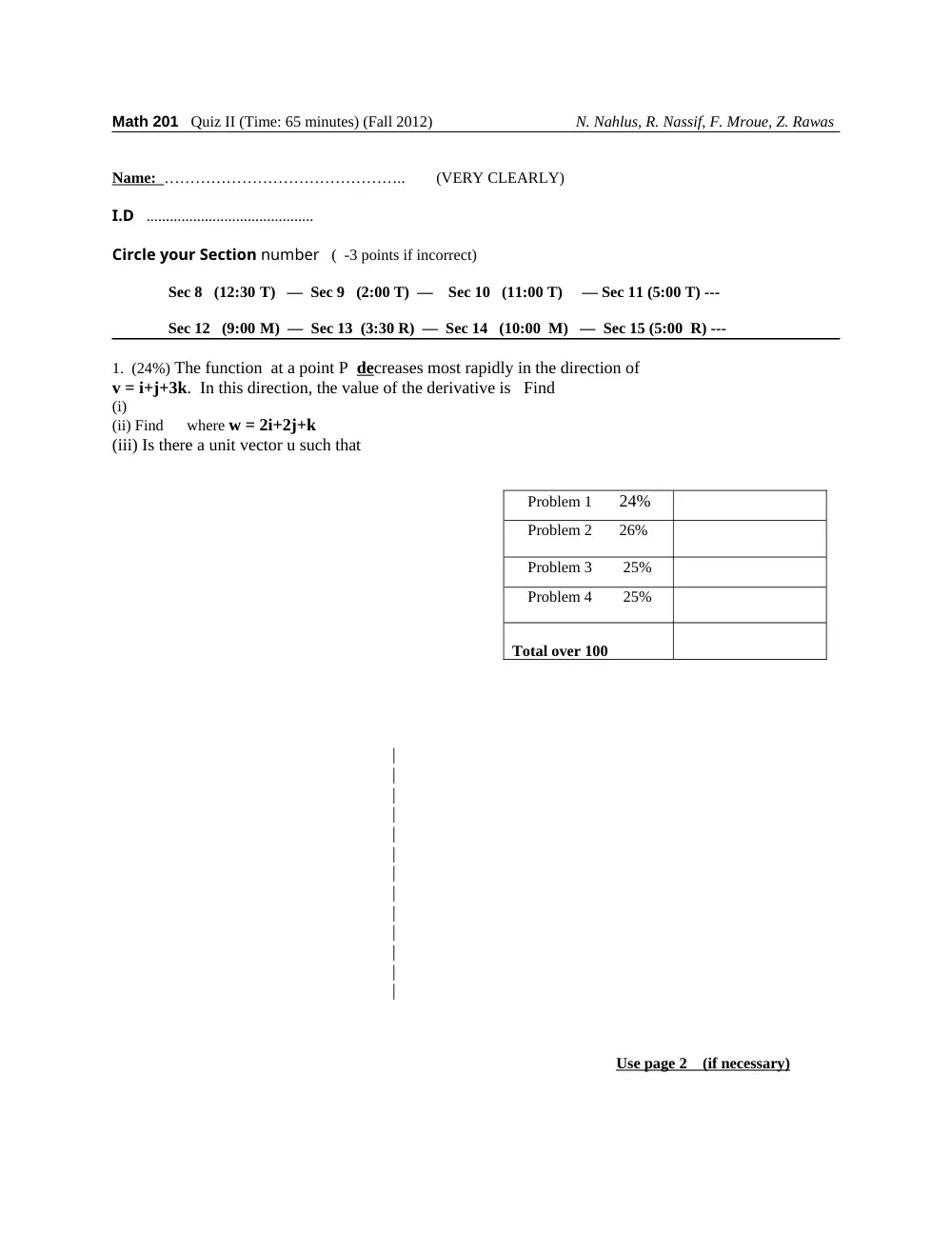
Math 201 Quiz II (Time: 65 minutes) (Fall 2012)
N. Nahlus, R. Nassif, F. Mroue, Z. Rawas
Name: ……………………………………….. (VERY CLEARLY)
I.D ...........................................
Circle your Section number ( -3 points if incorrect)
Sec 8 (12:30 T) — Sec 9 (2:00 T) — Sec 10 (11:00 T) — Sec 11 (5:00 T) ---
Sec 12 (9:00 M) — Sec 13 (3:30 R) — Sec 14 (10:00 M) — Sec 15 (5:00 R) ---
1. (24%) The function at a point P decreases most rapidly in the direction of
v = i+j+3k. In this direction, the value of the derivative is Find
(i)
(ii) Find where w = 2i+2j+k
(iii) Is there a unit vector u such that
|
|
|
|
|
|
|
|
|
|
|
|
|
Use page 2 (if necessary)
Problem 1 24%
Problem 2 26%
Problem 3 25%
Problem 4 25%
Total over 100
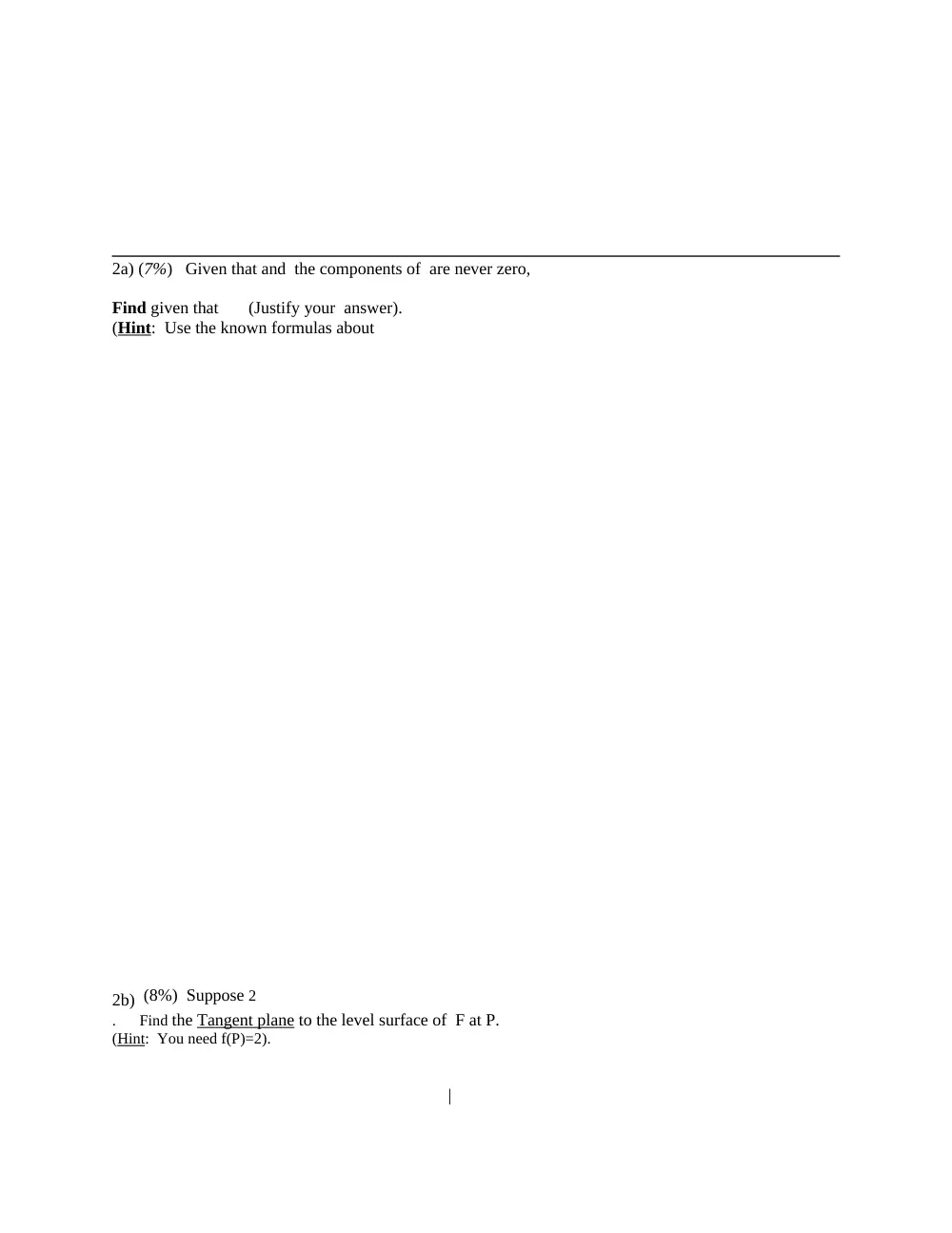
2a) (7%) Given that and the components of are never zero,
Find given that (Justify your answer).
(Hint: Use the known formulas about
2b) (8%) Suppose 2
. Find the Tangent plane to the level surface of F at P.
(Hint: You need f(P)=2).
|
|
|
|
|
|
|
|
|
|
|
|
|
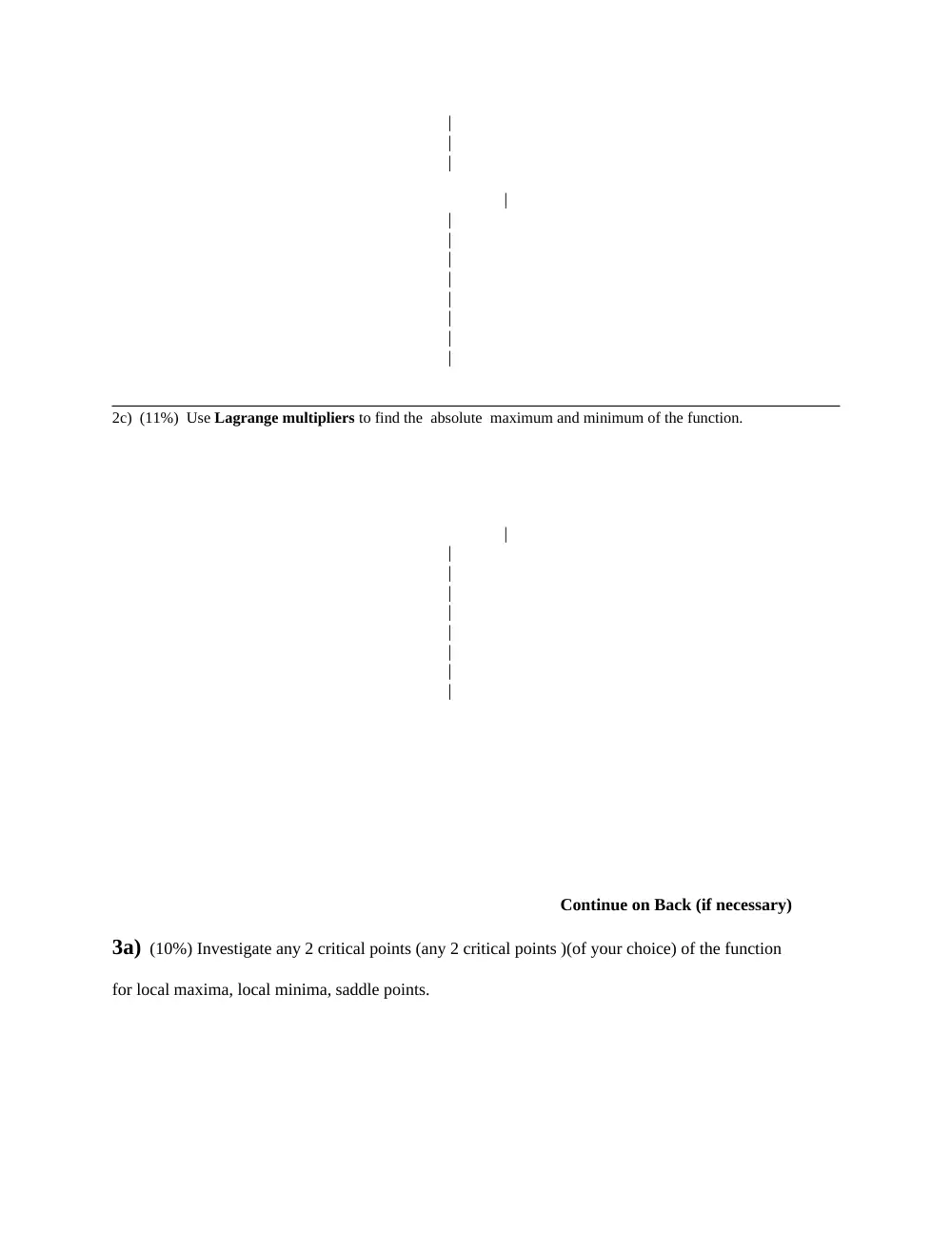
2c) (11%) Use Lagrange multipliers to find the absolute maximum and minimum of the function.
|
|
|
|
|
|
|
|
|
Continue on Back (if necessary)
3a) (10%) Investigate any 2 critical points (any 2 critical points )(of your choice) of the function
for local maxima, local minima, saddle points.
3b)
(10%) Check that
Then
show that
3c) (5%) Find, if it exists,
4ab) (5%, 6%) Let
a) By any method, show that (0,0) =5.
Then, by symmetry, we have (0,0) =5 (Do not prove it)
b) From definitions, show that f is differentiable at (0, 0).
-----------------------------------------------------------------------------------------------------------------------------
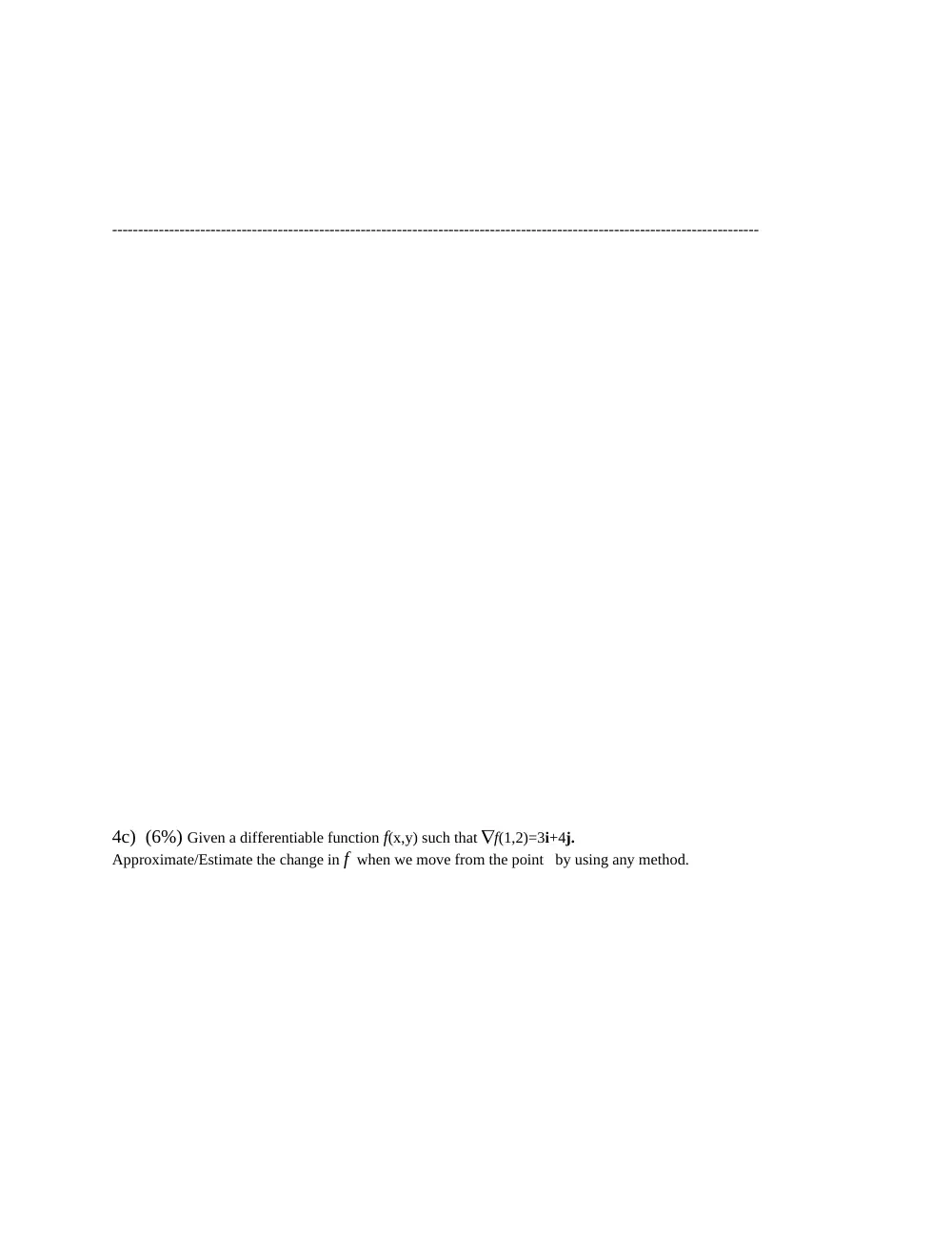
4c) (6%) Given a differentiable function f(x,y) such that f(1,2)=3i+4j.
Approximate/Estimate the change in f when we move from the point by using any method.
4d) (8%) Let (where f (u,v) is a sufficiently differentiable function).
Find